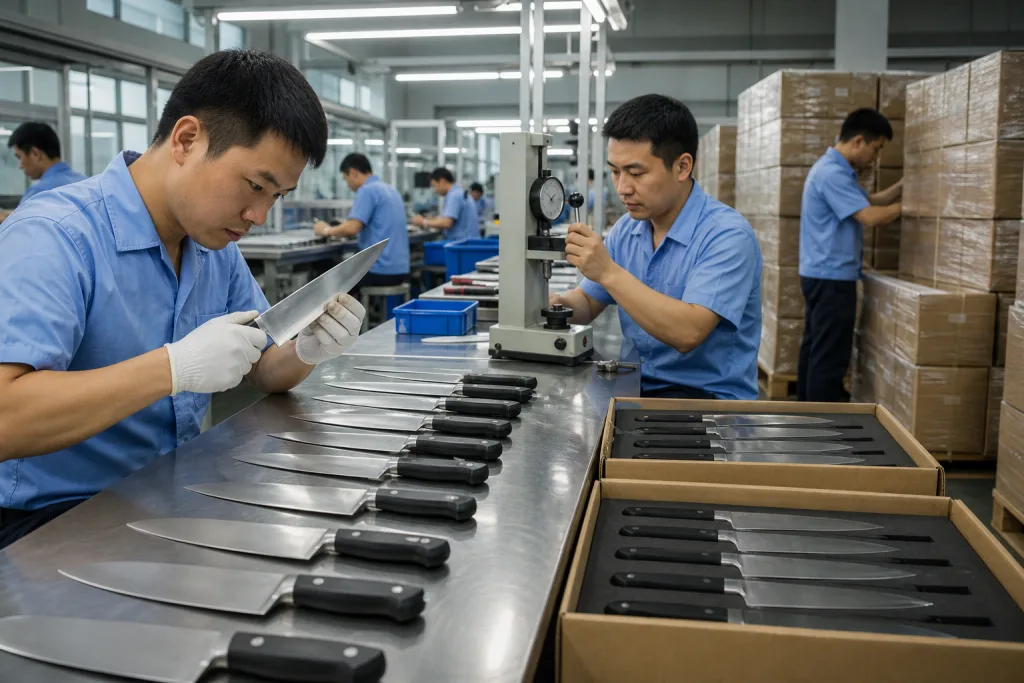
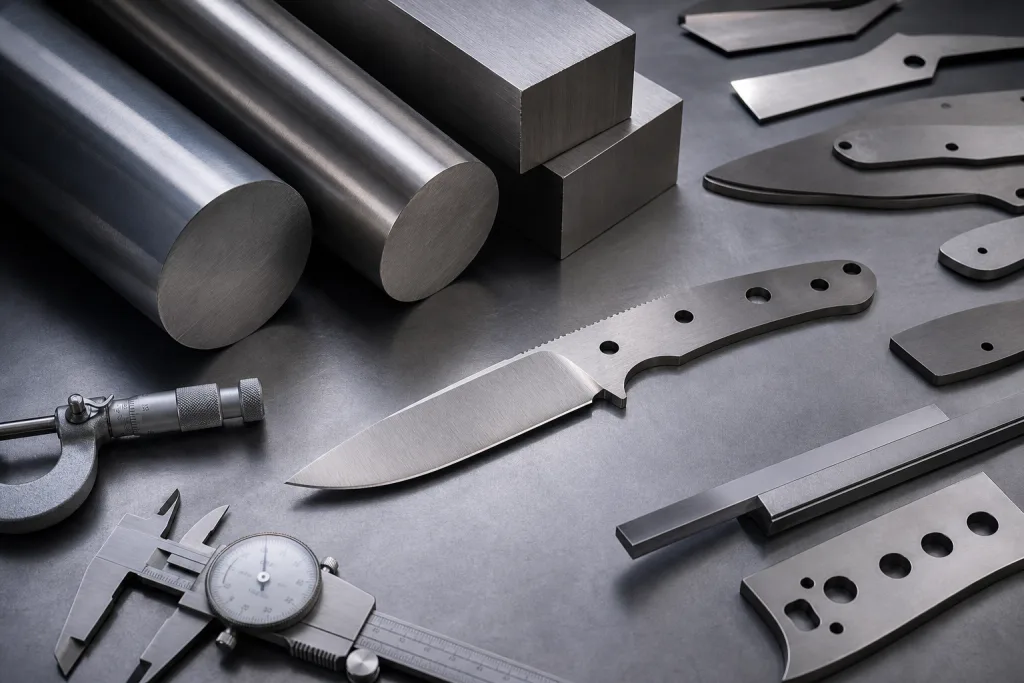
Pakkawood can look like one line on a product page. On the handle rack, we run 7 checks before it is safe for bulk: resin fill, shade tolerance, 4.1 mm pin-hole fit, epoxy line, end-grain cracks, food-contact files, and carton moisture under 12%. If you are buying from a Pakkawood handle knife OEM factory for the first time, treating the handle as “decoration” is the wrong question to ask; the handle spec can create as much risk as the blade steel.
At TANGFORGE in Yangjiang, China, we see the same issue on repeat RFQs: the buyer approves 2 clean samples, then a 2,000 pcs bulk order shows shade spread, visible glue lines, or raised pins after 32 days at sea. QC pulled samples last month where the brass pins sat 0.2 mm proud after the carton reached port, and the buyer flagged it before discussing the blade edge. This guide gives you the working numbers to set before sending an RFQ to a Pakkawood handle knife factory China buyers can work with seriously.
What Pakkawood Really Means
Pakkawood is not natural hardwood sliced straight from a log. We buy it as thin birch, beech, maple, or similar veneer, then resin makers impregnate the sheets with phenolic resin, dye them, stack them, press them, cure them, and cut them into handle blocks. On the incoming rack, QC measures block moisture and thickness; a 20 mm block that arrives bowed by 1.5 mm will fight the CNC jig later. Nice grain, steadier behavior.
For a custom Pakkawood handle knife, the spec needs color, layer pattern, surface finish, and food-contact requirement. “Black Pakkawood” is the wrong way to write a PO. One supplier’s black looks close to ebony; another shows brown lines under the buyer’s 5500K retail light box. We had a buyer flag this on a repeat steak knife order because the first PO said only “BK handle,” no chip code. If repeat color matters, ask the factory to keep a signed master color chip and photo record under 5500K light.
Pakkawood has good water resistance, but it is not magic. Dishwashers, 2-hour soaking, 85% humidity cartons, and loose rivet compression can still cause swelling or hairline cracks around the pin hole. We run a simple soak check before packing when the order is above 3,000 pcs, and QC pulled the sample once after a 0.3 mm gap opened near the rear rivet. Brands should print “hand wash only” on inserts and packaging, especially for North America and Europe. For resin-bonded handles, buyers often request LFGB, FDA, or REACH-related declarations depending on the market. Ask early, because test lead time can add 7-15 days.
In Yangjiang, China, Pakkawood is common for chef knives, steak knives, BBQ knives, hunting knives, and Damascus gift sets. The material sells because it gives a premium shelf look without the movement of untreated wood. Still, the math does not work if the factory treats it like plastic. We control block storage, CNC shaping, sanding from 240# to 800#, rivet pressure on the arbor press, and final oil or wax treatment; skip one step and the grinding line will send back handles with proud pins or cloudy edges.
Buyer Specs That Prevent Confusion
A good RFQ for Pakkawood handle knife OEM work should read like a production instruction, not a mood board. If you send one photo and a target price, we run the first sample by guessing handle contour, pin size, and finish, then QC pulls the sample and the buyer flags it after inspection.
Start with blade details: steel grade with standard code, thickness at spine in mm, blade length from tip to heel, hardness range in HRC, finish, edge angle per side, logo method, and tolerance. Then define the handle. For a full-tang chef knife, include handle length, maximum height at butt and middle, maximum width, scale thickness, rivet material, rivet diameter, tang exposure, bolster requirement, and spine rounding. For pocket or outdoor knives, add liner material, screw type, pocket clip position, lock type, and open/close force; we have seen a PO say “black clip left side” while the approved drawing showed right-side carry.
Useful Pakkawood handle specifications include:
- Handle block thickness before shaping: often 18-24 mm for kitchen knives.
- Finished handle tolerance: usually ±0.3 mm on width and ±0.5 mm on length.
- Rivet gap: no visible daylight; glue line under 0.15 mm target.
- Surface finish: 600 grit satin, polished gloss, or oiled matte.
- Edge rounding: 0.5-1.0 mm radius to avoid hot spots.
- Color reference: Pantone-like target, approved sample, or sealed master chip.
For blade hardness, be realistic. A 1.4116 chef knife at 58-60 HRC sounds good in a catalog, but the math does not work well for that steel on a busy kitchen line. In our grinding line checks, 7 out of 10 importers choose 56-58 HRC for German-style stainless, while 58-60 HRC is reserved for higher-carbon Japanese-style stainless. If the handle feels premium but the blade chips after the first drop test, returns still land on your desk.
MOQ and Price Expectations
Pakkawood handle knife MOQ starts with one question: are we using an open handle profile, or are we cutting a new scale shape on the CNC fixture? For standard kitchen knives, TANGFORGE can quote from 600-1,000 pcs per SKU when the blade blank, rivet spacing, and carton size already match our line. Custom Pakkawood color is a different job. A practical MOQ is often 2,000 pcs because the handle block supplier presses and dyes material by batch, and one 18 mm block lot cannot be split neatly for five small colors. We’ve seen this go sideways when a buyer asks for 300 pcs in a new red-black lamination; the math doesn't work.
Price moves with steel grade, blade thickness, grinding minutes, handle yield, rivet style, bolster work, polishing level, packaging specs, and QC requirement. Pakkawood itself is not always the cost problem. Waste is. On the grinding line, QC pulled a sample last month where the left scale showed clean brown grain but the right scale had a black streak near the rear rivet, so the pair was rejected after shaping. Figured or multi-color blocks create more scrap because the pattern must look matched from left scale to right scale, not just pass a caliper check at 2.5 mm edge thickness.
| Project type | Typical MOQ | FOB China price band | Sample lead time | Bulk lead time |
|---|---|---|---|---|
| Standard chef knife, existing handle | 600-1,000 pcs/SKU | USD 3.20-7.80 | 10-18 days | 35-50 days |
| Damascus kitchen knife with Pakkawood | 300-600 pcs/SKU | USD 9.50-22.00 | 15-25 days | 45-65 days |
| Custom Pakkawood color | 2,000 pcs/color | Add USD 0.25-1.20 | 20-35 days | 50-75 days |
| Outdoor fixed blade | 500-1,000 pcs/SKU | USD 5.80-18.50 | 15-25 days | 45-70 days |
These numbers are planning ranges, not promises for every drawing. At our Yangjiang facility, monthly knife capacity is about 300,000 units across kitchen knives, outdoor blades, pocket knives, tactical items, and gift-set lines. We run mixed orders every week, but a late barcode file or one typo on a PO handle color code can stop packing for 2 days. If you need 20,000 pcs before Q4 retail, approve samples and packaging artwork early, ideally before we book the heat-treatment slot.
QC Risks Around Pakkawood Handles
Pakkawood handle failures usually start small. QC pulled 80 pcs from a 1,200 pcs order last month and found 6 handles with a 0.2-0.4 mm gap near the tang, plus 3 proud rivets after buffing. Other claim photos show cloudy polish, left-right scale color mismatch, or hairline cracks that appear after 18 days in a humid warehouse, not 12 days in our dry room. That is the stuff your customer sends back with a red circle on the photo.
For incoming material, we check block moisture condition, delamination, resin voids, and lot color against the approved scale board under a D65 light box. Pakkawood is resin-stabilized, so a normal pin moisture meter gives a rough reading, not the full answer. We still log storage. Handle blocks stay 120 mm off the floor on plastic pallets, out of direct sun, with lot cards tied to each bundle. In Yangjiang, the workshop can sit above 75% RH during rainy weeks, so carton storage and dehumidifier control are not decoration.
During assembly, pressure causes most trouble. Too little clamping pressure leaves a black tang line. Too much rivet pressure can load the scale and crack it after packing. We run a pneumatic rivet press at the set pressure on the routing card, then the grinding line checks the first 10 pcs before bulk shaping. CNC shaping also needs cutter heat control; if the resin smells burnt, the math does not work. Sanding should step through grit stages, for example 240 to 400 to 800, instead of jumping from rough cut to polish. Side light will expose the waves.
For final inspection, ask for AQL 2.5 major and AQL 4.0 minor unless your brand spec is tighter. Major defects should include handle crack, loose scale, visible tang gap over the signed limit, sharp burr, wrong logo, blade warp beyond tolerance, unsafe edge, and carton drop failure. Minor defects can include small color variation, a tiny sanding mark under 3 mm, or light packaging scuff within the approved boundary sample. We have seen this go sideways when a PO only says “good handle finish.” A factory that refuses clear defect definitions is risky, even when the sample looks clean.
Testing, Compliance and Documents
Knife buyers in Europe and North America often ask first for the blade steel certificate. That is only half the file. Pakkawood uses resin and dye, so our QC team treats it as a chemical-risk item, not just a wood handle. For kitchen knives, buyers usually ask for LFGB food-contact testing for Germany and EU channels, FDA-related declarations for the US, and REACH/SVHC screening for EU importers. On the grinding line we mark handle lots by color code, because one black pakkawood batch and one brown batch can have different dye records.
Not every order needs every test. A 12,000 pcs private-label supermarket program usually asks for more documents than a 600 pcs D2 hunting knife run for specialty retail. Map the sales channel first. If you sell through Amazon, FNSKU labeling, carton barcodes, warning labels, and packaging drop test records often matter as much as the knife spec. If you sell to hospitality distributors, keep dishwasher warnings and stainless grade claims conservative. We have seen this go sideways when a buyer wrote “dishwasher safe” on the PO, then QC pulled the sample after handle swelling in a 70°C soak check.
Common documents include material declaration, steel grade certificate, hardness report, inspection report, packing list, commercial invoice, and test reports from SGS, Intertek, TUV, or other accepted labs. If the product includes a sheath, coating, glue, printed box, or foam insert, those materials need their own check. Small parts get missed. Last month the buyer flagged a PU sheath logo ink issue, not the knife, after the lab asked for a separate material breakdown.
TANGFORGE works with ISO 9001-style process control and has experience supporting BSCI audit requests from international buyers. That does not replace your importer responsibility, but it makes document collection faster when the PO is clean. Ask for document needs at quotation stage, not after goods are packed. Once cartons are sealed with 58 x 28 x 24 cm marks, re-opening for label photos wastes time and dents packaging. Third-party testing can add USD 180-800 per test item and 7-15 working days, depending on scope. The wrong question is “can we test later?” The better question is whether the test item matches the exact handle, glue, coating, and packaging we ship.
Packaging and Freight Details Matter
A Pakkawood handle can leave the polishing bench clean at 800 grit and still arrive with rub marks if the packing spec is loose. Sea freight puts cartons through temperature swings, salt air, and humidity for a 30-45 day route. We have seen handles scuffed by a 0.6 mm plastic tray lip and printed sleeves that were cut 3 mm short. No silica gel? The math doesn't work.
For mid-range and premium kitchen knives, we run a blade guard over the edge, anti-rust paper or a VCI bag when the steel needs it, a fitted tray with no handle pressure point, silica gel, and a 5-ply export carton. For gift sets, foam density matters more than the sales photo. Soft foam compresses; then a 210 g chef knife starts moving during carton drop testing. For Amazon or DDP shipments, master carton size and weight should be locked before production, because changing it after packing means reworking labels, inserts, and sometimes the whole outer carton.
Ask the Pakkawood handle knife OEM supplier for a packaging mock-up and carton drop test before bulk packing. QC pulled one sample last season where the knife passed visual inspection, then the handle picked up a bright rub line after three drops. A simple ISTA-style internal check from 76 cm on corners, edges, and faces catches this before shipment. For carton weight, 12-18 kg gross weight is the safer range for 8 out of 10 importers we ship to, since warehouse staff handle it faster and crushed corners show up less often.
Labeling needs the same control as grinding angle. Your cartons may need SKU, PO number, country of origin, blade warning, FNSKU, EAN/UPC, lot code, and mixed-carton marks, but each mark should have a fixed position on the artwork and carton layout. We once had a PO typo where “Made in China” was correct on the unit box but missing from the outer carton; the buyer flagged it before booking, thankfully. If the knives are made in China, country-of-origin marking must match on product, unit box, and shipping carton. Boring work. Still cheaper than a customs hold or a failed warehouse receiving scan.
How to Choose the Factory
A serious Pakkawood handle knife OEM factory will talk about the hard parts first: defect limits, handle block sourcing, heat-treatment records, pre-shipment inspection, and what the fix looks like if a first bulk lot comes back with a 6% cosmetic reject rate. If a supplier only says “quality is good,” that is the wrong question to ask. On our QC table, we run AQL checks and compare against the approved board, not promises.
Look for a factory that can keep design, tooling, blade production, handle machining, assembly, polishing, inspection, and packaging under one roof. Trading companies can move email faster, but for a custom Pakkawood handle knife, direct feedback from the grinding line saves weeks. We once saw a buyer ask for a thin handle profile that looked clean in CAD, then leave only 1.2 mm around the rivet hole. The math does not work, and a real engineer should say so before the mold is cut.
Ask for production photos from the actual line, not just showroom samples. Request a golden sample signed on the blade, handle, carton label, and outer box, then check whether the steel lot, handle block lot, rivets, glue, and finish match bulk production. We had one PO with a typo on the carton mark, and the buyer flagged it before shipment; that kind of slip turns into delays fast. For repeat orders, keep one approved defect board and one checklist, or the inspection result drifts by shift.
TANGFORGE has been making knives since 2008, with about 240 employees in Yangjiang, China, serving importers, brands, and distributors in Europe and North America. We are not the right fit if the only target is the lowest unit price and zero QC cost. We fit better when you need stable specs, a realistic MOQ, and a factory team that will tell you where the handle design may crack before your customer does.
Frequently asked questions
For a new brand, plan around 600-1,000 pcs per SKU if you can use an existing blade profile and existing Pakkawood color. If you need a new handle shape, new blade tooling, or custom laminated color, the MOQ usually moves to 1,500-2,000 pcs per design or color. Gift sets can sometimes be quoted from 300-500 sets because the total knife count is higher, but packaging MOQ may still be 1,000 boxes. A serious Pakkawood handle knife MOQ should include spare handles for rejects, testing samples, and retained samples. If a quote says 100 pcs for fully custom OEM, check whether it is actually small-batch workshop production with higher unit cost and limited consistency.
Compared with basic PP or ABS handles, Pakkawood usually adds about USD 0.40-2.00 per knife, depending on size, color, handle yield, rivets, polishing, and reject rate. A simple full-tang utility knife may only add USD 0.50-0.80, while a large Damascus chef knife with shaped multi-color scales can add USD 1.50-3.00 after extra sanding and polishing. The real cost is not only raw material. CNC time, hand finishing, glue curing, and inspection all affect price. If you require left and right scale grain matching or a high-gloss finish, build extra time into the quote. For FOB China pricing, ask the factory to separate blade, handle, packaging, and testing costs.
They can, but you should not assume every Pakkawood block passes every requirement. Pakkawood uses resin and dye, so compliance depends on the material supplier and the exact formulation. For EU kitchen knife programs, many buyers request LFGB food-contact testing and REACH/SVHC screening. For US programs, buyers often ask for FDA-related food-contact declarations and Proposition 65 review if selling into California. Testing normally takes 7-15 working days after samples are ready and can cost USD 180-800 per item or material group. If your order includes glue, coating, printed packaging, or a sheath, those may need separate checks. Confirm compliance documents before mass production, not during shipment booking.
Your checklist should define both safety and appearance defects. Major defects should include cracked handle, loose scale, visible gap between tang and handle, raised rivet, sharp burr, blade warp, wrong steel marking, wrong logo, unsafe edge, rust, and failed carton drop test. Minor defects can include slight shade variation, small sanding marks, tiny glue residue, or light packaging scuff if within approved limits. Use AQL 2.5 for major defects and AQL 4.0 for minor defects as a common starting point. Add measurements: blade length tolerance, handle width tolerance, edge angle, HRC range, carton weight, barcode scan, and country-of-origin label. Always compare against a signed golden sample.
A normal OEM timeline is 10-25 days for samples, then 35-65 days for bulk production after sample approval, deposit, and packaging artwork confirmation. Custom Pakkawood color can add 10-20 days because handle blocks must be dyed, pressed, cured, and checked before machining. Third-party testing may add another 7-15 working days. Peak season before Q4 retail can stretch schedules, especially for gift boxes, Damascus blades, and DDP shipments. If you need goods on shelf by October, approve samples by June or July. A good factory schedule should include material purchase, heat treatment, handle machining, assembly, polishing, inspection, packing, and shipping buffer.
Send Us Your Pakkawood Knife Specs
Share drawings, target price, market, MOQ and packaging needs. Our Yangjiang team will review handle risks, blade specs and production options before quoting.
Request a Quote