Pakkawood looks simple on a product page. On the factory floor, “wood handle” on a PO is the wrong question to ask; QC can pull 30 pcs and still find two different brown tones, a 0.3 mm proud rivet, or a laser logo that turns muddy after polishing. Color standard, rivet seating, moisture control, sanding grit, logo contrast, and inner-box protection all decide whether the knife sells cleanly or comes back from the retailer.
At TANGFORGE in Yangjiang, Zhejiang, China, we treat a Pakkawood handle knife private label specification as a manufacturing document, not a mood board. We run knife lines that output about 180,000 finished units per month, but the math does not work if the buyer approves one loose photo and asks for 12 days instead of 18 days after changing the handle shade. Stable quality needs a signed golden sample, clear MOQ by SKU, and checks at the grinding line, handle fitting bench, and final AQL 2.5 inspection. If you import for Europe or North America, lock these details before deposit.
What Pakkawood Actually Means
Pakkawood is not a wood species. We buy it as engineered veneer, often birch or a close hardwood, soaked with resin, stacked in a hot press, then cut into 120 mm handle blocks or scales. For knives, this changes the spec. You are not ordering a natural wood handle; you are ordering a wood-resin composite with grain, better moisture control, and a color we can match against a master sample under the QC light box.
For a Pakkawood handle knife OEM project, define the construction first: full-tang scales, hidden tang, wa-handle style, or molded profile. Most private label kitchen knives we ship use full-tang scales with 2 or 3 rivets because the knife feels solid and the rivet line looks good in product photos. Pocket, hunting, and tactical knives use Pakkawood scales on steel liners or bolsters, and the buyer usually flags gaps over 0.2 mm at the liner during pre-shipment photos.
The wrong question is “Is Pakkawood premium?” Ask how the blank was made and how it behaves on the grinding line. Good Pakkawood machines cleanly when resin penetration is even, the blank is dry before CNC shaping, and polishing does not burn the surface at the heel. Cheap blanks show color streaks, open pores, edge chipping, or a plastic-heavy shine; QC pulled 18 samples from one low-price batch last year, and 5 had chipped edges after 600-grit sanding.
At our Yangjiang, Zhejiang factory in China, we normally ask buyers to approve 1 physical handle color standard, not a screen image. Brown, black, red-brown, blue-black, and multi-layer rainbow Pakkawood shift between blank batches, sometimes enough that the buyer notices in the carton photo. If your brand sells replenishment orders over 12 months, keep one signed master sample and write the acceptable color range into the PO; we have seen this go sideways when “dark walnut” was typed as “dark wallnut” on the first order.
Specs Buyers Must Put In Writing
A workable custom Pakkawood handle knife spec puts blade, handle, branding, and packaging on one sheet, with drawing numbers if you have them. If the sheet only says “8 inch chef knife, Pakkawood handle, logo on blade,” we still have to fill in about 20 blanks on the sample bench. That is where jobs slip. Last month QC pulled the sample because the PO said “black box” but the artwork file showed kraft paper, and the buyer flagged the carton photo after 600 sets were already packed.
For the handle, write down length, maximum thickness, profile radius, finish gloss, tang style, rivet count, rivet material, and whether the tang sits flush, proud, or slightly recessed. For kitchen knives, a common handle thickness is 18-23 mm at the palm swell, but a US club-store chef knife and a Japanese-style santoku do not feel the same in hand. Send the reference sample. We run it under a digital caliper, check the palm swell in mm, and copy the hand feel instead of guessing from a photo.
For the blade, tie the handle choice to balance. A dense Pakkawood full-tang handle can pull the balance point backward by 10-25 mm compared with a lightweight PP or hollow stainless handle. That works on some santoku SKUs, but the math doesn't work on every long slicer; we have seen this go sideways when buyers approve the handle color before checking the balance point. Typical kitchen knife specs include 1.4116 or X50CrMoV15 at 56-58 HRC, 5Cr15MoV at 55-57 HRC, 10Cr15CoMoV or AUS-10 at 58-60 HRC, and Damascus-clad cores depending on target retail price.
- Handle tolerance: thickness ±0.5 mm, scale gap visually unacceptable above 0.2 mm.
- Rivet tolerance: no raised sharp edge after the polishing wheel; surface must sit flush.
- Logo area: confirm blade side, handle side, or end cap before tooling, because one wrong laser jig means 3-5 days lost.
- Edge angle: commonly 15-18 degrees per side for kitchen knives, checked on the grinding line before packing.
Private label work runs cleaner when you approve both a golden sample and a pre-production sample. The golden sample locks color, handle gloss, logo size, and blade finish. The pre-production sample checks bulk tooling, packaging, and barcode placement against the approved file; we once caught a one-digit EAN typo on the PO at this stage, before 48 cartons needed relabeling.
MOQ, Pricing, and Lead Time
Pakkawood handle knife MOQ starts with the blade and the mold. If we run an existing profile, the stamping die and grinding jig are already set. Standard brown Pakkawood also keeps the handle blank simple. Change the profile, request a matched red-black handle color, add a new gift box, or ask for FNSKU labeling, and each item creates setup loss. Setup loss is real. One buyer asked why a custom blue Pakkawood handle could keep the stock MOQ; the math doesn't work once the handle supplier cuts a separate 12 mm blank batch.
For 8 out of 10 importers, the realistic Pakkawood handle knife MOQ is 600-1,200 pcs per SKU. We can sometimes run 300 pcs for sample market testing if you accept standard materials and shared packaging dimensions, but unit cost will not represent bulk production. QC pulled the sample from a 300 pcs trial last week, and the color tolerance was wider than a normal 1,000 pcs run because the blank batch was too small to sort tightly. For distributors building a catalog, 1,000-3,000 pcs per SKU gives cleaner FOB pricing and better carton loading, and it spreads one inspection fee across more pieces.
| Project type | Typical MOQ | Indicative FOB China range | Normal lead time |
|---|---|---|---|
| Logo on existing kitchen knife | 600 pcs/SKU | US$3.20-7.80 | 35-50 days |
| Custom Pakkawood chef knife | 1,000 pcs/SKU | US$5.50-12.50 | 45-60 days |
| Damascus knife with Pakkawood | 600-1,000 pcs/SKU | US$12.00-35.00 | 50-70 days |
| Gift set with custom box | 1,200 sets | US$14.00-55.00 | 55-75 days |
These are sourcing ranges, not blind quotations. Steel grade moves the raw cost; blade thickness changes grinding time, especially when the spine goes from 2.0 mm to 2.5 mm. Handle complexity affects CNC and hand-polishing hours. Carton strength, compliance testing, and DDP terms sit in separate cost buckets, so mixing them into one target price causes trouble. If a quote looks 25% below the market, check the steel, handle blank grade, polishing steps, and carton specification before you celebrate. We have seen this go sideways when the buyer flagged a 5-layer carton on the PO, but the supplier packed with 3-layer board.
Private Label Branding Options
Branding on a Pakkawood handle knife can be quiet or obvious. For 8 out of 10 kitchen knife orders we run, the safest spec is blade laser engraving plus a printed or debossed logo on the color box. Handle logos are possible, but QC risk goes up because Pakkawood color, gloss, and grain direction change the contrast from batch to batch; QC pulled one 200-piece pre-shipment sample last month where the same logo looked gray on 3 handles and almost black on 17 handles.
Blade laser engraving is clean, repeatable, and cost-effective. It usually adds US$0.03-0.12 per unit depending on logo size and whether the mark is simple text, a deep mark, or positioned on both sides. Keep the logo at least 6 mm away from the food contact edge and clear of the bolster or transition area; this is the wrong place to save 2 mm on artwork. For coated outdoor knives, we test laser power on 5 trial blades first, because the mark can turn burned or patchy if the setting is off by one step on the fiber laser machine.
Handle branding options include laser engraving, metal badge inlay, end-cap logo, and packaging marks such as hot stamping or printed belly band. Laser on dark Pakkawood often gives weak contrast unless the logo is filled or the surface is lightly treated after sanding on the grinding line. A metal badge looks premium, but the math does not work for every MOQ: tooling, extra assembly time, and glue failure risk all sit on top of the knife cost. We have seen this go sideways when a buyer approved the badge drawing but missed the 0.2 mm recess depth on the handle CAD.
For Amazon or retail programs, specify barcode type, FNSKU, suffocation warning if polybags are used, master carton marks, and country-of-origin labeling. Agree on “Made in China” placement before mass production, especially for gift boxes and blister packaging; one PO came in with “Made In Chian” on the carton mark file, and catching that before plate making saved 12 days vs 18 days of reprint delay. TANGFORGE can pack under your private label in China, but artwork files must arrive in AI, PDF, or editable vector format, with dielines approved before printing plates are made.
QC Risks Specific to Pakkawood
Pakkawood is steadier than untreated beech or walnut, but it is not magic. We still see 6 common QC risks on the grinding line: rivet-area cracks, scale-to-tang gaps, color bands outside the approved swatch, rounded handle shoulders from buffing, exposed glue lines, and swelling after a soak test. Small in the workshop. Expensive on Amazon. QC pulled one 8-inch chef knife sample last month where a 0.35 mm black line at the tang looked harmless under factory light, then looked ugly in buyer photos.
Cracking near rivets usually starts with a bad drill bit, too much pressure on the pneumatic rivet press, weak blanks, or handle stock that moved after CNC shaping. We run a pin-gauge check on hole diameter before pressing, keep rivet pressure controlled, and reject blanks with visible inner splits at incoming inspection. For full-tang kitchen knives, the scale should sit tight against the tang with no black line unless the PO calls for a liner. The wrong question is asking whether Pakkawood is “premium”; ask whether the drilling, pressing, and curing steps are controlled.
Moisture testing needs to be agreed before bulk production for retail programs. Pakkawood-handled kitchen knives should be sold as hand-wash only. Even good resin-impregnated wood struggles in dishwashers because 70°C heat, alkaline detergent, and repeated drying cycles attack glue lines and the surface finish. If your packaging says dishwasher safe, expect claims. We do not recommend that claim for Pakkawood, and we have seen this go sideways on a 3,000 pcs reorder when the buyer flagged swollen handles after home-use testing.
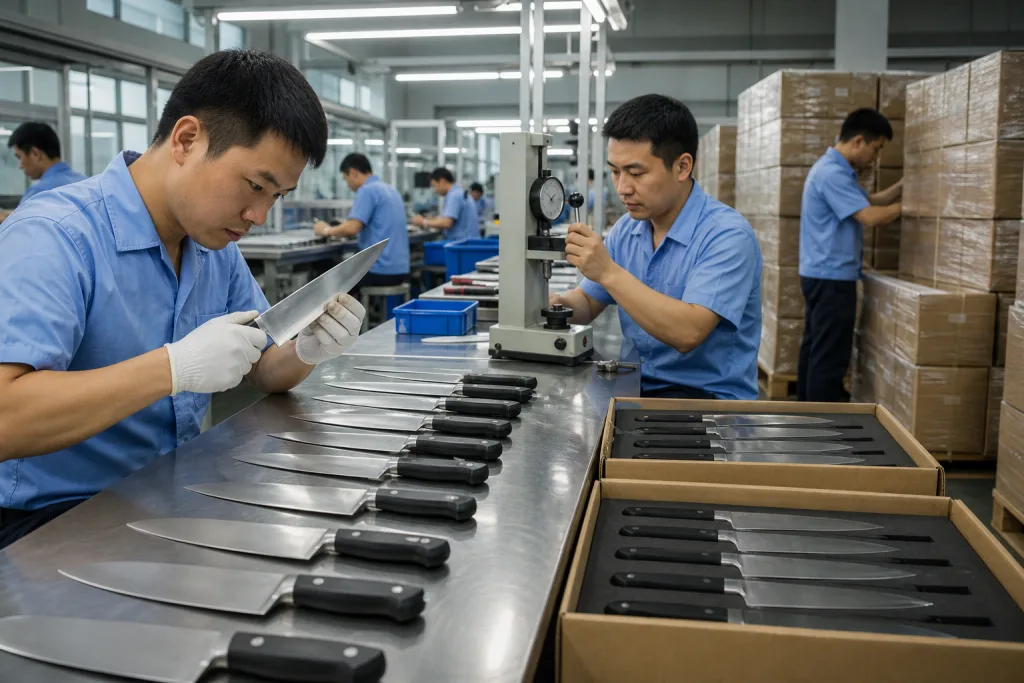
Inspection should cover appearance and use-safety, not just “looks OK” at the packing table. For standard export orders, AQL 2.5 for major defects and AQL 4.0 for minor defects is a practical baseline. Major defects include loose handle scales, open gaps over 0.2 mm, cracked handles, unsafe burrs at the heel, wrong steel mark, wrong logo, and blade tip damage. Minor defects include small polishing marks under 10 mm, slight color deviation within the signed sample range, and tiny box scuffs that do not affect retail sale. QC should check with a feeler gauge, cotton-wipe burr test, and approved color board, because eyeballing it under one LED lamp misses too much.
A Pakkawood handle knife factory China program should also include incoming handle blank inspection. If the handle material is already unstable, final inspection catches the problem late, after grinding, riveting, polishing, logo etching, and packing labor are already spent. The math does not work. On a 1,200 pcs MOQ private label run, rejecting 80 bad blanks at incoming is cheap; finding 80 cracked handles after carton sealing means rework, repacking, and 12 days lost instead of 2 days.
Compliance and Market Requirements
For Europe and North America, the Pakkawood handle is not the whole compliance job. Food-contact status still has to match the blade, bolster, adhesive line, inner tray, retail box ink, and label copy. For kitchen knives, German buyers usually ask for LFGB, U.S. buyers ask how the item meets FDA food contact expectations, EU importers want REACH-related chemical declarations, and some U.S. retail channels flag California Proposition 65 before they issue a PO. We had one buyer write “FDA handle cert only” on the PO; QC pushed it back because the coating and printed sleeve were also in scope.
Pakkawood raises fair questions because it uses resin and pigments, not plain timber. Ask for documents before we run the handle blanks through CNC and buffing, not after 3,000 sets are sealed in cartons. We can arrange third-party tests, but the math does not work if the ship date is already locked. A basic material or food contact test may take 7-12 working days. A retailer pack covering packaging inks, surface coatings, and restricted substances is closer to 16-22 working days, especially if the lab asks for extra 100 mm × 100 mm material swatches.
Factory audits may also decide whether the order can move. Some importers ask for ISO 9001-style process control with inspection records; others need BSCI social compliance or a 12-page supplier questionnaire with photos of the grinding line, packing tables, and needle detector log. TANGFORGE was established in 2008 and has about 240 employees in Yangjiang, Zhejiang, China. We are used to export documentation, but every sales channel has its own paperwork. Send the requirement list with the RFQ so we can price the lab fees, reserve samples, and schedule the inspection window correctly.
For outdoor/hunting programs and pocket/tactical folders, check local knife laws and courier rules before confirming the spec. Blade length, lock type, assisted opening, dagger-style geometry, and sheath build can change importability fast; a 95 mm blade that passes one market can get stopped in another. A good Pakkawood scale will not rescue a restricted blade design. This is the wrong question to ask at the end. If you sell into 4 or more countries, build the strictest market rule into the first drawing, then decide whether regional SKUs make sense.
How to Place a Safer Order
A safer private label order starts with a tight RFQ, not a one-line “best price” message. Send the target retail price, annual volume estimate, blade drawing or 3 reference photos, steel preference, HRC target, Pakkawood color chip, logo file in AI or PDF, packaging style, testing needs, and shipment term such as FOB, CIF, DDP, or EXW. Best price is the wrong question to ask first. Last month QC pulled a sample where the PO said “walnet” handle; purchasing guessed walnut brown, but the buyer meant a lighter coffee shade.
For first orders, we run it in this order: quotation, material confirmation, 2D drawing or specification sheet, sample payment, prototype sample, sample revision if needed, golden sample approval, deposit, pre-production sample, mass production, in-line inspection, final inspection, balance, and shipment. Slow on paper. Safer on the grinding line. Skipping the golden sample is how 2,000 pcs arrive with the logo 3 mm too close to the bolster or the handle shade off by one Pantone family.
Payment terms for new buyers are commonly 30% deposit and 70% before shipment after inspection. For repeat buyers with stable volume, terms can be discussed after 2 clean shipments, not after 20 emails. Normal production after approval is 45-60 days for about 8 out of 10 Pakkawood kitchen knife projects we ship; complex gift sets or Damascus programs may need 60-75 days because handle matching, etching, and inner-box packing add extra QC time. The math does not work if the buyer wants a 12-day lead time on a custom handle color and retail gift box.
Be honest about your channel. A supermarket promotion needs stronger cartons and fast barcode scanning; an Amazon FBA launch needs cleaner polybag labels and drop-test control; a culinary brand line needs tighter handle color sorting; a distributor catalog needs reorder planning by SKU. As a Pakkawood handle knife factory China partner, our job is not to push the most expensive handle. We specify the knife so it gets through production, AQL table checking, a 9 kg master carton, shelf display, and daily chopping without your brand taking the blame.
Frequently asked questions
For most private label kitchen knives, a practical Pakkawood handle knife MOQ is 600-1,200 pcs per SKU. If you use an existing blade, standard brown or black Pakkawood, and simple blade laser logo, 600 pcs may be workable. If you need a custom handle color, new blade profile, metal badge, custom gift box, or retailer labeling, plan for 1,000-3,000 pcs per SKU. Very small runs such as 200-300 pcs are possible only for market testing with standard components, and the unit price will be higher because setup, sampling, and inspection costs are spread over fewer pieces.
We do not recommend claiming dishwasher safe for Pakkawood handle knives. Pakkawood is resin-impregnated and more stable than untreated natural wood, but dishwasher heat, detergent, and drying cycles can attack the surface finish, rivet area, and glue line. For private label packaging, the safer claim is “hand wash only, dry immediately.” If your retailer insists on dishwasher-related testing, define the cycle count, temperature, detergent, and acceptance criteria before production. Without a written test method, a dishwasher claim creates unnecessary return risk.
You can choose a target color, but you should allow a controlled tolerance because Pakkawood uses wood veneer, resin, and pigment. Screen images are not reliable enough. The best method is to approve a physical master handle or finished golden sample, then define acceptable variation for bulk production. For repeat orders, we recommend keeping the same blank supplier and reserving enough material when the annual forecast is clear. If you reorder six months later without a master sample, red-brown, black-brown, and layered colors may shift visibly between batches.
For normal export orders, AQL 2.5 for major defects and AQL 4.0 for minor defects is a practical baseline. Major defects should include cracked handle, loose scale, open tang gap above the agreed tolerance, wrong logo, unsafe burr, broken tip, wrong packaging, or rust. Minor defects can include small polishing marks, slight color variation within the approved range, or minor carton scuffs. For premium retail or gift sets, you may tighten cosmetic inspection to AQL 1.5 or require 100% visual screening for logo position and handle cracks.
Send blade type, size, steel grade, target HRC, handle style, Pakkawood color, logo file, packaging type, estimated order quantity, compliance requirements, and shipment term. A reference sample or clear photos with dimensions helps a lot. If you have a target FOB price, share it honestly so the factory can recommend realistic steel, handle, and packaging options. For example, an 8 inch chef knife at US$5.00 FOB and one at US$12.00 FOB should not use the same assumptions. Clear specs usually save 3-7 days during quotation and sampling.
Send Your Pakkawood Knife Specs
Share your drawing, target price, MOQ, and packaging brief. TANGFORGE will review the manufacturing risks and quote a private label route that fits your channel.
Request a Quote