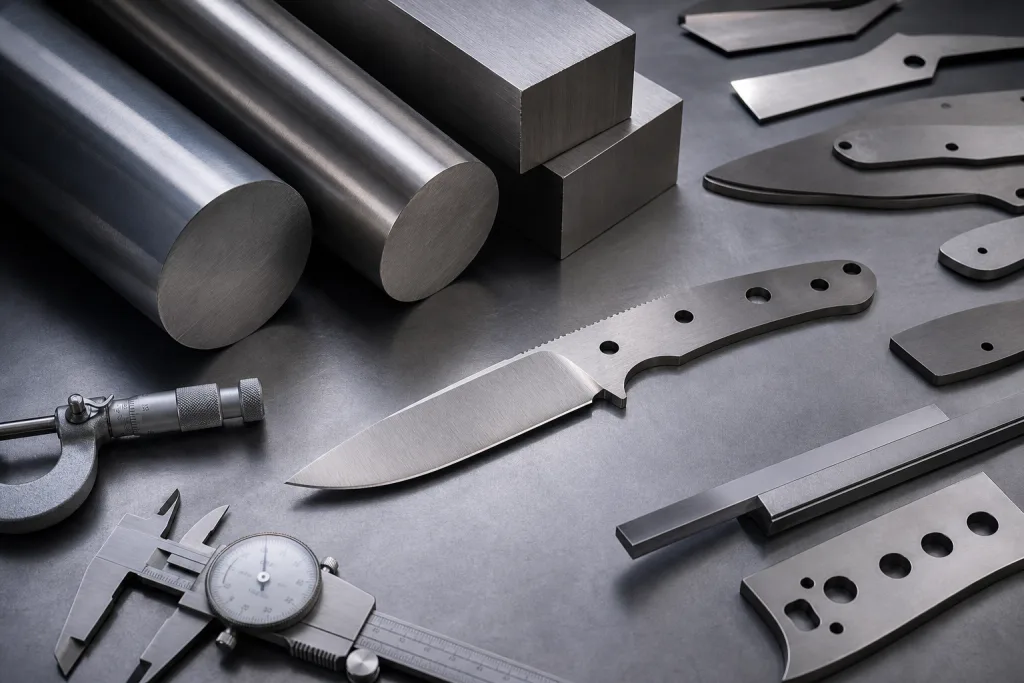
A paring knife looks simple, so buyers often leave gaps in the spec. That is where we see orders go sideways: 0.8 mm tips bend after the grinding line, PP handles shrink around the tang, 5-layer export cartons split in the drop test, or the shelf price cannot carry the steel and gift box the buyer asked for.
If you are sourcing from a paring knife factory China buyers need more than a photo and a target FOB price. Put the steel grade, HRC, blade thickness, handle fit, logo method, packaging, inspection level, and realistic paring knife MOQ on the PO. We run kitchen knife orders for importers and brands at TANGFORGE in Yangjiang, Zhejiang, China; our normal kitchen knife lead time is 35-55 days after artwork and samples are approved. One buyer once flagged a 2.0 mm blade as “too heavy” only after PPS, which is the wrong time to ask that question.
Start with the real retail position
Before you ask for a custom paring knife quote, fix the shelf position first. A USD 4.99 promo knife and a USD 19.99 branded paring knife cannot share the same steel, handle, satin finish, or color carton spec. Last month QC pulled a 3.5-inch sample with a 0.6 mm tip offset because the buyer sent only one nice photo and a hard target price. We see this 6 or 7 times out of 10. That is not a spec. It is the wrong question to ask.
For private label sourcing, we need four commercial numbers before engineering starts: target retail price, expected landed cost, first order quantity, and reorder forecast. If your landed cost ceiling is USD 1.40, we should not spend 12 days discussing X50CrMoV15, pakkawood scales, magnetic gift box foam, and individual blade guards. The math does not work. If your retail channel is specialty kitchen stores, a USD 0.78 FOB polypropylene handle knife with visible gate marks from the injection mold will hurt the brand before the second PO lands.
A basic paring knife OEM brief should state blade length, total length, steel, HRC, handle material, logo location, packaging type, compliance market, and inspection requirement, with tolerances where they matter. Give us 89 mm blade length if that is the target, not “small paring knife.” If you sell in Europe, include REACH and LFGB expectations. If you sell in North America, confirm FDA food contact packaging needs and any retailer carton standards. For Amazon FBA, barcode placement, FNSKU label size, carton weight, and master carton dimensions matter as much as the knife itself; one buyer flagged a 2 mm barcode shift after 3,000 color boxes were already printed.
At our Yangjiang, Zhejiang, China facility, kitchen knife monthly capacity is about 280,000-350,000 units depending on handle complexity and polishing workload. Capacity is not instant availability. We run different schedules for hollow-handle welding, ABS injection handles, and mirror polishing on the grinding line, so a clean spec lets the factory reserve steel coils, stamping dies, handle resin, and packaging slots without guessing. We have seen this go sideways when a PO typo changed MOQ from 12,000 pcs to 1,200 pcs after materials were booked.
Blade steel, HRC and geometry choices
Most paring knife private label specification problems start when the PO says “premium” but the cost sheet says budget steel. Steel should match the job, not the brochure line; asking for the hardest blade first is the wrong question. A paring knife peels apple skin with the first 20 mm of the tip and trims garlic or strawberry stems without forcing the wrist. It needs a fine tip, controlled flex, corrosion resistance, and sharpening a home user can handle. On our Rockwell tester, a nice-looking sample at 60 HRC still fails the program if the buyer’s target customer uses a pull-through sharpener.
For entry programs, 3Cr13 at 52-54 HRC is acceptable for supermarkets, promotional sets, and low-price bundles. It sharpens easily and keeps cost down, but edge retention is modest; we normally see this steel on orders from 1,200-3,000 pcs per SKU. 5Cr15MoV or 5Cr15 gives a better balance at 54-56 HRC and fits mid-market kitchen knives. X50CrMoV15 at 56-58 HRC is a strong European-style choice for branded retail. AUS-10 or 10Cr15CoMoV at 58-60 HRC works for premium lines, but the grinding line must hold the bevel clean, the tempering batch must stay consistent, and QC should watch for micro-chipping under the 10x loupe.
For a 3.5 inch paring knife, a sensible blade thickness is 1.5-2.0 mm at the spine before grinding. We check this with a digital caliper at 3 points, because one buyer once approved 1.8 mm on the drawing and then flagged 2.3 mm samples as “too heavy” after the first courier set arrived. A thick 2.5 mm blade feels strong but drags through apple skin and shallots. A thin 1.2 mm blade looks sharp in the showroom but can bend at the tip during a 1 m drop test or normal kitchen use. Edge angle normally sits around 15-18 degrees per side for Western kitchen knives. If you request 12 degrees per side on budget stainless, expect higher QC rejects or edge rolling. The math does not work.
Specify finish clearly: satin with grit number, mirror polish acceptance, stonewash depth, black coating type, or Damascus pattern layout. Coatings on paring knives sell well in photos, but poor adhesion near the cutting edge becomes a complaint fast; we have seen QC pull 32 pcs from a 500 pcs pre-shipment sample because the black coating lifted after tape testing. If coating is required, ask for adhesion test method and salt spray expectations, not just a black blade photo.
Handle, balance and logo decisions
The handle is where a cheap paring knife often fails first. A 3.5 inch blade leaves no room to hide bad balance, proud rivets, shrinkage marks, or black glue lines at the tang. QC pulled 32 samples from one PP handle order last month, and 5 had gaps near the front rivet after the water soak test. Write the handle material and assembly tolerance on the spec sheet, not just “black handle” on the PO.
Polypropylene and TPR work well for budget programs and dishwasher-friendly retail packs. We run these on standard molds, so MOQ often starts around 1,200 pcs per color, while a custom Pantone handle can push MOQ to 3,000 pcs because the resin batch must be mixed separately. ABS gives a glossy shelf look, but the buyer flagged hairline scratches after carton vibration testing. POM is steadier for riveted kitchen handles. Pakkawood looks warmer, but moisture control matters; we check incoming slabs with a pin-type moisture meter before cutting. G10 is tough and stable, but the math doesn't work for many entry-price paring knife sets.
Logo method should match the handle, finish, and retail price. Blade laser logo is the safest first-order choice because we can set it on the fiber laser from AI artwork and adjust position by 0.5 mm before mass production. Etching gives stronger contrast on satin blades, but it needs tighter masking control. Handle stamping, metal badges, and molded logos need tooling, artwork sign-off, and about 12 days of approval time versus 3 days for laser confirmation. For first orders, we usually advise blade laser logo plus branded packaging unless your annual forecast supports handle tooling.
Do not ignore balance. A 3.5 inch custom paring knife should feel controlled in pinch grip and handle grip. If the handle is too heavy, peeling feels clumsy; if it is too light, the knife feels disposable. We weigh pre-shipment samples on a 0.1 g digital scale and write total weight tolerance, such as 45-65 g depending on design. Smooth transitions at bolster, tang, and rivets need to be checked by finger, not only by eye. For full tang riveted handles, visible gaps over 0.20 mm should be treated as a major defect because water gets in, cartons come back, and we have seen this go sideways.
MOQ and price ranges by specification
Buyers often ask for the lowest paring knife MOQ. This is the wrong question to ask. MOQ moves with steel grade, handle material, logo method, packaging, and whether we run an existing design or open a new mold. For an existing blade and standard handle, 1,000 pcs per SKU can work; our QC still checks blade thickness with a 0.01 mm caliper before bulk packing. For custom handle color, special carton, or new mold, 2,000-3,000 pcs is the cleaner target. For a fully new handle mold, the first order should sit at 5,000 pcs or more, unless you pay tooling separately.
The table below gives practical FOB Yangjiang reference ranges. Not formal quotes. Steel cost, USD/RMB rate, packaging structure, and inspection requirements move too fast for that. Last month one buyer flagged a USD 0.08 gap after changing from sleeve to 350 gsm color box, and the math did not work at 1,000 pcs. Use these ranges to check whether the project makes commercial sense before sampling.
| Spec level | Typical material | MOQ per SKU | FOB reference | Best fit |
|---|---|---|---|---|
| Entry | 3Cr13, PP handle, polybag or sleeve | 1,000-2,000 pcs | USD 0.65-1.10 | Promo pack or supermarket bundle |
| Mid-market | 5Cr15MoV, POM or TPR handle, color box | 2,000-3,000 pcs | USD 1.20-2.20 | Private label retail shelf |
| Premium | X50CrMoV15 or AUS-10, pakkawood/G10 | 2,000-5,000 pcs | USD 2.40-5.80 | Brand line extension |
| Gift set | Matched steel, sheath, printed box | 3,000+ pcs | USD 3.20-7.50 | Seasonal set program |
If your first order is below 1,000 pcs, a China OEM factory might still ship stock goods with laser logo and neutral packaging. Unit price goes up. Custom options shrink fast. We have seen this go sideways when a PO said “matte black handle” but the stock bin only had glossy PP, and QC pulled the sample before packing. For serious paring knife OEM development, plan around 2,000 pcs per SKU as the normal starting point.
Packaging and compliance details buyers miss
Packaging is not decoration. On a 3.5 inch paring knife with a needle tip, it is part safety control, part logistics control. We have seen a 0.35 mm PET blister split at the tip after the vibration table ran 30 minutes, and QC pulled the sample before it reached packing. A paring knife can puncture a weak blister, cut through a thin paper sleeve, or rattle inside a gift box during container vibration. That becomes a retailer rejection, or worse, a consumer injury complaint.
Your specification should state whether the knife ships with a blade guard, tip protector, sheath, PET blister, paper sleeve, color box, or gift box. For e-commerce, we run blade guard plus inner box, then a 5-ply master carton under 15 kg where possible. For retail peg display, confirm hang hole strength and whether the packaging must pass a 1.0 m drop test. For Amazon or retailer warehouses, carton labels, FNSKU, suffocation warning on polybags, and barcode scan grade need checking before production. Small miss, big chargeback. One buyer flagged a 2 mm barcode quiet-zone error only after 3,000 sleeves were packed.
Compliance depends on market. For Europe, buyers often request LFGB for food contact components and REACH for restricted substances, including some coatings, inks, and handle materials. For the United States, FDA food contact expectations may apply to packaging and handle materials. California Proposition 65 may be relevant if you sell into that state. Do not leave this to the final inspection day. Testing can take 7-12 working days, and failed ink, glue, or coating tests can delay shipment more than blade production. The math does not work if your vessel closes in 8 days and the lab still has the color box ink sample.
Ask your paring knife factory China supplier to confirm packaging artwork dielines, barcode size, country of origin marking, importer address, warning text, and carton marks before sample approval. China export teams can move fast, but we cannot fix missing legal text after 20,000 color boxes have been printed. We once caught “Made in Chian” on a PO artwork file at 6 p.m.; the CTP plate had not been made yet, so that typo cost 0 cartons instead of a full reprint.
QC risks specific to paring knives
Paring knives are small, so defects have nowhere to hide. A 0.3 mm handle gap looks minor on a chef knife; on a 3.5 inch paring knife, the buyer flags it in the first carton. The usual QC miss is checking surface finish and carton count only. Wrong question. Returns usually come from weak tips, edge burrs, uneven sharpness, handle gaps, rust spots, loose rivets, and inserts that let the blade rattle during a 60 cm drop test.
A workable inspection plan should follow ANSI/ASQ Z1.4 or ISO 2859-1 sampling, with AQL 2.5 for major defects and AQL 4.0 for minor defects. Critical defects stay at 0 allowed. Critical defects include exposed unsafe burrs, broken tips, loose blades, contamination, incorrect warning labels, and any pack where the blade can protrude through the sleeve. Major defects include HRC out of tolerance, dull edge, handle cracks, logo shifted more than the approved limit, rust, coating peel, and carton label errors; we had one PO where “paring” was typed as “pairing” on the shipping mark, and QC pulled the sample before mass packing. Minor defects include small polish lines, slight color variation inside the approved limit, or small print defects that still scan on a Zebra barcode reader.
Factory-side QC has to start before final inspection. For steel heat treatment, check HRC by batch; for mainstream paring knives we normally control within a 2 HRC band, such as 56-58 HRC. On the grinding line, inspect blade thickness with a digital caliper, check edge angle against the approved sample, and look at tip shape under a 10x loupe. During handle assembly, check rivet height, bonding, gaps, and pull strength where relevant. During packing, we run a shake test so the knife cannot move enough to scar the box or expose the tip.
If you hire third-party inspection, send the approved golden sample and a written defect list with photos. Inspectors are not knife engineers. Without clear limits, they can pass a dull knife because the satin finish looks clean, or reject acceptable 0.1 mm polish lines because the checklist gives no finish standard. We’ve seen this go sideways on a 3,000 pcs private label order: the buyer cared about cutting paper cleanly, while the inspector spent half the report measuring color shade on the handle.
Sampling, lead time and reorder control
Sampling should prove the spec, not just look good in a meeting. For a private label paring knife, we ask for 3-5 pre-production samples: one for your office, one for sales or retailer review, one for lab testing if needed, and one kept at the factory as the signed golden sample. If you are comparing steels or handle materials, photo approval is the wrong question to ask. Weight, edge feel, handle texture, and balance have to be checked in hand, and QC will usually pull the sample back to the bench with calipers before we release it.
A realistic timeline is 7-10 days for an existing design sample with laser logo, 15-25 days for a custom handle color or packaging mockup, and 30-45 days if new tooling is needed. Mass production normally takes 35-55 days after deposit, artwork approval, and final sample sign-off. Peak season before Q4 can add 10-15 days, especially for printed cartons and gift sets. We have seen buyers miss a launch because the PO had one typo in the SKU, and that one line cost them a week.
Reorder control is where strong brands save money. Keep the same steel mill source where possible, record the HRC band, lock packaging color standards, and keep a retained sample from every shipment. If you change from FOB to DDP, check carton dimensions and weight again, because freight can wipe out the savings from a cheaper handle. If your distributor wants mixed cartons, inner pack quantities, or retail-ready trays, put that in the specification before quotation; the packing line needs the rule set, not a surprise after the sample is signed.
TANGFORGE was established in 2008 and has about 240 employees in Yangjiang, Zhejiang, China. We run OEM and ODM work, but we push buyers to approve written specs before they chase a lower price. A clear paring knife private label specification protects both sides: you get repeatable goods, and the factory can quote, produce, and inspect against facts. We have seen this go sideways when a buyer approved by email only and then changed the handle color after the first carton test.
Frequently asked questions
For an existing paring knife design with standard steel, standard handle color, laser logo, and simple packaging, 1,000 pcs per SKU is often workable. For a normal private label retail order with color box, barcode, custom carton marks, and approved artwork, 2,000-3,000 pcs per SKU is more realistic. If you need a custom handle color, new texture, metal badge, or exclusive mold, expect 3,000-5,000 pcs or a separate tooling charge. Very small orders below 1,000 pcs usually need stock knives with limited branding, and the FOB price can rise by 15-35% because setup and packing labor are spread over fewer units.
For budget retail or promotional sets, 3Cr13 at 52-54 HRC keeps cost low and sharpens easily, but edge retention is basic. For most private label kitchen programs, 5Cr15MoV at 54-56 HRC is a safer balance of price, corrosion resistance, and performance. X50CrMoV15 at 56-58 HRC is a good mid-premium choice, especially for European-style branding. AUS-10 or 10Cr15CoMoV at 58-60 HRC works for premium lines, but grinding and heat treatment control become more important. Do not choose steel only from a catalog name; match it to your retail price, warranty risk, and user expectations.
A basic 3Cr13 paring knife with PP handle and simple sleeve may quote around USD 0.65-1.10 FOB, depending on quantity and packaging. A mid-market 5Cr15MoV knife with POM or TPR handle and color box is commonly around USD 1.20-2.20 FOB. Premium versions using X50CrMoV15 or AUS-10, better polishing, pakkawood or G10 handle, sheath, and stronger packaging can run USD 2.40-5.80 FOB or higher. These are screening ranges, not fixed offers. Final price depends on blade thickness, handle construction, logo method, packaging board grade, inspection level, and order quantity.
At minimum, check dimensions, blade thickness, HRC, edge sharpness, tip shape, handle gaps, rivet security, logo position, rust, burrs, packaging safety, barcode scan, and carton drop resistance. Use AQL 2.5 for major defects and AQL 4.0 for minor defects, with 0 tolerance for critical safety defects. For HRC, set a specific band such as 56-58 HRC instead of saying “hard enough.” For sharpness, CATRA is best if budget allows, but many importers use controlled paper cut, rope cut, or tomato cut tests for batch screening. The key is to define pass/fail limits before mass production.
Yes, and it is often a smart way to test a new factory relationship. Start with one 3.5 inch paring knife using the steel, handle texture, logo style, and packaging direction planned for the wider line. After the first shipment, review returns, edge feedback, carton damage, and sell-through. If the results are good, expand into utility, santoku, chef knife, and set packaging using the same design language. This approach reduces tooling risk and helps you build a repeatable quality standard. Just tell the factory early, because handle molds, steel selection, and packaging dielines should be planned as a family, not one isolated SKU.
Send your paring knife specification for review
Share your target price, MOQ, steel, handle, packaging, and market. Our export team will check feasibility and return practical OEM options.
Request a Quote