A powder steel chef knife can look premium on a spec sheet, then fail at the first sample review because the RFQ was too loose. Ask only for “SG2 chef knife, pakkawood handle, gift box,” and 5 factories will quote 5 builds: 2.0 mm spine vs 2.5 mm, 60-62 HRC vs “around 60,” laser logo vs etched logo. We’ve seen this go sideways. QC pulled one sample where the handle gap was 0.4 mm, still boxed like a showroom piece.
At TANGFORGE in Yangjiang, Zhejiang, we run into this on new private label chef knife projects for Europe and North America about 3 times a month. Buyers ask for high HRC, clean branding, low MOQ and repeat supply; the grinding line needs the real inputs: steel grade, blade geometry, heat-treatment target, packaging structure, AQL level and payment terms. “What is your best MOQ?” is the wrong first question. If the spec reads like a production document, we quote faster, sample cleaner, and avoid the 12-day sample turning into 18 days because the buyer flagged a missing barcode on the gift box PO.
Start With Steel, Not The Logo
For a powder steel chef knife private label specification, steel choice is the first buying decision. Put the logo second. We can change a laser file on day 28; we cannot change SG2/R2 after the 300 kg steel order is cut and the PO says “R2” instead of “VG-10.” SG2/R2 and M390 sit in different cost bands, and S35VN or S45VN changes the grinding line, heat-treatment window and complaint risk.
For kitchen retail brands, SG2/R2 is the safer commercial pick. It gives a workable 60-62 HRC, holds an edge well, and still sharpens without turning every customer service email into a lesson on whetstones. Pushing the same blade to 63-64 HRC looks good on a product page, but we have seen it go sideways when the edge is ground to 0.18 mm before sharpening and the end user chops on glass. QC pulled the sample, the hardness was right, and the chips still came back.
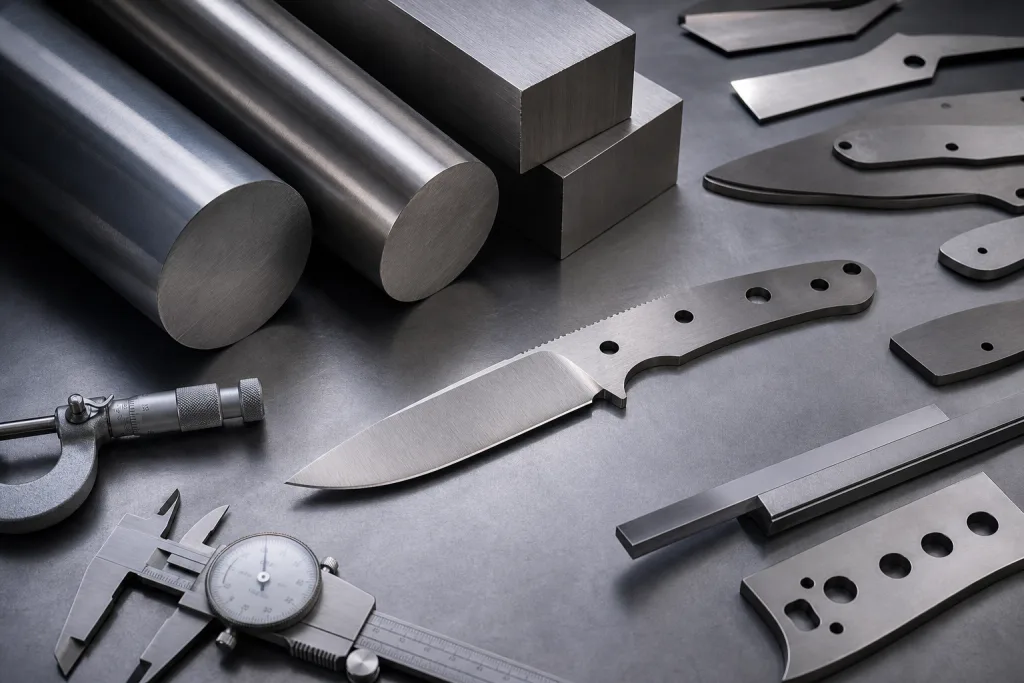
For powder steel chef knife OEM pricing, write the steel requirement clearly. “Japanese powder steel” is not a spec. Ask for the steel grade and mill certificate, then state the cladding structure if laminated, core thickness in mm, target HRC after final tempering, and hardness spot-check frequency. At TANGFORGE China, we normally use a band such as 60-62 HRC instead of one fixed number; on a 500-piece run, the Rockwell tester will not give the same reading on every blade.
Your spec also needs to say mono steel, san-mai laminated, Damascus cladding over powder core, or stainless clad. This is not decoration. It changes polishing minutes per side, weld-line rejects, rust complaints after salt-spray testing, scrap rate and FOB price. The wrong question is “which one looks premium?” The better question is whether your MOQ and retail price can carry the extra loss on the polishing bench.
Blade Geometry Drives Real Performance
About 7 out of 10 buyers spend 80% of the discussion on steel and 20% on geometry. For chef knives, it should be closer to 50/50. This is the wrong question to ask if the blade still wedges in onions. A powder steel core with poor blade geometry becomes an expensive average knife, and QC can spot it fast with a digital caliper at the heel. Your custom powder steel chef knife spec should define dimensions in millimeters, not only “8 inch chef knife.”
For an 8 inch chef knife, a common export specification is 200 mm blade length, 45-50 mm blade height at heel, 2.0-2.5 mm spine thickness at heel, tapering toward the tip, with total weight around 180-230 g depending on handle material. Edge angle is usually 12-15 degrees per side for premium kitchen use. We run 15 degrees per side for mainstream retail because the math doesn’t work on an aggressive 10-12 degrees when customers hit frozen food or glass boards. Last month QC pulled the sample at 2.8 mm spine thickness, and the buyer flagged the balance before we even packed the carton.
Define distal taper, choil rounding and spine rounding with photos plus target measurements. Tip thickness needs its own callout, such as 0.6-0.8 mm near the last 10 mm, because this is where we’ve seen this go sideways. These details decide how the knife feels in hand and whether users complain about comfort after 20 minutes of prep. For private label, we approve one golden sample and keep it as the production reference in the factory QC room beside the height gauge. Drawings help, but a physical reference cuts arguments later, especially when a PO says “satin finish” and the artwork file says “mirror polish.”
The grind type matters too. Full flat grind suits clean food release on a 200 mm chef knife, while convex grind leaves more meat behind the edge for rougher retail use. Thin behind-the-edge geometry cuts beautifully, but it can fail drop tests or chip when used on hard ingredients. We ship marketplace programs with a slightly stronger edge because a clean cutting demo does not cover 3% return claims. On the grinding line, one extra pass on the water-cooled belt can move the edge feel from premium to fragile.
MOQ, Price And Lead Time Reality
Powder steel chef knife MOQ will not sit at the same level as standard 5Cr15MoV or German 1.4116 knives. The steel bar stock costs more, the mill usually asks for a larger steel booking, and the grinding line moves slower because one overheat mark can kill the blade. We run 300-500 pcs per SKU as the practical first production run. Below 300 pcs, the math doesn't work once you count CNC handle setup, belt changes, and scrap from HRC re-checks. If the buyer wants a unique handle mold, custom bolster, special laminated steel, or rigid gift box, MOQ usually moves to 800-1,000 pcs. Last month QC pulled 18 blades from a powder steel trial because the bevel width drifted 0.6 mm after hand grinding.
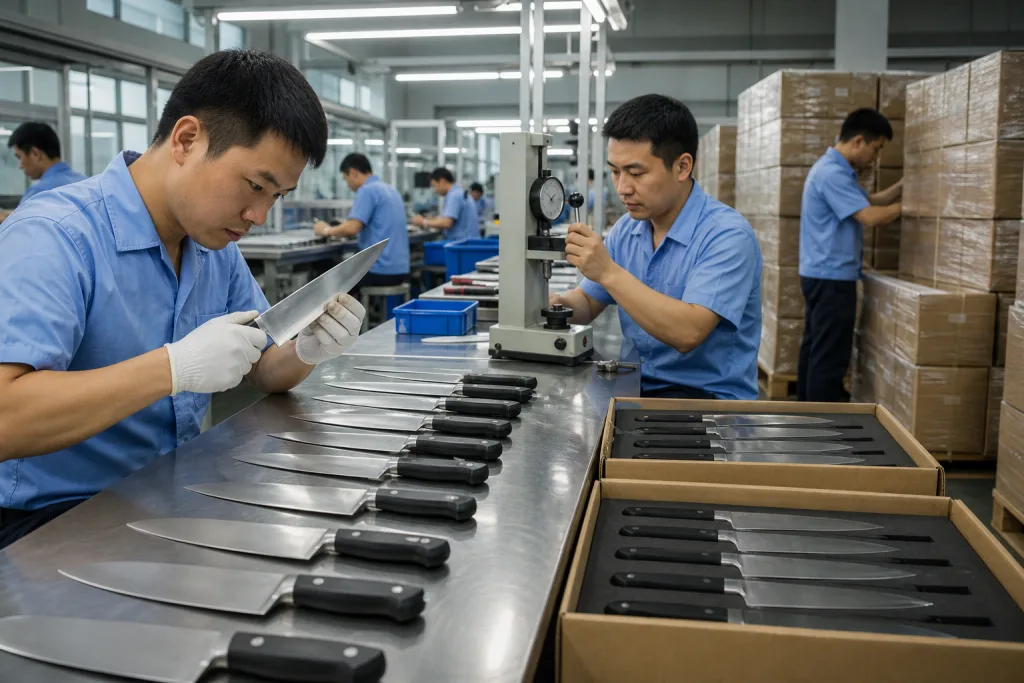
At TANGFORGE in Yangjiang, Zhejiang, our monthly capacity across kitchen, outdoor and pocket knife lines is about 180,000-220,000 units, but powder steel chef knives do not run like commodity blades. They need tighter heat treatment control, slower grinding, and extra inspection on edge straightness. A normal timeline is 7-15 days for technical drawing and sample confirmation, 25-35 days for production after deposit, and 7-10 days for final inspection, packing and export documents. We check hardness with a Rockwell tester before final polishing, because fixing a soft batch after handle riveting is painful. We've seen this go sideways when a buyer approved the sample on Monday, then changed the blade logo size by 2 mm after the etching film was made.
| Item | Typical Range | Buyer Note |
|---|---|---|
| Sample cost | USD 80-250 / design | Higher when the handle needs CNC programming or Damascus cladding |
| MOQ | 300-500 pcs / SKU | Lower MOQ may carry 8-15% surcharge |
| FOB price | USD 18-42 / pc | Steel grade, handle material, surface finish, and box style change the quote |
| Lead time | 35-55 days | Count from final sample approval and deposit receipt |
| Inspection | AQL 2.5 / 4.0 | Set cracked handles, loose rivets, and wrong logo as zero tolerance |
For DDP orders, add time for customs, duty classification, and last-mile delivery. Amazon and retail-chain orders need FNSKU, carton marks, pallet height, and carton drop-test rules before mass packing starts. Not after production is finished. We ship mixed cartons only when the PO says it clearly; one buyer once wrote “12 pcs/ctn” on the PO but sent artwork marked “10 pcs/ctn,” and the packing team had to reopen 64 cartons with a tape gun and carton knife.
Private Label Branding And Packaging Specs
Branding on powder steel knives is not decoration. It changes how the blade handles corrosion tests, finish matching and shelf price. We run 3 logo methods most often: laser engraving, electro-etching, and metal badge or end-cap branding when the handle design allows it. For powder steel chef knives, laser engraving is usually the safest spec at 0.01-0.03 mm mark depth, clean enough for satin blades and repeatable on a 500 pcs MOQ. Deep etching has a nicer old-school look, but the math doesn't work if the buyer also wants zero stain risk around the logo. QC pulled samples last month where the etch line bled 2 mm into a brushed finish after the salt spray check.
Your private label specification should name the logo file format, logo size in mm, position from heel or spine, engraving depth or color effect, and whether the mark goes on the blade, handle, or both. Be precise. A PO that says "same as artwork" is how jobs go sideways. We ask for AI or PDF vector files, not a 600 px JPG copied from a website, and we lock logo position with a caliper reading such as 38 mm from the heel and 12 mm below the spine. Do not approve a logo from a digital mockup only. Ask for a real blade photo under normal light and angled light, because satin, mirror and stonewash finishes show the same 18 mm logo in different ways.
Packaging is part of the product, especially for distributors and retail cutlery brands. Define box material thickness, insert type, barcode placement, warning labels, care card language, country of origin marking, silica gel requirement and outer carton strength. Our packing table checks 9 points before sealing cartons, including EAN code scan, blade tip protector fit and whether the care card has the right "Made in China" line. For Europe, check REACH requirements for coatings, adhesives and handle materials. For food-contact markets, 7 of 10 importers ask for LFGB or FDA declarations for components that may touch food, although the blade steel itself is usually the focus.
A practical retail set uses a 1.5-2.0 mm rigid box, EVA or paper pulp insert, printed sleeve, care card and blade tip protector. If you want plastic-free packaging, state it before sample tooling. Switching from EVA to molded paper after sample approval can change fit, drop resistance and cost, and we have seen a 240 mm chef knife punch through a loose pulp insert during a 1.2 m carton drop test. Small change, big headache.
QC Risks Specific To Powder Steel
Powder steel is not automatically “better” unless heat treatment, grinding and final packing stay under control. The risk list is shorter than buyers think: HRC drift, edge micro-chips, blade warp, handle gaps and rework scratches. We run powder steel blanks at higher material cost, so scrapping 37 borderline blades in a 1,000 pcs lot hurts, but shipping them hurts more. The math doesn't work if the reject rules are soft. QC pulled one sample last month with a 0.18 mm handle gap after buffing dust filled the seam.
For heat treatment, ask for batch-level HRC records and random third-party hardness checks when the order value justifies the lab fee. A workable control plan is three hardness test points per heat treatment batch, plus destructive testing on retained samples when launching a new steel or blade geometry. For kitchen knives, write the HRC band on the PO and approved sample card. If your approved sample is 61 HRC, mass production at 58 HRC fails, even if the blade looks fine under the LED bench lamp.
Edge QC is where 6 out of 10 powder steel disputes start. Define burr height, edge chips, wave marks and tip deviation with numbers, not adjectives. A 0.3 mm micro-chip can pass carton inspection and still show up in a customer’s phone photo after unboxing. We recommend 100% factory edge visual checks under strong light, then AQL inspection for packed goods. Critical defects should include broken tip, loose handle, wrong steel mark, wrong logo, rust, cracked blade and exposed sharp points in packaging; the buyer flagged this once when a tip cut through a PP bag during drop testing.
Handle stability is another risk. Wood and pakkawood move more than G10 or micarta when humidity changes during 18 days at sea versus 3 days in our sample room. Specify acceptable gaps, rivet flushness, handle symmetry and moisture control. China export shipments can cross 20°C temperature swings from container yard to warehouse; silica gel and sealed inner bags are cheap insurance. We ship better when the PO says “handle gap max 0.2 mm” instead of “good finish.”
Compliance Buyers Should Confirm Early
Procurement teams often ask for certificates when the order is already packed in export cartons. Too late. If your market needs REACH, LFGB, FDA food-contact documentation, Prop 65 assessment, BSCI audit reports, ISO 9001 records or retailer-specific restricted substance lists, put them in the RFQ before we cost the knife. We run quotations from a BOM sheet, not from guesses; last month one buyer added LFGB after the 2 mm kraft box artwork was printed, and the schedule moved from 12 days to 18 days. Some documents sit at factory level. Others tie to the handle resin, coating, glue, ink or finished product, so lab testing can be needed.
For Europe, REACH usually gets checked on handle coatings, colorants, adhesives and packaging inks. LFGB testing is often requested by German kitchenware buyers for food-contact safety. For North America, FDA-related food-contact declarations and Prop 65 risk review matter when handles, coatings or packaging include restricted chemicals. Knife steel chemistry is easier to control with a mill certificate and incoming PMI gun check, but black oxide finishes and colored POM handles are where QC pulled the sample more than once. Asking “is the blade compliant?” is the wrong question; ask which parts touch food, skin or retail packaging rules.
If you sell through large retailers, ask whether they require BSCI, SMETA, ISO 9001 or their own social compliance audit before you ask for the final FOB price. TANGFORGE China can support common export documentation, but the exact file list should be confirmed before quotation because testing fees and audit slots change cost and timing. We have seen this go sideways: a buyer approved a 1,000 pcs MOQ trial order, then the retailer asked for a fresh social audit with a 3-week booking window. The math doesn’t work if the audit cost lands after the PO is signed.
Label compliance gets missed because it looks simple on a dieline. Country of origin, item number, barcode, importer address, warning text and age restrictions may be legally or commercially required. A powder steel chef knife factory China can print what you send, but market accuracy usually sits with the importer. Send final approved artwork in editable format and PDF proof, then require a pre-production packaging sample before mass printing; our print room once caught a PO typo where “Made in China” was missing from a 70 mm side panel, and fixing it before the Heidelberg run saved 5,000 boxes from scrap.
How To Write A Factory-Ready RFQ
A factory-ready RFQ cuts email loops and gives you quotes you can line up side by side. Don’t ask 3 factories for a “premium powder steel chef knife.” Send a spec sheet with the blade drawing, steel grade, HRC band, finish, handle material, logo method, packaging, compliance needs, target MOQ, delivery term and inspection standard. We run faster when the drawing shows the 2D profile in mm, not a screenshot pasted into Excel.
Use this format: 200 mm chef knife, SG2 core stainless clad, 60-62 HRC, satin finish, 2.2 mm spine at heel, 15 degree edge per side, rounded spine and choil, black G10 handle with three stainless rivets, laser logo on left blade face, rigid gift box with paper insert, REACH declaration, AQL 2.5 major / 4.0 minor, FOB Shenzhen or Ningbo. Good spec. The grinding line can quote that because spine thickness, edge angle and handle build are locked. “High-end chef knife with premium box” is the wrong question to ask; the math doesn’t work until the factory knows what it is building.
State the buying plan plainly. If you need 300 pcs first order and 2,000 pcs quarterly after sell-through, say it on the RFQ. A factory can support a lower first powder steel chef knife MOQ when the roadmap looks real and the design will not jam production. We’ve seen this go sideways: one buyer asked for 50 pcs, six handle colors, custom box, engraved serial numbers and DDP delivery, then flagged the price as “too high.” Of course it was. Six color changes mean six small material pulls and extra QC checks before packing.
Before paying for mass tooling or bulk materials, approve a signed golden sample, packaging sample and QC checklist. Keep one sample with you and one at the factory in Yangjiang, Zhejiang. QC pulled the sample on a 500 pcs run last month and caught a 3 mm logo shift before cartons were sealed. That simple habit prevents arguments about polish, edge thickness, logo placement and handle feel when production starts in China.
Frequently asked questions
For most private label programs, a realistic powder steel chef knife MOQ is 300-500 pcs per SKU. If you use an existing blade profile, existing handle construction and standard packaging, 300 pcs can be workable. If you require custom handle molds, special Damascus cladding, unique bolsters, multiple colorways or a rigid retail box, expect 800-1,000 pcs. Small runs below 300 pcs are possible for samples or market testing, but the price may increase 8-20% because steel purchasing, setup, heat treatment and packaging printing are less efficient.
For mainstream premium kitchen retail, SG2/R2 is usually the safest powder steel choice. A 200 mm chef knife at 60-62 HRC gives strong edge retention without making sharpening too difficult for normal users. S35VN and S45VN can work, especially for brands that want North American steel positioning, but cost and sourcing stability need checking. M390 has excellent wear resistance, but it is expensive and can be overkill for many kitchen customers. The best steel depends on price target, edge angle, customer skill level and warranty tolerance.
For an 8 inch private label powder steel chef knife, typical FOB China pricing is about USD 18-42 per piece. The lower end usually means SG2-style core, standard handle, satin finish and simple color box. The higher end may include laminated construction, premium G10 or stabilized wood handle, polished spine and choil, rigid gift box and tighter cosmetic standards. Sample costs often run USD 80-250 per design. DDP pricing is higher because freight, duty, customs clearance and last-mile delivery are included.
Use AQL 2.5 for major defects and AQL 4.0 for minor defects, with zero tolerance for critical issues such as cracked blade, loose handle, wrong steel mark, wrong logo, rust, broken tip or unsafe packaging. Ask the factory for batch HRC records, edge visual inspection, handle gap checks, logo position checks and carton label verification. For powder steel, we recommend random hardness checks, blade straightness checks and close inspection of the edge under strong light. Keep approved golden samples at both buyer and factory sides.
Yes, but the method matters. Laser logo on the blade is practical even at 300 pcs. Custom printed care cards and carton labels are also easy. Fully custom rigid boxes, molded inserts, branded sleeves and multiple language manuals may require higher MOQ or printing surcharges. For Amazon or retail distribution, provide barcode, FNSKU, importer details, warning text and carton marks before packaging production. A factory can support private label work, but late artwork changes often delay shipment by 7-14 days.
Send Us Your Powder Steel Knife Spec
Share your drawing, target MOQ, steel grade, packaging idea and market compliance needs. TANGFORGE will review feasibility, quote clearly and flag QC risks before sampling.
Request a Quote