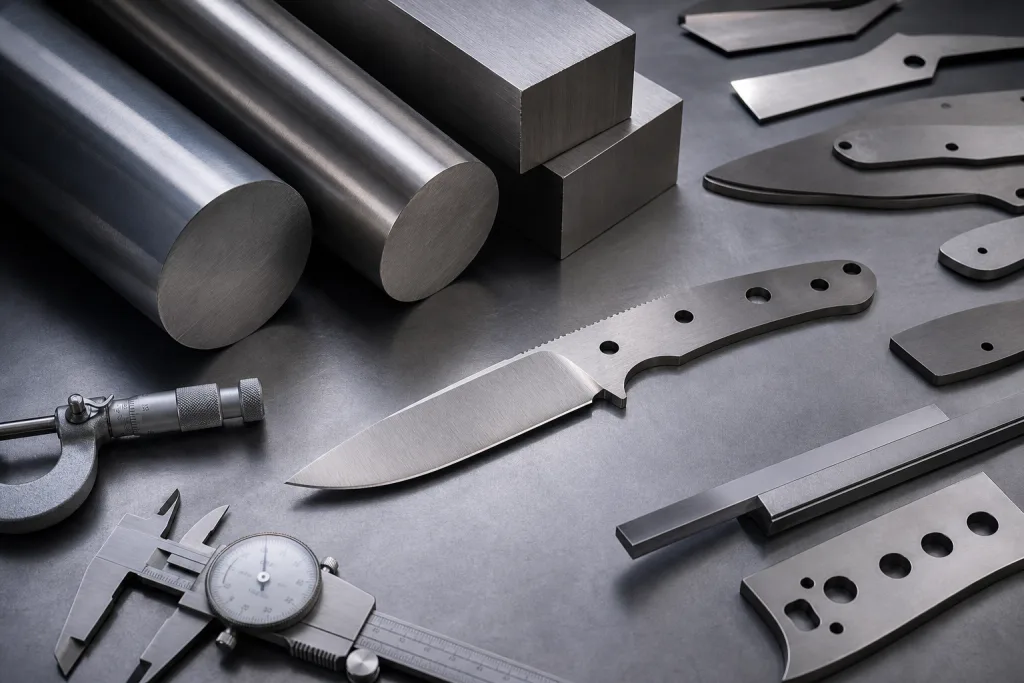
A knife shipment can look clean in the master carton and still fail at retail: 52 HRC blades when the PO says 56 HRC, 1.8 mm edge variance, loose rivets, mixed EAN barcodes, oil marks, or a color box that crushes after one 76 cm drop test. Looks fine. Then the buyer flags it. We saw this on a 2,400 pcs chef knife order where QC pulled 8 samples from the packed cartons and found two handles with 0.6 mm rivet gaps. Once the forwarder sends the arrival notice, your room to push the factory is almost gone.
Pre-shipment inspection is the wrong question to ask if it only starts after packing. We run it from RFQ, write the checkpoints into the PO, confirm them at sample stage with a digital caliper and Rockwell hardness tester records, then use PSI as the gate before balance payment. At our Yangjiang, Zhejiang factory in China, we treat PSI as sourcing control, not a last-minute audit after 300 cartons are sealed on the packing line.
Start PSI Terms at RFQ
Quality control is cheapest before we quote. Put PSI rules in the RFQ: inspected points, reinspection payer, and the action after a fail. Do it early. Once 6 pallets are wrapped and QC pulled a sample with a 0.5 mm tip bend, the factory treats PSI as an extra charge, not part of the order.
For a PSI knife order, write inspection terms as commercial conditions, not a soft note under the email signature. A workable RFQ line is: Final shipment subject to buyer-approved pre-shipment inspection at AQL 2.5 major / 4.0 minor, with HRC test by Rockwell tester, lock or handle function check, blade finish review under 600 lux light, inner box and master carton checks, barcode scan, and carton mark verification included. That line makes the quote carry the real risk. We have seen this go sideways when the buyer adds PSI after the grinding line has finished and 148 cartons already show a printed PO typo.
Ask for factory data that changes the inspection plan. For example, TANGFORGE runs knife production in Yangjiang, Zhejiang, China with about 240 employees and monthly output capacity around 300,000 standard kitchen and outdoor knife units depending on model mix. A 2,000-piece chef knife order and a 20,000-piece pocket knife order should not get the same inspection depth; the math does not work. For one 20,000-piece pocket knife order, the buyer flagged loose pivot screws after 32 samples, so we added torque checks before final packing with a 6 mm driver on the assembly bench.
PO line items to prepare at RFQ:
- Inspection standard: ANSI/ASQ Z1.4 or ISO 2859-1, normal inspection, Level II, written on the PO instead of buried in WhatsApp.
- AQL levels: critical 0, major 2.5, minor 4.0 unless otherwise agreed, with blade chips and failed locks treated as major defects.
- Inspection timing: production 100% finished, minimum 80% packed, before the warehouse team shrink-wraps the pallets.
- Reinspection cost: paid by factory if failure is due to production defects, including burrs found after the grinding line sign-off.
- Shipment release: balance payment after passed PSI and approved packing list, with carton marks checked against the final PI.
Lock Measurable Specs in the PO
A pre-shipment inspection knife checklist cannot rescue a weak PO. If the PO says only “8 inch chef knife, pakkawood handle, black gift box,” the inspector has no hard line to hold. Bad timing. On inspection day, this is the wrong question to ask. The supplier can defend a 1.8 mm spine, a 2.3 mm spine, satin finish, rough polish, or 56 HRC as “within spec” because nobody wrote the target into the order; we have seen QC pull the sample at the packing table with a 150 mm caliper and still lose the argument.
Write limits that a caliper can measure, a Rockwell tester can confirm, a torque driver can repeat, or a printed artwork overlay can catch. For kitchen knives, lock blade steel and heat treatment band, then give blade length tolerance, thickness tolerance, handle material, rivet type, edge angle, surface finish, logo position, packaging structure, carton weight, and labeling format with numbers where possible. For pocket or tactical knives, add lock function, opening force in N, clip screw torque, liner alignment at the pivot, detent feel, black oxide or stonewash finish standard, and corrosion resistance requirement. Small details matter. A 0.3 mm handle gap is not “normal” if the PO says flush fit.
Use a table inside the PO or technical sheet. Keep it simple enough for a third party inspection knife team to use beside the grinding line, with a 150 mm caliper in hand, not just in an office. We run into trouble when the spec sheet needs comments from sales, engineering, and the buyer before anyone can measure one knife; last month one buyer flagged a 2.0 mm heel thickness only after the first 600 pcs were packed. The math doesn't work.
| Item | Example PO requirement | PSI method |
|---|---|---|
| Hardness | 56-58 HRC for 1.4116 chef knife | Rockwell test against approved sample record or lab report check |
| Blade thickness | 2.0 mm +/- 0.15 mm at heel | Caliper measurement, sampled by AQL |
| Edge angle | 15 degrees per side +/- 2 degrees | Visual gauge check plus cutting test reference |
| Logo | Laser mark centered, +/- 1.0 mm | Measure against approved artwork |
| Carton | 5-ply export carton, max 18 kg | Carton count and weight check, with drop test when required |
If your product must meet REACH, LFGB, FDA food-contact expectations, or Prop 65 labeling requirements, state it at PO stage. A final inspector can check documents, warning labels, and carton marks, but cannot create compliance after production. We have seen this go sideways from one PO typo: “FDA box” written where the buyer meant FDA food-contact test report, and QC flagged it only after 86 cartons were sealed.
Use Samples as the Inspection Baseline
The approved sample turns buyer wording into checks the grinding line can repeat with 0.02 mm calipers, a bench HRC tester, and a D65 light box. It should freeze the bevel edge finish with a close-up photo, handle color under D65 light, logo contrast after 30 dry rubs, sheath fit at the mouth, packaging print position, and barcode placement. “Looks okay” is not approval. Risky. We’ve seen this go sideways: QC pulled the sample at final inspection, then nobody could prove whether the matte handle was approved or accepted by accident.
At sample stage, approve two files separately: functional construction and sales presentation. Function means the steel grade on the PO, heat treatment target, grind angle measured at the edge, edge retention result, lock strength reading, handle assembly gap, and corrosion result after the agreed test. Presentation means polish level, color tolerance with a D65 photo, gift box spec, insert card copy, warning label position, FNSKU label, and outer carton mark. Mixing these is the wrong question to ask. We had a buyer approve a sharp 15-degree chef knife sample, then flag the bulk because the insert card paper changed from 250 gsm to 200 gsm while everyone was talking about blade performance. The buyer flagged it on carton 7 during PSI, not during sampling. Bad timing. The rework bill landed after cartons were already sealed with BOPP tape.
For knives, HRC needs a hard line. If your approved sample tests at 58 HRC but your PO allows 54-58 HRC, the bulk goods can pass the PO while missing your brand target. Be realistic. Keep it narrow. For 6 of our mid-range stainless kitchen knife programs, a 56-58 HRC band is workable and keeps the complaint rate under control. For D2 outdoor knives, 59-61 HRC may fit the cutting job if the blade is not ground too thin. For high hardness Damascus chef knives, confirm brittleness risk and actual cutting use before demanding 62 HRC; the math doesn’t work if the customer expects thin 1.8 mm edges and rough chopping in the same knife. We run the Rockwell test on the flat near the heel, because testing too close to the bevel gives a nice number and a bad decision.
PO line items to close after sample approval:
- Golden sample quantity: 2 factory-retained, 1 buyer-retained, 1 inspector reference if needed.
- Sample version: signed date, photo record, drawing number, and packaging artwork version; we once saw a PO typo switch V3 artwork back to V2.
- Bulk tolerance: define allowed variation, such as natural wood grain or Damascus pattern movement, with side-by-side photos beside the approved sample.
- Test records: HRC report, salt spray if required, food-contact document if required; QC should file the tester reading, not just “pass.”
- Change control: no steel, handle, coating, packaging, or carton change without written approval, even when MOQ pressure makes a substitute look harmless.
Check Bulk Before Balance Payment
The best time for pre-shipment inspection is after 100% of the goods are finished and at least 80% are packed. Timing matters. The inspector needs sealed master cartons to pull from, not 40 loose knives sitting on the packing table beside the tape gun. At this point, we can still change 300 wrong color boxes, swap scratched blades from the grinding line, or retape cartons where QC found weak 48 mm sealing tape. Check at 50% production and you miss the night-shift batch. Check after container booking with no buffer and the math doesn't work; everyone starts arguing over a borderline order because the vessel closes tomorrow.
For most knife shipments, we run ANSI/ASQ Z1.4, General Inspection Level II. Critical defects should be zero. Major defects are normally AQL 2.5, and minor defects AQL 4.0. For a launch item, premium set, or regulated retail program, set major defects at AQL 1.5. Do not tighten every category by default. We have seen this go sideways: QC pulled a 13-carton sample, found 2 tiny retail box rub marks under the white-light bench, and the buyer held payment even though the blades, handles, and cutting edges were clean.
A proper PSI for a knife order needs four checks. Start with quantity and SKU against the PO and packing list, including handle color, blade length, set count, and carton mark typos such as “stainles” instead of “stainless.” Then inspect workmanship: blade scratches under white light, burrs on the heel, bevel symmetry, handle gaps over 0.3 mm, loose rivets, blade warp, lock play, sheath fit, and coating defects. Run function tests on the approved sampling size. Paper cut, agreed food cut, opening and closing, lock engagement, magnetism if relevant, and sharpness against the approved sample all belong on the bench. Last, check packaging and labeling: barcode scan, FNSKU, suffocation warning, carton mark, manual, insert, and retail box condition.
At TANGFORGE in China, standard OEM lead time is often 45-60 days after deposit and sample approval for repeat models, and 63-75 days for new tooling or special Damascus. Put PSI into that schedule from day one. We run a cleaner plan when inspection is booked 7 days before expected finish, carried out 3-5 days before loading, with 2-3 days left for correction. Tight timing causes bad calls. If the buyer flags a wrong FNSKU after balance payment, we can still relabel 1,200 boxes in one day with 6 packing workers and 2 barcode scanners, but only if the cartons are still in our warehouse.
What Inspectors Often Miss
A general inspector can count 126 cartons and catch blade scratches under a 600 lux lamp. That is basic carton PSI. Knife PSI needs a tighter checklist: HRC split by heat lot, edge samples pulled from the grinding line after final honing, loose tips and lock play checked by hand, carton data matched against the PO line by line. We run this because the missed item usually comes back later as a return, a chargeback, or a customs email after the container is already on the water. We've seen this go sideways.
Hardness trips people up. 8 out of 10 third-party inspection knife teams we meet do not bring a Rockwell tester, and an HR-150A is not backpack gear. For mass production, a factory HRC report by batch is acceptable only when the steel traceability is clean and the heat-treatment log matches the lot stickers on the trays. For risky orders, book third-party lab testing on retained samples, usually 3 pcs per heat lot. Do not ask for every unit to be HRC tested. The math does not work, and the indenter can leave a visible dot near the ricasso if the operator chooses a bad spot.
Edge performance is where buyers leave the spec sheet too thin. “Sharp” is not a test method. If CATRA testing is required, put it in the order before production and allow 5 to 7 days for lab time. For routine PSI, we run practical checks: 80 gsm A4 paper slice with no tearing, tomato skin cut without crushing, rope cut count using the same rope diameter, plus burr check under a side light at the inspection table. For tactical or hunting knives, check sheath retention and point safety; we have seen a knife pass the paper test and still rattle loose after 20 sheath pulls.
Safety defects belong in the critical column. Broken blade tips inside packaging, exposed loose blades, lock failure under hand pressure, cracked handles with sharp edges, missing warning labels for restricted channels, and oil leakage on retail boxes are not cosmetic issues. QC pulled one sample last season with oil inside the color box, and the buyer flagged it before we even discussed AQL. A critical defect should not be averaged into AQL. Hold the shipment.
Packaging mismatch sounds boring. It gets expensive fast. A wrong barcode, wrong country-of-origin mark, mixed SKU in master cartons, or missing FNSKU can cost more than 50 small blade scratches. Your inspector should scan actual barcodes with a handheld scanner, not just read the printed label from 300 mm away. We have seen a PO typo say “matte black” while the carton label said “MBK,” and Amazon still treated it as a mismatch.
Add a Container Loading Check
A passed PSI does not prove the right cartons went into the right container. We add a container loading check when an order has 6 or more SKUs, Amazon FNSKU labels, retailer routing rules, fragile gift boxes with 0.8 mm board, seasonal cut-off dates, or one loading bay handling goods for 2 buyers after lunch. Split lots need it. We’ve seen this go sideways: PSI passed at AQL 2.5, then the loading crew grabbed Lot B cartons while the approved packing list showed Lot A. QC caught it at dock 2 because the carton mark sheet had the wrong date code, printed 2025-08-14 instead of 2025-08-12.
The loading check is tighter than PSI. It confirms the container number, seal number, carton count against the final packing list, carton condition, SKU loading order, pallet condition if pallets are used, desiccant placement, and match to the approved packing list. For knives, QC also checks for dry cartons and compression marks. A 16 kg master carton with chef knives inside can crush gift boxes fast when the stack height passes 1.6 m; QC pulled the sample, the top flap looked fine, but the inner color box had a 12 mm corner dent.
PO line items for loading control:
- Factory must provide final packing list 24 hours before loading, with SKU, carton number range, and gross weight shown for each line item.
- Buyer or appointed inspector may witness loading and record container number plus seal number before the truck leaves the gate.
- Cartons must be loaded by SKU sequence unless mixed loading is approved in writing; we run this against the carton mark sheet at the warehouse door with a barcode scanner.
- Wet cartons, crushed corners over 10 mm, opened tape, or relabeled shipping marks cannot be loaded without buyer approval.
- Photos required: empty container floor, half-loaded container showing carton marks, full container before door closing, closed door, seal close-up.
If you ship FOB China, the loading check is normally done at the factory or forwarder warehouse before the container leaves. If you buy DDP, do not stop at “the supplier handles logistics”; this is the wrong question to ask. You still need visibility because the supplier controls truck pickup, vessel booking, and the handover scan at the warehouse, and we’ve had a PO typo where 84 cartons became 48 on the forwarder sheet. One missing pallet on a USD 38,000 knife order can wipe out the saving from skipping a USD 180 loading check. The math doesn’t work.
Use Inspection Results With Leverage
A PSI report should trigger one of four actions: ship, rework, sort with reinspection, or cancel the affected line. Don’t let it sit as a 40-page PDF in somebody’s inbox. We’ve seen this go sideways. Before QC pulls cartons from the stacking area with the hand pallet truck, agree who can approve concessions and how fast the factory must reply, such as 4 working hours after the inspector sends blade photos and AQL 2.5 findings.
If the shipment passes, release balance payment according to the PO. If it fails for major defects, ask the factory for a corrective action plan showing counted quantities, close-up photos for each defect type, and the exact packing-line slot by date and hour. Example: sort 3,000 units, replace 420 scratched blades, repack 600 boxes, then reinspect within 72 hours. Put it in writing. If minor packaging defects exceed AQL but your retail channel accepts them, negotiate a discount or replacement color boxes for the next order. Be strict on safety and compliance defects. A discount does not fix a liner-lock failure found during the 5 kg pull test. It also does not fix a 0.3 mm burr on the blade tip or the wrong food-contact claim printed beside an LFGB mark.
Your strongest position is written before the problem exists. Use payment terms that keep the factory focused on passable goods: 30% deposit, 70% after passed PSI is common for new OEM knife orders. For trusted repeat orders, terms can soften, but shipment release should still depend on approved inspection records. We run this clause on kitchen knife sets and folding knife gift-box orders because once the 70% is paid and cartons are sealed with 48 mm tape, the math doesn’t work for chasing rework.
At our Yangjiang, Zhejiang operation, we prefer buyers who define the rules early. It cuts argument. It protects your launch date. Factory QC also checks tighter when the failed-inspection clause is clear, especially at final packing when calipers, carton drop-test records, and barcode scans are all on the table. That clause is not hostile; this is the wrong question to ask. It is how both sides avoid guessing under vessel cutoff pressure in China, especially when the buyer flagged a PO typo on “satin finish” three days before loading.
Frequently asked questions
Book the inspection when production is close enough to completion that the result represents the whole order. The usual target is 100% produced and at least 80% packed. For a 5,000-piece kitchen knife order, we suggest contacting the inspection company about 7 days before expected completion, then inspecting 3-5 days before container loading. That leaves time for sorting, repacking, or reinspection. If you inspect too early, the last production batches may have different edge grinding, polish, or packaging quality. If you inspect on the loading day, you have almost no leverage except delaying shipment.
Use both, but do not confuse their roles. Factory QC should control production every day: incoming steel, heat treatment, grinding, assembly, polishing, and packing. A third party inspection knife service gives you an independent snapshot before payment and shipment. For a first order, high-value order, or retailer program, third-party PSI is worth the cost, often USD 250-450 per man-day in China depending on location and scope. The key is giving the inspector knife-specific criteria. A general checklist may miss HRC documentation, blade warp, lock play, burrs, sheath retention, and barcode scan accuracy.
For most B2B knife orders, use critical 0, major AQL 2.5, and minor AQL 4.0 under ANSI/ASQ Z1.4 or ISO 2859-1, General Inspection Level II. Critical defects include unsafe lock failure, broken tips, exposed blades, or serious compliance labeling errors. Major defects include loose handles, wrong blade thickness, deep scratches, wrong SKU, unreadable barcode, or packaging damage that affects saleability. Minor defects include small polish marks, slight color variation, or non-selling-surface carton marks. For premium launches or strict retail accounts, major AQL 1.5 may be justified, but define it before PO confirmation.
Yes, but the method must be realistic. HRC testing is usually batch-based, not every unit, because Rockwell testing can mark the blade. For stainless chef knives, a common band might be 56-58 HRC; for D2 outdoor knives, 59-61 HRC may be requested. Sharpness can be checked with practical agreed tests, such as A4 paper slicing, tomato skin cutting, or rope cutting. CATRA testing is more formal and useful for benchmarking, but it normally requires lab setup, sample submission, and extra cost. Put the test method and acceptance criteria in the PO, not only in a final email.
You need it when shipment execution risk is high. A passed PSI confirms sampled goods and packaging condition before release. A container loading check confirms the right cartons, quantities, SKU sequence, container number, and seal number actually leave the factory or warehouse. It matters for mixed SKU orders, FNSKU labeling, retailer routing guides, gift sets, and seasonal delivery windows. For a simple 1,000-piece single-SKU order, PSI may be enough. For a 20,000-piece order with 12 SKUs and multiple carton marks, loading control is cheap insurance compared with chargebacks or missed delivery appointments.
Build PSI Into Your Knife PO
Send your drawing, packaging file, target AQL, and shipment plan. We will help turn them into a practical QC checklist before production starts.
Request a Quote