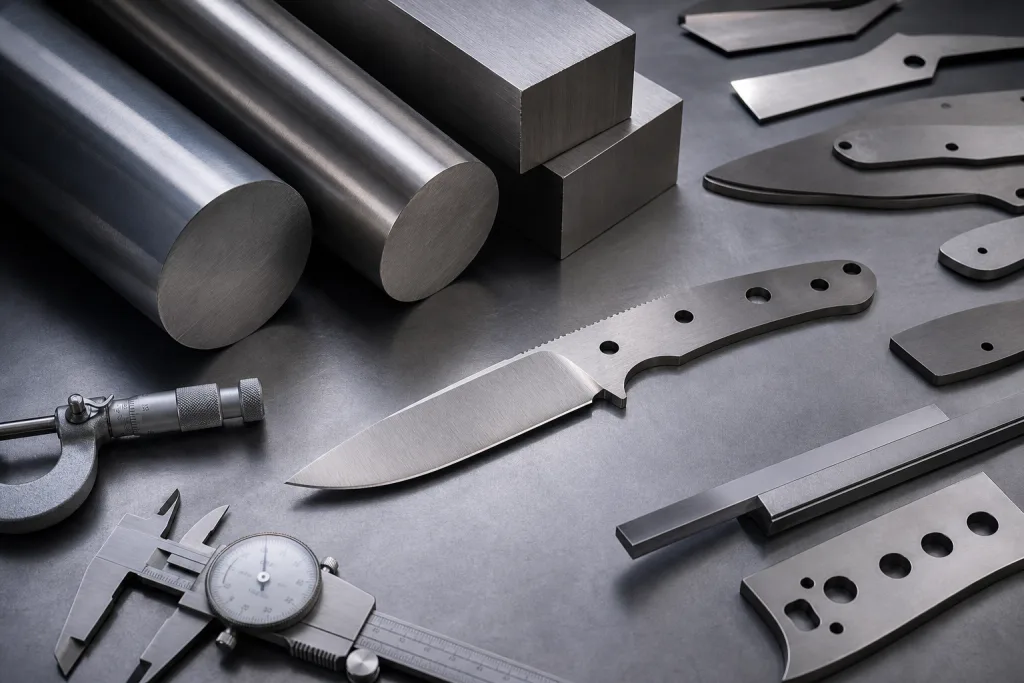
A santoku knife looks simple on a product page: 7 inch blade, decent steel, clean handle, printed box. On the floor, we check it as 9 separate risks: blade geometry, HRC drift, handle gaps, logo position, rust resistance, carton crush, barcode accuracy, Amazon prep mistakes, loose inserts. QC pulled the sample last month and found a 0.8 mm handle gap on 37 pieces. Small gap. Big claim risk.
If you sell on Amazon or DTC, your customer does not care whether the problem came from the steel mill, the grinding line, the polishing bench, or the packing table. They see a knife that chips, stains, rattles in the box, or fails to match the listing photo. At our santoku knife factory in Yangjiang, China, we treat QC as a release system, not a final photo before shipment; we run checks before grinding, after heat treatment, before logo printing, and again at packing. The buyer flagged it once: “listing says satin, sample looks mirror.” That is the wrong time to find out.
Start QC before the purchase order
The most expensive mistake in santoku knife bulk buying is opening QC after production. Too late. By then, the 3Cr13 or 1.4116 coil has already been slit, the blanks are stamped, the handles are pinned, the laser logo is burned, and 12-piece inner cartons are taped shut. If your spec is loose, the factory can make a decent knife, just not the knife your Amazon listing or retail buyer signed off. We catch this at the first coil slitting check with a vernier caliper on the table, and the buyer says, “Can you fix it on the next lot?” No. The math does not work.
Your purchase order needs numbers the QC team can check with a caliper, angle gauge, and Rockwell tester. For a custom santoku knife, don’t write only “7 inch German steel santoku with pakkawood handle.” Write blade length 178 mm ±2 mm, blade thickness at spine 2.0 mm ±0.2 mm, edge angle 15° per side ±2°, target hardness 56-58 HRC, total weight 180 g ±10 g, then spell out full tang or welded tang, handle material and rivet type, logo method, packaging structure, and barcode position. We once received a PO typo that said 187 mm instead of 178 mm; QC pulled the sample before mass grinding, saving 3,000 blades from the wrong size. Clean catch. It happened right beside the belt sander before the grinding line started running.
At TANGFORGE in Yangjiang, China, we normally ask new buyers to approve one pre-production sample and one packaging sample before we open bulk work orders. For repeat orders, we still keep a signed golden sample in the QC room with the buyer’s sticker, approval date, and carton layout clipped to it. Our chef knife lines can handle about 180,000 kitchen knives per month, but capacity will not repair weak documents. The grinding line follows the sample, not somebody’s memory from last season. If the PO is sloppy, the line copies the mistake.
Your PO also needs clear inspection rights. A practical clause is simple: final inspection must pass before balance payment and shipment release. If you use a third-party inspector, state whether they will follow ANSI/ASQ Z1.4 sampling and which AQL levels apply. We’ve seen this go sideways: the buyer expects zero hairline polishing marks under a bright desk lamp, while the santoku knife supplier counts 0.3 mm polishing lines as acceptable at that price point. This is the wrong time to argue. Put the standard in writing before we ship, not after the container is booked. QC pulled one carton last month because the barcode sat 4 mm too low on the sleeve.
Lock the golden sample and tolerances
The golden sample is not a catalog photo. It is the physical contract between you and the santoku knife manufacturer. Tag it, date it, sign it, and give it a sample code that matches the PO. For Amazon and DTC sellers, one approved sample stays with you and one stays at the factory. We keep ours in a marked pouch in the sample cabinet, beside the calipers and sample cards, not loose in a drawer.
Measure the golden sample like a QC inspector, not like a shopper. Use calipers for blade length, blade height, spine thickness, handle length, bolster thickness, and carton size, then record the readings in mm. Use a scale for finished knife weight and packed unit weight. Take clear photos from the top, side, edge, handle joint, logo, barcode, and retail box. QC pulled the sample on the packing table and checked it on a 0.1 g scale for a reason. If your listing says “lightweight 165 g santoku,” a finished batch averaging 205 g will trigger complaints even if the knife cuts cleanly.
The tolerance should match the product level. A budget private label santoku knife will not hold the same cosmetic tolerance as a premium hand-finished Damascus model. Still, functional dimensions need control. Blade thickness drifting from 2.0 mm to 2.8 mm changes cutting feel. Handle gap over 0.3 mm traps food residue and looks cheap. Logo shift over 2 mm shows up fast in customer review photos. Zero-defect theater is the wrong target. The math does not work. On the grinding line, a 0.4 mm swing is enough to turn a good batch into a return risk.
For custom santoku knife orders, confirm whether the golden sample was made by the same process as mass production. A hand-ground sample from a senior worker can look sharp and clean, but bulk units made on a different grinding jig will not always match it. Ask your santoku knife factory to run the sample with mass-production tooling, not a one-off bench method, especially when your MOQ is 500-1,000 pcs. We have seen this go sideways: the buyer approved the sample, then flagged the first PO because the carton spec was typed as 12 pcs instead of 120 pcs.
Check steel, hardness, and heat treatment
Steel choice is where buyer claims get expensive. The blade stamp must match the PO, invoice, carton label, and product listing. We once had QC pull a 180 mm santoku sample marked AUS-10 while the PO line said 5Cr15MoV, and the buyer flagged it before shipment. If you sell a knife as 1.4116, X50CrMoV15, AUS-10, VG-10, 5Cr15MoV, or Damascus clad steel, your santoku knife supplier should show mill certificates and incoming material records, not just a clean laser mark from the marking room. We run that check before the grinding line starts packing.
Hardness control gets missed by new sellers. Bad idea. A santoku for vegetables and boneless proteins needs edge hold, but it should not chip when a customer twists through squash or frozen meat. For common stainless santoku knives, we usually see 56-58 HRC for 1.4116 or 5Cr15MoV, 57-59 HRC for 7Cr17MoV, and 58-60 HRC for AUS-10. Damascus core knives may run 59-61 HRC depending on the core steel and target market; on our Rockwell tester, one point outside the band gets written on the inspection sheet. QC pulled the sample, checked the heel and mid-blade, then logged the number.
Ask how many pieces are tested per batch. For a 2,000 pc bulk order, checking only one blade is weak. The math doesn't work. A workable control plan covers incoming steel verification, furnace batch records, and HRC spot checks at the start, middle, and end of heat treatment lots. On higher-value orders, we test 5-10 pcs per heat treatment batch and record blade position and value; the grinding line hates rework, but catching a soft heel before handle assembly saves 12 days versus 18 days of sorting after packing. If the supplier says, “We checked one and it passed,” this is the wrong question to ask.
| QC item | Typical requirement | Buyer note |
|---|---|---|
| Steel grade | Match PO and marking | Request mill certificate for bulk order; check one stamped blade against the PO before mass packing |
| Hardness | ±1 HRC from approved band | Keep Rockwell tester photos or report with blade position noted |
| Corrosion test | 24-48 hour salt spray or wet cloth test | Good for Amazon return prevention when buyers complain about rust spots after first wash |
| Edge retention | Internal cutting test or CATRA on premium lines | CATRA adds cost but gives comparable data for repeat SKUs |
For food contact compliance, steel and handle materials need LFGB, FDA, or REACH documentation based on your sales market. Europe buyers should ask before deposit, not when the container is already at customs; we have seen one PO delayed because the handle material name had a typo, “PP” on the invoice and “ABS” on the declaration. That paperwork slip holds the shipment, not the blade.
Inspect blade geometry and cutting performance
A santoku knife gets judged in the first 10 seconds on a cutting board. If it wedges halfway through a 60 mm onion or skids on tomato skin, the buyer will get photos from customers and ask for credit, even when the mirror polish looks clean. We run a separate geometry check at QC because one quick A4 paper slice at the packing table will not catch a fat grind. QC pulled 3 samples from the lot, and one blade had a burr line you could feel through a thumb glove.
For most 7 inch santoku knives, the blade length is around 165-180 mm, blade height 43-48 mm, and spine thickness 1.8-2.5 mm depending on market position. A thinner blade cuts cleaner. We had 2 North American buyers push back because the sample felt “too light” beside their current SKU on the retail shelf. A thicker blade feels strong in the hand, but it wedges through carrots. Chasing spine thickness alone is the wrong question to ask. If you sell to DTC customers who care about cutting feel, write thickness behind the edge into the spec sheet. A practical target is about 0.25-0.45 mm behind the edge before final sharpening for stainless santoku knives, checked with a digital caliper at 10 mm, 80 mm, and 150 mm from the heel.
Control the edge angle. In our custom santoku knife projects, about 7 out of 10 performance-focused orders use 15° per side, while heavier retail sets often sit at 17-20° per side for fewer damage claims. If the grinding line opens the angle to save sharpening time, the knife no longer matches your “razor sharp” claim. QC pulled one sample last year at 22° per side after the PO said 15°, and the buyer flagged it before launch. Check with an angle gauge or a fixed cut-test standard, not by eye. We keep one gauge at the inspection bench. It saves arguments.
Useful functional tests are simple: slice A4 paper cleanly from heel to tip, shave tomato skin without thumb pressure, then cut 20-30 sheets of cardboard and check the edge under a 6000K inspection lamp for rolls or chips. Simple tests work. They are not laboratory data, but they catch burrs, soft heat treat, uneven sharpening, and over-polished edges before cartons leave Yangjiang. For premium programs, CATRA testing gives a cleaner edge-retention comparison, but the math does not work for every 800 pc reorder. We ship too many mid-market orders for that to make sense.
Check blade symmetry as a separate item. The santoku tip should be centered, the spine should not snake, and the edge line should not wave when QC sights down the blade against a steel ruler. On bulk production, a 1-2 mm visual wave across the cutting edge turns into bad review photos fast. We have seen this go sideways from one bent stamping die, and 500 pcs had to be reworked before packing. That is a factory-floor problem, not a marketing problem.
Control handle fit, balance, and safety
Handle defects become claims fast. They are safety issues too. A loose scale, sharp rivet lip, cracked pakkawood, uneven resin color, or open joint at the tang can pass in a factory photo, then fail on the first grip. Last year QC pulled 32 pcs from a 1,200 pcs santoku lot; 5 pcs had rivet edges that snagged a cotton glove during the wipe test. For Amazon, that turns into a one-star review within hours, because the buyer can film the gap or crack on a phone.
Check the handle material against the PO first. Then check wood or pakkawood moisture with a meter before final packing. We use a pin-type moisture meter on the line, and the reading has to match the spec, not the salesman’s promise. Inspect rivet alignment with a steel ruler, check joint gaps under bench light, then run a bare-hand touch test for surface smoothness. Smell is its own checkpoint. One loose “handle OK” line is weak. Some low-cost handles look clean on the bench and still carry a solvent odor after sealing. We saw this go sideways when knives sat in a closed retail box inside a hot container for 30 days, then the buyer flagged “chemical smell” before blade testing even started.
For full-tang santoku knives, check that the handle scales sit flush against the tang. The practical visible gap limit is 0.2-0.3 mm, depending on price level, and the inspector should use a 0.2 mm feeler gauge, not eye judgment. Rivets should not protrude more than about 0.1 mm above the handle surface after polishing. If the design uses G10, micarta, PP, TPR, or ABS, confirm REACH or food contact requirements where the market asks for it. The math does not work if 3,000 pcs are finished and the file is missing. We had a PO once with the handle code typed as “ABS matte blacke”; the buyer caught it before shipment, and that typo saved a week of rework.
Balance is not a marketing word. A santoku can sit slightly blade-forward, but it should not feel like a cleaver unless the spec says so. Record the balance point on the golden sample, for example 10-20 mm in front of the handle, and mark it on the inspection sheet with a caliper reading. Use the same point every time. During inspection, pull sample units from different cartons, not just the top layer of carton 1. If one carton feels nose-heavy and the next does not, something changed on the grinding line, the tang length, or the handle density.
Safety checks need to be blunt. Pull test the handle where possible, check for sharp burrs at the heel and spine, and confirm the knife cannot move freely inside the package. We run a simple shake test on the packed unit; if the blade tip moves more than 5 mm inside the insert, the packaging needs fixing. QC pulled one sample last month and found a burr at the heel that would have cut a finger on first use. A sharp edge cutting through a retail insert during transit is a packaging defect, but the customer experiences it as a dangerous knife.
Apply AQL inspection to packed cartons
Run final inspection when at least 80% of the order is packed and 100% is finished. Line checks miss packing mistakes. A loose santoku on the grinding line can show the edge and handle are acceptable, but it does not prove the retail unit your customer opens: knife with the correct blade guard, insert card with no typo, manual, silica gel, barcode label, retail box, master carton, and carton mark. We once had a clean 1.8 mm blade pass QC, then the buyer flagged a missing sheath after 240 cartons were sealed. Painful lesson. That one cost everyone half a day with tape guns and replacement sheaths on the packing table.
Most buyers use ANSI/ASQ Z1.4 general inspection level II with AQL 0 for critical defects, AQL 2.5 for major defects, and AQL 4.0 for minor defects. Critical defects mean exposed unsafe blades, wrong product, severe rust, broken handle, or missing legal labeling. Major defects mean wrong steel marking, wrong logo, loose handle, edge chip, barcode not scanning, or retail box crushed. Minor defects mean light polishing marks, small box scuffs, or slight color variation inside the approved sample range. Our QC checks blade hardness by batch, for example 56-58 HRC on common X50CrMoV15 santoku models, then pulls packed samples again with a durometer before the inspector comes. We run that check twice. Packing hands can mix cartons when 6 people are closing boxes and the line is trying to finish before the 5 p.m. truck.
For example, on a 1,200 pc santoku knife bulk order, general level II may require a sample size around 80 pcs depending on the lot size table. At AQL 2.5, the acceptance number is limited; if major defects exceed the allowed count, the shipment should fail and the factory must sort or rework. “Only a few percent” is the wrong answer if the issue can trigger an Amazon complaint, a customs hold, or a safety claim. The math does not work. One 3 mm edge chip in a customer review can cost more than opening 60 cartons for recheck, and we have seen this go sideways on a Friday evening when QC pulled the sample after the cartons were already strapped.
Your inspector should open cartons from different pallet positions, not only the top cartons prepared by the packing team. We ask them to cut random cartons from the front, middle, and back of the pallet with a carton knife, then scan barcodes, check FNSKU placement if shipping to Amazon FBA, verify carton weight, and compare carton marks with the shipping plan. For DDP shipments, wrong carton data can create warehouse receiving problems even when the knives are perfect. We once had a PO showing “CTN 1-48,” while the printed mark said “CTN 1-46”; the knives passed, but receiving still got messy. The buyer flagged it before the truck left. That saved us from peeling and re-labeling 46 master cartons by hand.
At our China factory, we prefer to catch problems before your third-party inspector arrives. Internal QC normally checks semi-finished goods, finished blades, handle assembly, sharpening, cleaning, and packing; the packing table keeps a barcode scanner, weight scale, and approved golden sample beside the cartons. Buyer inspection still matters before balance payment because it protects both sides. We ship faster when the report is clean, and you avoid finding a wrong logo after 500 pcs are already in your warehouse. Ask the right question: did the packed cartons match the PO, or did they just look fine on the line?
Verify packaging for Amazon and DTC
Packaging is part of the SKU, warehouse receiving, and claim control. We have watched a good santoku become a bad order because the tip punched through the insert, the blade guard slid 8 mm during transit, or the FNSKU ended up under shrink film where the scanner could not read it. For Amazon sellers, that turns into relabeling fees, stranded stock, or returns with customer photos of a loose blade. One bad pack can kill the margin. No drama there.
Your packaging spec should name the retail box material, the insert structure, the blade guard or sheath type, anti-rust paper, barcode size, FNSKU position, country of origin marking, suffocation warning for polybags, and master carton strength. For a 7 inch santoku, we run a fitted pulp tray, an EVA insert, or a rigid cardboard insert that locks the blade and handle in separate points. A loose sleeve can pass for some low-cost wholesale orders. For parcel-shipped sharp kitchen knives, the math does not work. QC pulled one sample last year where the blade moved 12 mm inside the box after hand shaking on the packing bench.
Ask for a carton drop test, especially if you sell DTC. Our internal check is 1 corner, 3 edges, and 6 faces from 60-80 cm. Then we open the carton and check four things: blade movement, box opening, cracked inserts, and tip marks on the inner wall. Not fancy. It is not ISTA certification, but it catches weak packaging before mass shipment. On the grinding line, we also check whether the tip protector still covers the last 3 mm of the blade after the drop.
For compliance, confirm “Made in China” marking if your import market requires it. If your product claims LFGB, FDA, BPA-free, or dishwasher safe, the box, insert, listing copy, and test reports must match word for word. Do not print claims first and chase documents later. We have seen this go sideways when the buyer flagged “dishwasher safe” on a PO, but the approved artwork said hand wash only. One word can hold a shipment. The PO typo becomes a warehouse headache.
If you use custom packaging from our Yangjiang, China production base or coordinated suppliers in Zhejiang, approve the dieline and color proof before bulk printing. A 1 mm dieline error can make the knife rattle, especially with a thin EVA slot around a 2.0 mm blade spine. A wrong Pantone color does not hurt safety, but it hurts brand trust when customers compare your listing photos with the delivered box. We ship courier samples first for this reason. The buyer sees the box before the carton line does.
Frequently asked questions
For most Amazon and DTC santoku knife orders, use ANSI/ASQ Z1.4 general inspection level II, AQL 0 for critical defects, AQL 2.5 for major defects, and AQL 4.0 for minor defects. Critical defects include unsafe exposed blades, severe rust, broken handles, or wrong product. Major defects include wrong logo, loose handle, edge chips, barcode failure, or incorrect packaging. Minor defects include small polishing lines or slight box scuffs. For high-end Damascus or gift-boxed products above about USD 15 FOB, you may tighten cosmetic requirements, but write them into the PO before production.
The sample size depends on order quantity and the inspection standard. For a 500 pc order, an inspector may check around 50 pcs under general level II. For a 1,200 pc order, the sample may be around 80 pcs. For a 3,000 pc order, it may be around 125 pcs. The exact number comes from the ANSI/ASQ Z1.4 table. Ask the inspector to pull cartons randomly from different pallet positions. They should inspect both knife quality and packed-unit details, including FNSKU scan, carton marks, gross weight, and retail box condition.
It depends on the steel and target customer. For 1.4116, X50CrMoV15, or 5Cr15MoV, 56-58 HRC is common and gives good toughness for general home cooks. For 7Cr17MoV, 57-59 HRC is typical. For AUS-10, 58-60 HRC is a practical range. Damascus santoku knives with VG-10 or similar core steel often run 59-61 HRC. Do not chase the highest HRC without considering chipping risk. For bulk QC, test several pieces from each heat-treatment batch and record actual values, not just the target.
For first orders, new SKUs, or orders above about USD 5,000, a third-party final inspection is worth the cost. Factory QC protects production quality, but an independent inspector protects your payment decision. Good factory QC should not object to this. At TANGFORGE, we prefer buyers to inspect before shipment because it reduces disputes after arrival. For repeat orders with stable defect history, you may rely on factory inspection reports and random video checks, but still do full third-party inspection every few shipments or when changing steel, handle, packaging, or logo process.
For a private label santoku knife using an existing blade and handle design, MOQ is often 300-500 pcs per SKU, with 35-45 days production after sample and packaging approval. For a custom santoku knife with new tooling, custom handle, new packaging, or Damascus material, MOQ may be 800-1,000 pcs and lead time can be 50-70 days. Add 7-14 days if you need LFGB, FDA, REACH, or special packaging tests. Always confirm lead time from approved golden sample, not from first inquiry date.
Send your santoku QC checklist today
Share your target steel, MOQ, packaging plan, and Amazon requirements. We will review manufacturability, QC points, and realistic lead time before quoting.
Request a Quote