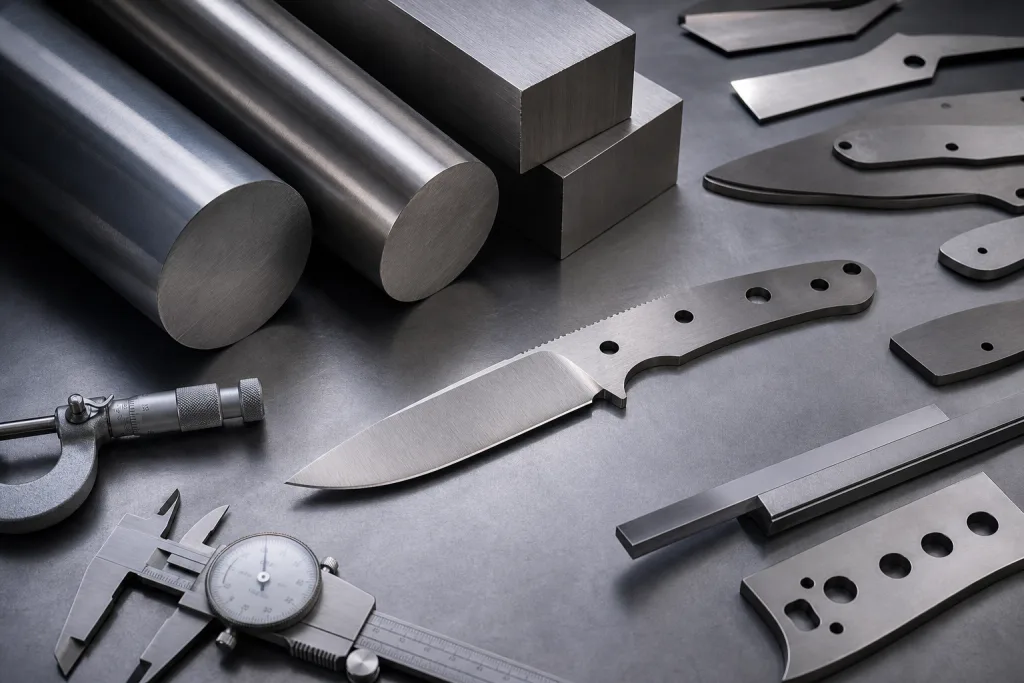
Santoku looks simple on a quotation sheet: 165 mm blade, stainless steel, pakkawood or G10 handle, gift box. On the grinding line, a 0.3 mm change at the spine, a different HRC target, or a tighter handle gap spec can push FOB up by 20-60%.
If you are sourcing from a santoku knife factory China buyers use for OEM programs, get the numbers before asking for samples. At TANGFORGE in Yangjiang, China, we run about 180,000 units/month across chef, santoku, utility, and paring knives; last month QC pulled a 32-piece santoku sample lot because the buyer flagged uneven bevel width under AQL 2.5. The math doesn’t work if MOQ, steel grade, packaging, and inspection level are treated as separate questions.
Where Santoku MOQ Really Starts
Santoku knife MOQ is not one fixed number. On our Yangjiang, China production floor, the starting point depends on one question: are we running an existing blade blank, or are we opening new tooling? For a standard 165 mm santoku, we quote 300-500 pcs per SKU when the blade blank is in the rack, the handle jig fits, and the color box dieline is already approved.
Custom work pushes the count up fast. A new handle profile means a mold, CNC sample checking, and at least one trial fit on the grinding line; that is why new handle molds often need 1,000-2,000 pcs to spread tooling cost. Full private tooling with an exclusive blade shape plus matched handle geometry is usually sensible at 3,000 pcs or above. Below that, the math doesn't work.
Color changes look simple on a PO, but QC sees the mess first. A black pakkawood handle may be easy at 500 pcs because we run that sheet stock every month; a custom resin color or injected TPR handle can require 1,000-3,000 pcs because the material supplier has its own batch limit. Printed sleeves, magnetic boxes, and barcode labels carry the same issue. If you sell through Amazon FBA, lock FNSKU labeling and carton weight limits before quotation; we have seen a 16.8 kg master carton get flagged after packing, and nobody enjoys repacking 42 cartons.
For a first order, chasing the lowest theoretical MOQ is the wrong question to ask. A 200 pc order split into five handle colors creates five setups, five QC sorting bins, and five carton marks, while one clean 500 pc SKU runs smoother through inspection under AQL 2.5. Your landed cost can come out worse even though the order feels smaller. A good santoku knife OEM supplier should push back when the design is too fragmented for stable production.
Price Bands by Specification Level
Price follows the full spec stack. Steel matters, but it is only one line on the cost sheet. Blade thickness tolerance, grinding method, surface finish, handle material, rivet quality, logo process, inner tray, and outer carton all move the quote. On our grinding line, a 1.8 mm blade held to ±0.10 mm and a loose 2.0 mm blade held to ±0.25 mm do not cost the same. Buyers comparing quotes from a santoku knife factory China supplier often miss this: two USD 6.00 knives can be built from different parts and different inspection standards.
The table below gives practical FOB Yangjiang, China ranges for 165-180 mm santoku knives. These are screening numbers, not fixed offers. We use them when a buyer sends a target retail price and asks whether the math works before we open a sample order. Last month QC pulled a 180 mm sample with a 0.7 mm tip warp; the steel grade was right, but the price band was wrong for that finish level.
| Spec level | Typical build | MOQ | FOB price range |
|---|---|---|---|
| Entry retail | 3Cr13 or 420J2, plastic handle, 54-56 HRC, color box | 500 pcs | USD 3.20-5.20 |
| Mainstream private label | 5Cr15MoV or 1.4116, pakkawood, 56-58 HRC, laser logo | 500-1,000 pcs | USD 5.80-8.80 |
| Better retail | German 1.4116 or 9Cr18MoV, G10 or walnut, 58-60 HRC | 1,000 pcs | USD 8.50-13.50 |
| Premium line | VG10 core or Damascus cladding, 60-62 HRC, gift box | 1,000-3,000 pcs | USD 13.80-18.50+ |
Watch the low quote. If a santoku knife MOQ and price guide shows USD 2.50 for a retail-ready knife with good steel, gift box, and full QC, the wrong question is “Can you match it?” Ask what was removed. It might be thinner blade stock, lower HRC, poor handle fit, 250 g carton board instead of 350 g, or no real final inspection. We have seen this go sideways: the buyer flagged chipped edges after shipment, and the PO even had “VG-10” typed while the approved sample was 5Cr15MoV. Your customer will not see the factory quote; they will see returns.
Core Specs Buyers Should Lock
Before you ask for a formal quote, lock the spec on paper. For a santoku, we usually see 165 mm or 180 mm, with 1.8-2.5 mm blade spine thickness depending on where it sits in the market. On our grinding line, we check spine thickness with a digital caliper before first sample approval, because a 0.2 mm miss will change the hand feel fast. Japanese-style buyers usually ask for 1.8-2.0 mm for easier cutting, while Western retail sets often want 2.2-2.5 mm so the knife feels stronger in hand.
For steel, the safe middle is 5Cr15MoV, X50CrMoV15, or 1.4116 at 56-58 HRC. These are not fancy steels, but they hold up well, resist rust, and are easy for home users to keep sharp. If you are building a higher-price santoku knife OEM program, 9Cr18MoV at 58-60 HRC or VG10 at 60-62 HRC makes sense. We once had a buyer push for 61 HRC on a budget line, and the math did not work after returns and sharpening complaints came in. If your after-sales team cannot handle people twisting blades in frozen food or sending knives through dishwashers, do not spec hardness too high.
Write the edge angle clearly. A lot of santoku knives go out at 15 degrees per side for sharper cutting, while value lines sit at 18-20 degrees per side for better durability. A Granton edge, hammered finish, black oxide coating, or Damascus pattern can lift shelf appeal, but each one adds QC work. QC pulled the sample on a tape adhesion check once because the coating lifted at the heel, and that lot never left the plant. Damascus needs even etching and no cloudy spots, or the buyer flags it right away.
Handle choice should fit the channel. Pakkawood works for mainstream retail and gift sets. G10 is tougher and more stable, but it adds cost. ABS or PP is the cheaper route for dishwasher-positioned products. Natural walnut looks premium, though it needs moisture control and better packing. For Europe, ask early about REACH, LFGB food-contact expectations, and the exact document set your importer wants. We have seen a PO typo on handle color turn into a 2-week delay, so get the details fixed before the sample signs off.
OEM Customization and Tooling Costs
A custom santoku knife can be a blade laser logo with a private box, or it can mean a locked blade profile with new drawings and trial runs. Big gap. On existing models, laser logo setup is often USD 30-80, and the unit cost change is usually under USD 0.05 when we run 1,000 pcs. The fiber laser is the cleanest choice for first orders because QC can check logo position with a 0.5 mm tolerance gauge before packing. Deep etching or handle inlay looks stronger on a sales page, but the buyer flagged this last March after 37 pcs showed uneven logo depth during setup. Start simple unless the retail price can carry the rejects.
Packaging is where 6 out of 10 new buyers lose schedule. A standard color box may need 7-10 days for artwork proofing and 15-25 days for print production. Magnetic gift boxes and EVA inserts add cost and weight, and multi-language manuals add one more approval loop. We once held a shipment 12 days because the PO wrote “Santuku” on the box artwork while the Amazon listing said “Santoku.” For North American e-commerce, carton drop resistance matters more than a soft-touch box finish. We usually recommend a 5-ply export carton for heavier kitchen knife orders and carton gross weight below 18 kg where possible.
Tooling costs vary by part. A simple handle modification may cost USD 200-600. Injection handle tooling can run USD 800-2,500 depending on complexity. New blade blank tooling is usually lower than handle tooling, but it still needs trial cutting and grinding validation on the grinding line. QC pulled the sample after heat treatment last week because the spine measured 2.3 mm against a 2.0 mm drawing. If the order is 500 pcs only, tooling cost can make the unit economics ugly. The math doesn’t work unless the buyer plans repeat orders.
A safer route is a semi-custom model: existing blade and handle construction, then your logo and retail packaging. After you confirm sell-through, move into exclusive tooling. We ship this way for first-time importers because it keeps sampling closer to 12 days instead of 18 days for a new handle mold trial. A factory in Yangjiang, Zhejiang, or another China production cluster can make almost anything, but not every custom feature belongs in your first purchase order. We’ve seen this go sideways when a buyer asks for a new blade profile, new handle mold, gift box, and manual before testing one carton in the market.
Lead Time, Payment, and Shipping
For santoku knife sourcing, split lead time into sample time, PP sample approval, bulk production, inspection, and shipping. A normal sample using an existing blade blank takes 10-15 days; we usually cut the first piece on the waterjet, then the grinding line checks spine thickness around 2.0 mm. A custom handle, special finish, or new color box pushes sampling to 20-30 days. If heat treatment trials are involved, rushing is the wrong question to ask. A good-looking prototype with 56 HRC on one side and 60 HRC on the other will cause trouble later.
Bulk production for a standard santoku knife MOQ of 500-1,000 pcs usually runs 35-45 days after deposit and approved PP sample. For Damascus, gift sets, or mixed-SKU containers, plan on 50-60 days because each SKU needs its own blade etching, insert tray, and carton mark check. Before Q4, add 10-15 days. Polishing, sharpening, and packaging become the bottlenecks; last October QC pulled 13 pcs from a 500 pcs lot for burrs at the heel, and that alone cost us another day.
First-order payment is normally 30% deposit and 70% balance before shipment. Established buyers sometimes get 30/70 against bill of lading copy, but only after 2-3 clean orders and no late balance payments. FOB works best for importers with their own forwarder. DDP can work for small replenishment orders, but get duty, anti-dumping exposure, insurance, and final delivery responsibility written on the PI; we have seen this go sideways when the buyer’s PO typed “DAP” and the supplier quoted “DDP.”
Shipping method changes landed cost fast. Air freight rarely makes sense for steel kitchen knives except urgent samples or a small launch of 100-300 pcs. LCL sea freight works for 500-2,000 pcs, but carton corner damage is more common after 4-6 warehouse handlings. FCL is cleaner for larger programs. If you supply distributors, lock barcode, master carton marks, pallet height, and mixed-carton rules before production; re-labeling 1,000 packed knives with a handheld scanner and new EAN stickers is slow, and the math does not work.
QC Risks That Create Claims
Santoku claims usually start with the same three misses. Blade geometry goes out first: a warped blank, a wavy edge line, or spine thickness drifting by 0.3 mm can still pass a quick photo check and then fail on the cutting board. On our line, we check blade length at ±2 mm, spot the spine with a caliper, and lay the knife on a granite plate for straightness before the grinding line moves the lot forward.
Heat treatment is the next one, and this is where buyers get burned. A standard santoku spec at 56-58 HRC should not land at 53 HRC or 61 HRC. Too soft, and the edge rolls fast; too hard, and the tip chips. We run HRC checks by heat-treatment batch, not one golden sample, and QC pulled a lot once that looked fine until the tester showed a 4-point spread. For VG-10 and other premium steels, we also watch decarburization and edge hardness near the last 5 mm.
Handle assembly causes a lot of avoidable claims. If the tang and scales leave a gap, moisture gets in and the customer sees it after 30 days, not on day one. Rivets need to sit flush, with no proud heads or sunken spots. Pakkawood and walnut must be seasoned right or they crack when humidity swings; on G10, we break the sharp edge with a light chamfer because Western buyers will flag comfort issues fast. We’ve seen this go sideways on a PO that had the handle size typed as 120mm instead of 125mm.
For export QC, AQL 2.5 for major defects and AQL 4.0 for minor defects is a normal start, with critical defects at zero. Critical defects cover loose handles, broken tips, exposed burrs, severe rust, wrong logo, wrong barcode, and unsafe packaging. If the buyer ships to Europe or North America, we also check REACH, LFGB or FDA food-contact papers where needed. Final inspection should include a cutting test, visual check, packaging drop check, carton count, and a metal burr sweep with a magnet; one loose burr in the box is enough to trigger a claim.
How to Request a Useful Quote
A vague RFQ wastes time and gives you fake comparisons. Ask three factories for “best price santoku knife” and you will get 3 knives: one 1.8 mm 3Cr13 promo blade, one 2.0 mm 420J2 item, and one thicker 5Cr15MoV model with different packing. Send a short buyer spec instead. List blade length, steel grade, target HRC, spine thickness in mm, edge angle, finish, handle material, logo method, packaging, annual forecast, first order quantity, destination port, inspection standard, and compliance requirements. We run into this weekly; QC pulled one sample last month where the PO said “black handle” but the approved photo showed pakkawood.
Tell the supplier where the knife will sell. A supermarket promo santoku is not built like a specialty retail SKU or a DTC launch item. If your target FOB is USD 6.00, write USD 6.00 on the RFQ. Then the factory can price 5Cr15MoV instead of VG-10, change from gift box to color sleeve, or move from laser logo to pad print without pretending the same knife costs less. If the buyer wants 60-62 HRC, pakkawood, full color box, and a 500 pcs first order at USD 6.00, the math doesn't work. Better to say that before the grinding line books sample time.
Ask for photos of similar production, not only studio renders. Ask whether the quoted model uses existing tooling. Ask for sample lead time, mass lead time, carton dimensions, estimated gross weight, and HS code. For private label, request a pre-production sample with final logo and packaging before approving bulk production. That PP sample is the contract reference when disputes happen. We ship plenty of repeat santoku orders, and the clean ones usually have a signed PP sample, carton mark artwork, and AQL 2.5 inspection notes before steel cutting starts.
TANGFORGE has produced knives since 2008 with about 240 employees, and our sales engineers prefer clear specs over long negotiation games. Short specs win. Whether you buy from Yangjiang, Zhejiang, or another China knife base, define the knife before negotiating the price. We have seen this go sideways when a buyer approves price first, then adds LFGB, a thicker 2.5 mm spine, and a new blister card after PI confirmation. That is how a santoku knife MOQ and price guide becomes a working sourcing tool, not a rough blog estimate.
Frequently asked questions
For an existing santoku model with your laser logo and standard packaging, 300-500 pcs per SKU is realistic. If you need custom color packaging, custom handle material, or a new surface finish, expect 500-1,000 pcs. For exclusive blade shape, new handle mold, or injected handle tooling, MOQ usually moves to 1,000-3,000 pcs. Buyers sometimes ask for 100 pcs, but the unit price becomes poor because setup, sampling, printing, inspection, and export handling are spread over too few units. For a first launch, one clean 500 pc SKU is often better than five weak 100 pc variants.
A basic stainless santoku with plastic handle can start around USD 3.20-5.20 FOB China. A better private-label knife using 5Cr15MoV or 1.4116 steel, pakkawood handle, laser logo, and color box usually sits around USD 5.80-8.80. G10, walnut, better polishing, tighter grinding, or improved packaging can move the price to USD 8.50-13.50. VG10, Damascus cladding, hammered finish, or magnetic gift packaging often lands from USD 13.80 to USD 18.50 or higher. Always compare the full spec, not only the steel name.
For mainstream retail, 5Cr15MoV, X50CrMoV15, or 1.4116 at 56-58 HRC is usually the safest balance of cost, corrosion resistance, and user tolerance. For a better line, 9Cr18MoV at 58-60 HRC gives stronger edge retention if heat treatment is controlled. For premium positioning, VG10 at 60-62 HRC works well, especially with layered cladding or Damascus styling. The best steel depends on your retail price and customer habits. If your customers use dishwashers or cut on hard boards, a slightly tougher steel at moderate HRC may create fewer returns than a harder, more brittle blade.
A common inspection setup is AQL 2.5 for major defects, AQL 4.0 for minor defects, and zero tolerance for critical safety defects. Critical defects should include loose handle, cracked blade, broken tip, severe rust, exposed burrs, wrong barcode, wrong logo, and unsafe packaging. Major checks should cover blade straightness, edge symmetry, handle gaps, rivet finish, HRC records, carton count, and packaging drop resistance. For every production batch, ask the factory to retain inspection photos and HRC data. If the order is for Europe or North America, confirm REACH, LFGB, or FDA-related documentation before shipment.
For an existing santoku knife model, samples usually take 10-15 days. If you add custom handle material, new packaging, special finish, or Damascus construction, sampling can take 20-30 days. Bulk production is normally 35-45 days after deposit and approved pre-production sample for a 500-1,000 pc order. More complex OEM programs can need 50-60 days, especially during Q3 and Q4 peak season. Add time for inspection, balance payment, export booking, and sea freight. If you have a fixed retail launch date, build your timeline backward from warehouse arrival, not factory completion.
Send Your Santoku Spec for Pricing
Share blade size, steel, handle, packaging, MOQ target, and destination port. We will quote practical OEM options with lead time and QC notes.
Request a Quote