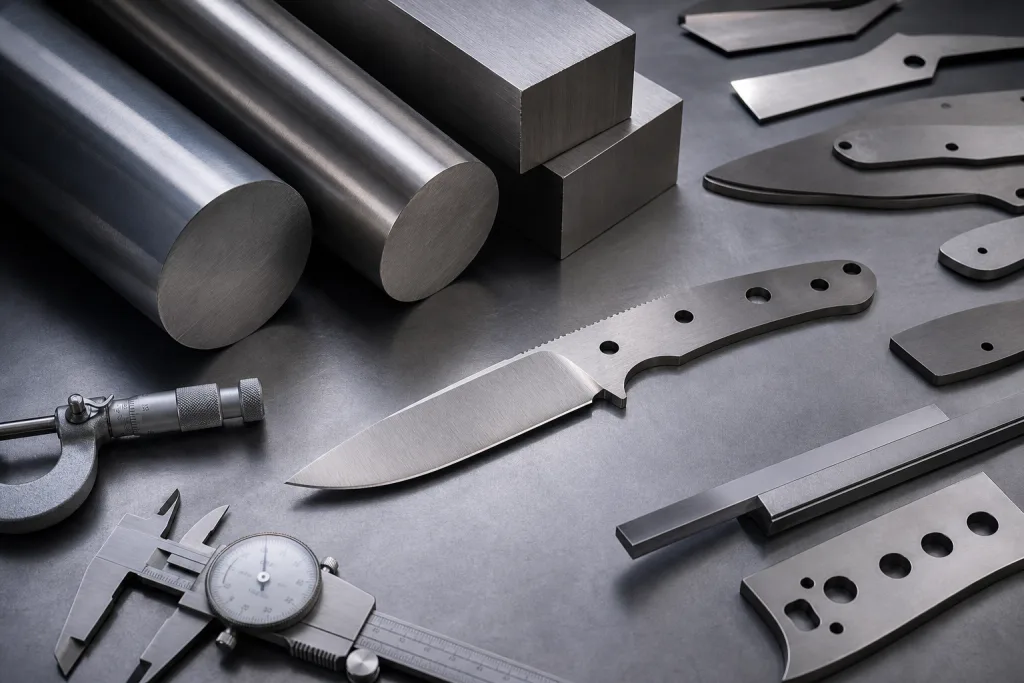
For a santoku knife PO, steel hardness is where cutting feel starts and warranty risk starts. A 56 HRC blade and a 60 HRC blade do not leave the grinding line with the same behavior, even if both cartons say “premium.” We check this on a Rockwell tester after heat treatment; one 200-piece pilot run had three blades reading 58.5 HRC against a 60±1 HRC spec, so QC pulled the sample before packing. Small number. Big result. For a kitchenware brand owner, that HRC reading changes edge life, heel chips, and whether the end user needs a 1000/3000 grit stone after six months.
At TANGFORGE in China, we see this every week in OEM and ODM santoku projects for Yangjiang and Zhejiang buyers, plus overseas importers. The wrong question is “what HRC is best?” The better question is what hardness fits the steel grade on the PO, blade thickness in mm, target retail price, and the claim rate your team can absorb. We saw this go sideways when a buyer asked for 60-62 HRC on a budget steel, then flagged edge chips after a 1,000-piece shipment; the math does not work. We run the heat-treatment sheet against the actual steel, not the catalog slogan. A matched spec and stable furnace process gives you a balanced blade for retail, a santoku knife wholesale program, or a private-label line with LFGB and FDA needs.
What hardness means in santoku knives
Hardness means the blade steel’s resistance to indentation after heat treatment, checked on a Rockwell C tester after the blade cools and the oil, scale, and shop dust are cleaned off. For a buyer, it shows how thin we can run the edge before it folds in normal prep. On a santoku, we judge that by vegetable slicing and light board work: herbs, fruit, boneless meat. Simple test. If the blade is too soft, the edge rolls after 2-3 shifts in a home kitchen test. If we push it too hard without a steady temper, QC will find micro-chips near the belly after a board-corner hit or a frozen-food abuse cut. I’ve seen a 57 HRC blade pass a chop test and still come back with a rolled heel after one weekend service run. That is the wrong place to save pennies.
The practical range for a santoku knife steel hardness specification is usually 56-60 HRC for mainstream kitchen use. We see 8 out of 10 retail programs land around 57-59 HRC because the edge holds and after-sales claims stay under control. Going to 60-62 HRC is possible on higher alloy stainless steels, but the heat-treatment window gets narrow, and your santoku knife manufacturer must control quench time and tempering temperature tightly. We run furnace charts by batch. No guessing. On the grinding line, a 1 mm grind change can move the feel more than the brochure copy. In Yangjiang high-volume kitchen knife lines, the gap between a stable 58 HRC and an uneven 56-60 HRC batch can decide whether you pass incoming inspection under AQL 2.5.
If you are buying from a santoku knife supplier, “Is it hard?” is the wrong question to ask. Ask what steel was used, which tempering cycle was run, and where the Rockwell C readings were taken on the blade, such as 20 mm behind the tip and near the heel. Most commercial knife sourcing uses Rockwell C as the reference, but the number only matters if the process repeats. We’ve seen this go sideways: one PO had “58±2 HRC” typed as “58-62 HRC,” and the buyer flagged chipping after QC pulled the sample from the grinding line. A factory in China can hit 58 HRC on one batch and 60 HRC on the next if furnace load, quench time, or grind stock changes by a few tenths of a mm. Your spec should control variation, not chase a headline number. If the vendor cannot show two test points and the furnace record, walk away.
Recommended HRC ranges by market
For OEM sourcing, set hardness around the end user and the steel grade, then check if the retail price can absorb scrap. A supermarket private-label santoku knife wholesale program should not carry the same spec as a premium D2 or VG10 line for specialty retail. We run the HR-150A Rockwell tester after tempering, 3 points per blade near the heel, middle, and tip, not from a steel mill brochure. Below is the sourcing table we use when a Europe or North America brand asks us to quote a custom santoku knife project.
| Target market | Typical HRC | Buyer priority | Risk if too hard |
|---|---|---|---|
| Entry retail | 56-57 HRC | Toughness and fewer returns from home kitchens | Edge dulls faster under daily board contact |
| Mainstream retail | 57-59 HRC | Daily-use balance for repeat shelf orders | Can chip if temper is poor |
| Premium stainless | 59-60 HRC | Better edge holding with cleaner cutting feel | Heat treatment window gets tighter |
| High-end alloy / Damascus | 60-62 HRC | Sharp bite with clean polish after final buffing | Chipping risk rises sharply |
If you sell into Germany, France, the UK, or the US, 57-59 HRC is the safer commercial band for most shelf programs. We had 4 buyers write “harder steel” on the PO, then reject samples after QC pulled the sample and found micro-chips from cutting on a glass board. Wrong question. For a santoku knife factory, 58 HRC is often the sweet spot because it works with common steels like 3Cr13, 5Cr15MoV, 7Cr17MoV, 9Cr18MoV, and select imported stainless grades when the heat treatment is controlled.
Do not copy a hardness spec from one product line to another without checking blade geometry. Our caliper check on the grinding line sees real differences: a 2.0 mm spine and a 15-degree-per-side edge do not behave like a 2.5 mm spine with a stronger 18-degree edge. Same HRC, different result. We've seen this go sideways on mixed chef knife and santoku knife catalogs when the buyer pushed one hardness target across both SKUs.
Steel grade and hardness must match
Hardness is tied to steel chemistry. We see this mistake in about 4 out of 10 first-time santoku orders. A low-cost martensitic stainless steel can be heat-treated to a Rockwell number, but it will not cut or hold an edge like a high-carbon alloy steel just because the PO says the same HRC. Same 58 HRC, different feel. On the grinding line, we set a 0.35 mm edge shoulder and final polishing strips the burr, yet two steels with the same Rockwell reading can still behave like two different knives. QC pulled one 58 HRC sample last month that passed hardness and still lost bite after 600 rope cuts. Wrong steel.
If you order a santoku knife from China using a common stainless like 5Cr15MoV, a target around 57-58 HRC is usually the sane bulk spec. We run this steel often, and QC checks 3 blades per lot on the Rockwell tester before packing. If you move to a better alloy, such as 9Cr18MoV or a Japanese-origin equivalent, 58-60 HRC can make sense when toughness is controlled. Powdered metallurgy and premium Damascus builds need a closer look because the core steel drives cutting performance, while cladding thickness and weld quality affect straightness, polishing loss, and cost. We once rejected 27 clad blanks before handle fitting because the core line wandered more than 1.5 mm near the heel. Your santoku knife manufacturer should quote the steel standard, not just the final HRC. The math does not work otherwise.
Ask for the steel grade, the target hardness range with tolerance, and whether the blade is through-hardened or clad with a defined core. If the supplier cannot explain how the hardness is achieved, performance will vary and traceability gets weak. A serious factory in Yangjiang or Zhejiang should be able to tell you the furnace cycle, tempering temperature, and whether cryogenic treatment was used. On one OEM job, the buyer flagged a PO typo showing 60-62 HRC for 5Cr15MoV, and we pushed it back before tooling because that spec would have raised tip breakage risk. The tip check was simple: 10 blades, light flex test, 2 showed micro-chipping under the loupe. We ship that kind of control every week. It is normal work.
Buyer rule: do not approve a 60 HRC spec on a steel that is better suited to 57-58 HRC just because the sales sample feels sharp out of the box. Initial sharpness is easy. Long-term stability is what shows up after 2,000 cuts, dishwasher abuse, and the first customer complaint. We have seen this go sideways on a 3,000-piece order where the sample sliced paper cleanly, but returns started after the first month.
Heat treatment decides real performance
Two santoku knives can share the same steel and the same HRC, then cut in a different way because the heat treatment was off. We see it on the Rockwell tester. Hardness is only the last number after blanking, controlled-oil quench, two temper cycles, press straightening, wet grinding, polishing, and final QC. One station drifts and QC finds a 0.8 mm tip warp, a soft heel near the bolster side, or an edge that moves from 15° to 18° on the same blade.
For production orders, put the heat-treatment window into the purchase order. Not a WeChat promise. A capable OEM factory should confirm the austenitizing temperature range, quench medium, tempering cycle count with hold time, and whether sub-zero or cryogenic treatment sits in the route. You do not need our furnace recipe in your marketing file, but you do need the same result from lot to lot. In China, 7 out of 10 kitchen knife factories can hit the target hardness on a sample; about 3 can hold tight batch variation across 3,000 or 8,000 pieces without cherry-picking the best test blades from the rack.
Our practical recommendation for a mid-market santoku is a hardness tolerance of ±1 HRC around the target, with sampling from each production lot. If you specify 58 HRC, approve a lot range like 57-59 HRC. That window is fair to the grinding line and still protects your brand; chasing 58.0 HRC on every blade is the wrong question to ask because the math does not work in mass production. We run batch hardness records, and QC pulled the sample after tempering before the handle shop touched it. For export orders, pair that with AQL 2.5 on critical appearance and function checks, then ask for hardness records by batch if your annual volume is above 10,000 units.
If your program includes laser logos at 20W, custom pakkawood handles where buyers flag 0.2 mm gaps, or gift packaging with a color box PO typo, do not use those items to hide weak steel treatment. Nice branding sells the first order. Heat treatment decides whether the customer still likes the knife after month six.
How to write a usable buyer spec
A usable santoku knife steel hardness specification should fit on one PO line, pass a Rockwell check, and match the blade drawing. Write it so your santoku knife supplier in China does not guess. State the steel grade, target HRC, tolerance, Rockwell test method, test position, and reject rule. We see this go sideways when a PO says only “hard blade”; QC pulled the sample at 55 HRC on the Wilson tester while the approved sample was 58 HRC. One typo on the PO can cost 12 days.
Use language like this, then copy the same wording onto the inspection sheet. Keep the same wording. The buyer should see no room for interpretation.
- Blade steel: 5Cr15MoV stainless steel
- Hardness: 57-59 HRC after final heat treatment
- Test method: Rockwell C per ASTM E18 or equivalent
- Test location: 2 points per blade, heel and mid-blade
- Sampling: AQL 2.5 for mass production lot inspection
- Condition: no visible chips after standard cutting test on paper and carrot
For a premium line, add the edge angle, such as 15 degrees per side, and state whether the blade is hollow-ground, flat-ground, or full-taper. This is not decoration. Hardness and edge geometry are one working spec. A 59 HRC blade with a 0.8 mm thick edge behind the bevel cuts like a cheap knife; a 57 HRC blade from the grinding line with cleaner taper feels better on tomato skins and cooked meat. Ask for both. The math does not work if hardness is tight but the edge drawing is loose. We’ve seen buyers fight over HRC and ignore the bevel, then complain when the knife skates on an onion.
For custom santoku knife programs, state the commercial target too: retail carton, gift set, or promotional wholesale with MOQ and packing limits. A knife built for santoku knife wholesale in 3,000 pcs needs a tougher spec and simpler finish than a premium display piece sold through independent retailers. The buyer flagged this once after the carton drop test, not the cutting test; the matte handle passed, but the gift box corner crushed at 62 cm. We ship around that problem by putting the packing spec next to the blade spec.
Testing methods buyers should request
Do not accept an HRC number unless the test method sits beside it on the report. We run Rockwell checks on a calibrated HR-150A tester, and a finished blade reading can sit 1-2 HRC away from a flat coupon from the same steel. Ask whether the reading came from finished santoku blades or coupons from the same heat-treatment lot, with the furnace batch number attached. Finished blade testing matches what your customer opens in the carton, but a thin area near the bevel can leave a poor indentation. Define the test point in the spec: 25 mm behind the tip and 8 mm above the edge. Short line. Fewer arguments. We had a buyer flag one PO because “60 HRC” was written, but no test position was printed anywhere.
For factory acceptance, I recommend a simple vendor inspection checklist:
- Verify steel grade against the incoming mill certificate, including coil or plate batch number.
- Check quench and temper records for the lot, with furnace time and temperature signed by the heat-treatment operator.
- Measure hardness on sample blades from both ends of the production run, not only the first approved sample.
- Confirm edge integrity after a standard paper cut and tomato slice test, then check for microchips under a 10x loupe.
- Record results in the quality report with batch number, date, inspector name, and tester ID.
If your program is big enough, ask for a pre-shipment inspection report with photos of the hardness tester display, not only a handwritten number. For a 3,000 pcs santoku order, we usually pull samples from the start and end of the grinding line before packing, then QC logs the tester ID on the sheet. Serious suppliers in Yangjiang and Zhejiang know this drill. If a santoku knife manufacturer cannot provide batch traceability, you may still get one nice counter sample, but the math does not work for repeated containers. We have seen this go sideways when the buyer flagged 58 HRC blades sold as 60-62 HRC.
For import compliance into the US and EU, hardness testing is not a regulatory requirement by itself, but it belongs in your internal quality control file. Keep the HRC report together with REACH, LFGB, and FDA-related material declarations where applicable. QC pulled one shipment last year because the PO said 1.4116, the mill certificate showed X50CrMoV15, and nobody matched the naming before carton sealing. That is not a steel problem. It is a paperwork problem, and a 2 mm label mismatch can turn into a claim fast.
Cost, lead time, and quality trade-offs
Harder is not always better, and it is rarely cheaper. Asking only for “60 HRC” is the wrong question. To hold that number, the heat-treatment operator has to watch the furnace window tighter, the Rockwell tester rejects more blades, and final QC spends more time on edge checks under the 10x loupe. In a normal Yangjiang santoku run, we run MOQ around 1,000-3,000 pcs per SKU, with lead time around 35-50 days after sample approval. Push the spec into a narrow hardness band, imported alloy steel, or a pakka handle with extra polishing, and the schedule can move from 40 days to 55 days because the grinding line slows down and QC pulled the sample twice per lot instead of once.
Here is a practical sourcing snapshot for buyers:
| Spec level | Indicative FOB impact | Production risk | Buyer fit |
|---|---|---|---|
| 56-57 HRC, standard stainless | Lowest | Low | Volume retail, promotions |
| 57-59 HRC, controlled process | Moderate | Medium | Mainstream brand lines |
| 59-60 HRC, premium finish | Higher | Medium-high | Specialty retail |
| 60-62 HRC, premium alloy | Highest | High | Top-end collections |
In China, the factory quotation should show the steel grade, heat-treatment tolerance, grinding loss, inspection rate, and carton spec instead of hiding everything inside one FOB number. On one 8-inch santoku project, the buyer flagged a 1.5 mm blade thickness change after the PO had already listed 2.0 mm, and that small typo changed both grinding loss and carton weight. We checked it with a digital caliper at incoming QC. This is the wrong question to ask: “What is your lowest price?” A smarter buyer looks at the full stack. If the knife is sold under a private label in the US, a stable 58 HRC line with a clean finish and a consistent 15°-17° sharpening angle will beat a risky 61 HRC knife that chips in home kitchens.
For large programs, negotiate by annual volume, not just the first order. A santoku knife supplier can usually cut cost if you commit to repeated lots, for example 6,000 pcs split into 3 shipments instead of one 1,000 pcs trial order. Do not let volume pressure blur the hardness spec. We have seen this go sideways: the buyer saved USD 0.18 per piece, then returns came back after edge chipping. The math does not work. A cheap knife that comes back in returns costs more than a slightly higher FOB with controlled heat treatment, especially when QC already saw micro-chips on 7 samples before shipment.
Frequently asked questions
For most kitchenware brands, 57-59 HRC is the safest commercial range. At 57 HRC you get more toughness and lower chip risk; at 59 HRC you usually get better edge retention. If you go to 60 HRC or above, your santoku knife manufacturer must control heat treatment more tightly, and the blade becomes less forgiving in real use. For mass-market retail, 58 HRC is often the best balance.
Not automatically, but it depends on the steel and edge geometry. A premium stainless or alloy steel can perform well at 60 HRC if tempering is correct and the edge is not too thin. For a standard santoku knife wholesale program, 60 HRC increases chipping risk if users cut hard vegetables, frozen food, or work on glass boards. If you choose 60 HRC, require batch testing and a tighter tolerance, usually 59-60 HRC rather than a single target only.
Ask for Rockwell C testing per ASTM E18 or an equivalent method, with a defined test location and batch record. Most buyers request 2 sample blades per lot for a small program, or 5-8 sample blades for larger runs. A serious santoku knife factory in China should also keep heat-treatment logs, mill certificates, and pre-shipment inspection photos. If you need AQL 2.5, include hardness in the functional acceptance checklist.
No. Hardness is only one part of performance. A very hard blade can hold an edge longer, but it may chip if the steel chemistry, tempering, or edge angle are not right. A slightly softer blade at 57-58 HRC can feel better in daily kitchen use because it is more forgiving and easier to resharpen. For most custom santoku knife projects, the best result comes from matching hardness to the steel grade, not chasing the highest number.
Ask for the steel grade, target HRC, hardness tolerance, heat-treatment method, MOQ, lead time, and whether the factory can provide batch-level test records. If you are buying from China, also ask about compliance documents such as REACH, LFGB, or FDA material declarations where relevant. A good supplier should tell you whether the blade is 57-59 HRC, how it is tested, and what the expected delivery time is, usually around 35-50 days for standard OEM production.
Specify the right santoku hardness
Send your target market, steel preference, and price point. We will help you set a realistic HRC spec for China production, whether you need OEM, ODM, or private label.
Request a Quote