Buying santoku knives for retail looks simple until the quote sheet lands on your desk. A 165 mm blade can be 3Cr13 for a promo set, 5Cr15MoV for daily retail, AUS-10 for a sharper mid-tier line, or VG-10 when the buyer wants a stronger shelf story. Edge angle changes the math too: 13° cuts cleaner but needs tighter grinding control, while 18° gives the line more room on returns. Handle rivets, coating thickness, carton layout, and barcode rules all move landed cost. They also change shelf price and return risk. On the grinding line, a 0.3 mm tip difference is enough for QC to pull the sample, even when the showroom piece looked fine under the light box. A solid santoku knife wholesale factory gives clean pricing, real lead times, and samples made on the same jigs used for mass production.
At TANGFORGE in China, we run into the same pattern almost every week. A buyer asks for one “mid-range” santoku knife, then sell-through data points to three SKUs: an entry 3Cr13 model for promo sets, a core 5Cr15MoV model around 56-58 HRC, and a premium steel option for better edge retention. The factory in Yangjiang must say what works at your MOQ, usually 1,000 to 3,000 pcs per SKU for private label, and what does not. We’ve seen this go sideways when the buyer flagged a PO typo on handle material after 38 cartons had already been printed for pre-production packing. Comparing a santoku knife manufacturer in Yangjiang, Zhejiang, or elsewhere in China? That is the wrong question to ask. Ask who can quote steel grade, HRC band, AQL 2.5 inspection, packaging cost, and production lead time without hiding the numbers.
What a Santoku Buyer Actually Needs
Santoku looks simple on a peg hook. On the shelf, it is a tight SKU. The buyer is paying for a flatter edge that sits cleanly on the board, a small belly for short rocking cuts, and a pinch-grip handle with no sharp corner under the index finger. It also has to cut cabbage without wedging and trim fish fillets without tearing the surface. If the spine runs 2.8 mm when the PO called for 2.2 mm, the knife feels front-heavy and sticks in carrots. If the edge is ground too thin on soft steel, it rolls after 3 or 4 weeks in home kitchens. QC pulled the sample last month and found a 0.4 mm gap near the heel on 6 pieces from a 30-piece check. This is the first question to ask: where do you sell, mass retail, kitchen specialty, Amazon, or gift sets? Box design can wait.
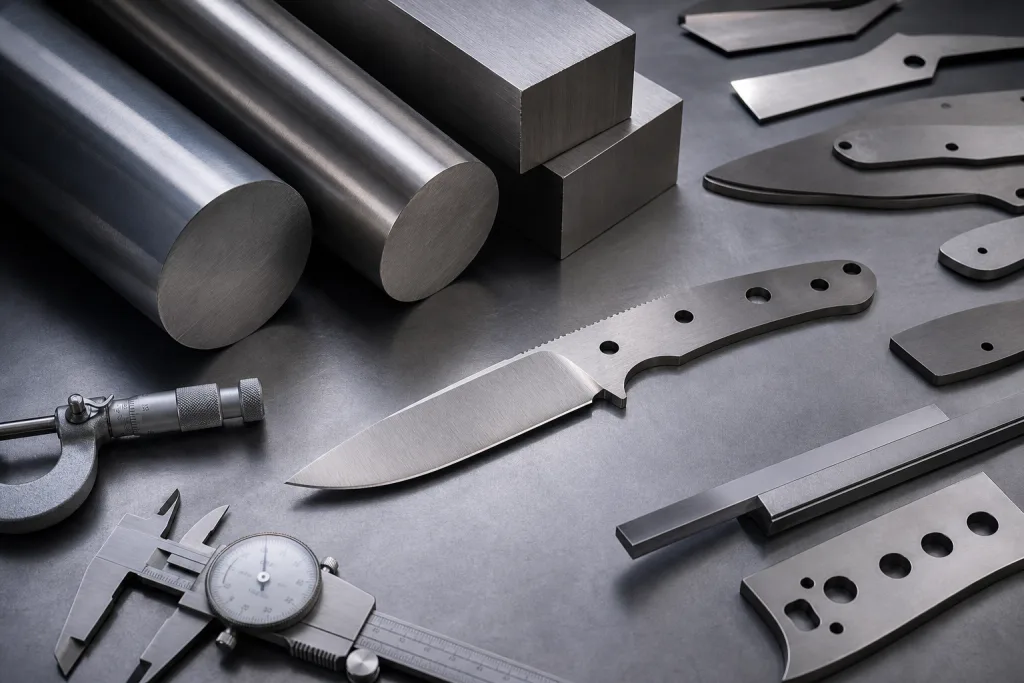
The common private label spec is 165 mm blade length, 2.0-2.5 mm spine thickness, with total weight around 140-190 g depending on handle and bolster style. For most European and North American retail programs, 3Cr13, 5Cr15MoV, 9Cr18MoV, or 1.4116 stainless steel keeps cost under control and still sharpens without drama. A custom santoku knife for premium retail may need cleaner steel, a tighter choil polish, and a neater edge finish, but the factory has to repeat it across the order, not just dress up 2 counter samples. We run HRC checks after heat treatment. The grinding line checks spine thickness with a caliper before handle assembly. Ask for blade flatness tolerance, hardness band, and edge angle before you discuss box art. We have seen this go sideways when the buyer approved a nice gift box and missed a 58 HRC target drifting to 55 HRC.
For Yangjiang and other China knife factories, the gap between a usable santoku and a return-prone one is not fancy design wording. It is process control. If your santoku knife manufacturer can hold the grind line, keep the laser logo in the same position, and maintain handle fit over 3,000 units, you have a product you can scale. One buyer flagged a 1.5 mm logo shift on the pre-shipment photos; small issue, but it showed the fixture was not locked. The math does not work if you save USD 0.08 on polishing and then take 2% returns for rough choils. We ship better when the spec sheet is boring and the inspection standard is clear.
How Factory Quotes Are Really Built
Ask a santoku knife wholesale supplier for a quote, and the first number is usually not ready for purchasing. A production-ready factory quote should show steel cost and blade processing cost, the handle material with drawing number, assembly and hand-finishing labor, packing spec, and the export term behind the price. If we see one lump sum with no steel grade, no handle drawing, and no carton size, we treat it as a placeholder. Not a buying price. In Yangjiang, we run into this every week: 5Cr15MoV sheet price moves, pakkawood handles take more belt-sander time than PP handles, and a 0.3 mm change on blade thickness can push the grinding line into another cost bucket.
For a basic OEM santoku knife, a practical FOB China range can look like this. Our costing clerk checks blade thickness, handle mold status, and MOQ before she opens the quote sheet. She also checks whether the spine is 2.0 mm or 2.5 mm, because that changes the grind time.
| Spec level | Blade steel | MOQ | FOB unit price | Lead time |
|---|---|---|---|---|
| Entry retail | 3Cr13 / 5Cr15MoV | 1,000 pcs | USD 2.80-4.50 | 35-45 days |
| Core private label | 1.4116 / 9Cr18MoV | 2,000 pcs | USD 4.80-7.20 | 40-55 days |
| Premium custom | High-carbon stainless or layered steel | 3,000 pcs | USD 7.50-12.00 | 50-70 days |
Those numbers shift fast once the buyer adds a PP gift box with color printing, an EVA insert cut to the handle profile, a hanging tab for retail display, or laser engraving on both blade faces. We had one PO last month where “single-side logo” became “double-side logo” after the sample was approved; the math doesn't work at the old price. DDP works for some smaller importers, but this is the wrong question to ask before you know the EXW or FOB baseline. A factory in Zhejiang or Yangjiang should tell you which costs are locked and which follow steel pricing. If the quotation skips sample fee policy, carton spec, and packaging damage tolerance, QC has nothing solid to check when they pull the sample carton at AQL 2.5.
Steel, HRC, and Edge Geometry
For a santoku knife wholesale program, steel is not a line item. It drives sharpening frequency, rust complaints after dishwasher misuse, and Q4 return volume for your service team. We see buyers chase 61 HRC on the quote sheet, then skip the heat-treatment control. That is the wrong question to ask. Last month QC pulled 32 pcs from a 1,200 pcs pilot run; the Rockwell tester showed 60.8 HRC, but the edge chipped after 40 cuts on a bamboo board. The math does not work. A steady 59 HRC blade that sharpens cleanly will outsell a harder knife that comes back with close-up photos of micro-chips.
For mainstream retail, the working band is usually 56-60 HRC for budget stainless and 60-62 HRC for premium stainless builds. For a santoku, we normally run 15-16 degrees per side. Push soft steel too acute and the buyer will flag edge retention within 30 days. Too thick is bad too. A 20-degree grind can pass a paper cut test at the packing table, but it drags through tomato skin and feels blunt on a demo counter. Your santoku knife manufacturer should state the cutting edge angle, the grind type with a cross-section photo, and the surface finish: satin, stonewashed, mirror, or laser-etched damascus pattern. On our grinding line, we check bevel width with a 0.01 mm caliper before the handle is riveted.
If you are comparing China options, ask for a steel comparison sheet and the test method. HRC without the test standard is weak data. A reliable santoku knife factory will reference Rockwell testing on the blade body, not only on a polished edge. For premium private label, ask for CATRA retention data or internal cutting tests with exact counts, such as 200 cardboard slices plus tomato skin checks after every 50 cuts. The lab trophy is not the point. The knife has to survive a normal kitchen, a wet sink, and a customer who uses a glass board even though the care card says not to. We have seen this go sideways when the PO says “VG-10 look” and the artwork team prints “VG-10” on the blade.
Private Label Design That Sells
Private label buyers spend 30 minutes on logo placement and 3 minutes on hand feel. The second part decides the sale. A custom santoku knife moves when it looks clean on the shelf and sits steady in a pinch grip. Handle scale shape, ferrule gap under 0.2 mm, tang exposure, and a rounded spine matter more than a fancy insert card after the customer opens the box. We’ve seen this go sideways on the grinding line: QC pulled the sample, the logo was dead center, then the spine still bit the thumb rest. Bad sample. If your channel is Amazon or marketplace-led, product photos will catch uneven satin lines, burrs near the heel, and a proud handle rivet, so lock the finish standard before mass production.
About 8 out of 10 Yangjiang factories can run laser logo, etched logo, silk-screen on the box, and custom color handle scales. For shelf impact, spec a 127 mm or 130 mm handle on a 165 mm blade for better control, or raise the blade heel by 3-5 mm for knuckle clearance. Small changes sell. For gift and culinary retail, buyers pick a 3-piece or 5-piece set because AOV is stronger and packaging cost per blade drops. We ship these with EVA trays, color boxes, or kraft sleeves. The math does not work if the buyer wants premium packaging on a low-cost cutter target price; we had one buyer push for a magnetic gift box on a USD 2.80 blade, and the carton quote killed the project. That is where a package-capable santoku knife supplier earns its margin. The buyer flagged the box sample for being 6 mm too wide. Fixed, but the margin was already gone.
- Logo options: laser engraving, acid etch, pad print
- Handle materials: PP, POM, pakkawood, G10, wood composite
- Retail formats: single box, belly band, gift set, hanging card
- Compliance: REACH, LFGB, FDA where applicable
If you need a brandable assortment, ask the factory for 2-3 handle profiles and one blade geometry family. We run this for supermarket and online sets because it keeps tooling to 1-2 handle molds and cuts sample approval from 18 days to 12 days. Check the PO carefully. Last month a buyer typed “santuko” on the artwork file, and the carton mark almost went into production before pre-press caught the typo. This is the wrong question to ask if the goal is speed; the real issue is whether the mold and artwork team can keep one spec sheet clean from sample to shipment.
Sampling, QC, and Audit Expectations
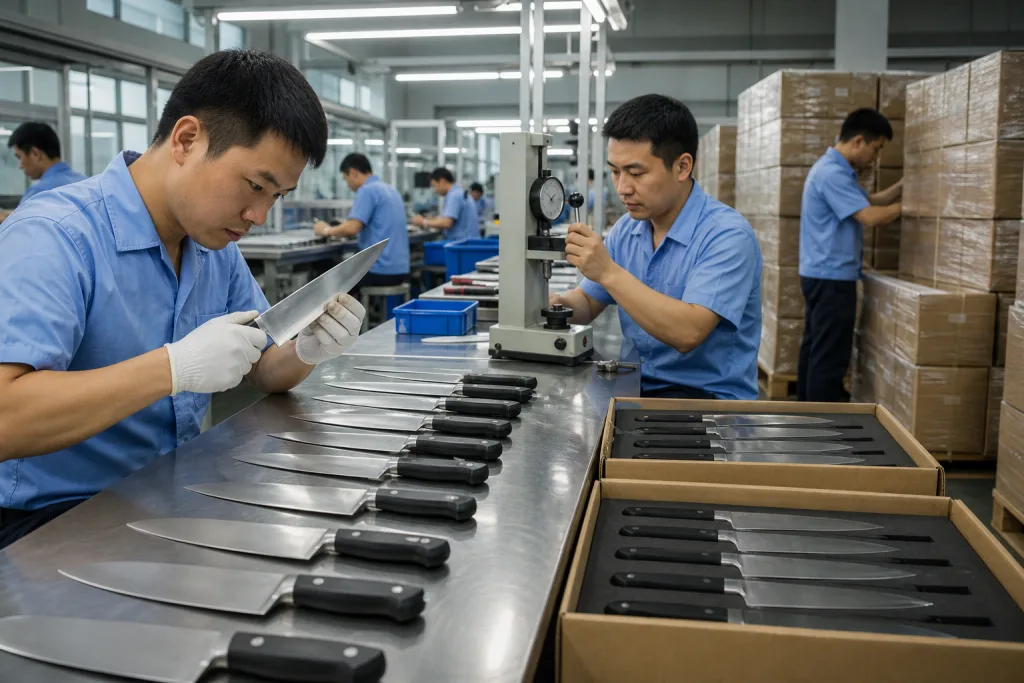
Sampling is where buyers lose 10 to 14 days. Ask for a sample built with production steel, production handle resin, and the same belt sequence we run in bulk, not a hand-polished showpiece from the sample room. For a santoku knife wholesale project, we run three checkpoints: a pre-production sample with the actual steel and handle resin, a production confirmation sample pulled after the grinding line is set, and a golden sample where both sides sign off blade finish, handle color, logo position, and box spec. QC pulled one piece last month with a 0.4 mm handle gap after a resin change. Small gap. Big argument. If the factory later changes handle resin or switches the edge angle from the approved setting, the signed sample turns into paperwork.
For mass production, ask for inspection under AQL 2.5 for major defects and 4.0 for minor defects, unless your channel needs tighter control. “Is it sharp?” is the wrong question. The checks should cover blade straightness on a flat gauge, edge sharpness consistency after the final belt, handle security under pull test, logo position within the approved tolerance, cosmetic finish under normal light, and box drop resistance with the export carton packed as shipped. We run the sharpness check after deburring, because a clean first cut means little if the edge rolls after two passes on the test card. If you sell into Europe, ask for REACH and packaging material compliance. For kitchen use in the U.S., buyers often request FDA-related material declarations for handle and food-contact components, even when the knife itself is not treated the same way as a bowl or spatula. We saw one shipment held for 6 days because the handle resin code on the PO did not match the declaration. The math doesn't work when the paperwork drifts.
A factory with real export experience in Yangjiang or Zhejiang should be comfortable with pre-shipment inspection, photo reports showing blade, handle, logo, and carton marks, plus carton count verification against the packing list. If you import at scale, ask about barcode labeling, FNSKU placement, and carton dimensions for warehouse receiving. Small labels create big problems. One buyer flagged an FNSKU placed 18 mm too close to the carton edge, and Amazon receiving rejected 42 cartons. The best santoku knife manufacturer will not push back on these questions. We ship this type of order every week, so fast answers on labels, MOQ, carton size, and inspection timing are basic factory work, not special service. A PO typo on carton height or pack count can slow the whole booking by 3 days.
Packaging and Compliance by Market
Packaging is the hidden cost in santoku knife wholesale sourcing. A plain kraft box may cost a few cents, but a four-color printed window box with an EVA tray and a separate insert card can add USD 0.40-1.20 per unit. That looks small until you place 10,000 pieces. On one 8-inch santoku PO, the buyer pushed for a 1.5 mm PET window plus a molded tray; the box cost moved more than the 3Cr13 to 5Cr15MoV blade change. The math does not work if you ignore packaging. Our packing clerk checked that PET window with a 0.01 mm digital caliper, then the buyer flagged the same line item during final PI review. A box spec can eat your margin faster than the steel upgrade.
For Europe, buyers ask for REACH files and recycling marks printed in the right icon size; carton labeling must stay clean, with no mixed SKU codes. For North America, scanable barcodes and warehouse-ready labels beat fancy graphics most of the time. Case pack still matters. If you are going through Amazon or retail distribution, ask the santoku knife supplier whether they can print FNSKU labels at factory, build bundle sets with inner boxes that do not rattle, and keep master carton sizes inside your warehouse limits. We run carton drop checks at 76 cm, and QC pulled the sample last month because the FNSKU was 2 mm too close to the carton seam. One wrong carton count can trigger chargebacks that cost more than the knife itself.
The practical packaging rule is simple: decide the retail shelf story first, then build the box around it. A knife in a rigid gift box sends a different signal than a hang card on a peg hook. Ask “what box looks premium?” and you are asking the wrong question; ask how many pieces fit per 40-foot container after the tray thickness, sleeve height, silica gel pack, and 5-layer master carton are locked. We have seen this go sideways when a buyer approved a deep tray from the showroom sample, then lost 11 cartons per pallet in loading. One PO even had a typo on the carton count, and that blew up the loading plan. In China, experienced factories balance retail appeal with container loading efficiency because we ship mixed santoku SKUs every week. That matters if your importer model depends on 20-foot or 40-foot container economics, and it matters more if you are sourcing from Yangjiang for 3 or 4 SKUs at once.
How to Compare Factory Offers Cleanly
Compare 3 quotes line by line, not by unit price alone. Cheap often hides trouble. We saw a USD 0.08 lower santoku quote come back with 0.5 mm thinner color boxes, 52-54 HRC steel instead of the agreed band, and an AQL standard that allowed handle gaps over 0.3 mm. QC pulled the sample with a digital caliper and the Rockwell tester before bulk packing. Build one comparison sheet and make every santoku knife manufacturer fill the same fields. This is the wrong question to ask: “Who is cheapest?” Ask who is quoting the same knife, the same packing spec, and the same inspection level.
| Comparison field | What to ask | Why it matters |
|---|---|---|
| Blade steel | Exact grade, hardness band, and HRC test method | Sets edge retention and corrosion resistance |
| MOQ | Per SKU and per color | Affects launch cash and SKU risk |
| Lead time | Sample approval date, PP sample date, bulk ready date, plus buffer days | Protects your launch date |
| QC standard | AQL level, defect definition, and photo examples | Reduces returns and disputes |
| Packing | Retail box spec, master carton strength, barcode file, and drop-test requirement | Controls logistics and sell-in readiness |
Ask whether the quote is EXW pickup, FOB port, or DDP door delivery, because the real cost changes fast. We ship FOB from Shenzhen or Nansha on most mixed kitchen knife orders, and a buyer once flagged a PO typo where “FOB Ningbo” changed the forwarder plan from 12 days to 18 days after routing changed. A higher FOB from a steadier Yangjiang factory can still land lower than a cheap offer with weak cartons that fail a 60 cm drop test, rivets showing red rust after salt-spray, and 3% rejects pulled by QC. If the supplier can show stable monthly output, say 60,000-120,000 units per month across 4 kitchen knife lines, take that more seriously than a polished catalog. We run the grinding line every day, and the math does not work if the factory cannot keep output steady. In wholesale buying, consistency beats drama.
Frequently asked questions
For most private label programs, 1,000 to 3,000 pcs per SKU is realistic. A basic stainless santoku with standard handle and box can sometimes start at 1,000 pcs, while a premium custom santoku knife with special handle material, laser pattern, or gift packaging usually needs 3,000 pcs. If you want multiple colors, many factories in Yangjiang will count each color as a separate SKU. Ask whether the MOQ is based on blade style, handle color, or total order volume across the program.
For mainstream retail, 56-60 HRC is the practical band for standard stainless steels. If you are sourcing a more premium santoku knife manufacturer spec, 60-62 HRC can work if the heat treatment is stable and the edge geometry is controlled. Do not chase HRC alone. A 61 HRC blade with poor temper control can chip more than a 58 HRC blade made well. Ask for the test method and sample consistency across the first 10-20 pieces.
A basic factory-direct santoku knife wholesale order can start around USD 2.80-4.50 FOB China for entry-level specs. Core private label models often land at USD 4.80-7.20, and premium custom builds can reach USD 7.50-12.00 or more, depending on steel, handle, finish, and packaging. The quote should clearly separate the knife from the box, because a rigid gift box can add USD 0.40-1.20 per unit by itself.
Ask for AQL 2.5 for major defects and 4.0 for minor defects, plus a golden sample signed before bulk production. The inspection should cover blade straightness, sharpness, logo placement, handle fit, finish, and packaging count. If you sell in Europe, request REACH-related material declarations. For North America, confirm carton labeling, barcode accuracy, and if needed FNSKU placement. A good santoku knife supplier will provide photo reports and carton counts without hesitation.
If you already have an importer or freight workflow, FOB is usually easier to compare because you see the factory price clearly. DDP can help smaller buyers who want one landed number, but it often hides freight and clearance assumptions. For a serious private label program from China, I recommend requesting both. That way you can see the factory’s true price and the delivered cost into your warehouse. A factory in Yangjiang or Zhejiang should be able to quote both without confusion.
Get a factory quote that matches reality
Send your target steel, blade length, packaging, and annual volume. We will quote a production-ready santoku knife wholesale program from China, not a guess.
Request a Quote