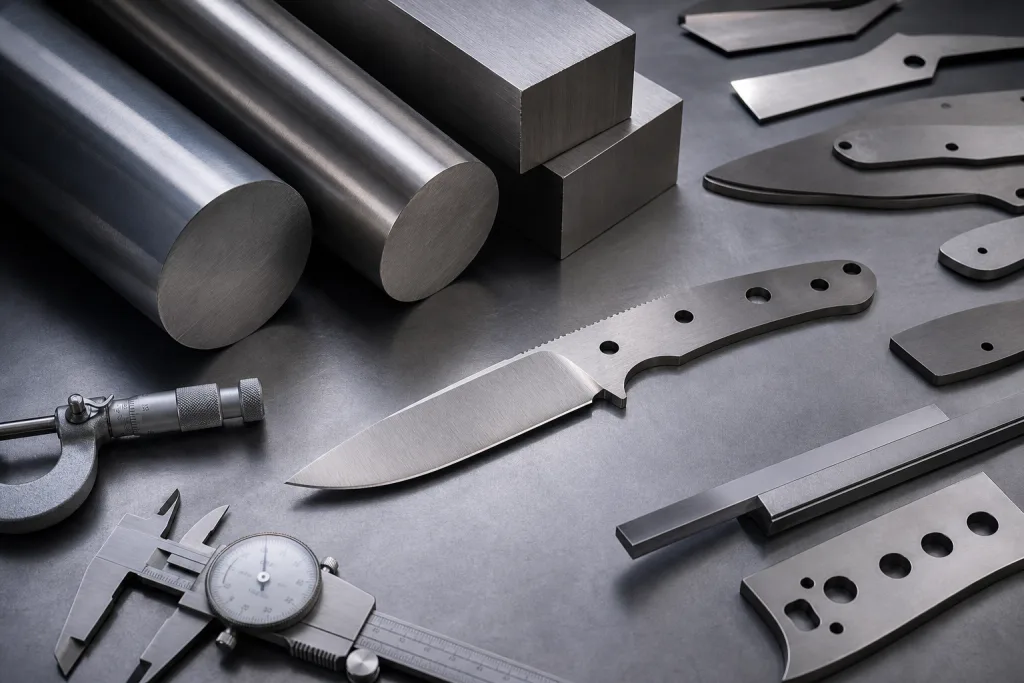
Stainless handle knives look clean on a product page. On the grinding line, they are less forgiving. The handle has to carry structure and surface finish, then survive packing without rub marks. We’ve had QC pull 20 pcs from a 500 pcs pre-shipment sample set because a 0.3 mm step at the spine transition felt sharp by thumb check; one weak spot weld or handle scratch is enough to turn a retail-ready knife into a chargeback claim.
As a stainless handle knife factory China buyers work with from Yangjiang, China, we see the same sourcing mistake in about 7 out of 10 new RFQs: the buyer locks blade steel and logo first, then writes the handle as “stainless steel, satin finish.” That spec is too thin. We need target weight, wall thickness in mm, HRC, balance point, finish standard, MOQ, packing method and AQL limits before the PO is cut; last month one buyer flagged a 12 g weight gap only after samples shipped, and the math doesn’t work once cartons are already booked.
Where stainless handles make commercial sense
A stainless handle knife is not the cheapest build on our costing sheet. If the buyer’s only target is the lowest FOB, PP or ABS usually beats it by USD 0.18-0.35 per piece on a 5 inch utility knife. Stainless handles make sense when the shelf needs a clean, modern, dishwasher-safe look, and when the knife must look tough through a retail blister, gift box window, or Amazon main image. QC sees this early: after mirror polishing with a sisal wheel and green compound, one hairline scratch across the handle can make the whole set look second grade.
For importers, the stronger orders we run are steak knife sets, entry-to-mid chef knife sets, utility knives, carving sets, cheese knives, BBQ tools, and promotional kitchen gift sets with 1,000-3,000 set MOQ. A one-piece or welded stainless handle gives the sales team a simple hygiene claim: no wood swelling, no exposed rivets, no color fade after dishwashing. That claim sells in Europe and North America, mostly for kitchenware distributors and private-label home brands. The buyer flagged this on a German PO last year: “stainess handle” was typed wrong, but the real issue was that every carton photo had to show the seamless weld line hidden after polishing.
The weak point is weight. Ask only “hollow or solid?” and you are asking the wrong question. Some buyers push for a fully hollow handle to shave cost, then reject the counter sample because it feels like a toy. Others ask for a thick solid handle, then the math doesn’t work once freight and wrist fatigue show up. For most 8 inch chef knives, a finished unit weight around 180-230 g is acceptable. For steak knives, 70-100 g normally feels better than 45 g ultra-light pieces. On the grinding line, QC pulled a 62 g steak knife sample and the buyer’s first comment was not about sharpness; it was “too empty in hand.”
At TANGFORGE in Yangjiang, China, our monthly knife output across kitchen, outdoor and OEM projects is about 300,000 units, but stainless handle projects need tighter line control than resin handle projects. Polishing and packing decide the order as much as heat treatment does. We’ve seen this go sideways: blades passed hardness at 54 HRC, yet 9 handles in a 200-piece pre-shipment check had buffing haze near the butt end. Treat the handle as a controlled component with its own finish standard, not as a styling note added after the blade spec.
Buyer specs that prevent vague quotations
Ask 3 factories for “custom stainless handle knife” pricing without a tight spec sheet and you will get 3 quotes for 3 different knives. The low quote often hides 1.5 mm blade stock instead of 2.0 mm, 3Cr13 instead of 5Cr15MoV, a lighter hollow handle, single-wall carton packing, and loose cosmetic sorting. QC pulled one pre-production sample last month that looked clean in the photo, but the caliper showed the spine was 0.4 mm under the buyer’s drawing. We’ve seen this go sideways.
Your RFQ should lock the commercial and technical points before the factory opens costing. For blade steel, common options include 3Cr13, 420J2, 5Cr15MoV, 1.4116 and 7Cr17MoV. For mass retail stainless handle kitchen knives, 3Cr13 at 52-54 HRC fits entry price points; 5Cr15MoV or 1.4116 at 56-58 HRC holds the edge better and still sharpens on a normal whetstone. We run HRC checks on the Rockwell tester after heat treatment, not after the buyer has already approved the carton artwork.
For the handle, state whether you need hollow stainless, stamped shell, welded tube, cast stainless, or one-piece forged construction. These do not cost the same. A hollow welded handle can look sharp at 1,200 pcs MOQ, but the welding jig, sealing paste, and polishing wheel decide whether water gets trapped inside. A one-piece design feels cleaner and survives heavier use; the math changes because tooling cost and grinding line time both climb, often pushing MOQ toward 3,000 pcs.
- Blade: steel grade, spine thickness in mm, length tolerance, grind type, edge angle, target HRC, plus the inspection tool to be used on the line.
- Handle: stainless grade, wall thickness, welding method, surface finish, target weight, balance point, and acceptable gap size after polishing.
- Logo: laser mark depth, position from bolster or heel in mm, color contrast, and whether the logo must pass 3M tape test.
- Packaging: sleeve, blister, color box, PET tray, gift box, FNSKU label, carton drop requirement, with carton size and gross weight locked before PO release.
- Compliance: LFGB, FDA food-contact documentation, REACH statement, BSCI or ISO 9001 if required by your account, with report holder name checked against the importer record.
A solid stainless handle knife OEM quote should answer these lines one by one. If the quotation says only “SS handle, good quality,” you do not have a buying basis yet. One buyer flagged a PO typo where “420J2” became “420”; that small line changed the factory’s costing by 6% and delayed approval by 12 days.
MOQ and price bands to expect
Stainless handle knife MOQ is driven more by tooling, handle finish, packaging, and inspection standard than by the blade itself. We run open-mold steak knives from 1,000 pcs per SKU if the 2D drawing matches our existing die and the buyer accepts our standard inner box. A custom stainless handle knife with new tooling, laser logo, private-label gift box, and a brushed No.4 handle finish usually needs 2,000-3,000 pcs per SKU. For a full 5-piece block set, the factory often quotes MOQ by set, not by each knife, because the tray, block slot width, and master carton must be checked together with a caliper.
Use these FOB China ranges for early costing. Not final offers. Steel price, exchange rate, carton CBM, and handle scratch rejection all change the number; last month QC pulled 37 pcs from a 1,000 pcs steak knife lot because the mirror polish showed hairline marks under the inspection lamp. The table helps you kill fantasy quotes before they burn 60 days in sampling, PO edits, and freight re-checks.
| Product type | Typical MOQ | FOB price band | Normal lead time |
|---|---|---|---|
| Stainless handle steak knife | 1,000-3,000 pcs | US$0.85-1.80/pc | 35-50 days |
| 8 inch chef knife, hollow handle | 1,000-2,000 pcs | US$2.20-5.50/pc | 45-60 days |
| 3-piece kitchen knife set | 1,000 sets | US$6.50-15.00/set | 50-65 days |
| Custom one-piece stainless design | 2,000-5,000 pcs | US$5.00-12.00/pc | 60-90 days |
Be careful with “500 pcs accepted” on stainless handle knife MOQ. Sometimes it is real for stock models sitting in the warehouse. More often, the factory will batch your order with another buyer, use existing packaging, or avoid making the custom grinding fixture. Fine for a market test. Wrong for a launch. We have seen this go sideways when the second order came back 18 days later than planned because the grinding line had to wait for a shared handle die.
DDP pricing needs a hard look. Knives get carrier restrictions, anti-dumping document questions, and extra inspection attention compared with ordinary kitchenware; one buyer flagged this after DHL asked for blade-use clarification on a mixed carton. For Europe and North America, we still see 8 out of 10 experienced importers choose FOB Yangjiang/Shenzhen or FOB China port terms, then control freight through their own forwarder. The math does not work if a low DDP quote hides weak paperwork.
Handle construction and finish risks
The handle is where stainless knife orders leak margin. We see 3 out of 10 stainless-handle complaints start there, even when the blade passes 56-58 HRC hardness and paper-cut sharpness checks. QC pulled the sample under a 600 mm LED inspection lamp and the blade looked fine, but the handle showed hairline scratches, uneven buffing, a visible weld seam, a hollow rattle, water entry, or bad balance. Small? Not for a white box, magnetic gift box, or Amazon listing with 6 close-up photos.
Common finishes include mirror polish and satin polish, plus bead blast, brushed grain, or PVD coating when the buyer wants a stronger shelf look. Mirror polish sells well in photos, but the grinding line knows it shows every tray rub after one pass through the cotton buffing wheel. Satin polish hides light marks better, as long as the grain direction stays consistent from heel to butt. Bead blast looks clean, but fingerprint marks and rust spots depend on passivation and cleaning after blasting; we check this with a 24-hour salt-spray sample, not a quick glance. PVD black or champagne looks sharp, but the MOQ often moves from 1,000 pcs to 3,000 pcs, and the scratch test must happen before bulk production.
For hollow handles, ask how the handle is sealed. Water trapped inside the handle becomes a dishwasher complaint fast; we have seen buyers flag it after 2 wash cycles, not after months. The welding points matter too. Poor welds can crack under torsion on chef knives and cleavers, so we run torque testing and handle pull testing during pre-production validation. Final inspection alone is the wrong place to catch this. By then, the cartons are taped and the math does not work.
Balance is a practical buying spec, not a design detail. A stainless handle can make the knife handle-heavy, and the buyer notices it as soon as the 8 inch chef knife leaves the sample room. For that size, most importers ask for the balance point within 10-20 mm of the bolster or blade-handle junction; we measure it on a simple balance jig during sample approval. Budget items can accept wider variation. For a chef knife aimed at serious home cooks, control it in the spec sheet and make QC record the mm result.
Packaging has to protect the handle finish. PET trays and paper sleeves need rub testing, and inner cards need enough clearance so the handle does not scrape during sea freight. We once opened a Chicago return sample where the knife left Yangjiang clean, then arrived with handle scratches because the blade and handle moved inside the box for 30 days. Add a 3 mm tighter tray cavity or a soft PE sleeve. Cheap fix, fewer claims.
QC checks importers should require
QC for stainless handle knives starts before mass production. Approve one pre-production sample with signed blade length, handle thickness in mm, unit weight on a digital scale, packaging dieline, photos and finish reference. We keep one tagged golden sample beside the grinding line; the buyer keeps one too. Video approval is the wrong shortcut unless the order is a straight repeat, same SKU, same carton, same logo file.
Write the inspection points into the PO before we cut steel. We check incoming coil or sheet grade, then heat-treatment hardness on the Rockwell tester, blade profile against the drawing, edge bite, handle welding or assembly, satin or mirror finish, logo position and carton drop result. For kitchen knives, HRC testing goes by batch. We run 3-5 pcs per heat-treatment batch, and the accepted band must sit on the PO, for example 5Cr15MoV at 56-58 HRC, not “hard enough.” We have seen a PO typo list 58-56 HRC; QC pulled the sample and the buyer fixed it before packing.
For final inspection, importers usually work to ANSI/ASQ Z1.4 with AQL 2.5 major and AQL 4.0 minor. Critical defects get zero tolerance. Put that in writing. A critical defect means a broken tip poking through the blister, loose stainless handle after a pull test, red rust found under the handle seam, unsafe burr, wrong steel declaration, wrong customer logo or missing warning label where the market requires it. The math does not work if a 3,000 pcs shipment reaches a chain store with even one safety defect.
- Major defects: loose handle after 10 kg pull test; blade bent over the agreed mm tolerance; chipped edge visible under inspection light; hardness outside the PO band; wrong packaging code; barcode that fails the handheld scanner.
- Minor defects: light polish mark under 30 cm visual check; small color variation between handles; logo shade slightly off the approved print; carton print shifted but still readable.
- Functional tests: paper cut test on A4 copy paper; tomato or sponge sharpness test; handle pull test with fixture; dishwasher simulation only when the claim appears on the label.
- Transit tests: 1.0 m carton drop test; carton compression check with loaded master carton; inner tray movement check after shaking the box by hand.
If you sell through retail chains, ask for a pre-shipment inspection report with photos grouped by defect type, not a one-line “passed.” If you sell online, add barcode scan, FNSKU placement and master carton label checks. We have seen 600 cartons held because the FNSKU sat 8 mm too close to the carton seam. Wrong labels cost more than a few polish scratches.
Compliance and market documentation
Knife compliance starts with food-contact safety, but the file cannot stop at the blade. For stainless handle kitchen knives, we ask buyers for 6 document lines before sampling: blade steel, handle steel, surface finish, packaging material, label artwork and any retailer audit request. In the EU, LFGB and REACH declarations are common requests. In the US, FDA food-contact expectations and California Proposition 65 review may appear depending on material and channel. Last month QC pulled a 3Cr13 handle sample from the polishing bench because the PO said “SS handle” but gave no grade.
On a stainless handle knife, the handle and blade usually count as food-contact or incidental food-contact surfaces. Coating, paint fill, glue, printed sleeve, plastic tray and color box ink need review if they can touch the knife or contaminate it in packing. Clean stainless is easier to document than painted plastic. Still, we need the stainless grade, mill sheet and supplier lot number, not just a photo of the handle. We run this check before mass production, while the grinding line is still setting edge angle at 15-18° per side.
BSCI, ISO 9001 and retailer audit documents sit in a different file from product safety. They do not prove the knife is sharp, safe or rust resistant. They show the management system or factory social compliance has been assessed. Some importers confuse these categories and ask for “BSCI certificate for LFGB.” This is the wrong question to ask. We have seen this go sideways at final inspection when AQL 2.5 passed for appearance, but the buyer still blocked shipment because the LFGB report was never ordered.
At TANGFORGE, based in Yangjiang, Zhejiang for export registration purposes and working inside the Yangjiang knife supply chain in China, we normally help buyers prepare specification sheets, material declarations and inspection files before shipment. For new stainless handle knife OEM projects, put this paperwork into the production calendar from day 1. If you request LFGB migration testing after goods are packed, you can lose 10-15 days and still not fix a wrong-material issue. The math does not work when 1,200 color boxes are already sealed and the lab asks for unpacked samples.
Your purchase order should name the exact market: EU, UK, US, Canada, Australia or mixed distribution. Labeling, warning text and carton marks change by market. A generic export carton is not enough for a serious distributor program. We ship mixed-market orders only after the buyer confirms each SKU label, because one typo on a PO, “Prop 65” written as “Prop 56,” can stop a US retailer booking before the container even reaches the forwarder.
How to brief a factory properly
A proper factory brief saves more money than another two cents of price fighting. Send one clean RFQ to the stainless handle knife factory China team, not 14 screenshots in a WhatsApp thread. We need the retail channel, annual forecast, first order quantity, steel grade, handle construction, surface finish, pack style, compliance market, target FOB price and carton requirement. If you ask for US$1.85 FOB on a full tang 5Cr15MoV chef knife with brushed stainless handle, the math does not work; our cost sheet will show whether the pressure sits in blade thickness, mirror polishing, gift box board or freight cube. Last month QC pulled a 180 mm sample because the buyer forgot to state 2.5 mm spine thickness, and the grinding line made it at 2.0 mm.
Photos help. Do not ask for a direct copy of another brand’s design. Use reference photos for style direction, handle feel, blade length and packaging format, then build your own custom stainless handle knife with changed geometry, logo position and shelf story. This keeps you away from IP trouble and gives the supplier space to engineer a product we can hold in bulk. We have seen this go sideways: one buyer sent a competitor blister card with the barcode still visible, and our merchandiser had to reject the PO before the sample room cut the first blank.
The clean development flow is practical: RFQ, factory feedback, 2D drawing, costed specification, prototype or pre-production sample, sample correction, deposit, bulk production, inline inspection, final inspection and shipment. For most OEM projects, plan 7-10 days for quoting and drawing, 10-20 days for sampling if tooling is not complex, and 45-60 days for bulk after approval. New tooling can add 15-30 days. We run the first drawing through caliper checks before quoting; if the handle radius is 6 mm on paper but the stamping die needs 8 mm to avoid cracking, it is cheaper to catch that before the T1 sample.
Do not hide your volume forecast. If your first order is 1,000 pcs but the annual plan is 30,000 pcs, say so. The factory can choose better tooling, fixtures and packaging. If the real plan is a one-time promotional order, say that too. Different future, different setup. For 30,000 pcs, we may build a dedicated polishing jig and order printed color boxes by the pallet; for 1,000 pcs, the MOQ and setup cost move the other way, and the buyer flagged it too late once when the PO typo showed “10,000” instead of “1,000.”
For procurement managers, “what is your best price?” is the wrong question to ask. Ask this instead: “what specification can you hold at this price, MOQ and lead time, and what defect risks should we control before mass production?” That gets a straighter answer. On stainless handle knives, we would rather discuss weld marks, handle hollow gaps, blade hardness target, logo depth and AQL 2.5 inspection points before deposit than argue after 120 cartons are packed and the final inspector finds uneven satin lines under the light box.
Frequently asked questions
For open-mold stainless handle knives, a realistic MOQ is usually 1,000-3,000 pcs per SKU. If you need custom handle tooling, PVD coating, special gift box packaging, or retailer-specific labels, expect 2,000-5,000 pcs. Some factories will accept 500 pcs for stock models, but you may have limited control over steel, finish and packaging. For a 3-piece or 5-piece set, MOQ is often calculated by set, usually 1,000 sets. If your launch is small, choose an existing mold first and spend your budget on packaging, logo control and inspection.
For entry-level retail, 3Cr13 or 420J2 at about 52-54 HRC keeps cost low and corrosion resistance acceptable, but edge retention is modest. For mid-range kitchen knives, 5Cr15MoV or 1.4116 at 56-58 HRC is a better balance of sharpness, toughness, corrosion resistance and sharpening ease. For higher-end lines, 7Cr17MoV or other upgraded steels can work, but the handle finish and packaging must also improve or the buyer will not see the value. Always write the HRC band into the PO and test by batch.
Most scratches happen during polishing, handling, packing or ocean transit. Mirror and satin stainless finishes show rub marks quickly. If the knife moves inside a PET tray or color box for 30-40 days, the handle can arrive scuffed even if it passed factory visual checks. Require gloves during final packing, protective sleeves where needed, and a carton drop test from 1.0 m. For glossy handles, approve an actual packaging sample and shake-test it before mass production. Cosmetic limits should be written into AQL 4.0 minor criteria.
It can be designed for dishwasher resistance, but do not claim it casually. The blade steel, handle sealing, welding, passivation, logo method and packaging instructions all matter. Hollow handles must be sealed well enough to avoid water ingress. Laser logos usually survive better than printed logos. For a dishwasher-safe claim, run at least 24-48 cycle internal testing or use a third-party protocol if your retailer requires it. Even then, many brands still recommend hand washing because detergent, heat and salt can reduce edge life and create staining.
A practical standard is ANSI/ASQ Z1.4 general inspection level II, AQL 2.5 for major defects and AQL 4.0 for minor defects, with zero tolerance for critical safety defects. Add product-specific checks: HRC band, blade straightness tolerance, edge chips, handle looseness, weld cracks, rust, logo position, barcode scan, carton marks and packaging movement. For a first order, add inline inspection when 20-30% of goods are finished. Final inspection alone is risky because handle scratches, wrong trays or weak welds are expensive to correct after packing.
Send your stainless handle knife RFQ
Share drawings, target price, MOQ, packaging and market requirements. Our Yangjiang engineering team will review specs and flag cost or QC risks before sampling.
Request a Quote