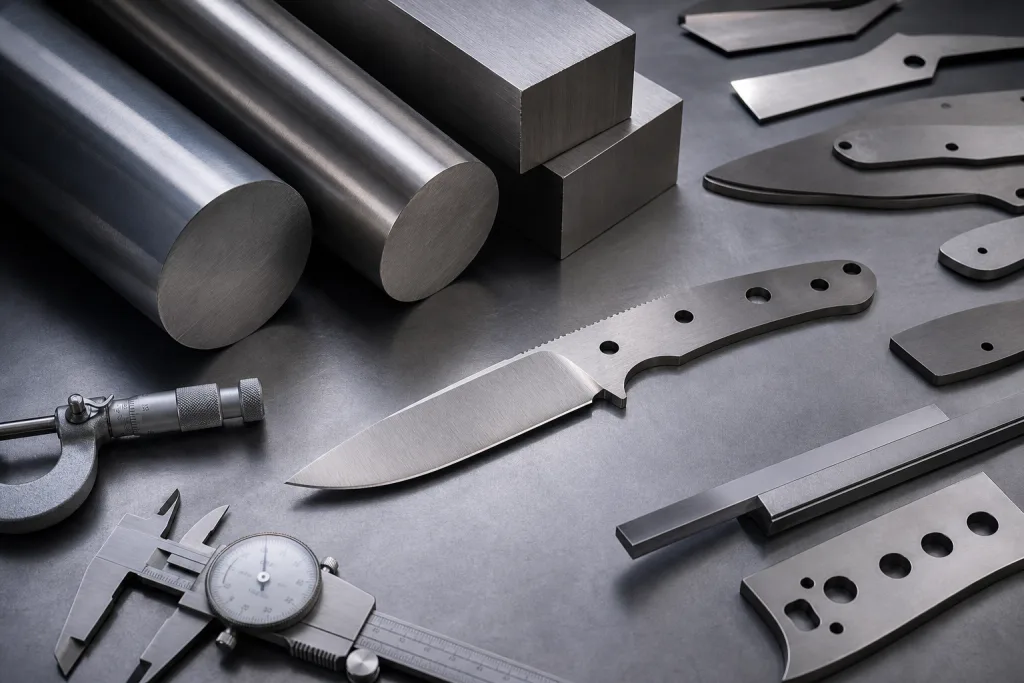
A stainless handle knife looks clean on a retail shelf. On the grinding line, it is a different job. We have to hold blade hardness within spec, choose hollow or solid handle construction, control the weld seam, grind and polish without waves, keep balance acceptable, mark the logo straight, then pack each piece so the handle does not pick up hairline scratches before QC opens the carton.
At TANGFORGE in Yangjiang, China, we see the same sourcing mistake about 8 times a month: buyers compare blade steel and FOB price only. That is the wrong question to ask. For a stainless handle knife OEM factory order, the handle structure and finishing route can change cost by USD 0.25-1.20 per piece, and it can decide whether your AQL inspection passes or fails; last month QC pulled the sample and the buyer flagged 0.3 mm weld shadow lines on the handle, not the blade steel.
Why stainless handles change the sourcing math
Stainless handle knives sell well for importers because the shelf look is clean and modern, and the same SKU can fit kitchenware, hotel supply, BBQ, or gift programs. But this is the wrong question to ask first. The real issue is that stainless removes the easiest hiding place in knife assembly. On wood, G10, or PP handles, a 0.2 mm rub mark can disappear into texture. On mirror or satin stainless, QC pulled the sample under a 6000K inspection lamp and every scratch, weld shadow, pin pit, and polishing wave showed up like a complaint waiting to happen.
A serious stainless handle knife OEM factory should talk construction before price. Is the handle hollow stainless tube welded to a tang? Is it stamped in two shells and seam welded? Is it a solid forged or cast integrated handle? Each route changes tooling cost, grinding-line time, balance point, and defect pattern. A USD 3.20 knife and a USD 5.80 knife may both be called “stainless handle,” but we would not treat them as the same product. The math doesn't work if the buyer expects forged-handle weight with hollow-handle pricing; we saw one PO typo list 85 g instead of 185 g, and the whole quotation had to be rebuilt.
For importers, the cleanest control is a written sample spec. Photos are not enough. Record blade steel, blade thickness in mm, total weight, handle wall thickness, balance point, surface finish, logo position, edge angle, hardness band, and packaging method. In Yangjiang, China, around 40 factories we know can produce stainless handle knives, but only 12 lines we would trust for steady polishing and scratch control at export AQL levels. We run calipers on the handle wall, check HRC after heat treatment, and mark the approved sample with tape at the balance point before bulk production starts.
Core specs buyers should lock first
Before you ask for a stainless handle knife MOQ or final quotation, lock a spec sheet that tells our costing team what is fixed and what can move. This is the wrong question to ask first if the drawing still says “stainless steel handle” with no wall thickness, weld position, or surface Ra target. On our quoting desk, a 5000 pcs RFQ with a 0.8 mm hollow handle and a 1.2 mm hollow handle prices out differently before the grinding line even touches the blade.
For kitchen knives, common export specifications are 3Cr13, 420J2, 5Cr15MoV, X50CrMoV15, or 1.4116 depending on your target price. Budget stainless handle knives are often hardened around HRC 52-55. Better retail chef knives usually sit at HRC 56-58, while selected 1.4116 or 5Cr15MoV programs may target HRC 57-59. Do not push cheap steel past its lane. We have seen 3Cr13 samples at HRC 57 come back from QC with edge chips after the brass rod test, and the rework math does not work on a low-price OEM order.
Handle construction needs the same attention as blade steel. A hollow stainless handle keeps weight down, but the sealing line and weld bead must be controlled; QC pulled samples last month where water entered after a 30-minute soak test. A solid integrated handle feels premium, but an 8 inch chef knife can turn handle-heavy if the blade is ground thin at the spine. We usually recommend buyers define a finished knife weight tolerance of plus or minus 8-12 g for chef knives and plus or minus 5-8 g for utility or paring knives.
- Blade thickness: 1.8-2.5 mm for most kitchen knives; heavier outdoor styles may run 3.0-4.0 mm.
- Edge angle: 15-18 degrees per side for kitchen use; 20-25 degrees per side when the buyer expects bone contact, camping use, or rough cutting.
- Handle finish: satin and brushed finishes hide small handling marks better; mirror polished, PVD coated, or electroplated handles need tighter packing control because fingerprints and pinholes show fast.
- Logo method: laser engraving is safest; deep etching or stamping needs sample approval, especially when the PO logo file has thin 0.2 mm letters.
MOQ, tooling and price reality
A stainless handle knife MOQ is usually decided at the handle station, not by the blade outline. Wrong question to ask. If we run an existing handle mold with standard satin finish, we can often open at 1,000 pcs per SKU for kitchen knives; QC checks wall thickness with a 0.01 mm caliper before polishing. A new handle profile or private integrated handle needs fresh tooling and 2-3 sample rounds, so MOQ moves to 3,000-5,000 pcs per SKU. Special PVD color and custom shell stamping add rack marks, setup scrap, and re-polishing loss, so the math changes fast.
At TANGFORGE, our normal monthly capacity is about 350,000-500,000 knives across kitchen and chef lines, plus outdoor/pocket/tactical/Damascus jobs, depending on the production mix. For stainless handle knife OEM programs, we quote sample lead time at 10-18 days and mass production at 35-55 days after deposit, artwork approval, and golden sample sign-off. Real example: one PO came in with “mirror polish” typed as “matt polish,” and the grinding line stopped until the buyer confirmed by email. Peak season before Q4 can add 10-15 days, mainly when gift boxes need EVA trays, barcode stickers, and outer carton drop-test approval.
| Project type | Typical MOQ | FOB China price band | Notes |
|---|---|---|---|
| Existing stainless handle kitchen knife | 1,000-2,000 pcs/SKU | USD 2.20-5.20 | Good for importer test orders; we use current molds and standard satin finish |
| Custom stainless handle knife with new finish | 2,000-3,000 pcs/SKU | USD 3.00-7.50 | PVD or brushed pattern trials can fail at the polishing bench and lower yield |
| Private mold integrated handle series | 3,000-5,000 pcs/SKU | USD 5.00-12.00+ | Tooling, balance tuning, and sample rounds must be budgeted before bulk order |
Be careful with quotes far below the market. We’ve seen this go sideways. The saving often comes from 0.6 mm thinner handle walls, loose buffing control, lower blade hardness, skipped 24-hour salt spray checks, or a flimsy inner tray that cracks during sea freight. QC pulled one sample where the handle seam looked fine under showroom light, then opened after the alcohol wipe test. You may not see that problem until the carton lands in Europe or North America.
QC risks unique to stainless handles
The biggest QC risk on stainless handle knives is not cutting performance. It is cosmetics. We run into this on the polishing bench: the blade passes paper-cut and edge checks, then QC pulls the sample because the handle shows a weld shadow under 600-grit brushing. Watch for visible weld lines, pinholes, black polishing paste left near the bolster, brushing that changes direction, orange peel after coating, sharp handle edges over 0.3 mm burr feel, jig dents, and hairline scratches from bulk trays before final packing.
Water ingress is the one that comes back as a claim 45 days after shipment. Hollow stainless handles need clean sealing at the rear cap and neck joint. If wash water gets inside, the knife can rattle, smell, or leak rusty liquid later. Be careful with dishwasher-safe claims; this is where we have seen orders go sideways. A normal hand-wash pass does not prove the adhesive, inner weld, and laser logo will survive machine washing. If you want to print “dishwasher safe,” ask the factory to run at least 10-20 wash cycles, then check logo fading, rust spots, handle leakage, and edge condition. For EU food-contact programs, REACH and LFGB may be requested. For the US, FDA food-contact expectations and clear material declarations are usually part of the importer file.
Balance creates quiet complaints. A stainless handle that weighs too much makes a chef knife feel dead, even when the blade is ground well. On an 8-inch chef knife, a balance point 10-25 mm in front of the bolster area is common, but your buyers may want more blade-forward weight for prep work. Define it on the spec sheet. If the PO only says “good balance,” the grinding line and assembly team will choose the easiest build, not your brand’s hand feel.
For inspection, use AQL 2.5 for major defects and AQL 4.0 for minor defects. Write the scratch rule like an inspector can use it: no scratch longer than 3 mm on the handle front face at 30 cm viewing distance under normal light. We once had a buyer flag 27 pieces because the PO said “no obvious scratches,” which is the wrong standard to put in writing. Without a clear limit, your inspector, our line QC, and the packing supervisor will each make a different call.
Samples, golden samples and pilot runs
Do not jump from a good photo to a 5,000 pcs purchase order. We’ve seen this go sideways. A stainless handle knife OEM order needs three checkpoints before bulk cutting starts: prototype sample for look and hand feel, pre-production sample made with the real steel and tooling, then a signed golden sample for QC. If the handle is an existing mold, one sample round often clears it. If the handle is custom, plan on 2-3 rounds before mass production; our sample room usually checks handle gap under 0.20 mm with a feeler gauge before the buyer sees it.
The first sample should prove shape, weight, balance, and surface direction. Simple job. The second sample must prove the real production route: blade steel from the approved coil, heat treatment at the target HRC, handle welding from the mass-production jig, logo method from the bulk setup, and packaging from the printed carton supplier. The golden sample is the physical standard kept by both buyer and factory. At TANGFORGE in Yangjiang, Zhejiang-facing export teams often use a signed golden sample plus a written inspection checklist, because photos cannot show brushing depth or whether the handle spine bites the palm after 30 seconds of grip testing.
For new designs, a 100-300 pcs pilot run is worth considering before a full container or national launch. The math doesn’t work if you save 7 days on sampling and lose 18 days sorting returns. A pilot run catches carton rub marks, tray pressure marks, barcode placement issues, and blade tip puncture during 1.2 m drop tests. QC pulled the sample last March on a stainless handle chef knife because the PET tray pressed a shiny line into the brushed handle during transit. Not a glamorous problem. It still causes chargebacks.
Ask your stainless handle knife factory China supplier to provide production photos at key stages: blade blanking, heat treatment, grinding, handle welding, polishing, logo marking, final cleaning, and packing. You do not need to micromanage the line, but you need proof that the approved process is being followed. We run photo checks by lot number and carton mark; one buyer once flagged a PO typo where “satin handle” became “sand handle,” and catching it before logo marking saved 2,400 pcs from rework.
Packaging and compliance details buyers miss
Stainless handle knives scratch fast after final polishing, so packaging is not decoration; it is a QC control point. On our grinding line, a 0.3 mm burr or one loose staple in the inner carton can mark a mirror handle before the buyer even sees the sample. For basic bulk retail orders, we run a blade tip protector plus one individual polybag or paper sleeve, then separated inner carton packing with dividers. For gift sets, the EVA, PET tray, paper pulp tray, or magnetic box needs a firm grip on the knife, or the handle will rub during vibration. QC pulled 12 packed samples last month and found 5 handles scratched because the tray cavity was 2 mm too wide.
If you sell through Amazon or retail chains with strict receiving rules, lock the packaging artwork before mass packing starts. FNSKU labels, country of origin, warning labels, barcode grade, carton marks, and master carton dimensions need checking against the PO, not just the designer’s PDF. We have seen this go sideways: the buyer approved a good-looking box, then the chef knife tip cut through the insert in a basic drop test. For knives, we normally recommend a 60-80 cm carton drop test on packed samples, then checking blade tips, handle scratches, and box deformation. Small thing, big delay. One PO even had “stainess handle” printed on the side mark, and the buyer flagged it after 3,000 boxes were finished.
Compliance depends on market and product claim. For Europe, importers ask for LFGB food-contact testing, REACH declarations, and packaging material compliance. For North America, buyers request FDA-related material statements, California Proposition 65 review where applicable, and CPSIA checks if the gift set artwork looks child-oriented. A BSCI or ISO 9001 factory profile helps vendor approval, but it does not replace product testing. This is the wrong question to ask if the buyer says, “Do you have a certificate?” Ask which market, which material, which claim. Our lab tray usually has 2 retained samples, 1 sealed sample, and the test request sheet clipped together before shipment.
DDP pricing looks convenient on a quote sheet, but knives need a closer check on HS code, duty, anti-dumping exposure, and carrier restrictions. The math does not work if a cheap DDP rate turns into a customs hold for 12 days vs 18 days because the forwarder used a vague kitchenware description. FOB Yangjiang or FOB Shenzhen/Ningbo is cleaner for experienced importers who already control freight and insurance. We ship under the buyer’s forwarder most often; the carton mark, gross weight, and CBM still get checked with a tape measure and platform scale before loading.
How to brief the factory properly
A good RFQ saves both sides 3 to 5 email rounds. Don’t ask “price for stainless handle chef knife.” Send a brief we can put straight on the costing sheet: target retail price, annual forecast, first order quantity, market, blade steel preference, HRC target, blade thickness, handle construction, surface finish, logo method, packaging, compliance documents, inspection standard, and shipment term. If you have a reference sample, send 2 physical pieces, not screenshots; our caliper reading on a 2.3 mm spine often tells us more than 8 photos.
For a custom stainless handle knife, say what can move. Maybe the handle shape is locked, but blade length can shift from 200 mm to 203 mm. Maybe the target FOB price is locked, but the color box can change from 350 gsm to 300 gsm. We can take cost out on the grinding line, welding fixture, or packing table, but only when we know the buyer’s real priority. If every line says “must match,” the math doesn’t work; the quote comes back padded or the sample goes sideways.
Procurement managers should ask who owns tooling, how many free samples are included, what happens if the first production fails AQL, and how replacement parts or credit notes are handled. Put these points in the purchase order. Verbal promises during sampling do not help much when the shipment is 12 days late and QC pulled the sample for handle gap over 0.3 mm. We’ve also seen a PO typo change “satin” to “mirror,” so confirm the finish code before deposit.
TANGFORGE was established in 2008 and now has about 240 employees in China supporting OEM and ODM knife programs. We are practical about stainless handle knife OEM: some designs deserve private tooling with a 3,000 pcs MOQ, and some should start with an existing handle for a 600 pcs market test. The right answer depends on your sales channel and margin. Launch risk is real; the buyer flagged it last year when a premium set looked good in sampling but moved too slowly at retail.
Frequently asked questions
For an existing stainless handle design, a realistic stainless handle knife MOQ is usually 1,000-2,000 pcs per SKU. If you need a custom stainless handle knife with new tooling, new PVD color, or private logo packaging, expect 3,000-5,000 pcs per SKU. Some factories may accept 500 pcs for sampling or trial orders, but the unit price will be higher and packaging choices limited. For a first order, we normally suggest fewer SKUs with deeper quantity. For example, 2,000 pcs of one chef knife is easier to control than 500 pcs each across four shapes.
For FOB China pricing, basic stainless handle kitchen knives often sit around USD 2.20-5.20 per piece. Better chef knives using 5Cr15MoV, 1.4116, improved polishing, branded packaging, and stricter QC can run USD 5.00-12.00+ per piece. Tooling is separate if the handle is private, and simple stamping or shell tooling can cost hundreds to a few thousand USD depending on complexity. Gift boxes, magnetic boxes, EVA trays, and retail sleeves can add USD 0.30-2.00 per set. Always compare quotes against the same steel, thickness, HRC, finish, packaging, and AQL standard.
There is no single best steel. For entry programs, 3Cr13 or 420J2 can work if the retail price is low and the HRC target is honest, usually around HRC 52-55. For mainstream kitchen retail, 5Cr15MoV, X50CrMoV15, or 1.4116 are better choices, usually around HRC 56-58 or HRC 57-59 depending on heat treatment. For outdoor or tactical stainless handle knives, steel choice depends on lock structure, blade thickness, and corrosion requirements. Do not over-spec steel if your handle and packaging budget cannot support the same quality level.
For stainless handle knives, inspection should start with handle cosmetics and safety. Check scratches, dents, weld marks, polishing direction, sharp handle edges, loose handles, water leakage, rust spots, logo position, and carton rub marks. Then check blade thickness, total length, weight, balance, HRC test records, edge sharpness, tip alignment, and packaging. Use AQL 2.5 for major defects and AQL 4.0 for minor cosmetic defects unless your retailer requires stricter levels. Give the inspector a golden sample and a written defect photo sheet. Without those, cosmetic judgment becomes subjective and arguments start after the goods are packed.
Sometimes, but do not print the claim casually. Stainless handle construction may resist water better than wood, but blade steel, internal welding, adhesive, logo marking, and surface coating still need testing. If you want a dishwasher-safe claim, run repeated wash testing, usually at least 10-20 cycles for development screening and more if your retailer demands it. Check for rust, handle leakage, rattling, coating change, logo fading, and edge dulling. For European programs, align the claim with LFGB and REACH documentation where needed. Many brands choose safer wording such as “hand wash recommended” to reduce warranty risk.
Send Your Stainless Handle Knife Spec
Share drawings, target price, MOQ, market, packaging, and compliance needs. Our Yangjiang team will check feasibility and quote a practical OEM route.
Request a Quote