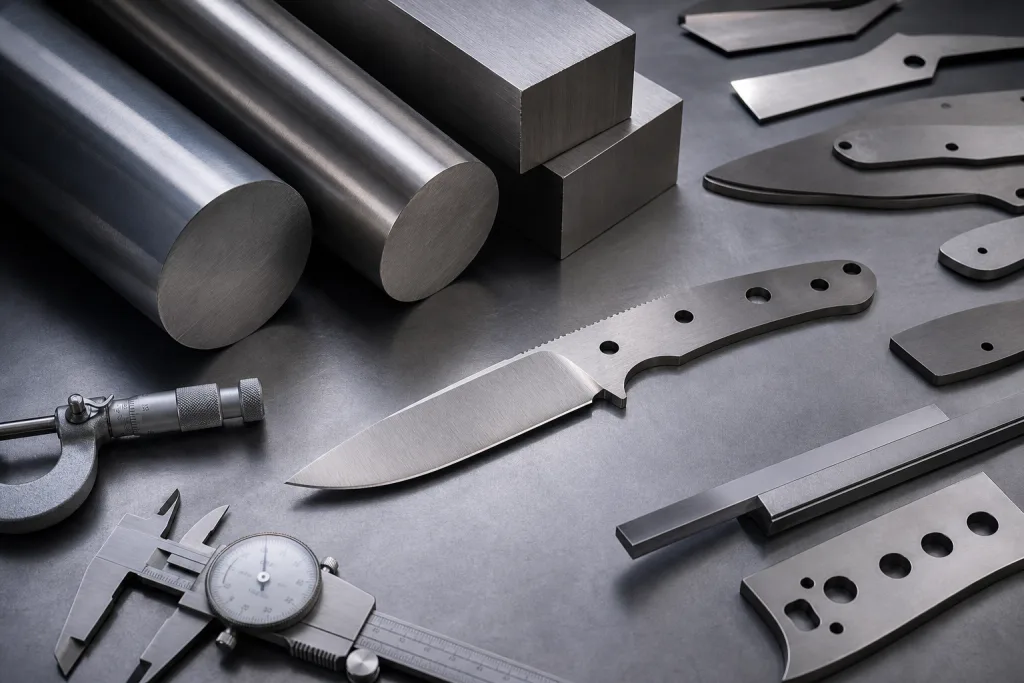
Steak knife finishing changes more than appearance. It sets the shelf read, the photo detail, and the handwork we price into FOB. On the line, a 600-grit belt leaves a different story than a mirror wheel, and scratches show up fast once the blade goes through packing and transit.
At TANGFORGE in Yangjiang, Zhejiang, China, we run steak knife programs for retail brands, hospitality suppliers, and gift sets from 1,000 to 50,000 sets. The finish has to fit the target price, handle material, carton style, and how much wear the buyer will accept after 2 or 3 meals. A polished blade feels premium, a satin finish reads clean and modern, and stonewashed hides use marks better. Pick the wrong one and the buyer flags the photos, QC pulls samples again, and the schedule slips. The math does not work any other way.
Finish Is A Positioning Decision
For steak knives, finish tells the story before the first cut. A mirror-polished blade reads formal, gift-ready, and old-school. Satin feels controlled and practical. Stonewashed says the buyer expects daily use and less worry over small marks. None is automatically better. We run the finish to match the brand promise and the target retail price, or the math does not work.
Product developers often ask which finish looks most premium. That is the wrong question. Ask where the knife will live. A boxed wedding set needs the opening moment to land clean, so polish can earn its keep there. A restaurant supply line has to survive repeated washing, plate contact, and rough staff handling. A design-led DTC brand may choose a fine satin blade because it shoots clean in a 6500K light box and does not throw glare across the photo. On one sample round, the buyer flagged the mirror blade for reflecting the softbox straight back.
In Yangjiang, Zhejiang, China, we see buyers over-spec the finish and then try to squeeze the item into a USD 19.99 retail set. That usually goes sideways. The finish has to fit the steel grade, handle build, packaging, and inspection level. A polished 3Cr13 blade with a thin hollow handle can look off from the start. A clean satin finish on 5Cr15MoV with a balanced pakkawood or G10 handle feels more honest. On the grinding line, QC pulled the sample and the blade face showed every sanding mark after two passes.
For steak knives, the finish is multiplied by four, six, eight, or twelve pieces in one box. If one blade comes out brighter, darker, or scratched, the customer spots it fast. Set consistency matters more than chasing one perfect sample. We have seen this go sideways when a PO mixed two polish settings in the same carton. QC lays the tray under the strip light and compares all 12 pieces side by side. That is the real check.
How The Three Main Finishes Compare
Polished, satin, and stonewashed finishes come from different abrasive steps, and the price gap is not just about raw material. On the shop floor, it shows up in buffing time, fixture control, rework, and how fast QC can clear a lot. A polished blade needs more wheel passes and gentler handling after the last buff; satin lives or dies on belt grit, pressure, and grain direction; stonewash depends on media load, tumble time, and edge protection. We run this every week, and the grinding line will tell you the same thing: finish choice changes the whole process.
| Finish | Typical look | Cost impact | Best use | Wear visibility |
|---|---|---|---|---|
| Polished blade | Bright, reflective, formal | +USD 0.18-0.45 per knife | Gift sets, premium dining | High for fine scratches |
| Satin finish knife | Linear, clean, controlled | Baseline to +USD 0.20 | Modern retail, hospitality | Medium if scratches cross grain |
| Stonewashed | Matte, broken-in, textured | +USD 0.10-0.30 per knife | Casual, outdoor, BBQ ranges | Low for small marks |
These numbers assume common stainless steak knife steels like 3Cr13, 420J2, 5Cr15MoV, or X50CrMoV15 equivalents, with blade thickness around 1.5-2.5 mm. Once you add Damascus cladding, forged bolsters, or tight serrations, the cost curve shifts fast; the buyer who asks for those extras and still wants the same finish price is asking the wrong question. We checked a 420J2 lot last month at 2.0 mm, and the finish time changed as soon as the blade profile got heavier.
Buyers often miss the photo problem. A polished blade mirrors the studio, the carton insert, and the photographer’s hand, so one bad light setup can make a 500-piece order look uneven online. Satin is easier to shoot because the grain gives the surface some direction, while stonewash works in lifestyle shots but can look flat on a white sweep. QC pulled the sample on a 120 mm blade coupon because the reflection band was too hot for the product page.
If the brand depends on a clean visual identity, ask for two finish panels or blade blanks before full sample tooling. That is cheaper than redoing 24 assembled samples after handles are fitted, and the math does not work any other way. We have seen this go sideways when the PO had one typo on the finish note and the buyer flagged it only after the first sample run.
Polished Blades Need Honest Expectations
Buyers ask for polished blades on premium steak knife sets because the blade flashes under retail lighting and looks sharp beside glossy gift boxes, walnut cases, and classic riveted handles. Fair request. The finish can sell the set in 3 seconds. Still, polished is not scratch-proof, and it will not make 5,000 blades come out like watch parts after the grinding line, buffing wheel, and packing bench all touch them.
We run polished steak blades through rough grinding, 600-1000 grit sanding, cotton-wheel buffing compound, and ultrasonic cleaning before QC pulls the sample. The brighter the surface, the more it shows small waves, pinholes, belt-change lines, and finger marks. On a 110-125 mm steak blade, a 6 mm hairline scratch near the tip can jump out if the rest of the blade is mirror bright. This is where we see buyers get surprised.
Define the polish level with physical limit samples, not only words like mirror, high polish, or premium polish. Those labels cost arguments later. At TANGFORGE, we prefer signing off on 1 golden sample plus 2 boundary samples: 1 acceptable and 1 rejected. For larger programs, we photograph the samples under fixed 5500K light, so our QC team in China and your receiving team in Europe or North America judge the same blade instead of debating a PDF comment.
Polished blades change the packing process too. Workers need nitrile gloves, blade sleeves, or paper separators earlier in the line, sometimes right after final wiping with alcohol. If the knife sits in a molded tray, the tray material cannot rub the blade during vibration testing. For export cartons, we often recommend a 60-80 cm drop test and a 24-hour packed sample hold before final approval. If haze or rub marks show after 1 day in the tray, the math does not work after 30 days at sea.
The polished look makes sense when your retail price can carry the extra handwork and your customer sees the knife as a formal dining piece. It is the wrong question to ask if the set is going into dishwasher baskets, steakhouse service with 120 table turns per night, or a channel where buyers expect a new-looking surface after months of use. We have seen this go sideways on repeat orders when the PO says “mirror polish” but the end user treats the knife like a utility tool.
Satin Finish Is The Safer Default
For design-led steak knife programs, satin is the safer default for about 7 out of 10 retail briefs we see. It looks planned, but it does not punish the buyer for normal shelf handling. It pairs cleanly with wood, pakkawood, ABS, PP, G10, Micarta, and stainless handles. On the grinding line, our supervisor can hold one sample under the LED bench lamp and judge the grain direction in 3 seconds, which gives production a clearer standard than mirror polish.
A satin finish knife is made with abrasive belts or wheels in a set grit range. Common production references are 240 grit, 320 grit, 400 grit, or finer decorative brushing. For steak knives, lengthwise satin from heel to tip looks cleaner than vertical brushing because it visually stretches a 110 mm blade and hides light dishwasher scratches if they follow the same line. We run most export steak blades on a 320 grit belt first, then confirm the face against the approved pre-production sample before handles go on.
The risk with satin is not the finish itself. It is drift. If belt pressure changes by one operator, one blade looks brighter. If the hand angle changes near the tip, QC sees a hook mark under the inspection lamp. If the satin line crosses a logo, the engraving can look weak. This is why logo placement should be checked after finish selection, not before. Laser engraving on satin needs more contrast testing than stonewash on 5Cr15MoV hardened to 54-56 HRC; last month QC pulled a sample where the logo passed artwork review but disappeared after the final brush.
For procurement, satin scales better than polish. On a 3,000-set order of six-piece steak knives, satin finishing cuts rework because inspectors are checking grain consistency, burrs, and logo contrast instead of chasing a mirror face with 6 tiny handling marks. At our Yangjiang, Zhejiang facility, a normal satin steak knife set moves through finishing and packing in about 12 days vs 18 days for full mirror polish during the spring and holiday export rush. The math doesn't work if the buyer wants mirror polish pricing with satin-level scrap.
If you do not have a strong reason to choose polish or stonewash, choose satin first. Then put the design time into handle ergonomics, blade profile, serration geometry with the 0.8 mm pitch you actually want, and packaging that survives a 1.2 m carton drop test. Those details drive repeat purchase more than pushing satin from 400 grit to a near-reflective finish. We have seen that spec go sideways when a buyer flags “not shiny enough” only after mass production, so lock the sample under real store lighting before the PO is signed.
Stonewashed Works For Wear Hiding
Stonewashed steak knives do not show up often in formal cutlery, but they sell well for BBQ sets, patio dining, camping kits, and gift packs for men. We tumble the blade in a ceramic-media drum or mixed stone load, usually for 20 to 40 minutes, so the face picks up a broken matte grain instead of a mirror shine. That finish takes the edge off light wear, so a fresh scratch does not jump out on day one.
This is the real selling point: stonewash resets expectations. A polished blade tells the buyer to babysit it. A stonewashed blade tells them it is a working knife, full stop. On a 10-piece sample pull, QC checks the grain against the signed master card before we ship. For grill brands, camping labels, steakhouse merch, and outdoor gift programs, that message usually lands. The buyer will ask if it still looks premium; that is the wrong question if the channel is built around use, not display.
Stonewash is not a fix for poor grinding. Deep 120-grit belt marks, a 0.2 mm burr, or an uneven bevel still print through. The tumbler can soften the look, but it cannot hide bad blade prep. It also needs edge control. If we sharpen before aggressive tumbling, the media can round the edge or leave small dents. If we sharpen after, the bright edge line may stand out hard against the darker body. We have seen this go sideways on the grinding line, so the approved sample is the only rule that matters.
Stonewash also changes how hygiene feels to the buyer. Some customers look at the texture and assume the knife will trap soil, and that pushback shows up fast in hospitality reviews. That is a fair concern, but on stainless steel a controlled stonewash still washes clean when the process is right. Our QC team pulls the sample after the rinse check, and for food service you should still confirm LFGB, FDA, or customer-specific food contact requirements across the full knife and packaging system. If the knife has coating plus stonewash, adhesion and migration checks get tighter.
For design-led brands, this is mostly about brand language. Stonewash sits well with black G10, dark walnut, burnt wood, full tang silhouettes, and kraft or black packaging. It sits poorly next to fine porcelain, polished bolsters, and wedding gift positioning. We shipped a 300-piece pilot to a grill brand with a 6 mm full tang handle, and the stonewashed blade did the heavy lifting in the box. If your brief says rugged, fire, smoke, and workshop, stonewash deserves a sample. If the line is formal and refined, satin usually closes faster.
Cost, MOQ, And Lead Time Reality
Finish choice changes the route on the grinding line, so it changes cost and lead time. I have seen buyers line up two quotes and miss the point: one factory priced a basic satin blade, the other priced hand polish. That comparison does not work. Ask the supplier to spell out the finish process, steel grade, HRC band, handle material, packing method, MOQ, and inspection level in the quotation.
For TANGFORGE steak knife programs, MOQ usually starts at 1,000 sets for private label with existing blade and handle structures. New ODM shapes or custom molds usually start at 2,000-3,000 sets, depending on handle construction. Normal lead time is 35-55 days after PP sample approval and deposit. A new custom handle mold may add 15-25 days before mass production. We run about 800,000 units a month across our knife lines, but finish-heavy jobs still need reserved polishing slots and QC time on the line.
FOB pricing for a six-piece steak knife set can swing a lot, and finish is one of the first cost drivers. On a mid-range stainless set, moving from basic satin to higher polish may add USD 1.08-2.70 per six-piece set before packaging changes. Stonewash may add USD 0.60-1.80 per set. Those are planning ranges, not fixed prices. If the math does not work at quote stage, the margin will not improve later.
DDP landed cost can make the gap look wider because higher FOB also lifts the duty base, financing cost, and sometimes insurance. Packaging matters here. A polished blade in a premium rigid box with EVA insert can look right. We have also seen a polished blade in a thin PET window tray get scratched in transit and come back as a complaint. A satin blade in a kraft drawer box usually ships cleaner and costs less.
If you are building a range, use finish hierarchy. Entry line: machine satin. Core line: finer satin with better handle. Premium line: polished or satin plus upgraded packaging. Casual outdoor line: stonewashed. That keeps the range clear and stops every SKU from fighting for the same shelf position. One typo on a PO can still change the spec, so we check finish notes twice before we run.
Quality Standards Buyers Should Lock
Finish quality belongs on the purchase order and in the approved sample pack. Leave it loose and factory QC will judge by normal production tolerance, while your brand team judges against catalog photos shot under softbox lighting. Bad place to save words. We have seen this go sideways after 18,000 pcs were packed, when re-polishing meant opening every inner box and adding 4 days on the packing line.
Start with AQL 2.5 for major defects and AQL 4.0 for minor visual defects, then tighten the limits if your retailer charges back for shelf-visible marks. Define major defects in plain language: exposed rust, cracked handle, loose rivet, blade deformation, sharp burr on spine, wrong logo, wrong finish, or visible contamination. Minor finish defects can include small scratches, slight haze, or color difference inside the signed range. On one 2024 order, the buyer flagged “wrong shine” because the PO said polished but the sealed sample was satin. The math does not work if the paperwork and sample fight each other.
For steak knife finishing, set limits with a ruler, not adjectives. Example: no scratch longer than 5 mm on the presentation side of a polished blade; no cross-grain scratch longer than 8 mm on satin; no unwashed bright patch larger than 3 mm on stonewash; no burr detectable by cotton swab test along spine, choil, or serration start. If serrated blades are used, inspect cutting function and burr removal after finishing. QC pulled the sample with a 10x loupe last month and found burrs only at the first serration tooth, exactly where the brushing wheel missed.
Hardness and corrosion checks also need numbers. About 7 out of 10 stainless steak knife projects we run sit around 52-56 HRC, while higher-grade martensitic stainless may run 56-58 HRC depending on steel and heat treatment. Do not push HRC blindly. A hard thin steak blade can chip on ceramic plates if the edge angle is too narrow; we usually check this after grinding with a Rockwell tester and a 0.01 mm caliper at the edge shoulder. For corrosion, a basic salt spray reference or internal humidity test helps, but dishwasher results change with detergent, temperature, drying cycle, and user habits.
Keep approved samples in three places: your office, the factory sample room in China, and the inspection team file. At TANGFORGE, we mark PP samples with date, version, finish code, steel, HRC target, logo method, and packaging version. Simple discipline. It prevents expensive misunderstandings, like the PO typo we saw where “SW-02 stonewash” became “S-02 satin” and the grinding line followed the wrong finish card for the first 600 pcs.
Sampling The Finish Before Production
Do not approve steak knife finishing from a render. A render is the wrong approval tool. It hides reflection, texture, and hairline scratches that show up the minute QC pulls the sample under a 6500K light box. You need physical samples under office lighting, bright retail lighting, and the lighting used for product photos. A polished blade that looks clean in a meeting room can mirror black camera equipment in a marketplace image. A stonewash that feels premium in hand can turn dull on a white background.
A sensible sampling path stays simple. First, approve the blade profile and handle grip with a rough finish if the CNC handle fit and 0.2 mm tang exposure are still being checked. Second, approve finish coupons or unfinished blade blanks in 2 or 3 surface options. Third, approve complete PP samples with final logo, handle, edge, and packaging. Fourth, approve carton packing plus vibration or drop-test results if the finish marks easily; we have seen a mirror blade pick up rub lines from one loose PET tray.
For design-led brands, ask for at least 2 sets per finish option during development. One set stays untouched as the golden sample. One set gets used. Handle it, wash it, photograph it, and abuse it a little. Cut steak on a ceramic plate, wash by hand, dry with a cotton towel, and inspect after 10 cycles. QC should check the edge shoulder, logo area, and handle rivets with the same cloth the packing team uses. This small test tells you more than a perfect studio sample.
If you are stuck between polished and satin, choose satin for the first production run unless your brand position clearly needs polish. Satin gives fewer surprises on the grinding line. We run 400 grit or 600 grit depending on the target look, and the buyer usually flags fewer random hairline marks than on mirror polish. If you are stuck between satin and stonewash, show both to your sales team and 3 key accounts. The answer comes fast because the two finishes fit different shelves.
The best finish is the one your customer still respects after dinner. A steak knife is not a display piece. It hits plates, salt, acid, dishcloths, and impatient hands. Put that use case into the design brief, including target HRC, logo depth, MOQ, and packing method. Then your factory in Yangjiang, Zhejiang, China can make the finish repeatable instead of guessing what “premium” means from a PO line with one vague word.
Frequently asked questions
A polished blade usually gives the strongest premium impression at first glance, especially in a rigid gift box or wood presentation box. But premium is not only shine. A consistent 400 grit satin finish knife with tight handle fitting can look more expensive than an uneven mirror polish. If your retail price is above USD 39.99 for a six-piece set, polish may make sense. For USD 19.99-29.99 sets, satin often protects margin and reduces complaints. Stonewashed works best when the brand story is BBQ, outdoor, or casual dining rather than formal tableware.
The steel does not become softer because it is polished, but scratches are easier to see on a polished blade. A 5 mm hairline mark may be obvious on mirror polish and barely visible on stonewash. Satin hides scratches better if the new scratch runs in the same direction as the original grain. Cross-grain marks still show. For household steak knives around 52-56 HRC, plate contact, washing, and towel drying will eventually create marks. If your customers expect a perfect surface after repeated use, avoid high polish or explain care instructions clearly.
Yes, but keep the logic clear. A common structure is entry-level machine satin, core fine satin, and premium polished blade with upgraded packaging. Stonewashed can sit in a separate BBQ or outdoor dining sub-range. Avoid mixing polished, satin, and stonewashed blades inside the same boxed set unless it is an intentional design feature; most customers will read it as inconsistency. For range development, we suggest approving one master finish standard per SKU and keeping a physical reference sample for each production lot.
AQL 2.5 for major defects and AQL 4.0 for minor visual defects is a practical starting point for retail steak knives. Define your finish defects in measurable terms before production. For example: no rust, no wrong finish, no visible burr, no presentation-side polished scratch longer than 5 mm, no satin cross-grain scratch longer than 8 mm, and no stonewash bright patch larger than 3 mm. Also define viewing distance, usually 30-40 cm under normal white light, because microscope-level inspection is not realistic for mass production.
Decide the target finish before PP samples, and ideally before final logo placement. Finish affects laser engraving contrast, handle color choice, packaging insert material, and even photography direction. For a custom ODM steak knife, TANGFORGE typically needs 7-12 days for first samples after design confirmation if no new mold is required, and 15-25 extra days if a custom handle mold is needed. If you change from satin to polish after PP approval, expect re-sampling, new cost confirmation, and possible lead time movement.
Send Your Steak Knife Finish Brief
Share target retail price, steel, handle idea, packaging, and reference finish. We will suggest a practical satin, polished, or stonewashed route for sampling.
Request a Quote