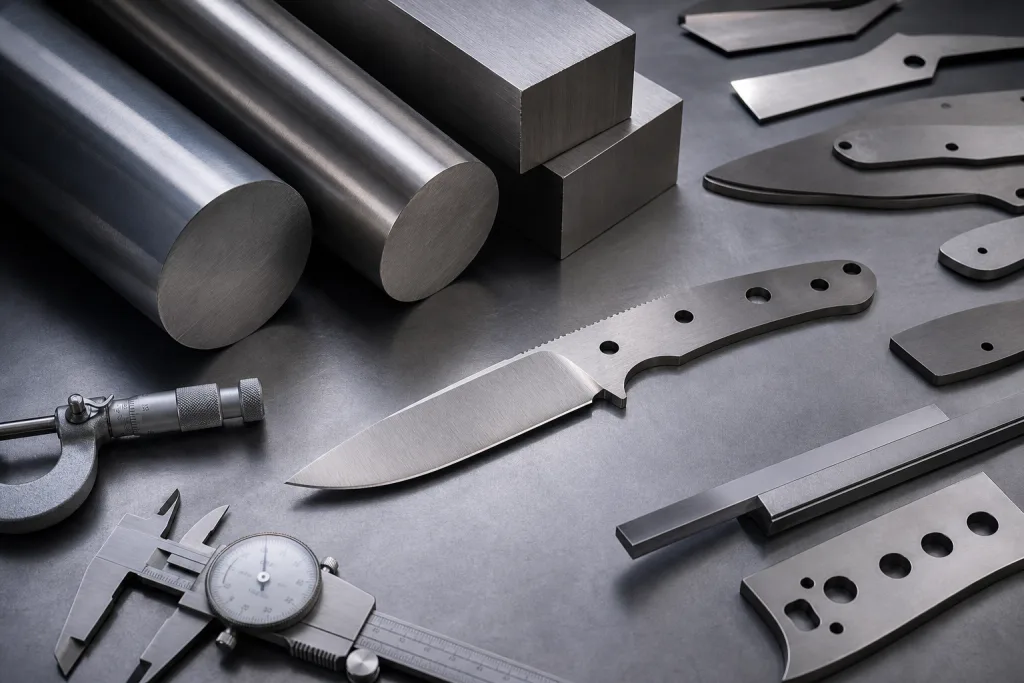
Most steak knife programs look sharp in a sample photo and feel average once the buyer picks one up. Steel grade is only part of it. We check whether the blade sits centered in the handle within 0.3 mm, whether the satin finish throws uneven light from the grinding line, and whether the laser logo still reads clean after 30 dishwasher cycles.
If you source private-label tableware from China, the spec has to sell on shelf and survive repeat production. At our Yangjiang, Zhejiang factory, our 240-person team runs steak knife sets at 180,000 to 220,000 pieces a month, but the math doesn't work if the MOQ is too low for custom handles, color boxes, and logo jigs; last month QC pulled a sample lot because the buyer's PO said “mirror polish” while the approved sample was brushed finish.
What Makes a Set Look Premium
A premium steak knife set sells through three visible cues: proportion, finish, consistency. On our grinding line, QC checks the first 12 pcs with a caliper before bulk polishing starts. If the blade is too short, too thin, or different from piece to piece, the customer reads it as cheap. For retail, keep blade length around 110-125 mm, keep the handle family identical across the set, and use the same finish on every piece. Mirror-polished blades with matte black handles can work because the contrast looks planned. Three handle shades in one carton? We’ve seen this go sideways. It looks like leftover inventory.
The fastest way to raise perceived value is to make the set feel designed, not assembled. Lock the blade profile, handle color, box layout, and logo position before asking for a quote; otherwise the sample room will build what the PO says, not what your shelf needs. A custom steak knife program does not need a complicated shape to look expensive. It needs clean transitions at the bolster, a stable silhouette on the table, and a weight target that feels deliberate in the hand, usually checked on a 0.1 g digital scale. In private-label tableware, buyers often overfocus on steel grade and underfocus on presentation. This is the wrong question to ask if the set dies in the first two seconds on shelf.
- Blade symmetry: keep the profile identical across the set, with tip height and serration start checked against one approved master sample.
- Handle alignment: no visible gaps, no offset rivets, and no glue line wider than 0.2 mm after final buffing.
- Visual rhythm: run one finish family across blade and handle, then match the tray spacing so every knife sits at the same angle.
For hospitality, use a cleaner visual style because chefs and purchasing managers care more about reorder stability than decoration. We ship 6-pc and 12-pc sets for hotels where the buyer flagged shiny handles as “too slippery” after a wet-hand trial. For retail, the box and set layout must do some selling before anyone touches the knife.
Choose the Blade Spec First
Chasing exotic steel first is the wrong question to ask. A private-label steak knife needs steel and heat treatment that match the selling price, the packaging claim, and the edge you plan to ship. For 7 out of 10 retail sets we quote, 5Cr15MoV or 1.4116 at 56-58 HRC is the sensible spec: it takes a clean satin or mirror polish, resists rust in normal table use, and holds a usable edge. We run Rockwell checks after heat treatment with a bench HRC tester, and the grinding line can feel the difference when a batch comes back soft. For an entry set, 420J2 or 3Cr13 at 52-54 HRC keeps the math under control, but do not sell it as long-edge cutlery. For a higher shelf position, 12C27 or a similar stainless gives a cleaner polish and a firmer feel in the hand.
Keep the blade geometry tight. Most steak knives we ship sit at 1.8-2.2 mm on the spine and 110-125 mm in blade length. Too thick feels clumsy. Too thin looks cheap. QC pulled one 2.5 mm sample last season because the buyer said it felt like a utility knife, not tableware. Serrated edges cut well straight from the box, which matters for a 6-piece gift set sitting in a supermarket aisle. Straight edges look closer to fine cutlery, but the end user needs to sharpen them sooner. For private-label tableware brands, a fine serration or micro-serration is usually the safer commercial call.
Ask for the actual hardness range, not the sales name printed beside the steel grade. A stable China factory should hold batch variation within about +-1 HRC; if it cannot, the steel upgrade will not save the order. We have seen this go sideways when a PO said “German steel style” but the buyer expected 1.4116, while the factory quoted 3Cr13. Put the grade, target HRC, blade thickness, and edge type on the spec sheet before artwork starts.
Handles Buyers Notice Fast
The handle is where a steak knife private label program looks finished or looks cheap. Steel grade gets too much credit. On the sample rack, a Pakkawood handle with a clean matte sand finish closes faster than a pricier blade that feels plain in the hand. For export sets, we run Pakkawood, stabilized wood, G10, stainless steel, and molded ABS for different price points. Pakkawood reads warm. G10 reads technical and tough. Stainless reads formal. ABS sits at the budget end, but a neat matte surface and a sharp profile still move units.
Balance matters more than buyers expect. A steak knife that feels handle-heavy comes across as cheap even when the finish is clean. The math does not work if the knife pulls back in the hand. QC pulled the sample on the grinding line and the complaint was the same every time: the butt felt dead. If you want a fuller feel, use a hidden tang with a weighted bolster or a full tang with visible rivets. For retail sets, two rivets are the floor, and three rivets feel better on a 120-130 mm handle. Keep handle thickness at 10-14 mm so the knife sits steady without turning bulky.
If you are building private-label tableware for more than one channel, keep the handle family the same across the line. One shape can carry a chef knife, steak knife, and kitchen knife set when the proportions are set right. The tool room likes that because one mold base and one texture insert carry more of the program, and you spend less time chasing three separate specs. That also keeps knife branding steady on the shelf. We've seen this go sideways when a buyer flagged a PO with two handle lengths for the same set and the carton art had to be reworked. The factories that get repeat orders usually design the family first, then trim each SKU around it.
Branding and Finish Options
Knife branding is not just a logo. It is the mark method, the blade finish, and where the buyer’s eye lands first. For repeat washing, we run laser engraving or electro-etching because it holds up. At QC, we pulled a sample after 20 dishwasher cycles; the pad print was already breaking at the edge. If the set is meant to read premium, keep the logo small on the blade and let the steel do the work.
Finish changes price perception fast. A mirror finish reads formal and gift-ready. A satin brush finish looks controlled and modern. Bead-blast or stonewash works for a cleaner brand line, but only if the handle and carton match that look. PVD black or gunmetal can move the set into a higher price band, and the grind shop feels that right away because masking, rack loading, and rework all slow down. On a typical steak knife program, PVD can add about USD 0.35-0.80 per piece depending on blade size, masking, and order volume.
| Finish | Look | Best Use | Commercial Note |
|---|---|---|---|
| Mirror polish | Bright, formal | Gift sets | Low tooling cost, shows fingerprints fast |
| Satin brush | Clean, modern | Retail and hospitality | Safe choice for most brands |
| Bead blast | Soft matte | Contemporary lines | Works best when the handle is also matte |
| PVD black | Dark, premium | Higher-priced sets | Needs tight process control |
If your target is private-label tableware buyers, keep the branding clear, the finish repeatable, and the claim honest. The math does not work any other way. We have seen this go sideways when a buyer flagged a PO typo on logo size and the first carton sample came back wrong. A plain, well-run sample sells better than an overworked one.
Set Sizes and Packaging
Set size is a commercial decision, not just a merchandising choice. For retail, we see 4-piece and 6-piece sets take about 70% of steak knife private-label RFQs. A 2-piece set works as a checkout add-on, while an 8-piece set fits gift programs and family channels. For hotel and restaurant buyers, the math changes. They ask for 12-piece replacement packs, bulk cartons, and easy re-order codes more than a window box. Last month QC pulled a 6-piece sample because the PO said “set/6” but the artwork file said “set of 4.” That mistake is cheap on screen and painful after printing. If you sell retail and hospitality, one package should not do both jobs.
Packaging changes perceived value faster than a blade upgrade in some price bands. A belly band with a PET tray is fine for entry programs, especially when the target FOB is tight. A rigid box with a molded insert can support a higher shelf price because the buyer can see the gift angle in 3 seconds. We run quotes where a printed sleeve may add USD 0.08-0.18 per set, a molded insert can add USD 0.15-0.35, and a rigid gift box can add USD 0.45-1.20 depending on size and print. The wrong question is “what is the cheapest box?” Ask whether the package can recover USD 1.00-2.00 at retail. On the packing table, a 1.5 mm loose insert can let the knives rattle, and the buyer flagged that sound before checking the blade finish.
For e-commerce and Amazon-style programs, the outer pack also needs correct barcode logic. If you need FNSKU labels, unit cartons, master cartons, or drop-test ready packing, say it before the sample invoice is issued. We ship different carton structures for courier and pallet orders; a 5-layer K=K master carton is not the same discussion as a thin retail shipper. The factory in China should treat packaging as part of the product. For a giftable line, use FSC paper and a clean insert with one strong visual direction. Do not cover the box with 8 claims. We have seen this go sideways when “dishwasher safe,” “German steel,” and “premium forged” were all printed before the buyer approved the final steel grade.
MOQ, QC, and Lead Times
For a custom steak knife program, we quote a realistic MOQ at 1,000 sets per SKU when the job uses our existing handle molds, current blade profile, and standard satin or mirror finish. Go below that and the math doesn't work. If the buyer asks for a new handle tool, a custom sheath, or PVD on the blade plus bolster, plan for 3,000-5,000 pieces before tooling, masking, and rack setup stop eating the margin. Sample lead time is often 10-15 days; our last walnut-handle counter sample cleared in 12 days because the logo file arrived clean as AI artwork. Mass production is usually 35-55 days after sample approval, with black PVD and gift-box packing sitting closer to the 55-day side.
Quality control should be simple and measurable. Put numbers on blade straightness, edge consistency, logo position tolerance, handle gap control, and hardness checks on each batch. QC pulled the sample last month and rejected a handle with a 0.8 mm gap at the rear rivet, so we now call out the gap limit on the inspection sheet instead of arguing later by photo. AQL 2.5 for major defects and AQL 4.0 for minor defects is a normal export standard. For Europe or North America, ask for REACH on coatings, LFGB or FDA contact-material support where relevant, and ISO 9001 process control. If the set is for retail, run a carton drop test and packaging compression test before artwork is locked; we have seen a nice box fail because the inner tray was 1.5 mm too shallow.
Our Yangjiang, Zhejiang plant uses a 240-employee line structure and typically runs 180,000 to 220,000 knives per month when the program is stable. That matters. A factory already pushing that volume has tighter habits on the grinding line, polishing wheels, and final packing tables, so finish quality is less likely to wander between the pilot run and the second PO. For a premium result, define the visual spec first, down to brushed direction, logo size in mm, and acceptable color range, then ask for a commercial quote on FOB or DDP terms. Skipping that step is the wrong question to ask on cost, because you end up paying to fix the same finish problem twice.
Frequently asked questions
For most standard steak knife private label programs, 1,000 sets per SKU is a realistic starting point if you use an existing blade shape and standard handle materials. If you want a new handle mold, special finish, or custom box insert, the workable MOQ often moves to 3,000-5,000 pieces. In China, that is the point where tooling and setup costs stop distorting the unit price. If you are testing a new brand, ask for one pilot run at 1,000 sets, then scale the second order after sell-through.
Mirror polish still reads as the most formal finish, but it is not always the best commercial choice. Satin brush often looks more modern and hides fingerprints better, which matters for open-box retail and showroom samples. If you want a higher-ticket look, PVD black or gunmetal can work, but it typically adds about USD 0.35-0.80 per piece and needs tighter process control. For private-label tableware, the best finish is the one that matches your box, handle, and price point instead of chasing a luxury look that your packaging cannot support.
If your customer wants immediate performance with low maintenance, serrated or micro-serrated is usually the safer choice. It cuts well straight out of the box and hides wear longer. Straight-edge steak knives feel more refined and are easier to sharpen, but they need more care from the end user. For most retail lines, a fine serration on 110-125 mm blades and 56-58 HRC stainless steel gives the best balance. If you are building a premium gift set, straight edge can work, but only if your brand story supports more care and higher kitchen skill.
For repeated washing and daily use, laser engraving or electro-etching is usually the best option. Both are permanent and look clean on stainless blades. Pad printing is cheaper and can be useful for samples or promotional sets, but it is weaker under dishwasher exposure and strong detergents. If you want the logo to stay visible after 30-50 wash cycles, keep it small, place it on the blade flat, and avoid busy artwork. Good knife branding is simple. A logo that survives use is worth more than one that only looks good in a photo.
For Europe and North America, ask for REACH support for coatings and inks, LFGB or FDA material support where needed, and ISO 9001 process control. If the factory is exporting at scale from Yangjiang, Zhejiang or elsewhere in China, it should also know how to document carton dimensions, barcodes, and traceability. For retail orders, I would also ask for AQL 2.5 inspection on major defects, hardness checks, and packaging drop tests. If you are importing under FOB or DDP, confirm who owns customs paperwork, labeling, and carton marks before you approve production.
Start Your Steak Knife Quote Today
Send your target set size, finish, logo method, and box style. We will turn it into a clear OEM or private-label spec with practical pricing and lead times.
Request a Quote