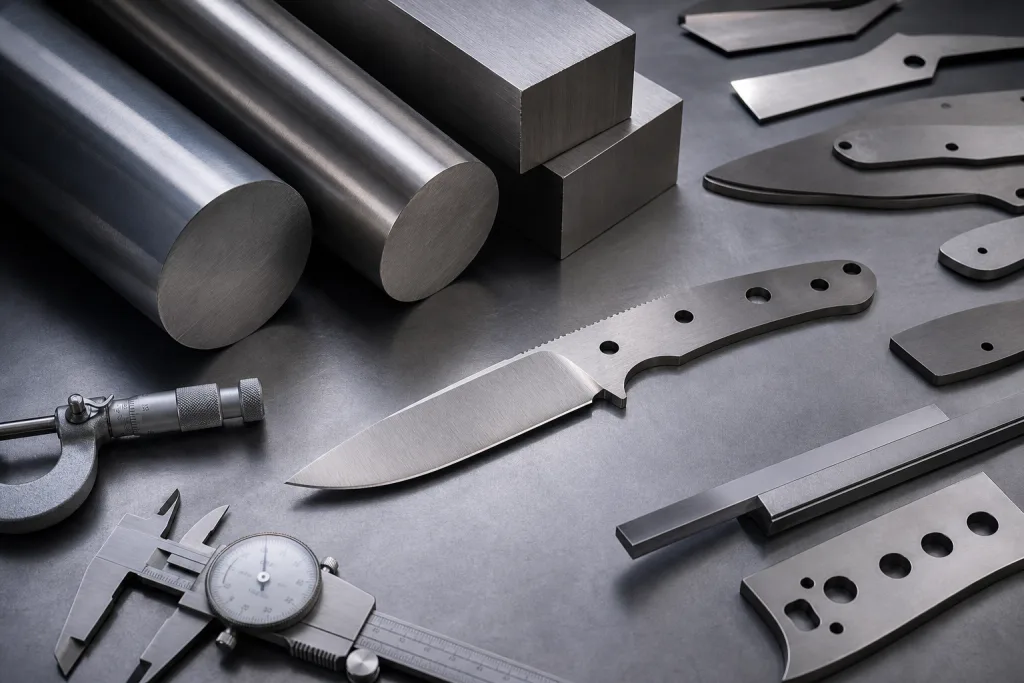
A bushcraft knife is not shelf decoration. Your customer will baton 80 mm dry hardwood, scrape a ferro rod, make feather sticks, cut sausage on a camp board, then blame your brand if the tip snaps or the black coating flakes by Sunday night. For bushcraft knife sourcing, asking for the "hardest steel" is the wrong question. We check blade grind, tang build, heat treatment, handle stock, and sheath lock against the jobs the knife must survive. Small things matter. Last month the grinding line rejected 23 blades because the tip thickness ran 0.2 mm under our drawing after flat grinding.
At TANGFORGE in China, our Yangjiang and Zhejiang supply chain supports outdoor brands buying survival knife OEM production with controlled MOQ, repeatable HRC, and export packaging that passes warehouse handling. For a new fixed-blade line, we usually start from 600 pcs per model, 45-60 days after sample approval, with inspection to AQL 2.5 for major defects. We run HRC checks before coating, not after cartons are taped. On one recent order, QC pulled the sample at 58 HRC with a 0.6 mm edge before coating; the buyer flagged sheath rattle, so we tightened the Kydex mouth before bulk packing.
Start With The Abuse Case
The first sourcing question is not “which steel is best?” That is the wrong question to ask. Ask what the customer does on day 30, after the black coating is scratched, the sheath smells damp, and the knife has been left wet for 72 hours. A Scandinavian woodcraft knife needs a clean carving grind; a survival knife buried in a roadside emergency kit needs margin against abuse. A hunting camp knife needs its own brief, usually more belly and easier wash-down. We’ve seen this go sideways. The buyer wrote “tough outdoor knife,” QC pulled the sample after batoning pine on a 6 kg test block, and the 0.35 mm edge started rolling because nobody wrote impact use on the sample sheet.
For outdoor brand owners, we run the sample sheet in three working grades. Light bushcraft covers feather sticks and food prep, with cord cutting and ferro rod scraping written as separate tests; blade length can be 90-110 mm, spine thickness 2.5-3.2 mm, and stainless steel makes sense when 1-star Amazon reviews keep saying “rust spots.” General bushcraft means carving and fire prep, with shelter notches and occasional batoning added to QC; blade length is often 105-125 mm, spine 3.2-4.0 mm, full tang, with heat treatment set for toughness instead of kitchen-knife bite. Survival use assumes impact, prying risk, wet storage, glove use, and rough users who will not read the care card; blade length usually sits at 120-150 mm, spine 4.0-5.0 mm, and the handle must keep grip after mud or cold water. On the grinding line, a 4.5 mm spine and a 0.6 mm pre-sharpening edge feel slow under the digital caliper. Still cheaper than replacing 800 cracked blades after launch.
At our China factory, we ask buyers to sign a written product brief before CAD starts. No brief, no clean sample. It should state target retail price, intended market, blade length, steel, HRC band, coating, sheath type, packaging, and compliance needs such as REACH for Europe or FDA/LFGB if food contact claims appear on the packaging. A procurement manager does not need to be a metallurgist. The abuse case just needs plain words: “batoning 70 mm dry pine,” “stored wet in sheath,” or “field sharpened with a 400 grit stone.” Last month we had a PO typo calling for 58 HRC on one line and 60-62 HRC on the artwork file; the buyer flagged it only after the first 12 pcs pre-production run.
- Will customers baton wood wider than the blade height, such as splitting a 70 mm branch with a 32 mm tall blade?
- Will the knife be stored wet in a sheath for 3 days after rain or kayaking use?
- Is edge retention the selling point, or should a user sharpen it with a small field stone in 5 minutes?
- Does the brand need a traditional bushcraft look with wood or Micarta scales, or tactical survival styling with black coating and a molded sheath?
- Will the same platform be sold in Europe with REACH files, North America with retail clamshell packaging, and Amazon FBA with FNSKU labeling printed at 30 x 15 mm?
Q: Which Tang Is Worth Paying For?
For bushcraft knife sourcing, tang design is where saving USD 0.60 can become a USD 12 return claim. We see it on the assembly bench, not in the catalog photo. For a serious bushcraft or survival knife OEM project, full tang is still the safer buy. The steel follows the full handle outline, the scales are pinned or bolted from both sides, and the customer can understand the build in 3 seconds without opening a support ticket. QC checks it fast with a 0.05 mm feeler gauge: a 0.20 mm handle gap, a pin sitting proud, scale overhang near the ricasso, or glue squeeze-out at the butt will show before packing.
A hidden tang is not weak by default. About 4 out of 10 traditional outdoor knife inquiries we get still ask for a narrow tang set into wood, TPR, or polymer handles. It feels warmer in hand and cuts weight, but the handle assembly has to stay tight. We run a pull test on pre-production pieces because one dry epoxy pocket inside the handle will not show in photos. Bad surprise. If your brand is new to fixed blades and wants fewer after-sales emails, full tang is the safer first launch. For a premium traditional line, hidden tang can work, but we ask for destructive testing on pre-production samples before locking the PO. We have had a buyer flag this after the PO already said “walunt handle” instead of walnut, and the rework cost more than the tang upgrade.
Skeletonized full tangs make sense when the buyer flags weight in the first sample review. Removing internal steel can reduce finished knife weight by roughly 15-25%, depending on handle shape and cutouts. The trap is sharp inside corners. We have seen samples crack near the front pin after batoning tests because the CAD file had a clean 90-degree corner that looked fine on screen. In CAD, we radius those openings and keep enough steel around the front pin and lanyard hole; on a 4.0 mm blank, that small radius matters after heat treat. The math does not work if a 20 g weight saving creates a warranty claim.
A practical specification is simple: request 3.5-4.5 mm spine thickness for general bushcraft, full tang thickness matching the blade stock, two or three mechanical fasteners, and epoxy bonding if using G10, Micarta, stabilized wood, or hardwood scales. On our grinding line, a 4.0 mm blank normally leaves enough stiffness after bevel grinding without making the knife feel like a pry bar. For a heavy survival blade, consider a protruding pommel or exposed tang butt, but do not sell it as a hammer unless you test it like one. We have seen this go sideways: QC pulled the sample after 30 strikes on pine, and the coating chipped while the rear scale lifted by 0.3 mm. No pommel is better than that.
Grind Choices Buyers Actually Ask About
Scandi grind sells fast in a sales photo: one wide bevel, usually no secondary bevel. We run it most on 3.0-4.0 mm stock, and it makes clean feather sticks when the bevel angle and edge thickness stay on the drawing. Simple shape. Hard to hide mistakes. The weak point is chipping. If heat treat lands too high, or the end user twists through a knot, a pure scandi edge can come back with small bites missing. On the grinding line, uneven bevel height shows before polishing; QC pulled a sample last month where the left bevel was 0.8 mm taller than the right, and the buyer flagged it before we packed the counter sample.
Flat grind is the better answer when the knife must slice camp food and cut 10 mm rope without feeling like a pry bar. It cuts cleaner than a thick saber grind through cardboard cartons and camp prep. A high flat grind on 3.2-3.8 mm stock feels right in hand. A 5 mm blade may look tough in a catalog, then wedge in dry pine and annoy users who know knives. We have seen this go sideways: the PO said “survival knife,” the buyer expected a cutter, and the first sample took 18 days instead of 12 days because we had to regrind the primary bevel on the belt grinder.
Saber grind leaves more steel behind the edge and fits heavy survival styling. It is a safe choice for larger fixed blades, but the math does not work if the edge is left too thick. The sample looks strong. It cuts badly. That is why we write both grind type and edge thickness before sharpening on the spec sheet, not just “saber grind” in the drawing. For 6 out of 10 bushcraft blades, 0.35-0.55 mm before final sharpening is a practical target, while heavy survival models can go thicker after the buyer signs off on cutting tests. Our caliper check is simple: three points per side before the sharpening wheel touches it.
| Grind | Best use | Typical issue | Factory note |
|---|---|---|---|
| Scandi | Wood carving and feather sticks | Chips if too hard or ground too thin | Control bevel height within ±0.5 mm |
| Flat | Camp food prep and 10 mm rope cutting | Less old-school bushcraft look | Good for 3.0-4.0 mm stock |
| Saber | Heavy survival work | Wedges in wood when the edge is thick | Check edge thickness before sharpening |
| Convex | Chopping with stronger edge support | Harder to hold even across 500 pcs | Better for premium small batches |
For an entry bushcraft line, we usually compare flat grind with scandi after checking the brand story and target retail price. For a technical survival line, saber or high flat brings fewer complaints after field testing. A thick scandi blade is the wrong question to ask unless the buyer accepts the tradeoff. Test batoning before mass production approval. Test carving too. Twenty samples in mixed hardwood will tell you more than a clean render. Last year, one buyer approved the render first, then rejected 30 pcs after dry beech batoning because the edge wedged too early; the inspection table still had blue marker notes on every failed blade. Looks do not cut wood. Geometry does.
Q: What Bushcraft Blade Steel Fits?
Choose bushcraft blade steel from the claim printed on the carton, not from forum noise. We see the same mistake in 7 out of 10 new RFQs. Carbon steel takes an edge fast on a 400 grit field stone and handles baton work, but it will rust if the user gives it one wipe and stores it wet overnight. Stainless cuts warranty chatter for coastal retailers and humid warehouses where cartons sit 30 days before shelf-in. Tool steels keep the edge, but on the grinding line the same 3,000 pc lot runs 12 days instead of 8 days, and the heat-treat record needs tighter watching. The math doesn't work when a buyer asks for tool-steel performance at promo pricing.
For price-sensitive outdoor retail, 8Cr14MoV or 9Cr18MoV works when the heat treat is honest and QC checks real blades, not only the furnace chart. Do not call it premium. Use 56-58 HRC for budget toughness, or 58-59 HRC when edge life matters more than impact abuse. 440C is familiar, corrosion resistant, and safe for mid-market fixed blades at 57-59 HRC. D2 appears in survival knife OEM programs because it gives wear resistance and a cleaner sales story. It is still only semi-stainless. If your packaging says “rust proof,” D2 is the wrong steel. We had one PO last quarter with “D2 rustproof” typed into the artwork column; the buyer flagged it after 48-hour salt-spray photos came back from QC. 14C28N is the better stainless pick when the spec needs impact toughness and corrosion resistance, with a fine stable edge around 58-60 HRC.
1095 carbon steel still sells because outdoor users know the name. It sharpens easily and holds up when heat treated around 56-58 HRC. It needs a coating and a care card with oiling language in plain English. No fancy wording. If the customer base includes first-time campers, expect rust photos unless the insert tells them to dry the blade before putting it back in the sheath. QC pulled one returned sample with orange spots along the laser mark after 3 days in a wet nylon sheath, and the coating thickness gauge showed the edge shoulder was thin.
| Steel | Usual HRC | Strength | Sourcing comment |
|---|---|---|---|
| 8Cr14MoV | 56-58 | Low cost, stainless | Works for promo sets and 1,000 pc entry orders when the buyer accepts basic edge life |
| 440C | 57-59 | Corrosion resistance | Stable mid-market choice when buyers want a known steel and fewer service complaints |
| 14C28N | 58-60 | Tough stainless performance | Fits serious bushcraft brands that put HRC readings and edge-angle checks into QC |
| D2 | 58-60 | Wear resistance | Needs clear rust wording on packaging, care cards, and marketplace copy |
| 1095 | 56-58 | Field sharpening and toughness | Coating plus care card should be locked before shipment, especially with nylon sheaths |
TANGFORGE can run typical outdoor fixed-blade production at about 60,000-80,000 units per month across models in our China network, but capacity is the wrong question to ask first. Ask whether the bulk order stays in the same HRC band as the approved sample. Get hardness checks on every production lot, with readings recorded from at least 5 pcs per batch. We run Rockwell checks near the ricasso after heat treat because a clean satin finish will not save a blade that comes in 2 HRC soft.
Coatings, Finishes, And Rust Complaints
Coating choice is where marketing and the grinding line usually argue. A black blade sells well in photos. On the bench, it tells a different story. After batoning, feather-stick carving, and 30 minutes of sheath draw testing, bare steel on the edge, spine, and high rub points is normal. QC pulled one sample last month after 80 sheath draws; the buyer flagged the bright line near the ricasso under our 5500K lamp. That was not coating failure. Wrong question. Ask whether the wear line is clean, whether flakes lift at the shoulder, and whether red rust appears before the sample gets a proper dry-down.
For carbon steel such as 1095, we usually coat the blade unless the brand wants a forced-patina story and accepts the return risk. Black oxide is thin and keeps cost down, but we treat it as color, not real outdoor protection; after a 24-hour damp cloth check, it often shows freckles around the logo etch. Powder coating covers better, but it can build up near the grind line by 0.08-0.15 mm and drag when cutting dry pine. PTFE-style and epoxy coatings work well on survival knives when the blasted surface is even, around 80-120 mesh before spray. Bad prep kills adhesion. Stonewash and satin finishes suit stainless steels. Bead blast looks tactical, but it holds moisture in the surface texture. We have seen rust specks on semi-stainless blades after 12 days in damp cartons when passivation and VCI packing were skipped.
For Europe and North America, confirm REACH expectations before the first sample order, mainly when coatings, dyes, adhesives, or handle materials are part of the product claim. Do it early. We had a PO typo where the buyer wrote "food safe black coating" on page 2, then asked for LFGB or FDA-related documentation after the pre-shipment inspection. If the knife is marketed for camp cooking, food-contact questions are fair. A coated blade used on sausage or apples is harder to defend, so the math does not work if the sales page promises too much.
Our coating approval checklist is short. First, approve a clean studio sample and a used sample after cutting rope, cardboard, and dry wood, with photos taken under the same 5500K inspection lamp. Second, run a cross-hatch adhesion check on coated production samples as well as the golden sample; QC should use fresh 3M tape, not the roll sitting open beside the packing table. Third, test sheath rub by drawing the knife 100-200 times; Kydex with a tight mouth will mark a coating faster than nylon. Fourth, treat salt spray as a comparison between finishes, not a perfect field result. We have seen this go sideways when a buyer trusted a lab number, then a knife stored wet inside a sheath in Canada or Germany rusted in under 18 days.
If you sell D2 or 1095, include a small care card: dry after use, oil before storage, expect cosmetic wear. Short wording works. One outdoor buyer we ship for cut returns by about 22% after adding a 90 x 55 mm care card beside the silica gel pack. In Yangjiang and Zhejiang export production, the brands with fewer rust complaints are not always the ones buying the most expensive coating. They are the brands that say what the coating can and cannot do before the customer finds out with a wet sheath and a weekend trip.
Handle And Sheath Questions Before Tooling
Repeat orders for a fixed blade usually start in the handle. If the palm swell feels square, the texture turns slick after rain, or the grip is too short for winter gloves, the blade steel will not rescue the project. We run 115-125 mm on most adult bushcraft handles, then check the first CNC sample with a 150 mm digital caliper and one pair of insulated gloves before the 3D file is frozen. Finger grooves can look good in CAD. On the grinding line, a buyer flagged one groove layout because a size XL glove sat half on the ridge and half in the valley. Dead design by 10:30 a.m.
G10 is still the cleanest handle choice for repeat outdoor programs: stable sheet stock, reliable CNC texture, and color control across a 1,000 pc MOQ. Micarta feels warmer in cold weather and sells well in bushcraft channels, but the fabric weave and shade need limit samples taped to the QC desk, not only a Pantone number on the PO. Rubberized TPR or overmolded handles can lower the unit price once volume is real, but the mold bill kills the math on a one-off order. Test aging. We have seen soft-touch surfaces turn shiny after 72 hours in the UV box. Wood gives the traditional look buyers ask for, but moisture movement and color sorting add inspection time; stabilized wood fits premium lines when the buyer accepts extra cost and 12 days more lead time.
The sheath is safety equipment. Treat it that way. Kydex-style sheaths give firm retention and a modern look when the mouth is heat-formed evenly; if the forming jig shifts 1 mm, retention changes fast. Leather fits traditional bushcraft, but stitching pitch, edge paint, and mildew control need checking before cartons sit 18 days on the water. Nylon sheaths save cost. The plastic insert and rivets carry most of the risk. “Does it look nice?” is the wrong question. Ask whether the knife can cut through the sheath if a tired customer pushes it in at a bad angle. QC pulled that sample once, and the liability talk started before lunch.
- Check handle scale gap: target less than 0.15 mm visible gap on premium orders, measured near the front pin and butt end with a feeler gauge.
- Specify fastener type: stainless pins for clean production, hollow tubes for lanyard-heavy users, Torx screws for serviceable scales, or decorative mosaics with approved artwork and placement drawings.
- Test wet grip with bare hands and gloves after a 30-second water spray, then have the inspector twist the handle under load.
- Confirm lanyard hole diameter, usually 5-6 mm for paracord, and check burrs with a cotton swab.
- Require sheath retention testing upside down and after 100 draw cycles, then record any rattle or mouth cracking.
If the line includes private label packaging, leave space for warning text, country of origin, barcode, FNSKU if needed, and care instructions. Outdoor customers buy the story; importers receive cartons, labels, and compliance documents at 9 a.m. on a Monday. We ship both. One PO typo changed “Made in China” to “Made China” on 3,000 color boxes, and nobody enjoyed that reprint invoice.
OEM Checklist For Sampling And QC
Sampling has one job: prove the knife can be repeated on the line. A nice photo from one bench polisher does not prove that. For a new survival knife OEM project, we run 2-3 sample rounds. Round one locks the outline, handle feel, balance point in mm from the guard, and wet-hand hot spots after 10 pull cuts on rope. Round two checks production grind, HRC, coating adhesion, sheath click, logo position, and retail box fit. Then QC pulls a golden sample, writes the PO number on the tag, and keeps it beside the grinding line for shift comparison. If steel, coating, or grind changes after that, we open a new validation step. This is the wrong place to save time.
Typical commercial terms for custom bushcraft knives start at 600 pcs MOQ per model for simpler fixed blades. MOQ climbs when the job needs overmold tooling, custom Kydex tooling, or special steel procurement, because the mold shop will not stop a CNC machine for 200 pcs. Sample cost usually runs USD 80-300 per design, based on CNC time, handle material, surface finish, and whether we need a fresh laser fixture. Mass production lead time is commonly 45-60 days after deposit and sample approval; on one 1095 project, black oxide samples took 12 days, while the revised stonewashed version took 18 days because the buyer changed the spine jimping after the first FedEx pack left Yangjiang. FOB China is the usual export term. DDP can be arranged through a freight partner when your team needs landed cost before listing the SKU.
Inspection has to go past appearance. For bushcraft knives, we check blade length with a digital caliper, overall length against the drawing, spine thickness at 3 points, grind symmetry under a light box, edge chips, HRC, handle fit, fastener torque, logo placement, coating scratches, sheath retention, carton drop condition, and barcode readability. Use AQL 2.5 for major defects and AQL 4.0 for minor cosmetic issues unless your retail channel sets stricter rules. Critical safety defects such as loose blades, cracked handles, or sheath penetration risk are zero tolerance. We have seen this go sideways: a buyer approved photos only, then their warehouse flagged 27 sheaths that let the tip print through the liner.
A practical pre-shipment test set includes 5 pcs HRC readings per lot, 3 pcs destructive or high-stress functional tests where agreed, 20 pcs sheath draw checks, and 100% visual check for edge chips before packing. QC pulled the sample last month with a Rockwell tester mark at 59 HRC when the spec said 58-60 HRC, so it passed. The same carton failed because 4 blades had burrs near the belly after belt grinding. If your brand needs BSCI, ISO 9001 process records, REACH declarations, or material traceability, ask before the first sample. Documents made after production rarely satisfy serious importers, and the math does not work when a shipment is already boxed on 7 pallets.
TANGFORGE has exported knives from China since 2008, with about 240 employees supporting kitchen, pocket, hunting, tactical, Damascus, and outdoor lines. The outdoor brands that move fastest give us a clean brief, approve measurable specifications, and stop changing the knife once tooling starts. One PO even had “micarda” typed instead of “micarta,” and the buyer flagged it before we cut the handle slabs on the panel saw. Good discipline saves more money than pushing another USD 0.20 off the unit price. We ship better when the drawing, golden sample, carton mark, and inspection checklist all say the same thing.
Frequently asked questions
For a first line, 14C28N at 58-60 HRC is a strong choice if your target customer expects corrosion resistance and real outdoor use. It costs more than 8Cr14MoV but creates fewer rust complaints than D2 or 1095. If your retail price is more budget-driven, 440C at 57-59 HRC is a practical mid-market option. For a traditional bushcraft story, 1095 at 56-58 HRC works well, but you need coating, oiling instructions, and honest care language. Avoid choosing steel only by online popularity; match it to warranty risk, user skill, and price.
Choose scandi grind if your brand promise is woodcraft: carving, feather sticks, and simple field sharpening. It is easy for customers to understand and fits a traditional bushcraft identity. Choose flat grind if you want a more versatile camp knife that also handles food prep, rope, and packaging. For production, scandi grind needs tighter bevel-height control, usually within about ±0.5 mm, because uneven grinding is very visible. Flat grind is often more forgiving at scale. If this is your first OEM fixed blade, approve cutting tests before you approve only the appearance sample.
For a custom fixed-blade bushcraft or survival knife, 600 pcs per model is a realistic starting MOQ at TANGFORGE for standard materials and normal handle construction. If you need custom overmolded handles, special Kydex tooling, premium steel procurement, or multiple color SKUs, MOQ may move to 1,000 pcs or more. Sample development usually takes 10-20 days per round, and mass production is commonly 45-60 days after deposit and golden sample approval. Smaller trial orders are sometimes possible for semi-custom designs using existing blanks, handles, or sheath platforms.
For general bushcraft, 3.2-4.0 mm spine thickness is usually enough. It gives useful strength without making the knife feel like a pry bar. Light carving and camp knives can use 2.5-3.2 mm stock, especially with stainless steel and a flat grind. Heavy survival models may use 4.0-5.0 mm stock, but cutting performance will suffer if the grind is too low or the edge is too thick. Specify edge thickness before final sharpening, not only spine thickness. A common target is 0.35-0.55 mm before sharpening for a durable bushcraft edge.
At minimum, inspect dimensions, grind symmetry, edge chips, HRC, handle fit, fastener security, coating condition, logo placement, sheath retention, barcode readability, and carton strength. Use AQL 2.5 for major defects and AQL 4.0 for minor cosmetic defects, with zero tolerance for critical safety problems such as loose handles, cracked blades, or sheath penetration risk. For each production lot, ask for at least 5 HRC readings, sheath draw testing, and functional cutting checks. If the order uses coated 1095 or D2, include coating adhesion and rust-risk review before packing.
Build A Bushcraft Knife Spec That Works
Send your target price, sketch, steel preference, and market country. We will return a practical OEM specification with MOQ, lead time, and risk notes.
Request a Quote