A 5-inch kitchen utility knife looks simple on a product page. It is not. Order 1,000 to 10,000 units from China for Amazon stock, and MOQ starts touching every line on the job sheet: blade steel, handle tooling, carton layout, AQL inspection hours, deposit cash, landed cost. Lead time decides whether your FBA listing keeps selling or sits out of stock for 18 days instead of 6. We once had QC pull a pre-shipment sample where the buyer flagged a 0.3 mm tip variation under calipers. Small knife. Real supply-chain problem.
At TANGFORGE, our Yangjiang, Zhejiang factory has made OEM and ODM knives since 2008 for importers, marketplace sellers, and private-label cutlery brands. For utility knives, normal MOQ starts around 600 pcs per SKU for standard construction, with production lead time usually 35 to 55 days after deposit and artwork approval. The first order is rarely the painful one. The second order is where we’ve seen this go sideways, because 35 days of production plus sea freight can become 72 days before the next carton reaches FBA. We run the grinding line in batches, QC pulls samples by SKU, and a late logo file or one typo on the PO can push the schedule back. Asking “what is your lowest MOQ?” is the wrong question to ask; ask “what MOQ keeps my reorder cycle safe?”
What MOQ Really Means
MOQ is not a number a utility knife factory invents to push your purchasing team. It starts with steel coil ordering and furnace batch size, then gets squeezed by handle injection loss, grinding setup time, carton layout, and the print shop’s lowest run. For a standard 5-inch custom utility knife, a serious utility knife manufacturer in China quotes MOQ per SKU, not per total order. Two handle colors means two SKUs. Simple as that. Last month QC pulled a sample on the inspection table: the PO said black POM handle, but the buyer’s artwork showed dark grey. That one mismatch turned a clean 1,000 pcs batch into two short runs, and the grinding line hated it.
For Amazon and DTC sellers, the practical MOQ range from our last 38 utility knife quotes is:
- 600 pcs per SKU: workable when we run an existing blade profile and handle mold; standard steel stays in stock, laser logo only, and the CNC fixture is already on the shelf.
- 1,000 pcs per SKU: cleaner for private-label packaging because unit cost drops and the grinding line can schedule one 6-hour setup without stopping for a small batch.
- 2,000-3,000 pcs per SKU: normal when the order needs a new handle mold or unusual blade geometry; special coating or a custom gift box also pushes MOQ up, because the print supplier will not open plates for 300 boxes.
MOQ alone is the wrong question to ask. A 600 pcs order with a rigid box, air freight, and rushed AQL 2.5 inspection can leave less margin than 1,200 pcs shipped by sea. We have seen this go sideways. If your target retail price is USD 24.99-39.99, every USD 0.20 in factory cost matters after Amazon referral fees, FBA fees, storage, and returns. On one 5-inch knife project, the buyer saved USD 0.18 on the handle but lost USD 0.42 on packaging and freight because the master carton moved from 0.038 CBM to 0.052 CBM. The math did not work.
At TANGFORGE in Yangjiang, Zhejiang, we split MOQ into three buckets: blade and handle production MOQ, packaging MOQ, and logo process MOQ. Laser logo gives more room because one fixture can cover small runs, and we change the file on the marking machine in about 8 minutes. Printed color sleeves or rigid boxes are tighter because print suppliers often work with 1,000-3,000 pcs minimums, and they charge plate fees when the artwork changes by even 1 mm. If your launch budget is tight, customize the knife and keep the packaging semi-standard for the first run. We ship cleaner that way.
Typical Lead Time by Order Type
Lead time starts after we close 3 items: deposit received, approved sample or pre-production sample with signed photo, and final packaging artwork with barcode, warning text, and carton mark. About 7 of 10 new buyers still count from the first inquiry email. Wrong question. If your team spends 18 days changing the handle Pantone, moving the EAN code 12 mm left, and fixing a PO typo like “stainess” on the color box, our production clock has not started.
For a utility knife supplier, the slow steps are material prep, heat treatment, grinding, handle assembly, QC, and packing. We run 3Cr13 and 5Cr15 blades through the grinding line faster when the handle is standard POM or PP, because the jigs are already set and QC knows the normal tolerance. Simple saves time. A full-tang forged knife with G10 scales and a retail gift box moves slower; last month QC pulled a sample with a 0.4 mm gap at the scale, and that finding cost 2 extra days before packing.
| Order type | Typical MOQ | Production lead time | Notes |
|---|---|---|---|
| Stock blade, laser logo, plain box | 600 pcs | 25-35 days | Fastest route for a test launch if the buyer accepts our existing blade, current carton size, and standard laser position on the fixture |
| Private-label utility knife, custom color box | 1,000 pcs | 35-45 days | Common Amazon order; the buyer often flags barcode placement or asks us to resize the FNSKU label after the first print proof |
| New handle material or custom packaging set | 1,500-2,000 pcs | 45-60 days | Needs sample approval and a print proof; we also run a carton drop check before we ship |
| New blade profile or new mold | 2,000-3,000 pcs | 60-90 days | Needs tooling and trial grinding; mass production should wait for extra samples and a signed limit sample |
For sea freight to the US or Europe, add about 25-45 days for ocean transit and destination handling. For Amazon FBA, add another 3-14 days for receiving; we have seen Q4 check-in stretch to 21 days when the warehouse is backed up and the carton label is scanned twice. If your launch date is fixed, do not plan around factory lead time only. The math doesn't work. Put factory lead time, AQL 2.5 inspection, freight, customs, and FBA check-in into one schedule.
Cost Drivers Behind Utility Knife MOQ
A utility knife wholesale quote can look wrong at first glance. We have had two 5-inch samples come in USD 0.80-2.50 apart at FOB, even when the buyer sent almost identical reference photos. The price gap usually starts with steel grade and blade thickness, then moves into handle build, surface finish, retail pack, and the inspection level written into the PO. A 5-inch stamped 3Cr13 knife is not the same factory job as a full-tang forged 1.4116 or AUS-10 knife. Different animal on the line. When the spine changes from 1.8 mm to 2.1 mm, the grinding line burns more belts, polishing takes longer, and one worker may finish 420 pcs before lunch instead of 560 pcs.
For kitchen utility knives, we run 3Cr13 and 420J2 when the buyer is chasing entry price. For supermarket repeat programs, 5Cr15MoV or 1.4116 is usually the steadier call because heat treatment and edge feedback are easier to control across 10,000 pcs. For a stronger shelf story, buyers move to 440A, VG10 clad steel, or Damascus composite billets. Entry-level stainless utility knives often run 52-56 HRC. Better mid-range knives usually target 56-58 HRC. Premium Japanese-style or Damascus utility knives target 58-61 HRC, but higher hardness means tighter grinding and sharpening checks. Asking for 60 HRC on cheap steel is the wrong question to ask. The math doesn't work. QC pulled 30 samples from one batch last year, tested them on 10 mm rope, and the edge rolled after the first cut cycle.
Handle choice pushes MOQ faster than buyers expect. PP and TPR keep the unit price low, but custom color or shape usually starts at 3,000-5,000 pcs because the injection mold trial and Pantone matching still need to be paid for. POM is the safer pick for classic Western kitchen knives and repeat orders; rivet fit, buffing wheel work, and final handle shine are easier to repeat. G10 and micarta fit premium private-label lines where the buyer accepts tighter color sorting. Pakkawood and stabilized wood need moisture checks lot by lot. We check wood handles with a handheld moisture meter before assembly, and anything outside the agreed range gets pulled before riveting. For Europe, buyers often ask for REACH paperwork and material declarations before they release the PO.
Packaging is where new sellers burn money. A magnetic rigid box looks good in photos, but it can push carton volume up 25-40%, and freight cost follows on the forwarder's CBM sheet. A printed color box with blade guard is usually enough for Amazon. For DTC, we ship sleeves, care cards, and QR code inserts only when the buyer's margin can carry it. Keep FNSKU labels, suffocation warnings if polybags are used, and country-of-origin marking clear from the start. We have seen production sit 12 days because one PO said “Made in PRC” while the artwork said “Made in China,” and the buyer flagged it at pre-pack inspection.
Sampling Before You Commit MOQ
Do not pay for mass production until you have a physical sample in hand, or at least a pre-production sample made with the final steel, handle, logo, and packaging direction. Photos hide trouble. We have seen a utility knife look clean in a studio shot; then QC pulled the sample under the bench light and found a handle-heavy balance, weak pinch grip, and a rough 0.3 mm burr on the spine near the thumb rest. Hold the knife first.
A normal sampling path is simple. First, ask the utility knife manufacturer for available samples so you can check blade shape and handle comfort in the hand. If stock samples are on the shelf, we usually need 3-7 days before courier pickup, not 12 days unless the laser room is backed up. Second, lock the working details: logo position, blade finish, handle color, packaging, barcode size, and carton mark wording. One PO typo turned “matte black” into “matt back”; the buyer flagged it before print film was made, which saved a messy reprint. Third, approve a pre-production sample before the factory starts bulk steel cutting and handle material preparation.
At TANGFORGE, sample fees depend on the customization level. A stock utility knife sample with laser logo may cost USD 30-80 plus courier. A new handle CNC sample or new mold prototype can cost several hundred dollars. Tooling for injection handles may range from USD 800 to USD 3,000 depending on cavity count and complexity. Nobody likes paying sample money. Fair. But the math does not work if you save USD 120 on samples and then receive 2,000 units with the wrong grip angle; we have seen this go sideways on repeat orders.
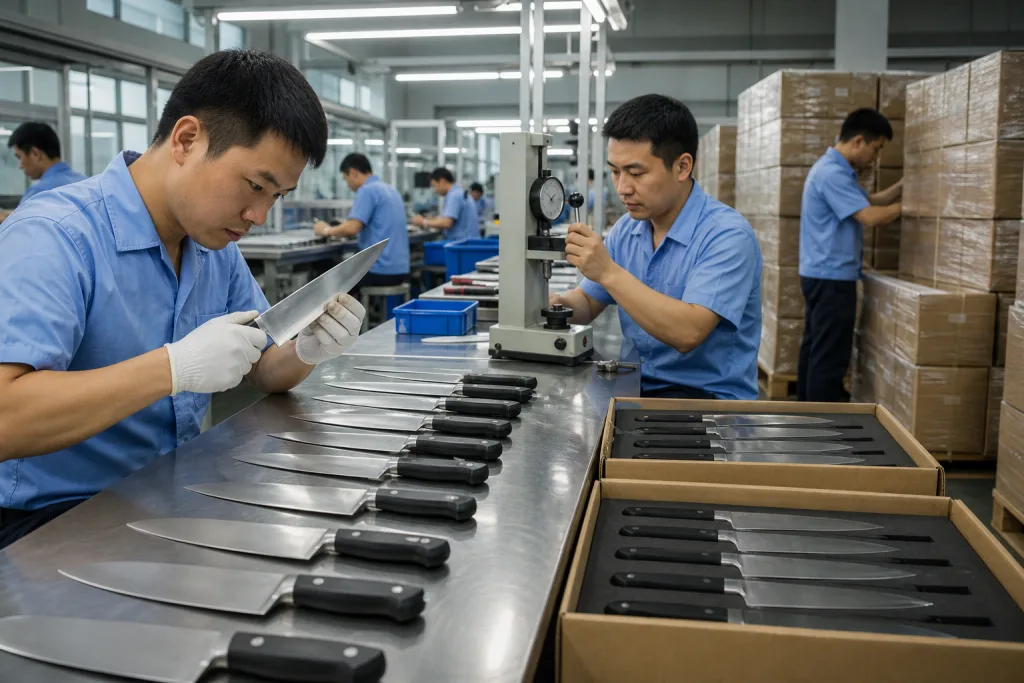
Be specific in your sample evaluation. Measure blade length in mm, blade thickness, handle length, weight, balance point, edge angle, and HRC target; our QC table uses a digital caliper, Rockwell tester, and a 0.1 g scale for this check. For a Western-style utility knife, 120-150 mm blade length and 1.8-2.5 mm spine thickness are common. Want a nimble petty knife feel? Say it before the grinding line sets the profile. If you want a heavier mini chef knife feel, say that too. Waiting until bulk sharpening is the wrong time to ask.
Quality Checks That Affect Delivery
Quality control costs hours, not weeks. Skipping it costs more. For Amazon sellers, one bad lot can bring 23 returns in a week, refund pressure, safety complaints, or a listing review after customers report loose blades. A utility knife is a sharp tool. Treat it like one. Last quarter QC pulled 5 samples from a 3,000 pcs run because the slider lock felt soft after 200 open-close cycles on the test jig; the buyer flagged the video before we packed the inner boxes.
A workable QC plan starts with incoming steel checks by coil lot, then moves through heat treatment, grinding-line patrol, final inspection before packing, and carton inspection before shipment. For export orders, most buyers we ship for use AQL 2.5 for major defects and AQL 4.0 for minor defects. Critical defects need zero tolerance. A blade loose in the handle is not a minor issue. Neither is a cracked handle, exposed burr, wrong barcode, or missing blade guard. We run hardness checks on the bench Rockwell tester before the grinding line starts full speed, because finding 52 HRC after packing is when the math does not work.
Useful inspection points include:
- Blade length tolerance, commonly within ±1.0 mm for standard utility knives, checked with a digital caliper before bulk packing.
- Blade thickness and straightness near the tip, where we have seen 0.3 mm bowing cause buyer pushback on a repeat PO.
- Hardness testing, often checked within a target band such as 56-58 HRC on 3 blades per cavity or batch, with the reading logged before blades move to assembly.
- Edge sharpness, burr removal, and bevel angle consistency after the final pass on the grinding line, checked under a bench light before retail packing starts.
- Handle gaps, rivet finish, glue overflow, and balance, with QC rejecting visible gaps over 0.5 mm on retail orders.
- Logo position, retail box print, FNSKU, carton label, and country-of-origin marking, including PO typos like “Made in Chian” before cartons are sealed.
If you require CATRA cutting tests, salt spray tests, LFGB, FDA food-contact documentation, REACH declarations, or ISO 9001 factory records, say so before quotation. These requirements add cost and days: a normal pre-shipment inspection may take 1 day, while third-party lab booking can move loading from 12 days to 18 days. Our China team can prepare common export documents, but lab testing needs a slot. Do not ask for lab reports two days before loading. We have seen this go sideways.
Reorder Timing for Amazon Sellers
Set the reorder plan before the first shipment leaves China. We see 7 out of 10 new Amazon sellers wait until stock falls below 30 days. Too late. For US sea freight, place the next utility knife SKU order while 75-90 days of sellable inventory is still on hand. For Europe, use 85-100 days when customs clearance, VAT paperwork, or a warehouse transfer sits in the route. Last month, the buyer flagged this exact point after QC pulled the pre-shipment sample with a caliper check on the handle gap, and the PO still showed the old FBA code.
Use actual sales velocity. Not a clean spreadsheet guess. If you sell 25 units per day and the full reorder cycle is 80 days, you need 2,000 units just to cover the gap. Add safety stock for promotions and FBA receiving delays, especially when we run the grinding line behind another private-label order already booked for 12 days. If Prime Day or Black Friday is coming, add a 20-40 percent buffer and check the MOQ against carton loading before you push the PO. We’ve seen this go sideways: one buyer planned on 1,500 units and sold 1,900 before the vessel reached Long Beach.
A practical reorder formula is: daily sales x total replenishment days + safety stock. Total replenishment days should include production, inspection, export booking, sea transit, customs, domestic delivery, and Amazon receiving; split these on the PO instead of hiding them in one date. For example, 30 days production plus 5 days inspection and booking plus 35 days sea freight plus 10 days receiving equals 80 days. At 20 units per day, that is 1,600 units before safety stock. With a 25 percent buffer, reorder quantity becomes 2,000 units. The math does not work if the blade spec changes from 56 HRC to 58 HRC after the PO, because heat treatment and re-testing on the Rockwell tester can burn another 3-5 days.
For DTC sellers holding inventory in a 3PL, receiving usually runs faster than FBA, but carton labels and packing accuracy still need checking. QC pulled the sample on one bundle order and found the outer carton marked “10 pcs” while the packing list said “12 pcs”; that small mismatch held shipment for 2 days. If you sell bundles with cutting boards, knife guards, or sharpeners, confirm each component lead time before you lock the ship date. A knife ready in 40 days does not help if the gift box supplier needs 55 days, and we ship late only once before the buyer starts asking for air freight at our cost.
How to Brief a Factory Properly
A clear brief gets a real quotation. A loose RFQ gets a safety price, because the sales desk has to cover steel loss, packing changes, and line time. Send the commercial facts first when you contact a utility knife supplier in Yangjiang, Zhejiang or another China knife base: order quantity, target FOB price or retail price, sales channel, destination country, packing style, and compliance papers needed for customs or platform review. Then send the product details. We run the quote sheet from those basics. Last month one buyer wrote “standard pack” on the RFQ; after sampling, the carton changed from 24 pcs to 48 pcs, and that changed the drop test height, gross weight, and freight quote.
For a custom utility knife, give the blade length and overall length in mm, steel grade or hardness target, handle material, surface finish, logo process, retail pack, barcode format, master carton limits, and inspection standard. Add drawings in mm if you have them. Tiny gaps bite. A 0.8 mm blade holder gap does not run like 1.2 mm on the grinding line, and QC pulled one sample because the slider had side play after 200 push-pull cycles. If you have a competitor-style photo, use it to show function and shelf position, not to copy protected design details. A good utility knife factory should convert that reference into a producible design without IP risk.
Be straight about forecast volume. If the first order is 800 pcs but you expect 5,000 pcs per quarter after launch, say it early. The factory can quote one price for the first MOQ run and a better price after volume is stable. At TANGFORGE, our monthly knife capacity is about 180,000 units across kitchen, chef, outdoor, pocket, tactical, and Damascus lines, but capacity still needs a slot on the board. “Can you ship faster?” is the wrong question to ask. Ask whether artwork, barcode, color box dieline, and deposit are ready. A repeat order with confirmed artwork can slot in 12 days after material arrival; a rushed first order with unfinished packaging often takes 18 days because the color box proof gets corrected twice.
Decide the shipping term before the PI is issued. FOB is clean for experienced importers. DDP suits some Amazon sellers, but it hides freight, duty, and tax inside one number, so the math can look better than it is. EXW looks cheap on the PI, then your team spends time chasing pickup booking, export docs, and local charges. We’ve seen this go sideways when a PO had “FOB Ningbo” typed on page one and “EXW factory” on page two. The buyer flagged it only after the forwarder asked who was paying the local handling fee. For most new Amazon and DTC cutlery sellers, FOB plus a trusted forwarder gives cleaner visibility.
Frequently asked questions
For a standard custom utility knife using an existing blade profile and handle, MOQ is usually 600-1,000 pcs per SKU. If you need custom packaging, 1,000 pcs is more realistic because printed boxes and sleeves often have their own minimums. If you need a new blade profile, new handle mold, special coating, or multi-piece gift set, MOQ commonly moves to 2,000-3,000 pcs. The lowest MOQ is not always the best buy. A 600 pcs order can carry higher unit cost, less packaging flexibility, and higher freight cost per knife. For Amazon launches, 1,000-1,500 pcs often gives a better balance between cash risk and margin.
For a normal private-label utility knife, production lead time is usually 35-55 days after deposit, sample approval, and packaging artwork confirmation. A stock design with laser logo and plain box may be ready in 25-35 days. A new mold, unusual handle material, or premium gift box can push production to 60-90 days. You also need to add inspection, export booking, freight, customs, and warehouse receiving. For US Amazon FBA by sea, many sellers should plan 75-100 days from reorder placement to sellable inventory. Air freight can shorten transit, but it can add USD 1.50-4.00 per knife depending on weight and season.
Sometimes, but it depends on the design. A utility knife factory may support 300 pcs if the knife is a stock model, packaging is simple, and only laser engraving changes. For a true private-label retail product, 300 pcs is usually too low because setup time, QC, packaging print, and export packing become inefficient. The unit price may look unattractive, and you may still need to pay sample, artwork, or small-order fees. If your budget is tight, choose an existing blade and handle, use a standard color box or sleeve, and reserve deeper customization for the second order after you prove sales velocity.
For sea freight, reorder when you have 75-90 days of inventory left for the US and 85-100 days for Europe. Use your actual daily sales, not your launch forecast. If you sell 15 units per day and your replenishment cycle is 80 days, you need 1,200 units just to avoid running out. Add 20-40 percent safety stock for promotions, Q4 congestion, FBA receiving delays, or listing growth. If your MOQ is 1,000 pcs but your reorder math says 1,600 pcs, do not order only the MOQ. MOQ is the factory minimum, not your correct inventory quantity.
Send quantity, destination country, sales channel, target retail price, blade length, steel, HRC target, handle material, logo method, packaging type, barcode or FNSKU requirements, and inspection standard. If you have a target FOB price, share it. For example, a 5-inch stainless utility knife with 1.4116 steel, 56-58 HRC, POM handle, laser logo, blade guard, and color box is much easier to quote than “send best price for utility knife.” Also confirm whether you need FDA, LFGB, REACH, BSCI, ISO 9001 records, or third-party inspection. These requirements affect both lead time and cost.
Plan Your Utility Knife Reorder Earlier
Send your target MOQ, sales forecast, packaging idea, and delivery country. We will quote a practical utility knife plan with lead time, samples, and reorder timing.
Request a Quote