A 5-inch kitchen utility knife looks simple on a line sheet, but hardness is where 7 of 10 private-label quotes come back for correction. If the PO only says “sharp, durable, good steel,” the factory gets too much room. We have seen one supplier ship 52 HRC blades that rolled after 7 days on bamboo boards. Another pushed 60 HRC on low-cost stainless, then the buyer flagged chipped tips in the first return batch. QC pulled the sample, set it on the Rockwell tester, and the reading explained the complaint.
For kitchenware brand owners, “what is the hardest steel?” is the wrong question to ask. Ask which hardness band fits the retail shelf price, the buyer’s return limit, and the cutting board your end user actually owns. At TANGFORGE in Yangjiang, Zhejiang, China, we run utility knives as daily-use precision tools: thin behind the edge, tough enough for tomatoes and citrus, stable enough for repeat utility knife wholesale orders. Small changes matter. On our grinding line, a 0.25 mm edge change can make the knife feel sharper in a carton-opening test. But if the HRC spec is wrong, the math doesn't work.
Why HRC Matters on Utility Knives
HRC is the Rockwell C hardness number. On a custom utility knife, it tells us whether the blade held the planned structure after quenching and tempering. It is not the whole knife. Still, it is one of the few specs a buyer can write on a PO and our QC team can check again with the Rockwell hardness tester. We run a 3-point sample from each batch near the heel, middle, and tip; last week QC flagged one lot at 54.2 HRC on the tip when the PO called for 56-58 HRC.
A kitchen utility knife sits between a chef knife and a paring knife. It cuts tomatoes, apples, citrus, cheese, sandwiches, herbs, cooked meat, and small vegetables. Buyers push it harder than normal use: twisting through cheese blocks, hitting ceramic plates, scraping boards, or putting it through a dishwasher cycle. We hear those complaints after field tests, and the grinding line sees the clues first, such as blue heat marks near the tip after a rushed #320 belt change. Wrong question. “How hard can we make it?” usually leads to a blade that looks good on the spec sheet and fails in a buyer’s kitchen.
If hardness is too low, the edge rolls. The knife leaves our packing table looking clean, then after 10 to 14 days the customer says it is dull. If hardness is too high for the steel and geometry, the edge can micro-chip, especially on thin 12-15 degree edges. QC pulled the sample on one run before carton packing and found 6 visible chips under the 10x loupe. Both failures hurt reviews, but chipping brings more warranty claims because the damage is easy to photograph. The buyer flagged it in 3 photos before we even received the return sample.
For most kitchenware brands sourcing from a utility knife factory in China, the working target should be a controlled middle range. For common stainless steels like 5Cr15MoV, X50CrMoV15, or 420 variants, 55-58 HRC is a sensible band. We have seen buyers ask for 60 HRC on the same 2.0 mm blade, then complain about breakage in field testing after 18 days instead of passing the usual 30-day kitchen trial. If you want premium positioning with better edge retention, match the steel grade with the heat treatment curve and blade thickness; the math does not work when only the HRC number changes. A hard number without process control is decoration on a spec sheet, and we have seen that PO typo cost 800 pcs of rework.
Practical Hardness Bands by Steel
Start the utility knife steel hardness spec with the steel grade, not with a target HRC copied from a competitor sample. 3Cr13 will not become a Japanese-style premium blade because the PO says 60 HRC. We have watched this go sideways: QC pulled 12 pcs from a 3Cr13 run, the Rockwell tester read 58 HRC on two blades, and both tips chipped after the 20 mm carrot cut. Wrong spec. Good steel also fails when the heat-treatment furnace overshoots or the grinding line blues the edge after hardening.
This is the sourcing table we use with OEM and ODM kitchenware buyers before tooling, logo etching, and carton artwork approval. These are not lab-sheet numbers. They are production bands we can hold across 3,000 to 20,000 pcs with normal AQL inspection, blade straightness checks on the granite plate, and HRC spot testing on the flat above the heel. One buyer once wrote “hardness max” on the PO for 6 SKUs; the math does not work when the end user drops the knife into a dishwasher basket with forks.
| Steel type | Typical HRC | Best fit | Buyer note |
|---|---|---|---|
| 3Cr13 / 420J2 | 52-55 | Entry gift sets | Low cost, easy sharpening, acceptable edge life for promo pricing |
| 5Cr15MoV | 55-57 | Mass-market utility knives | Safe balance for dishwasher-prone users; fewer return photos from chipped tips |
| X50CrMoV15 | 56-58 | European-style retail lines | Stable choice for branded kitchen programs where repeat orders matter |
| 8Cr13MoV / AUS-8 class | 57-59 | Mid-premium private label | Better edge holding; furnace timing and quench control need tighter checks |
| VG10 core | 59-61 | Premium Damascus utility knife | Sharper bite at first use; chipping risk rises when the edge is ground too thin |
For a broad retail utility knife line, we usually run 5Cr15MoV at 56±1 HRC or X50CrMoV15 at 57±1 HRC. Not fancy. It ships. On our line, that band cuts edge-chip complaints faster than chasing 59 HRC on budget steel, and the 15° per side sharpening wheel still passes a clean paper-cut test after final wipe-down. If your brand promise is razor-like cutting, 8Cr13MoV at 58±1 HRC or VG10 at 60±1 HRC can work, but lock the edge angle, sharpening finish, and final burr check on the spec sheet. Add the packaging warning for frozen food and bone contact too. We have seen buyers skip that line, then blame the blade after a user snaps it on a frozen pack.
Heat Treatment Is the Real Spec
Hardness is the number on the test report. Heat treatment decides whether that number means anything. When we qualify a utility knife supplier, we ask for the furnace set point, quench oil or air-cooling method, tempering minutes, and how they control heat after grinding. “We can make any HRC” is the wrong answer. Last year, one buyer flagged a 57 HRC batch that passed the report, but QC pulled the sample after the blade showed edge chips at 200 carton-cutter strokes on a 9 mm test blade.
For stainless kitchen blades, we run blanks through stamping or laser cutting, profile shaping, hardening at the approved furnace temperature, quenching, tempering, grinding, polishing, sharpening, and final inspection. Not every station carries the same risk. Hardening temperature and soak time change the steel structure. Quench consistency controls stress. The tempering cycle decides whether the edge feels tough or glassy in use. Put each window in writing. A 12-minute soak vs 18 minutes, or a worn 240-grit belt running hot on the grinding line, can leave blades inside nominal HRC but dead at the edge, with a 1-2 HRC swing from heel to tip.
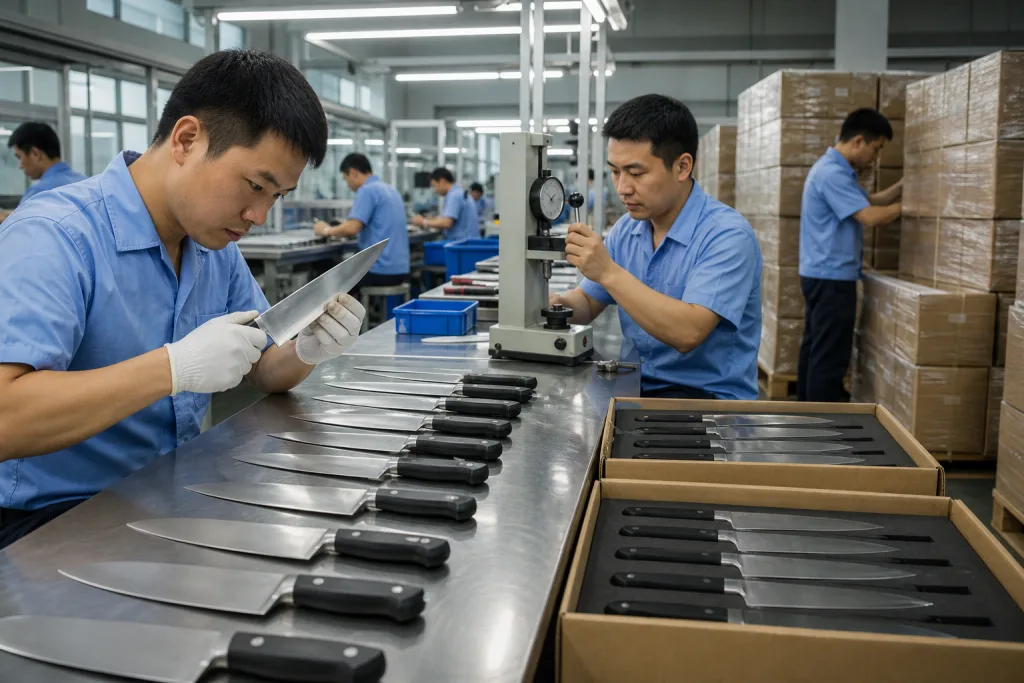
At TANGFORGE, our Yangjiang, Zhejiang, China production team checks hardness after heat treatment and again after major grinding steps on new projects. QC uses a Rockwell tester on the blade flat, not on the bevel. If the first reading looks wrong, QC pulls the sample and checks a second point before release. Simple rule. For stable repeat orders, we test samples from each production lot, normally 3-5 blades per SKU depending on order size. We ship about 80,000 kitchen and utility knives per month, so repeatability beats one polished pre-production sample every time.
Write the heat-treatment expectation into the technical file. A practical line is: “Blade hardness 56-58 HRC measured at blade flat after heat treatment; no reading below 55 HRC or above 59 HRC; supplier to keep batch test records.” For premium programs, add retained samples and ask for hardness readings from the first mass-production lot before final packing. The cost is small, usually one extra QC check sheet and 10 minutes at the tester, but the math doesn't work if the buyer finds the problem after goods are already FOB China.
Match Hardness with Edge Geometry
A utility knife does not cut because the spec sheet says HRC. It cuts because the edge is ground right. We have seen 60 HRC blades come off the grinding line feeling blunt because the shoulder was too heavy, 0.55 mm behind the edge on a Mitutoyo caliper. Grind the same steel too thin and the first tomato cut looks clean, then 12 days later the buyer sends chip photos from a ceramic plate test. Specify hardness with blade stock and the real edge angle. Otherwise, the math doesn't work.
For a 120-150 mm kitchen utility knife, common spine thickness is 1.5-2.0 mm. A thin Japanese-style utility knife usually runs 1.3-1.6 mm, while a forged European-style profile often lands at 1.8-2.2 mm near the heel. Behind-the-edge thickness is harder to hold in production; one worn 240-grit grinding belt can shift the reading by 0.08 mm before the operator catches it. For mainstream stainless utility knives, 0.25-0.40 mm behind the edge is a safe commercial range. QC usually pulls 5 pcs from each heat-treatment lot and checks them with a digital caliper before packing.
Edge angle should follow hardness. For 55-57 HRC stainless, a 17-20 degree per side edge gives fewer after-sales headaches in mass-market retail. For 58-60 HRC steels, 15-17 degrees per side gives a cleaner first cut, but only if the buyer accepts hand washing and proper cutting boards. We ship supermarket orders. We also ship premium gift-box lines. They should not share the same geometry. Last year one buyer flagged 16 degrees per side on a discount PO; we pushed back because chipped-tip returns would cost more than the blade upgrade.
Ask your utility knife factory for sample sets with two edge options, not two handle colors. This is the wrong question to ask if the PO only says “sharp edge” and nothing else. Test the samples on tomatoes and paper first, then rope and cardboard; use a soft plastic cutting board, not the office desk. Write the cut count on the sample bag with a marker so nobody argues later. If the sharper sample loses its bite after 50-80 cuts, the geometry is too aggressive for that steel. If the tougher sample cannot slice tomato skin cleanly out of the box, the edge finish needs work, and QC should pull the sample back to the polishing wheel before you approve the pre-production run.
Inspection Points Buyers Should Require
Put hardness inspection in the QC plan, not just the final-inspection sheet. AQL 2.5 does not prove edge life; it catches lot drift after something has already moved. For kitchen utility knives, we see 7 out of 10 importers set AQL 2.5 for major defects and AQL 4.0 for minor defects. Critical defects need zero tolerance: cracked blades, loose handles, handle burrs that cut fingers, oil-stained packaging, and wrong SKU labels. Stop the line. Last season QC pulled one 3.0 mm blade with a hairline crack near the heel under the LED lamp; the carton looked clean, but the lot could not ship.
Your PO should name the hardness test location and the test method. Rockwell testing leaves small dents, so we run it on a non-cosmetic blade flat before final polishing when the design allows it. If not, we keep test coupons from the same heat-treatment batch and log them by furnace lot. If the inspector tests finished goods, agree on the exact spot and acceptance limit before production starts. We usually mark a 6 mm test window near the tang with a paint pen. Do not let a third-party inspector dent the visible blade face at random. We have seen this go sideways.
For edge performance, keep the checks simple enough for the grinding line to repeat at 9 a.m. and again after lunch. CATRA testing makes sense for 20,000-piece retail programs, but the math doesn't work for every 1,200-piece reorder. We run a paper slice test for snagging, a tomato skin cut with light hand pressure, a burr check under an LED lamp, an edge angle check with a goniometer, and rope or cardboard cutting against an approved golden sample. Seal the golden sample in a PE bag, sign across the label, and record the edge angle in degrees. No sample, no argument.
Packaging compliance can block a shipment even when the blade spec is right. For Europe, ask for REACH status on handles and LFGB support where food-contact expectations apply. Carton labels also need the correct importer details, not a sales-office shortcut. For North America, confirm FDA food-contact material expectations and run a California Proposition 65 risk review if the handle material or coating calls for it. FNSKU or retail barcode placement on the master carton should be checked against the PO artwork. We once had a PO typo on the FNSKU, and the buyer flagged it 2 days before vessel closing. Good steel with wrong packaging still sits in the warehouse.
How Hardness Affects Cost and MOQ
Harder steel does not automatically mean a higher knife price. The expensive part is keeping a tight HRC window batch after batch. On our production sheet, the cost lines we watch are steel grade, heat-treatment yield, grinding minutes per blade, scrap after straightening, and QC time on the Rockwell tester. Small difference. Big bill. A stamped 3Cr13 utility knife can still sit in the low-cost range. Ask for ±1 HRC control, mirror polish, and a color box with foam insert, and the math changes fast. QC pulled 32 pcs from one trial lot last month; 5 blades came in under the lower HRC limit after tempering, so we reworked them instead of hiding them inside the export carton.
For FOB China pricing, a basic stainless private-label utility knife often starts around USD 1.20-2.20, depending on handle material and carton spec. A better X50CrMoV15 or 5Cr15MoV knife with clean satin finishing usually lands around USD 2.50-4.50. Forged construction adds press work, then the grinding line spends extra minutes thinning the bolster shoulder so it does not feel chunky in the buyer's hand. Damascus cladding brings steel loss and slower etching, especially when the buyer wants both sides matched under a 600-grit inspection lamp. Gift boxes or FSC wood packaging can cost more than the knife. We ship quotes every week where the blade is USD 2.80 and the rigid box adds another USD 1.10. These ranges move with RMB rate, steel coil price, order quantity, and one line on the PO: AQL 2.5 or full-piece inspection.
MOQ follows the spec. TANGFORGE usually runs custom utility knife projects from 600 pcs/SKU for standard materials and small tooling changes, such as logo laser marking or a common PP handle color. New molds, special handle colors, exclusive blade profiles, or custom packaging often need 1,000-3,000 pcs/SKU because the injection shop and printing supplier both lose material during setup. The injection master will not warm up a mold for 200 handles just because the buyer wants a soft-touch beige sample. Normal lead time is 35-50 days after sample approval and deposit. For complex Damascus or gift-set projects, plan 60-70 days, not 35 days. We have seen this go sideways when the buyer approves the sample on Friday, then asks for vessel booking the next Tuesday while the EVA tray drawing still has one handle-length typo.
Watch quotes far below market that still promise premium HRC, premium steel, and premium packaging. If the target is stable retail quality, this is the wrong question to ask. Something gets cut. The steel may be swapped, hardness tolerance opens up, cartons drop from 5-layer to 3-layer, polishing is rushed on the grinding line, or inspection becomes a paper stamp. A serious utility knife supplier should show the cost trade-off on the quote sheet, not just say yes to every target price.
Write a Clear Purchase Specification
A clean purchase spec should be short, measurable, and hard to bend. For a kitchenware brand buying from a utility knife manufacturer, keep it to 1-2 pages and print the approved sample number exactly, for example “golden sample US-UK-130-01.” No poetry. “High hardness,” “German quality,” and “super sharp” are not specs; they turn into arguments beside the grinding line unless the PO states HRC, blade length, edge angle, and surface finish. We had 3 POs last quarter where the buyer’s clerk typed “US-UK-103-01” instead of “US-UK-130-01”; QC caught it with a caliper on the 130 mm blade before packing.
A workable utility knife steel hardness specification can read: “Blade steel X50CrMoV15 or approved equivalent; hardness 56-58 HRC; blade length 130±2 mm; spine thickness 1.8±0.2 mm; satin finish; edge angle 17-19 degrees per side; handle POM black, three rivets; logo laser engraved; AQL 2.5 major, 4.0 minor; packed one piece per color box.” Then the factory can run production without guessing. Clear is faster. QC pulled a sample last month at 55 HRC on the Rockwell tester because one PO said “around 56-58” while another said “58 HRC minimum.” We have seen this go sideways: 12 days of sampling work turned into 18 days of email correction and rechecking.
For a premium line, add bench-checkable controls: steel certificate by coil lot, heat-treatment batch record with furnace time, first-article inspection before bulk grinding, retained sample signed across the label, edge retention test method, salt spray requirement for corrosion-sensitive markets. If the buyer needs carton strength, name the carton drop-test standard such as ISTA-style internal testing and the drop height in mm; our packing room usually checks 5 master cartons before sealing the export batch. For a promotional line, cut the paperwork, but keep hardness and edge safety defined. The math doesn’t work if you ask for VG-10 behavior on a 10,000 pcs budget knife with a soft target price; the belt sander and furnace cannot fix a bad cost sheet.
Negotiate the spec before sampling, not after mass production. Send your target retail price, market, sales channel, and expected claim rate, then we can recommend a hardness band that matches the steel and heat treatment instead of copying a competitor’s catalog number. We ship better when the buyer says “EU supermarket, 24,000 pcs, claim rate under 0.8%” than when the email only says “make it premium.” That is the wrong question after 18 days of mass production and 42 cartons sealed; the buyer flagged one case like this when the logo position was 3 mm off against the signed sample. A small utility knife becomes a repeatable product when the spec matches the sample, the invoice, and the QC checklist.
Frequently asked questions
For most kitchenware brands, specify 56-58 HRC for a stainless utility knife using 5Cr15MoV, X50CrMoV15, or similar steel. This range gives a good balance of edge holding, toughness, sharpening ease, and lower chipping risk. If your line targets supermarkets or general home cooks, avoid pushing above 59 HRC unless the steel and edge geometry justify it. For an entry-level gift set, 54-56 HRC may be acceptable if price is the main driver. For premium VG10 or Damascus-core utility knives, 59-61 HRC can work, but you should pair it with a 15-17 degree edge and clear hand-wash care instructions.
Ask the utility knife factory to provide batch hardness records and define a sampling rule before production starts. For a normal order, test 3-5 blades per SKU from the heat-treatment lot. The purchase order should state the target, such as 57±1 HRC, plus rejection limits. You can also ask a third-party inspector to witness Rockwell testing, but agree on the test location because Rockwell leaves a small mark. For finished goods, many buyers use retained test coupons or hidden blade-flat positions. Keep one approved golden sample and compare cutting performance from every order against it.
No. A harder knife can hold an edge longer, but only when the steel, heat treatment, and geometry support that hardness. A 60 HRC blade with poor tempering or a very thin edge may chip during normal home use. A 56-58 HRC blade with clean grinding and good sharpening may receive better reviews because it cuts well and survives rough handling. For broad retail, durability usually matters more than maximum edge retention. If your customer base uses dishwashers, glass boards, or ceramic plates, a slightly tougher hardness band is the safer commercial choice.
Send blade length, steel preference, target HRC, handle material, logo method, packaging type, order quantity, destination market, and target FOB or landed cost. For example: 130 mm utility knife, X50CrMoV15, 56-58 HRC, black POM handle, laser logo, color box, 1,200 pcs, EU market, REACH-aware packaging. If you already have a benchmark sample, send photos, dimensions, and weight. A serious utility knife supplier can then quote more accurately and warn you if your target hardness, edge angle, or price is unrealistic.
You can, but it is not always ideal. Chef knives, santoku knives, utility knives, and paring knives often use the same steel and similar hardness for production efficiency, commonly 56-58 HRC for mainstream stainless sets. However, blade thickness and edge angle should still vary by knife type. A utility knife may need a finer edge than a heavy chef knife, while a cleaver needs more toughness. If you are ordering a set, define the shared steel and HRC band, then list individual dimensions and edge targets for each knife.
Get a hardness-controlled utility knife quote
Send your blade size, steel target, HRC band, packaging plan, and market. We will review the spec and quote a realistic OEM or ODM production route.
Request a Quote