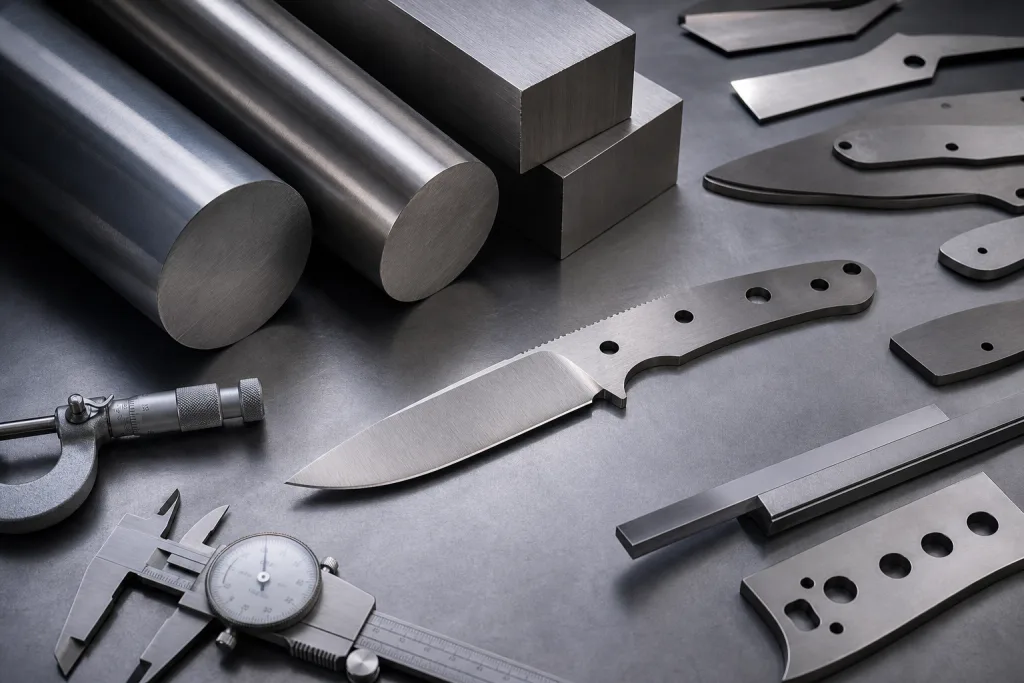
VG10 sells because buyers already know the pitch: Japanese-origin stainless core steel, solid edge holding, clean mirror or satin polish, and a premium hand feel at a lower landed cost than powder metallurgy steel. The VG10 stamp is not the spec. We have seen this go sideways when the PO only says “VG10 chef knife, 60-62 HRC” and says nothing about core thickness, cladding, blade warp tolerance, or edge angle; QC pulled one sample last year with a 0.45 mm tip bend after grinding, and the buyer flagged it before shipment.
TANGFORGE is a Yangjiang, China knife OEM/ODM factory established in 2008, with about 240 employees and monthly capacity around 180,000 knives across kitchen, chef, pocket, hunting, tactical, and Damascus lines. On our floor, VG10 orders usually fail for five fixable reasons: loose drawings, MOQ that does not match the grinding line setup, the wrong HRC target, packaging that saves $0.18 but creates return claims, and no AQL 2.5 plan before mass production. The math doesn't work if the buyer wants 300 pcs, custom G10 handle colors, laser logo, gift box, and 12-day delivery; we run better when specs are locked before the first pre-production sample.
What VG10 Actually Means
VG10 is a stainless cutlery steel most buyers know from Japanese-style kitchen knives. A normal melt sheet shows around 1.0% carbon and 14.5-15.5% chromium, with cobalt, molybdenum, and vanadium in the mix. On our heat-treatment record, the useful window is narrow: the steel must come out hard enough for edge life, but not so brittle that QC sees micro-chips under the 10x loupe after sharpening.
For a buyer, ask this first: where is the VG10? It is the core steel, not the whole knife. In 8 out of 10 RFQs we see, the knife is laminated, with VG10 in the cutting core and outer cladding in 420J, 430, 10Cr15CoMoV, or stainless Damascus layers. If your purchase order only says “VG10 Damascus knife,” the math doesn't work. The buyer flagged this on one PO last year because the artwork said 67 layers, while the written spec never named the cladding steel.
A serious VG10 steel knife manufacturer China should put the build on paper. Use a line like this: VG10 core, 67-layer stainless Damascus cladding, 2.0 mm spine at heel, 15 degree per side edge, 59-61 HRC, full tang G10 handle, brushed bolster, laser logo, color box. That gives the grinding line numbers to run and gives your QC inspector a clear reject point. QC pulled the sample at 58 HRC once; without the hardness band in the spec, the buyer had no clean claim.
In Yangjiang, China, 30 factories can make a knife shine for catalogue photos. Fewer can hold the same edge angle, hardness band, handle fit, and carton finish across 500 or 5,000 pcs. VG10 rewards control. It punishes shortcuts. If the core is overheated, ground under 1.6 mm before tempering, or sharpened without enough water cooling on the belt, the edge can chip even when the material certificate looks fine.
Buyer Specs That Prevent Confusion
Your RFQ should be boring and specific. “8 inch VG10 chef knife with pakkawood handle, good quality, private label” gives the factory too much room to guess. We have seen 4 suppliers quote the same line with different cladding, 1.8 mm versus 2.5 mm blade stock, A-grade versus B-grade handle scales, and plain box versus gift box. Cheap quote? Check the missing specs first. Last month a buyer flagged a PO typo: “VG-10 look” instead of “VG10 core,” and that one word would have changed the whole grinding line plan.
For VG10 steel knife OEM projects, we ask buyers to lock these points before quotation: blade pattern, steel construction, target HRC, blade thickness, bevel angle, handle material, logo method, packaging, test standard, and order quantity by SKU. Our QC desk checks thickness with a digital caliper at the heel and confirms hardness on the Rockwell tester before we price repeat orders. If you need FDA, LFGB, REACH, or California Proposition 65 support documents, say it at RFQ stage. Compliance paperwork is manageable, but the math does not work if we quote standard material and then switch later; lead time can move from 12 days to 18 days.
- Steel: VG10 core with 420J2 cladding for clean satin blades, or Damascus stainless cladding when the pattern must show clearly; certificate required.
- Hardness: 59-61 HRC for chef knives; 58-60 HRC if your customers complain about micro-chipping.
- Blade thickness: 1.8-2.2 mm at heel for most 8 inch chef knives, measured before final edge grinding.
- Edge angle: 14-16 degrees per side for kitchen use; wider for outdoor use where buyers expect rough cutting.
- Handle: G10 or micarta for stable color batches; pakkawood, stabilized wood, PP, ABS, or stainless when cost and style drive the SKU.
- Packaging: white box for bulk orders; color box, magnetic gift box, sheath, sleeve, FNSKU label, and carton drop requirement if retail shelves are involved.
A custom VG10 steel knife is easier to control after you approve a golden sample and keep it sealed. QC pulled the sample should match final logo depth, handle finish, packaging insert, and the same sharpening route planned for mass production. Small detail, big difference. If you approve a hand-finished sample from a 1000 grit belt but mass production runs 600 grit before buffing, the edge feel and satin line will not match; we have seen this go sideways during AQL 2.5 inspection.
MOQ, Price, and Lead Time Reality
VG10 steel knife MOQ comes down to the parts we have to set up on the floor. With an existing blade shape, standard handle, and laser logo, we run 300 pcs per SKU without much drama; the laser jig is already there and QC can pull 13 pcs under AQL 2.5 for a normal check. A new blade mold, new handle tooling, custom Damascus pattern, magnetic box, barcode labels, and retail carton usually need 500-1,000 pcs per SKU. Low MOQ is possible. The math often does not work, because steel cutting, CNC programming, printing plates, and inspector time still start from the same setup sheet.
At TANGFORGE in Yangjiang, Zhejiang, our normal OEM lead time for approved VG10 production is 35-55 days after deposit and sample approval. New tooling or complicated gift packaging can add 10-20 days, especially when the box supplier needs a second color proof or the insert foam is off by 2 mm. For first orders, do not plan your Amazon, retail launch, or distributor promotion around the shortest promised date. We have seen this go sideways when a buyer booked ads for day 35, then QC pulled the pre-shipment sample and flagged uneven handle gaps. Build in time for sample revision and incoming packaging approval.
| VG10 project type | Typical MOQ | Indicative FOB China price | Lead time after approval |
|---|---|---|---|
| Existing 8 inch chef knife, laser logo | 300 pcs/SKU | USD 7.50-12.50 | 30-45 days |
| VG10 Damascus chef knife, G10 handle | 500 pcs/SKU | USD 13.00-22.00 | 40-55 days |
| Custom handle and color gift box | 500-1,000 pcs/SKU | USD 16.00-28.00 | 45-65 days |
| Full knife block or gift set | 300 sets | USD 28.00-85.00/set | 50-75 days |
These prices are working ranges, not fixed quotes. Spine thickness, handle material, polishing grade, cladding count, sheath, box weight, and carton packing all move the price; one PO typo changing 2.0 mm spine to 2.5 mm can push steel weight and grinding time up fast. DDP works for some buyers, but serious procurement teams should compare FOB Yangjiang or FOB Shenzhen first. Keep product cost and freight cost separate. It makes supplier quotes easier to judge and stops the freight line from hiding a weak knife price.
Heat Treatment and Edge Risks
VG10 can cut beautifully, but it is not magic steel. Heat treatment decides the complaint rate. The same billet behaves differently after vacuum furnace temperature control, double tempering, wet belt grinding, and final sharpening on the 6000 grit wheel. For kitchen knives, we recommend 59-61 HRC for most Western markets. Pushing to 62 HRC sounds premium on a spec sheet, but we have seen it go sideways when end users cut frozen food, chicken bones, hard squash, or use glass boards.
A VG10 steel knife factory China should be ready to talk through the heat treatment route and testing frequency. You do not need every furnace setting in the quotation, but you should know the target HRC band, the test position, and the sample count per batch. For a 1,000 pc chef knife order, we run Rockwell checks on 8 pieces from different furnace baskets and different grinding times, not just one clean golden sample pulled from the showroom drawer.
Common QC risks include blade warp after heat treatment, decarburized edges, lamination lines drifting off center, micro-chipping during sharpening, and overheated tips. QC pulled one 8-inch sample last month with a 0.7 mm tip bend after straightening, and the buyer flagged it immediately in the PSI photos. A mirror polish can hide bad geometry, so ask for side-view photos, spine photos, choil photos, and cutting-test video before shipment. Pretty is not enough.
For performance checks, 12 buyers still rely on paper slicing and tomato cutting, but that is the wrong question to ask if you sell above entry level. Add a simple 50-cut rope test or 80-cut cardboard repeat test so your team can compare one batch against the next on the same bench. If your brand sells at a higher price point, consider CATRA testing on selected models during development. CATRA is not needed for every shipment, but it gives cleaner data when you compare VG10 against 9Cr18MoV, AUS-10, or 14C28N for a product line decision.
OEM Options Worth Paying For
Not every customization improves sell-through. This is the wrong question to ask if the buyer only says, “Can we change everything?” Pay for blade profile that matches the use case, balance checked at the bolster on a 210 mm chef knife, handle comfort after a 30-second grip test, edge consistency from the grinding line, and packaging that passes carton handling. Spend less on trim changes that add 2 extra jigs but do not raise the shelf price.
For VG10 steel knife OEM work, logo options include laser marking, etching, screen printing on packaging, metal badges, and engraved handle marks. Laser engraving is the cleanest choice for most orders; we run it after final polishing so the mark stays sharp and the blade face does not get reworked. Deep etching looks premium, but QC pulled samples last month where acid bite looked uneven on Damascus cladding near the logo edge. If the artwork has fine letters under 0.8 mm stroke width, simplify it before production. Tiny logos look good in PDF and poor on steel.
Handle choice has a bigger effect than 7 out of 10 first-time OEM buyers expect. Pakkawood gives a classic kitchen look, but color and grain variation must be accepted; we usually approve a shade range board before mass production. G10 is stable and durable for premium chef or outdoor knives. Micarta looks tough but can show surface variation after contour sanding. Natural wood can be beautiful, but for North America and Europe the math goes bad if humidity, cracking, or restricted species documents are ignored. For food-contact kitchen knives, we usually keep handle materials inside known REACH, LFGB, and FDA-friendly options.
Packaging is part of the product. A USD 0.35 thin color box may be fine for wholesale distribution, but not for e-commerce parcel shipping; we have seen this go sideways when the buyer flagged 18 dented boxes from a 200-piece pilot carton. If you sell through Amazon or direct-to-consumer channels, specify FNSKU labeling, polybag rules, carton weight under 15 kg where possible, edge guard retention, and a drop test such as 76 cm on one corner, three edges, and six faces.
QC Plan Before You Pay Deposit
Agree the QC plan before deposit. Do not wait until 3,000 finished VG10 knives are sitting in cartons and then start arguing about “acceptable.” We split defects into critical, major, and minor on the PI and inspection sheet. Critical defects include loose handles, broken tips, exposed sharp edges outside the blade guard, wrong steel, unsafe packaging, and severe rust. Major defects include blade warp over 1.5 mm, off-center core, wrong logo, poor sharpening, handle gaps over 0.2 mm, deep scratches, and failed carton markings. Minor defects are small finish differences that do not affect cutting. Last month QC pulled the sample from the grinding line because 7 pieces had spine burrs the buyer never mentioned in the PO.
For most importer orders, AQL 2.5 for major defects and AQL 4.0 for minor defects is a practical starting point. Some premium brands use AQL 1.5 for major defects, but inspection cost goes up and rework time can move shipment from 12 days to 18 days. If you ask for zero cosmetic variation on pakkawood or Damascus, this is the wrong question to ask. Natural handle material and layered steel will not look like printed plastic. The math doesn't work unless the factory adds scrap into the price or walks away from the order. We have seen this go sideways on a 1,200-piece run where the buyer flagged normal wood grain as “color defect.”
Your pre-shipment inspection checklist should include length, weight, blade thickness, HRC spot checks if available, logo position, handle gap, rivet finish, sharpness, tip symmetry, spine burrs, carton drop condition, barcode scan, and packaging count. Put numbers beside the words: blade thickness 2.0 mm ±0.2 mm, logo offset within 1 mm, handle gap under 0.2 mm, 60-62 HRC if that is the agreed VG10 spec. We run barcode scans with a handheld scanner before sealing the master carton, because one typo on a PO barcode can block a retailer warehouse. For regulated markets, keep documentation for REACH, LFGB, FDA food-contact materials, and any retailer-specific requirements.
At TANGFORGE, our internal QC process uses incoming material checks, in-process grinding inspection, heat treatment hardness sampling, handle assembly inspection, final visual inspection, and packing audits. Incoming VG10 coil or plate gets checked against the material cert, and hardness sampling is done after heat treatment with a Rockwell tester, not by guessing from the spark. We are ISO 9001-oriented in process control and can support third-party inspection from SGS, Intertek, TÜV, or your nominated inspector. Give the inspector measurable standards, not loose words like “premium finish.” If the checklist only says “nice polishing,” the inspector, factory, and buyer will each read it a different way.
How to Shortlist a Supplier
Do not open the supplier comparison with price. Start with the knife’s shelf position. A distributor selling a USD 19.99 retail knife is not buying the same build as a brand selling a USD 99 VG10 Damascus chef knife, even if both POs say “VG10” in the steel column. We see this mix-up at the quotation desk at least 6 times a month. The grinding line, satin finish, gift box board thickness, and final AQL 2.5 check all need to match the retail promise, not just the steel name.
Ask each potential VG10 steel knife manufacturer China for three things: a written spec sheet with blade thickness in mm and HRC band, real production photos from the current batch, and a sample made by the same quoted process. If the sample looks sharp but the factory cannot explain MOQ, lead time, HRC band, or cladding construction, slow down. QC pulled one sample last year that measured 60-62 HRC, while the quoted bulk spec had no heat-treatment window written anywhere. “Yes, no problem” is not a factory answer. It is a sales answer.
A good supplier should push back when the request is risky. A 1.5 mm thin VG10 chef knife at 62 HRC with a 12° edge per side cuts nicely in a video, but we have seen this go sideways after 30 days in normal home kitchens. A heavy magnetic box can make the knife feel premium, then add 0.4 kg per set and crush the bottom cartons on a 1,200 pc shipment. A complex handle shape may need CNC time that makes a 300 pc trial order lose money. The math does not work.
China remains a strong sourcing base for VG10 knives because steel processing, grinding, polishing, packaging, and export logistics are already built around knife orders. Yangjiang, China has deep knife labor, heat-treatment partners, handle shops, and subcontract polishing rooms within a short truck ride. Zhejiang and other coastal export hubs also matter for color box printing, freight consolidation, and retailer compliance files. Your job is not to find the loudest supplier. It is to find the one that can repeat the approved sample at your target cost, MOQ, and inspection standard, even when the PO has a typo like “VG-10 damasucs” and the buyer flagged it two days before deposit.
Frequently asked questions
For a first OEM order, a realistic VG10 steel knife MOQ is 300-500 pcs per SKU if you use an existing blade shape and standard handle. If you need a new blade profile, new handle tooling, custom box, or special Damascus cladding, expect 500-1,000 pcs per SKU. A mixed order can sometimes reach 1,000-2,000 pcs total across several SKUs, but each SKU still needs enough volume to justify setup. If a factory accepts 50 pcs with full customization, check whether the price includes real production tooling or just workshop sampling.
For most kitchen knives sold in Europe and North America, specify 59-61 HRC. This gives a good balance of edge retention and toughness. If your customers are professional chefs who understand knife care, 60-61 HRC can work well. If your product is aimed at broad household use, 58-60 HRC may reduce chipping complaints. Avoid writing only “high hardness” in the purchase order. State the HRC band, test location, sampling quantity, and whether failed pieces require sorting, re-tempering, or replacement.
Ask for the steel supplier certificate, incoming material record, and the construction specification showing VG10 core and cladding material. For higher-value orders, you can request third-party chemical composition testing on 1-2 pcs from mass production. Destructive testing is not practical for every carton, but it is useful for first orders or new suppliers. Also check the lamination: a real VG10 core should be centered and visible in many polished or etched laminated knives. Documentation, sample retention, and random mass-production testing together are stronger than a certificate alone.
Price changes with core steel source, cladding layers, blade thickness, grinding time, polishing grade, handle material, logo method, packaging, and inspection level. An 8 inch VG10 Damascus chef knife may be USD 13.00 FOB with a simple handle and box, or USD 25.00+ with premium G10, better polishing, magnetic packaging, and tighter QC. Some quotes also hide cost by using thinner blades, cheaper cladding, low-grade boxes, or loose inspection standards. Compare full specs, not just the word “VG10.”
Yes, but VG10 is more common in kitchen knives than heavy outdoor knives. For pocket or hunting knives, specify blade thickness, lock strength, pivot tolerance, handle screws, sheath or clip standard, and corrosion testing. A 58-60 HRC target is often safer than pushing hardness too high for impact use. If the knife is tactical or field-oriented, compare VG10 with 8Cr13MoV, 9Cr18MoV, D2, 14C28N, and 440C based on your price point and warranty risk. The best steel choice depends on use case, not the most premium name.
Send Your VG10 Knife Spec for Review
Share blade drawing, target price, MOQ, packaging, and market. Our Yangjiang team will flag cost drivers, QC risks, and realistic OEM options before sampling.
Request a Quote