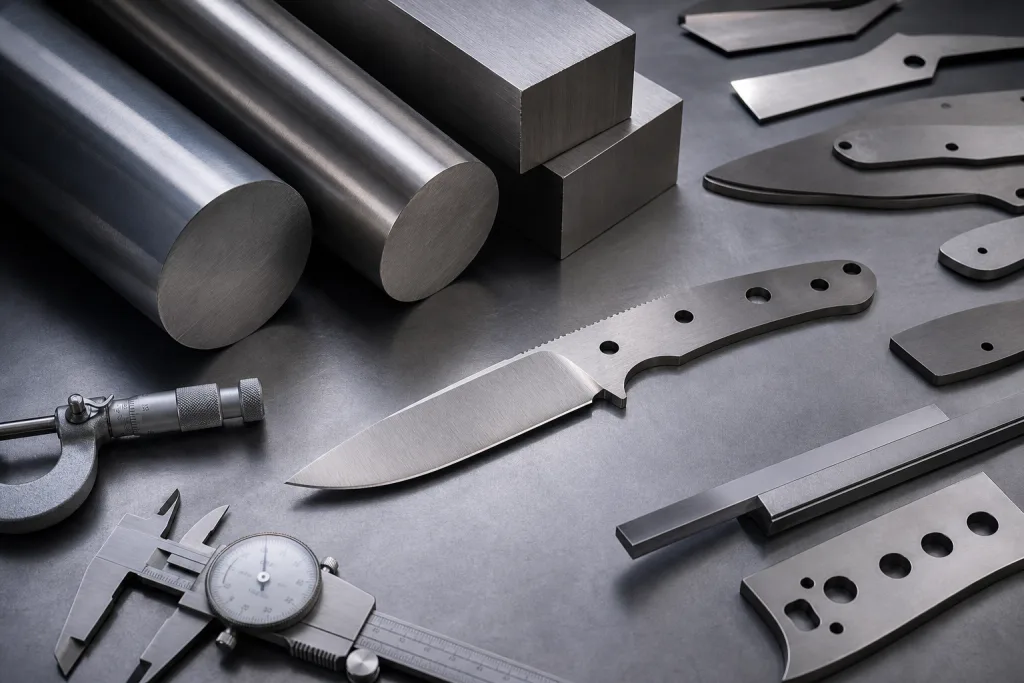
VG10 sells because buyers know the steel name. That label does not stop a 56 HRC blade, a wavy lamination line, a 1.2 mm tip warp, a loose pakkawood handle, or a crushed color box. For a VG10 steel knife OEM order, we want the quality checklist locked before quotation, sample making, and bulk run; asking for “best quality VG10” is the wrong question to ask.
At TANGFORGE in Yangjiang, Zhejiang, China, we see this on about 7 out of 10 new VG10 inquiries: the PO says “VG10 chef knife,” then leaves hardness, core thickness, cladding, edge angle, handle tolerance, and AQL level blank. We run about 180,000 knives per month, but the grinding line and QC table cannot inspect a guess. Last month QC pulled a sample at 58 HRC when the buyer expected 60-62 HRC, and the math did not work after cartons were already printed.
Start with the real VG10 specification
A useful VG10 steel knife quality checklist starts with the steel callout, not the blade profile. VG10 is a Japanese stainless cutlery steel usually around 1.0% carbon and 14.5-15.5% chromium, with cobalt, molybdenum, and vanadium in the mix. On our side, the common problem is not ignorance of VG10. It is a PO that says “VG10” while the quote sheet is priced on 10Cr15CoMoV, a VG10-equivalent grade, or a 0.8 mm VG10 core inside a laminated billet. We have seen this go sideways when QC pulled the sample and the buyer flagged the stamp after the blades had already passed the grinding line.
For kitchen knives, specify monosteel VG10, VG10 core with stainless cladding, or Damascus-pattern cladding over a VG10 core. These are not small wording differences. They change steel cost, polishing minutes per blade, scrap rate after straightening, and the look after etching. A custom VG10 steel knife with 67-layer Damascus cladding can sell at a premium, but the centerline must stay centered within about 0.5 mm at the tip, and the acid tank time must be controlled batch by batch. Pretty pattern first is the wrong question to ask.
Your material line should name the steel grade, construction, blade thickness, finish, and hardness. A workable buyer spec is: “VG10 core, 67-layer stainless Damascus cladding, 2.2 mm spine at heel, satin etched finish, 59-61 HRC, 15 degree per side edge.” That sentence gives the VG10 steel knife factory China team enough detail to price the job and inspect it without guessing. We run Rockwell checks after heat treatment, and if the first 5 blades read 57 HRC instead of 59-61 HRC, the math does not work for a premium listing.
Ask for a mill certificate or supplier declaration, but do not make paperwork your whole QC system. Paper can look clean. Steel can still be wrong. For larger programs, TANGFORGE can arrange third-party chemical composition testing on pre-production steel before mass cutting starts. It adds cost and usually 3-5 working days, which is cheaper than receiving 3,000 knives that miss the brand promise because nobody checked the coil before blanking.
Set hardness and heat treatment limits
VG10 works because it holds a fine edge and still lets a home user touch it up on a 1000/3000 grit stone. For most VG10 kitchen knives, we run 59-61 HRC. Some buyers push for 62 HRC because it sounds premium on the spec sheet; this is the wrong question to ask if the edge is ground too thin. On a 15° per side slicer, 62 HRC can pass, but QC pulled samples that chipped after 20 cuts on frozen chicken and hard squash. Bone is worse.
Your checklist should separate the hardness target from the inspection tolerance. A clean spec reads like this: production target 60 HRC, accepted batch range 59-61 HRC, rejection trigger below 58 HRC or above 62 HRC. Test at least 5 pcs per SKU during pilot run and 13 pcs per SKU during final inspection for medium orders. Use the Rockwell tester on the bevel shoulder. A random reading near the tang or spine looks tidy in a report, but it does not tell you how the cutting edge will behave.
Heat treatment also needs visual and dimensional checks. VG10 blades can warp after quenching, especially 240 mm and 270 mm chef knives and slicers. A 210 mm chef knife should normally hold blade straightness within 1.0 mm deviation when checked from both spine and edge lines with a feeler gauge on the granite table. For premium lines, you can tighten this to 0.6 mm. The math doesn't always work, because the grinding line then spends more time straightening rejects than finishing usable blades.
At our Yangjiang, Zhejiang, China facility, we log furnace batch numbers against production lots. Not fancy paperwork. If one heat-treatment batch shows low hardness, abnormal brittleness, or 9 out of 200 pcs with straightening marks, we can isolate that lot before it gets mixed into packed cartons. We’ve seen this go sideways when a PO typo changed “59-61 HRC” to “61-63 HRC” and nobody caught it until final inspection.
Build the buyer spec sheet
A VG10 steel knife OEM project should not go to sampling until the buyer signs off a one-page spec sheet. Photos are not enough. We had one PO where “8 inch chef” was typed, but the attachment showed a 210 mm gyuto; QC pulled the sample and the grinding line had already set the jig. Photos sell the idea, specs control the shipment. Put every key dimension on the sheet with tolerance, because 1-2 mm changes can change hand feel, retail box fit, and carton weight.
For a 8 inch chef knife, we run blade length ±2.0 mm, total length ±3.0 mm, spine thickness ±0.2 mm, handle length ±1.5 mm, and weight ±8% as practical targets. Edge angle needs a number, not “sharp.” Use 15 degrees per side for most Western export kitchen knives, or 12-14 degrees when the buyer wants a sharper Japanese-style position. If the knife goes into retail, define tip sharpness and heel polishing too. The buyer flagged this once after a 50 pcs counter sample batch: the VG10 passed 59-61 HRC, but the heel scratched the user’s finger. Steel chemistry was not the problem.
Handle specs need the same discipline. G10 and micarta stay stable in wet kitchens; pakkawood and stabilized wood need clear limits for soaking, dishwasher claims, and drop testing; ABS or PP needs a different check for shrink marks. For riveted full-tang knives, write down rivet material, flushness, gap tolerance, and tang exposure. Use a feeler gauge. A visible 0.3 mm gap between scale and tang looks small on the factory table, but the math does not work for a premium SKU when food residue sits in that line.
| Spec item | Typical export target | QC risk if missing |
|---|---|---|
| Hardness | 59-61 HRC | Soft edge or brittle chipping after cutting tests |
| Blade straightness | ≤1.0 mm deviation | Warped look, poor cutting feel at inspection |
| Edge angle | 14-16 degrees per side | Uneven sharpness, returns from first retail batch |
| Handle gap | ≤0.2 mm visible gap | Food trap, weak premium feel under a light box |
| Carton drop test | ISTA-style 10-drop check | Broken tips, crushed retail boxes, buyer claim photos |
Understand MOQ and price drivers
VG10 steel knife MOQ is not one factory number. We run it from the parts sheet: steel format, handle material, packaging spec, logo process, and existing tooling. For an open blade profile with laser logo and our standard color box, 300-600 pcs per SKU can pass. For a custom VG10 steel knife with a new handle mold, private packaging, and dedicated inserts, expect 600-1,200 pcs per SKU. If the order needs FNSKU labels, Amazon carton rules, or mixed sets, plan MOQ by packing configuration, not only blade SKU; last month QC pulled the sample because the PO said “1pc/box” while the carton mark showed “3pcs/set.”
Price moves faster than new buyers expect. A simple VG10 core 8 inch chef knife with pakkawood handle may quote FOB China around USD 8.80-13.50 at 1,000 pcs. A 67-layer Damascus VG10 chef knife with G10 handle, premium polishing, and magnetic gift box may land around USD 16.00-24.50 FOB. Pocket knives and hunting knives using VG10 or laminated stainless structures use another cost model, because liner locks, Kydex sheaths, CNC handle scales, T6 screws, and lock-up inspection add bench time. The grinding line feels this first.
Be careful with a quotation that is 20-30% below the normal range. It may still be real, but the math usually moved somewhere: 2.0 mm blade stock instead of 2.5 mm, satin polish instead of mirror finish, dyed wood instead of pakkawood, 800 gsm box board cut down to 600 gsm, skipped edge-retention checks, or hardness drifting outside the agreed window. Ask the factory to mark the changed items on the quotation sheet. This is the wrong question to ask: “Can you match this price?” Ask, “Which spec did you remove?”
Payment terms for new OEM buyers are commonly 30% deposit and 70% before shipment after inspection. Production lead time is usually 45-60 days after sample approval, but we have seen 45 days turn into 58 days when the buyer changed the logo file after the copper mold was already made. Air samples take 5-9 days to Europe or North America; sea freight timing depends on port, season, and DDP or FOB arrangement. We ship faster when the carton size, barcode file, and shipping mark are locked before mass packing starts.
Control samples before mass production
A golden sample is not a showroom piece. It is the production target for 1,000, 3,000, or 5,000 knives. Before you approve a VG10 steel knife factory China sample, ask one blunt question: was it made on the same grinding line with the same jig, or did a senior sample worker hand-save it with a 400# belt and extra buffing time? Hand work is fine during design trial. For mass production, the sample needs repeatable fixtures, belt sequence, polishing SOP, and heat-treatment routing; otherwise the math doesn't work once the order hits the line.
For first sample review, check the knife twice. Buyer hat first: balance point, palm comfort, shelf look, logo position, and whether the knife fits the target price. Inspector hat next: blade length in mm, spine thickness, bevel symmetry, handle gaps, rivet height, HRC, and color box fit. QC pulled one sample last month where the blade looked good, but the left bevel was 1.2 mm wider than the right and the insert tray rubbed the tip. If you approve only the photo, you have not approved a production standard.
A clean sample process has three stops. The first rough sample checks outline and handle feel; we run this before spending money on full packaging. The second pre-production sample locks steel, finish, logo, edge angle, color box, and barcode. The third sealed approval sample stays in our sample room, and one stays with you. Write the signed date, SKU, revision number, and allowed tolerance on the tag, such as spine thickness ±0.2 mm or handle color within one approved swatch.
At TANGFORGE, we ask buyers to sign a revision sheet together with the sample. It saves arguments later. We've seen this go sideways when a PO said “same as sample,” but the buyer's purchasing team changed the box board from 350 gsm to 300 gsm, adjusted the edge angle, and switched handle color to save USD 0.30 per piece. Put every change in writing before mass production starts, even if it feels small on a spreadsheet.
Inspect VG10 knives with AQL discipline
Final inspection is not carton opening and logo checking. For VG10 knives, we run the plan across cutting function, handle safety, blade dimensions, surface finish, retail packing, and required markings. A common export standard is AQL 2.5 for major defects and AQL 4.0 for minor defects, using ANSI/ASQ Z1.4 or ISO 2859-1 sampling. For premium retail programs, set critical defects at 0 accepted; QC pulled 200 pcs last month and stopped the lot after 1 loose pakkawood handle moved 0.6 mm under a torque check.
Critical defects include cracked blades, broken tips, loose handles, sharp burrs on handle edges, contaminated packaging, wrong steel marking, and unsafe sheaths. Major defects include hardness outside agreed range, warped blades beyond tolerance, uneven bevels, visible handle gaps, wrong logo position over 2 mm, and boxes that fail carton handling. Minor defects include small polishing lines, slight color variation in natural handles, or tiny retail box scuffs inside the approved limit. We check these under a 600 lux inspection lamp, and the grinding line knows a 1.5 mm tip bend is not a “small cosmetic issue.”
Sharpness testing needs a method buyers and factories can repeat. CATRA testing works for benchmark programs, but not every production lot needs it because the math does not work on a 500 pcs reorder when the lab adds 5 days and extra cost. For routine QC, we use paper slicing, edge visual checks, and controlled cutting tests on the sample table with 80 gsm copy paper. If your brand makes sharpness claims, write the claim into the spec. “Razor sharp” is marketing copy. “Cleanly cuts 80 gsm paper along 80% of blade length without tearing” is inspectable.
Packaging inspection gets skipped too often. We have seen this go sideways: the knife passes, then the buyer flags crushed retail boxes, dead barcodes, or blade tips cutting through a 0.45 mm PET insert. Use a carton drop test, scan EAN/UPC/FNSKU codes, confirm carton marks, and check inner protection around the tip and edge. On one PO, the FNSKU had one wrong digit, and 36 cartons sat in the warehouse for 12 days instead of shipping out in 2.
Check compliance and shipment risks
VG10 steel is only one line on the import checklist. If you sell kitchen knives in Europe, check REACH limits for restricted substances and LFGB requirements when the carton or product page makes a food-contact claim. For North America, FDA food-contact expectations apply to kitchen knife surfaces and any sleeve, tray, or polybag touching the product. Wooden handles need a moisture reading, coating check, and destination-rule review; we run a pin-type moisture meter on incoming pakkawood and usually hold it around 8-12% before assembly. If the set includes oil, cutting boards, sharpeners, or leather sheaths, the compliance file gets wider fast.
Factory audits matter for chain retailers and national importers. BSCI, ISO 9001, and customer social audits do not improve the edge angle, but they reduce sourcing risk when 4,000 sets are going into a retail DC. Ask for current certificates, not old PDF files from three ownership changes ago. We have seen this go sideways: the buyer flagged an expired BSCI during carton booking, and the shipment sat 12 days before the audit agent updated the portal. In China, capable knife factories are often practical production shops, so put the audit requirement in the RFQ before we quote, not one week before shipment.
Shipment terms can change landed cost more than the knife. FOB works well when you already have a forwarder. DDP suits some smaller importers, but confirm HS code, duty, anti-dumping exposure where relevant, insurance, and the party responsible for customs documents. The math does not work if a cheap DDP quote hides the wrong HS code. Knives are sharp tools, so some express channels and marketplaces require blade guards, warning labels, and 5-layer export cartons; QC pulled one sample last month because the tip pierced the inner sleeve during a 60 cm drop test.
The safest buying pattern is simple: freeze the spec, approve the sample, inspect during production for larger orders, run final AQL inspection, and release balance after defects are closed. No guessing. On our grinding line, a 15° edge spec and 60-62 HRC blade must match the approved sample, not the salesman’s memory or a PO typo like “VG-01” instead of “VG-10.” That is how a VG10 program stays boring, repeatable, and profitable. A knife factory in Yangjiang, Zhejiang, China can make excellent VG10 goods, but your checklist has to tell production exactly what to build.
Frequently asked questions
For most VG10 chef knives, specify 59-61 HRC as the production target. This range gives a good balance of edge retention and chip resistance for normal kitchen use. If your knife is a thin slicer, 61-62 HRC can work, but only with careful edge geometry and clear customer instructions. For Western-style chef knives sold through mainstream retail, going too hard often creates more warranty risk than value. Your purchase order should list the target range, test quantity, test position, and rejection limits. A practical rule is to reject below 58 HRC or above 62 HRC unless engineering approval is given.
A realistic VG10 steel knife MOQ is 300-600 pcs per SKU when using an existing blade profile, standard handle material, laser logo, and simple color box. For custom handles, new molds, special Damascus cladding, or private-label gift packaging, plan 600-1,200 pcs per SKU. Sets can be more complicated because MOQ may be driven by the slowest component, such as a custom box, molded tray, sheath, or printed manual. If you need mixed cartons, FNSKU labels, or distributor-specific packaging, discuss the packing MOQ separately from knife MOQ.
For OEM sourcing, a simple VG10 core chef knife usually falls around USD 8.80-13.50 FOB China at roughly 1,000 pcs, depending on blade size, handle material, finish, and packaging. A 67-layer Damascus VG10 chef knife with G10 or premium pakkawood handle and gift box is more often USD 16.00-24.50 FOB. Very low quotes are not automatically fake, but you should ask what changed: blade thickness, polishing grade, hardness control, packaging board, inspection standard, or steel construction. Always compare quotations against the same written spec sheet.
For first orders, yes, third-party inspection is worth the cost, especially above USD 8,000 order value or when selling through retail channels. Use AQL 2.5 for major defects and AQL 4.0 for minor defects, with critical safety defects set at 0 accepted. Ask the inspector to check HRC samples, blade straightness, edge consistency, handle gaps, logo position, barcode scanning, carton marks, and drop-test packaging. For repeat orders with a stable factory, you may combine factory QC reports with random third-party inspections every few shipments.
VG10 kitchen knives can be prepared for LFGB, FDA, and REACH-related requirements, but compliance depends on the complete product, not only the blade steel. Food-contact surfaces, coatings, handle materials, adhesives, inks, retail packaging, and accessories may all need review. For Europe, many buyers request LFGB and REACH documentation. For North America, FDA food-contact expectations and state-level chemical rules may matter. Testing should be planned before mass production because changing a coating, glue, or handle finish after production can delay shipment by 2-4 weeks.
Send your VG10 knife spec for review
Share drawings, target price, MOQ, market, and packaging needs. Our Yangjiang team will check manufacturability, QC risks, and realistic FOB cost before sampling.
Request a Quote