Amazon private label knife projects are won long before the listing goes live. For importers, brand managers, and Amazon sellers, the decisive work sits upstream: steel selection, blade geometry, logo application, packaging compliance, FNSKU labeling, AQL inspection, and freight planning that fits a target margin after fees.
This guide is written for buyers who already know the Amazon basics and need a supplier-side checklist they can use in RFQs and factory reviews. It covers the real numbers that shape outcomes, including MOQ bands from 300 to 1,200 units, sample cycles of 7-20 days, production windows of 25-45 days, hardness ranges such as 56-60 HRC, and inspection practice like AQL 2.5. The goal is simple: help you choose an Amazon FBA knife supplier that can deliver a repeatable product, compliant packaging, and stable replenishment economics.
What an Amazon private label knife supplier must prove first
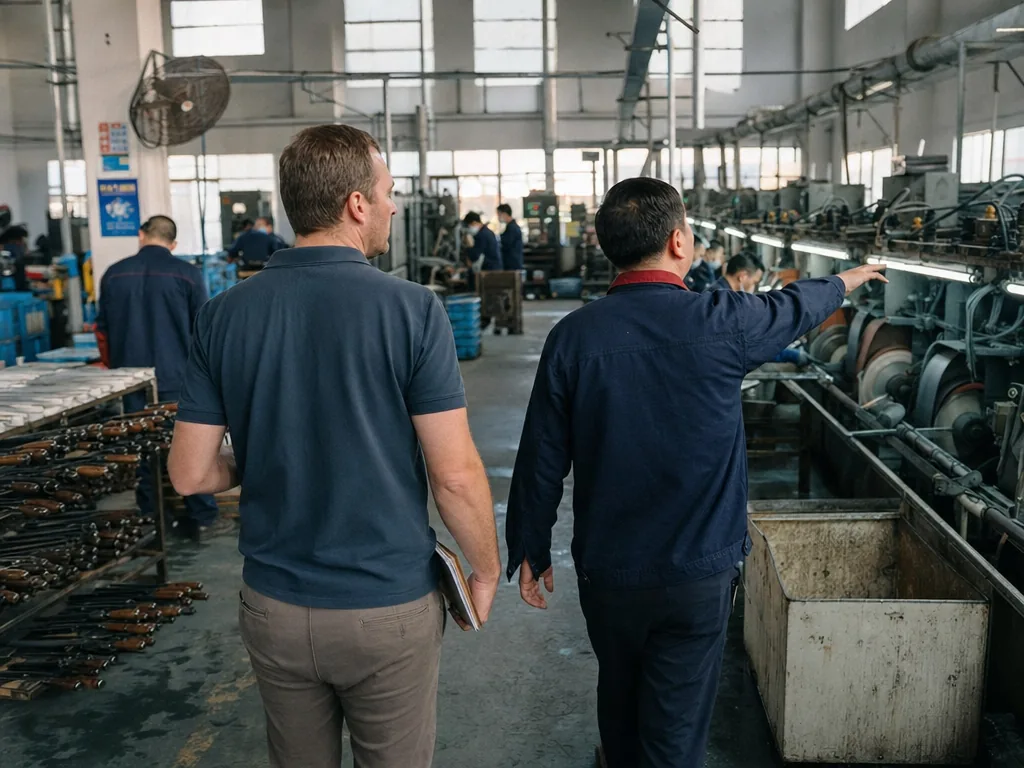
The first filter is not price. It is whether the factory can build a knife program that survives Amazon returns, buyer reviews, and replenishment cycles. Ask for a capability file that covers blade steel options, heat treatment range, handle materials, finishing methods, logo processes, packaging formats, and export markets served. For a credible program, a factory should be comfortable discussing 3Cr13, 5Cr15MoV, 7Cr17MoV, 8Cr13MoV, and premium options such as 9Cr18MoV or German 1.4116, with typical hardness windows of 54-58 HRC for entry products and 56-60 HRC for sharper, more durable kitchen SKUs.
Document control matters. Require ISO 9001 or an equivalent internal QA system, incoming material records, hardness testing logs, and final inspection forms. On export terms, confirm whether the supplier quotes EXW, FOB, or DDP, and whether they routinely ship to Amazon prep centers or directly to FBA through a forwarder. If you are using a private label service, ask exactly which items are included: logo laser etching, packaging artwork review, barcode application, insert cards, and carton mark control.
- Core documents: business license, export registration, factory audit summary, QA checklist, social compliance if required by your brand.
- Operational proof: sample lead time 7-15 days for stock molds, 15-25 days for new tooling.
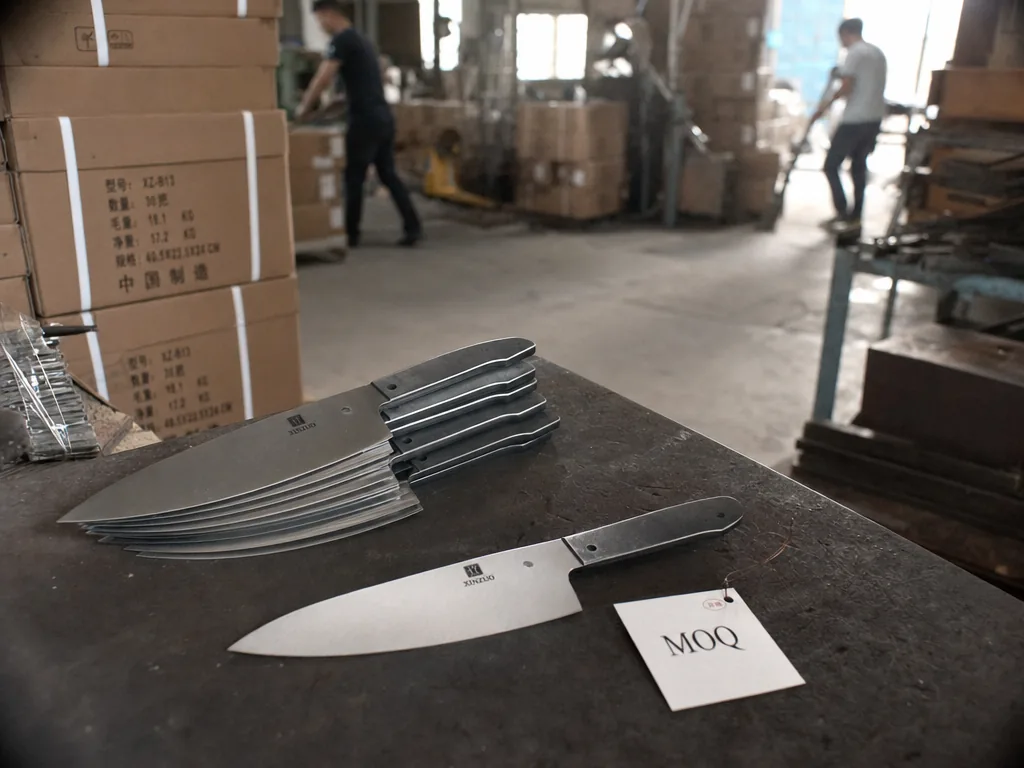
- MOQ reality: 300-500 units per SKU for standard models, 800-1,200 units when custom molds or low-volume premium packaging are involved.
- Risk question: can they hold blade grind angle tolerance and logo placement consistency across repeat orders.
A supplier that cannot answer these points in writing usually cannot support an Amazon knife brand setup at scale.
Product architecture for private label knife Amazon success
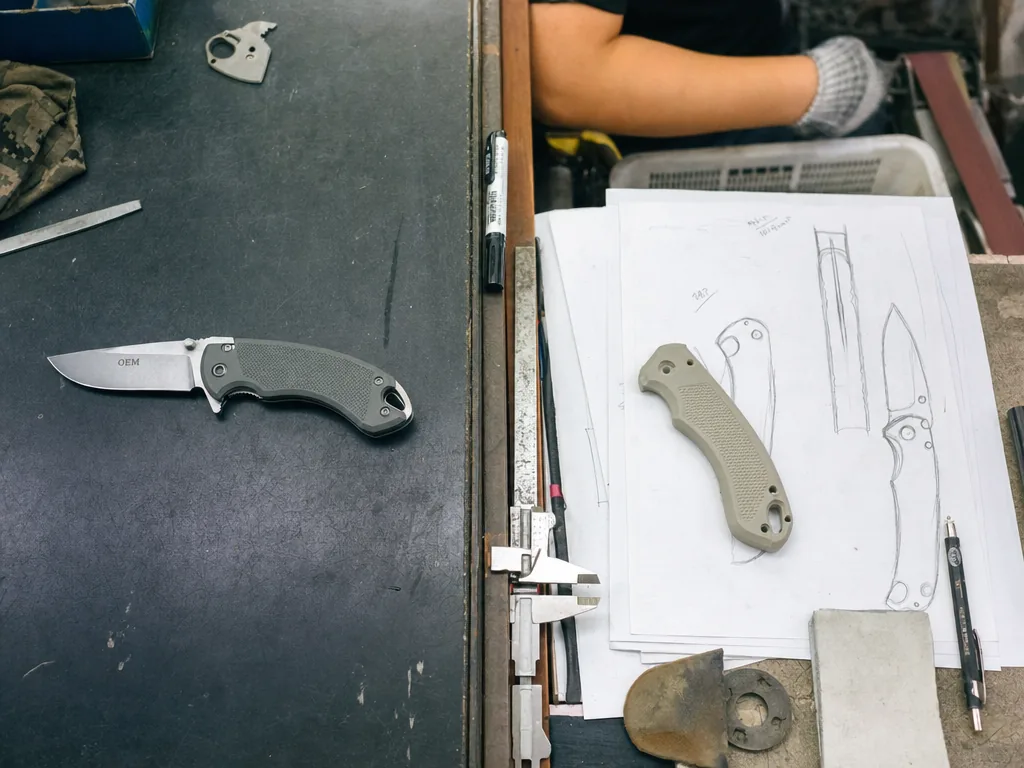
Most Amazon knife failures are product architecture problems disguised as marketing problems. Before negotiating price, define the exact SKU architecture: blade length in mm, spine thickness, edge profile, handle construction, rivet count, bolster style, sheath or blade guard, finish, and carton dimensions. For kitchen formats, common starting points are 8-inch chef knives around 200 mm blade length, 2.0-2.5 mm spine thickness, and a gross weight target of 180-260 g depending on steel and handle material.
Material choice directly affects complaint rates. A 3Cr13 blade can hit aggressive cost targets, but edge retention is weaker and return risk rises if the listing promises professional performance. 5Cr15MoV and 1.4116 are common mid-market choices because they sharpen well, resist corrosion, and usually hold 56-58 HRC without becoming too brittle. For higher review expectations, move up the finishing standard rather than overspecifying steel alone: cleaner plunge lines, more consistent belt finish, tighter handle fit, and better out-of-box sharpness usually matter more to customers than a flashy steel name.
Amazon sellers entering the culinary segment should also evaluate accessory and set logic. Single-SKU launches are easier to forecast, but two-piece or three-piece bundles can improve contribution margin if FBA dimensional weight remains acceptable. Review available kitchen knives platforms carefully before commissioning a unique shape; leveraging an existing proven model reduces tooling cost and shortens validation.
- Target sharpness: practical BESS thresholds or paper-slice performance should be defined in the spec sheet.
- Fit and finish: gap at handle joints should be near invisible; obvious glue overflow is unacceptable.
- Corrosion test: agree a simple salt or humidity exposure protocol for claim prevention.
Costing an Amazon private label knife: MOQ, tooling, margin
An Amazon private label knife should be costed backward from net margin, not forward from factory quote. Start with expected retail price, then subtract Amazon referral fee, FBA fee, PPC, returns reserve, and freight. For many standard kitchen knife SKUs, referral fee is 15 percent of selling price. FBA fees vary by size tier and season, so build a current model rather than relying on old assumptions. Then calculate your allowable landed cost. If your target net margin is 15-22 percent after ads, the landed cost often needs to stay around 20-30 percent of retail on competitive entry and mid-market SKUs.
Tooling and packaging drive hidden cost. A stock model with a laser logo and standard color box may require no tooling and MOQ of 300-500 units. A custom ABS handle mold, embossed EVA insert, magnetic gift box, and blade guard can push mold and setup charges into USD 800-3,500 depending on complexity, while carton dimensions may increase FBA fees enough to erase the brand premium.
| Cost element | Typical range | Buyer note |
|---|---|---|
| Standard knife unit cost | USD 2.80-8.50 | Depends on steel, size, handle, finish |
| Premium kitchen knife unit cost | USD 8.50-18.00 | Higher polish, better steel, gift packaging |
| Logo application | USD 0.05-0.25 | Laser is cheapest; etch or print may cost more |
| Custom color box | USD 0.25-1.20 | Rigid box raises dimensional weight |
| New mold/setup | USD 800-3,500 | Clarify ownership and amortization terms |
| Inspection | USD 200-350 per man-day | Budget third-party QC before balance payment |
Require the supplier to quote separately for unit price, packaging, barcode labeling, master carton, and spare parts or replacement policy. This prevents margin leakage when reordering under time pressure.
Amazon FBA knife supplier checklist for packaging, FNSKU, and prep
For Amazon, packaging is not decoration. It is a compliance and damage-control system. The supplier should confirm whether the knife ships with a blade guard, plastic tip protector, sheath, or full internal tray. Any exposed point or edge that can cut through the retail box will generate chargebacks, prep delays, or returns. If the product is giftable, test the box for vibration, compression, and drop handling without allowing the blade to migrate inside the pack.
Your PO and artwork file should state exactly where the knife FNSKU label goes, whether Amazon labels are supplier-applied or 3PL-applied, and whether the factory can print carton content labels for inbound appointments. A common process is supplier applies suffocation warnings where required, product barcode is covered if necessary, FNSKU label is placed on the retail box exterior, and master cartons carry shipment marks plus quantity and gross/net weight in kg. If you need premium presentation, coordinate custom packaging early because insert design, barcode zone, and carton dimensions affect both timeline and FBA fees.
- Retail box targets: minimize empty space, protect tip and edge, maintain scanner-readable barcode contrast.
- Master carton targets: consistent carton count, strong burst strength, moisture protection for ocean freight.
- Prep responsibility: define who polybags, labels, seals, and palletizes, and who pays for relabeling errors.
- Inbound accuracy: carton marks should match booking data to avoid receiving disputes.
Ask the factory to send pack-out photos, barcode scan photos, and carton drop-test videos before final balance. Those records reduce expensive ambiguity when inventory reaches FBA.
Quality control standards for Amazon knife brand setup
A knife is not a generic hard good. Small quality errors create immediate review damage because customers inspect edge sharpness, handle fit, and cosmetic finish within minutes of opening the box. Build a QC plan around measurable checkpoints. At minimum, define incoming material verification, in-process checks on grinding and assembly, and pre-shipment AQL inspection. For most orders, AQL 2.5 for major defects and 4.0 for minor defects is a defensible baseline, but sharpen this standard for premium price points or brand-sensitive launches.
Typical major defects include wrong logo, cracked handle scales, loose rivets, rust spots, bent blades, exposed sharp burs outside the cutting edge, broken tip, severe scratches, wrong FNSKU label, or packaging that fails to secure the blade. Minor defects include light cosmetic inconsistency, small print shift, or slight color deviation that does not affect function. Hardness testing should be recorded per batch; a kitchen knife sold as 56-58 HRC should not arrive at 52 HRC because heat treatment drift will show up as edge-rolling complaints.
Inspection should also measure dimensions against your approved sample: blade length tolerance, total length, spine thickness, weight range, and center of balance if the listing positions the product as a balanced chef knife. For first orders, consider 100 percent visual checks on logo and packaging plus random destructive checks on retention or handle bond. A supplier experienced in Amazon programs will not resist this discipline; they will already have standard checks adapted to buyer requirements.
- Approve a golden sample signed and dated by both parties.
- Freeze artwork, barcode, carton marks, and revision number.
- Require pre-production confirmation before bulk starts.
- Schedule final random inspection when 80 percent packed.
- Release balance payment only after QC pass and photo evidence.
Logistics, compliance, and reorder planning for private label knife Amazon
Freight mode should be selected from sales velocity, not convenience. If a new SKU is testing with uncertain demand, air or fast sea-air may be justified for 300-500 units despite higher cost, because stockouts on a promising launch can be more expensive than freight. For stable replenishment, FOB China plus your nominated forwarder usually gives better control than accepting an opaque door-to-door quote. Confirm carton dimensions, gross weight, HS code usage, and whether the supplier has experience preparing shipment data for Amazon appointments.
Lead time planning should include more than production. A realistic first-order timeline for a stock-model Amazon private label knife can be 7-12 days sampling, 5-7 days artwork approval, 25-35 days production, 2-4 days inspection and rework, then 7-12 days air transit or 25-40 days ocean depending on destination and routing. Reorders may compress to 20-30 production days if materials are standard and packaging is unchanged.
On compliance, buyers should confirm destination-market labeling rules, country-of-origin marking, outer carton marks, and any retailer-specific restrictions. Product claims must align with what the factory can prove. Do not advertise impossible hardness or premium steel language not supported by purchase records and test reports. If your program scales, ask the supplier about safety stock on packaging and critical components, because missing boxes can delay a shipment as easily as missing blades.
- Incoterm discipline: FOB is common for control; DDP can simplify small launches but often hides cost.
- Reorder trigger: place POs when 45-60 days of stock remain, adjusting for seasonality.
- Supplier resilience: ask about backup polish lines, spare packaging inventory, and peak-season overtime capacity.
The best Amazon FBA knife supplier is the one that can repeat the same acceptable result across the third, fifth, and tenth order, not just produce an attractive first sample.
Frequently asked questions
For a standard stock model with laser logo and basic color box, MOQ is often 300-500 units per SKU. If you request a custom mold, premium gift box, or low-volume special finish, MOQ can rise to 800-1,200 units. Always separate MOQ for the knife itself from MOQ for custom packaging components.
A realistic first cycle is 40-60 days before transit. Sample approval may take 7-20 days, production 25-45 days, and final inspection plus corrections 2-5 days. Transit then depends on mode: roughly 7-12 days by air or 25-40 days by ocean for many lanes.
AQL 2.5 for major defects and 4.0 for minor defects is a common starting point for kitchen knives sold on Amazon. However, premium SKUs may justify tighter standards. Major defects should include rust, loose handles, wrong logo, broken tip, unsafe burrs, packaging failure, and labeling errors such as wrong FNSKU.
FOB usually gives experienced importers better cost transparency and control over routing, customs, and delivery appointments. DDP can simplify small test orders, but hidden margin often sits inside the freight quote. Compare both using total landed cost, not just convenience, and verify who is responsible for relabeling or prep errors.
They treat packaging as branding only. The bigger issue is protection and prep compatibility. If the blade can pierce the box, if the barcode is unreadable, or if carton marks do not match the shipment plan, you can face delays, damage, and returns. Protect the edge, control movement, and verify every label position in writing.
Get your project quoted
From a single SKU to a full product line, we can quote, sample and ship from our Zhejiang facility. Talk to a specialist who's worked on hundreds of buyer briefs.
Request a Quote