Knife MOQ custom branded is rarely one fixed number. For importers and brand managers buying from China, the true minimum depends on the base model, blade steel, handle material, logo application, packaging format, and whether the factory can use existing tooling. A simple laser-marked stock SKU may start at 300-500 pcs, while a fully bespoke folding knife with custom molds, colorways, and retail packaging may require 1,000-3,000 pcs to make production efficient.
The procurement risk is not just volume. MOQ drives unit cost, carton utilization, inspection scope, and lead time. Buyers who understand where minimums come from can often reduce them by standardizing components, accepting shared packaging sizes, or phasing customization across orders. This article explains realistic knife OEM MOQ ranges, where suppliers hold firm, and how to structure a project that gets approved internally and executed cleanly at the factory level.
What knife MOQ custom branded usually means at factory level
In knife manufacturing, MOQ is a production economics threshold, not just a sales policy. The factory is balancing setup time, material purchasing, machine utilization, packaging procurement, and QC workload. For a stock item with a laser logo, the minimum order quantity knife can be relatively low because the blade blank, handle scales, and cartons already exist. The supplier is adding a branding step rather than launching a new SKU from zero.
Typical starting ranges in China look like this:
- Stock kitchen knife with laser logo: 300-500 pcs per model
- Stock knife with custom color handle and box: 500-1,000 pcs
- Private label set with insert card and sleeve: 500-1,500 sets
- Custom folding knife with new tooling: 1,000-3,000 pcs
- Complex gift-ready assortment with mixed SKUs: often driven by packaging MOQ rather than knife MOQ
Many buyers confuse sample quantity with production MOQ. A factory may produce 1-3 prototype samples but still require 800 pcs for mass production because heat treatment runs, blade grinding setup, and packaging purchasing become inefficient below that level. If you are sourcing through a private label program, ask the supplier to separate MOQ by knife body, logo process, and box. That breakdown often reveals where flexibility exists.
For procurement teams, the practical question is not “What is your MOQ” but “What is the MOQ by customization layer.” That wording gets better answers and fewer surprises at PO stage.
Knife OEM MOQ by product type, steel, and customization level
Knife OEM MOQ changes significantly by product architecture. Kitchen knives, pocket knives, and multi-piece sets use different production flows, and the steel grade matters because mills and subcontract processors may impose their own minimums. A standard 3Cr13 or 5Cr15MoV kitchen knife can be bought in lower volume than a premium VG10 laminated blade or S35VN folding knife, where raw material cost and yield loss are higher.
| Project type | Typical MOQ | Common cost drivers | Lead time |
|---|---|---|---|
| Stock chef knife + laser logo | 300-500 pcs | Logo setup, carton label, master carton split | 20-35 days |
| Stock kitchen knife + custom handle color | 500-1,000 pcs | Handle material lot, color matching, packaging | 30-45 days |
| Private label knife set | 500-1,500 sets | Box MOQ, EVA tray, barcode labels | 35-50 days |
| Custom folding knife, existing parts adapted | 800-1,500 pcs | CNC setup, hardware finish, assembly | 45-60 days |
| Fully custom knife with new molds/tooling | 1,000-3,000 pcs | Tooling amortization, pilot run, packaging | 55-75 days |
Hardness targets also affect feasibility. For example, 5Cr15MoV kitchen knives are often specified around 54-56 HRC, while 7Cr17 can be 55-57 HRC and some D2 folders run 58-60 HRC. Tighter hardness windows increase QC burden and scrap risk, which can push a low MOQ knife manufacturer to request higher volumes or surcharge smaller runs.
Where buyers gain leverage is specification discipline. If you can stay on an existing blade profile, use a standard finish such as satin or stonewash, and avoid unique screw hardware, the knife OEM MOQ often drops. Every custom variable has a batch consequence.
Private label knife minimums: where MOQ actually comes from
The private label knife minimum is often set by the least flexible component in the BOM. Buyers may assume the knife itself drives volume, but packaging, inserts, and accessory components are frequently the real constraint. A color gift box supplier may require 1,000 pcs per artwork. EVA foam insert vendors may quote 500-1,000 pcs per cavity design. Printed sleeves, care cards, and barcode sticker rolls can each create small but real production thresholds.
Common MOQ drivers include:
- Blade material purchasing: mill supply lot sizes and thickness availability
- Handle scales or injection parts: color batching and mold setup
- Logo method: laser is flexible; silk screen and etching may need setup minimums
- Retail packaging: custom CMYK boxes often start at 500-1,000 pcs
- Inspection economics: AQL 2.5 final inspection cost per unit increases sharply on very small runs
For example, a plain stock paring knife might be possible at 300 pcs. Add a matte black PVD blade, Pantone-matched PP handle, custom hang card, and bilingual instruction leaflet, and the realistic MOQ may move to 800-1,200 pcs. The knife did not become technically harder to make; the supply chain became less tolerant of fragmentation.
Buyers planning launch bundles should examine whether individual SKUs can be combined into gift sets. Consolidating several knives into one packaging format can raise the per-set ticket value, improve carton efficiency, and justify printing minimums faster than ordering each knife separately at low volume.
How to negotiate a low MOQ knife manufacturer without hidden cost
Low MOQ is possible, but rarely free. Factories usually offer one of three concessions: reduced customization, higher unit pricing, or phased production. The smartest negotiation is to choose the concession that preserves your margin and launch timeline. Asking for 200 pcs with full customization often produces a nominal yes, followed by expensive setup charges, long replenishment cycles, or inconsistent repeatability.
Better approaches include:
- Use existing tooling. Keep the blade shape and handle mold standard, then customize logo, color, and box.
- Accept digital sample approval first. Avoid repeated pre-production sample loops that consume setup time.
- Bundle the first PO. One 1,000-pc order split into two logos or two cartons is often easier than two separate 500-pc productions.
- Stage packaging complexity. Launch with plain white box plus sticker, then upgrade to retail box on reorder.
- Share components across SKUs. Same carton size, same insert thickness, same steel grade.
Ask suppliers to quote three tiers, such as 500, 1,000, and 3,000 pcs, with FOB pricing, packaging assumptions, and lead time. Procurement teams can then compare the delta between price and cash tied up in inventory. In many cases, moving from 500 to 1,000 pcs drops unit cost by USD 0.40-1.50 depending on the knife category, enough to offset storage cost over a quarter.
Serious suppliers should also clarify Incoterms. A low ex-works MOQ may look attractive until inland trucking, export customs, and LCL handling are added. Compare EXW, FOB, and DDP on the same specification before deciding.
Knife MOQ custom branded and the impact on price, QC, and lead time
MOQ is tightly connected to three operational outcomes: price stability, quality consistency, and shipment timing. Smaller runs usually carry less buffer in the production line. If yield drops during grinding or polishing, a 300-pc order can become fragile quickly. Larger batches allow the factory to absorb normal process loss and still hit delivered quantity without rushing rework.
From a QC standpoint, most importers still apply AQL 2.5 for major defects and 4.0 for minor defects on finished knives, especially when buying consumer retail product. On a 500-pc lot, the sample size is small enough that one quality issue can materially affect acceptance confidence. On a 2,000-pc lot, the inspection effort is more economical per unit and trend analysis is more reliable.
Lead times also compress or expand based on MOQ profile. A stock laser-logo order may be finished in 20-35 days. Once custom packaging, insert cards, and export labeling are added, 30-45 days is more realistic. Full OEM with tooling, pre-production sample sign-off, and carton drop testing can move the schedule to 55-75 days. During peak periods before Q4, add 10-20 days buffer.
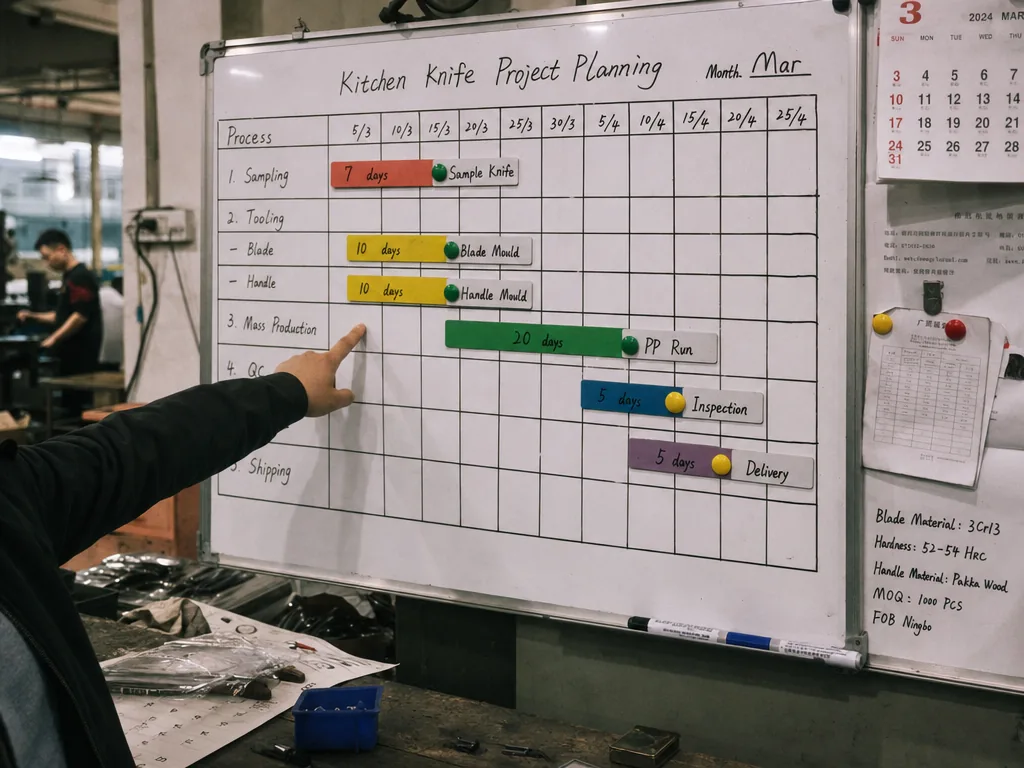
Buyers should request a milestone plan with dates for artwork approval, sample confirmation, packaging proof, mass production, final inspection, and vessel booking. If a supplier cannot map these steps, the quoted low MOQ may be operationally weak even if the price looks workable on paper.
MOQ planning for Amazon, importers, and procurement teams
Different buyer types should size MOQ differently. Amazon private label sellers prioritize listing velocity, review accumulation, and cash discipline. Importers care more about container optimization, replenishment cadence, and customer-specific packaging. Corporate procurement teams may focus on approval thresholds, vendor compliance, and landed cost predictability. The same knife OEM MOQ can be acceptable for one model and unworkable for another.
For Amazon-focused launches, a practical first order is often 500-1,000 pcs for a proven base model, especially where the product can be differentiated with packaging, accessory bundle, or branding rather than new tooling. For regional importers serving distributors, 1,000-3,000 pcs may be more rational because freight and QC economics improve. If the order is promotional or seasonal, lock artwork and delivery windows earlier than usual.
When benchmarking suppliers, ask these exact questions:
- What is MOQ by model, logo method, and packaging type?
- Can mixed sizes or colors be packed under one master PO?
- What are the tooling charges and are they refundable after volume milestones?
- What hardness range and finish tolerance do you control in mass production?
- Do you operate under ISO 9001 and provide final inspection to AQL 2.5?
Once you have the answers, use them to build an internal sourcing memo. Include MOQ, unit FOB price, packaging assumptions, tooling cost, sample lead time, production lead time, and defect standard. If you need project-specific numbers, the fastest path is to request quote with target volume, steel, packaging concept, and destination market listed up front.
A realistic MOQ framework buyers can use before placing the PO
A practical sourcing framework starts with defining the lowest acceptable customization level that still supports your market position. If your brand needs only logo visibility and compliant retail labeling, do not begin with a full custom build. Start from an existing platform, validate demand, then move into proprietary geometry or packaging once sell-through data justifies it.
A realistic decision model for custom branded knives looks like this:
- 300-500 pcs: suitable for stock knives, laser logo, simple carton labeling, low SKU count
- 500-1,000 pcs: suitable for private label launch with custom box, color variation, or bundle strategy
- 1,000-3,000 pcs: suitable for custom handles, premium packaging, or full OEM economics
- Above 3,000 pcs: strongest leverage for tooling amortization, price negotiation, and dedicated production planning
As a rule, use the first order to prove process control, not to maximize customization. Confirm actual HRC range, finish consistency, logo placement tolerance, carton drop performance, and barcode readability. Then use reorder volume to negotiate better terms: lower packaging surcharge, partial tooling credit, or improved payment structure such as 30/70 T/T against inspection. For established buyers, some factories will discuss OA terms after several clean cycles, but this is relationship-dependent.
The most realistic expectation is simple: if you want the lowest MOQ, keep the project close to existing production. If you want the deepest differentiation, prepare for higher minimums, longer lead times, and more approval steps.
Frequently asked questions
For a first run using an existing knife model with a laser logo and standard packaging, 300-500 pcs per SKU is realistic from many Chinese factories. If you add custom color parts or printed retail boxes, expect 500-1,000 pcs. Fully custom knives with new tooling usually start closer to 1,000 pcs and can go higher depending on complexity.
They may be quoting different customization scopes. One supplier may assume stock carton plus laser mark, while another includes custom box, insert, and export labeling. Their internal setup costs, subcontractor minimums, and production planning also vary. Always ask for MOQ split by knife body, logo process, and packaging so offers can be compared on equal terms.
Sometimes, but the economics are usually weak. The factory may agree only with high unit pricing, setup fees, or long lead times. Packaging vendors often impose their own minimums of 500-1,000 pcs per artwork. A better path is to use plain or shared packaging for the first PO, then upgrade to full custom packaging once reorder demand is proven.
Not always, but there is usually a meaningful break between small pilot volume and stable production volume. On common kitchen or folding knives, moving from 500 to 1,000 pcs can reduce unit cost by roughly USD 0.40-1.50 depending on steel, finish, and box type. Above that, savings continue but often at a slower rate unless tooling amortization is involved.
Look beyond price. Confirm hardness range, finish tolerance, logo placement standard, packaging spec, and final inspection terms such as AQL 2.5. Small lots can be more fragile because production losses and quality deviations have less buffer. A slightly higher MOQ can improve process stability and make inspection more reliable, which matters more than a small unit cost saving.
Get your project quoted
From a single SKU to a full product line, we can quote, sample and ship from our Zhejiang facility. Talk to a specialist who's worked on hundreds of buyer briefs.
Request a Quote