Custom knife production timeline is one of the first variables buyers need to lock before pricing, launch calendars, and freight plans can be trusted. For a standard private-label kitchen knife with existing geometry, total lead time may be 25-40 days after sample approval. For a fully customized knife with new molds, packaging, and compliance testing, 45-90 days is more typical.
The gap comes from engineering detail, not factory mood. Steel selection, hardness targets, surface finish, handle construction, logo method, carton spec, and AQL inspection all affect the knife manufacturing lead time. This article maps the knife OEM timeline from RFQ to vessel loading, with realistic day ranges, common delays, and the decision points that shorten or stretch a knife production schedule.
What sets the custom knife production timeline before production starts
Most schedule risk appears before the first blade is blanked. Buyers often ask how long to make a knife, but the factory can only answer accurately once the specification pack is complete. A useful RFQ should define blade steel grade, thickness in mm, hardness target in HRC, grind type, finish, handle material, rivet or full-tang construction, logo placement, packaging method, barcode requirements, and destination compliance needs.
For an existing factory model with minor branding changes, quotation can be issued in 1-3 working days. For a new structure requiring engineering review, allow 3-7 days. If you need geometry development rather than simple branding, the schedule should include concept review under the factory's ODM design workflow, where CAD confirmation, ergonomics, and manufacturability are checked before sampling.
- Fast-track case: Existing blade profile, standard 3Cr13 or 5Cr15MoV steel, laser logo, stock gift box. Pre-production phase: 5-10 days.
- Mid-complexity case: New colorway, custom handle mold insert, printed sleeve, Amazon FNSKU labels. Pre-production phase: 10-18 days.
- Complex case: New knife series, custom tooling, drop test validation, and retail packaging revisions. Pre-production phase: 15-30 days.
The buyer-side actions that save the most time are simple: approve technical drawings in one round, consolidate comments from sales and marketing, and lock carton and labeling specs before mass production starts. Revisions after sample sign-off usually cost more time than the sampling itself.
Knife OEM timeline: sampling, tooling, and approval milestones
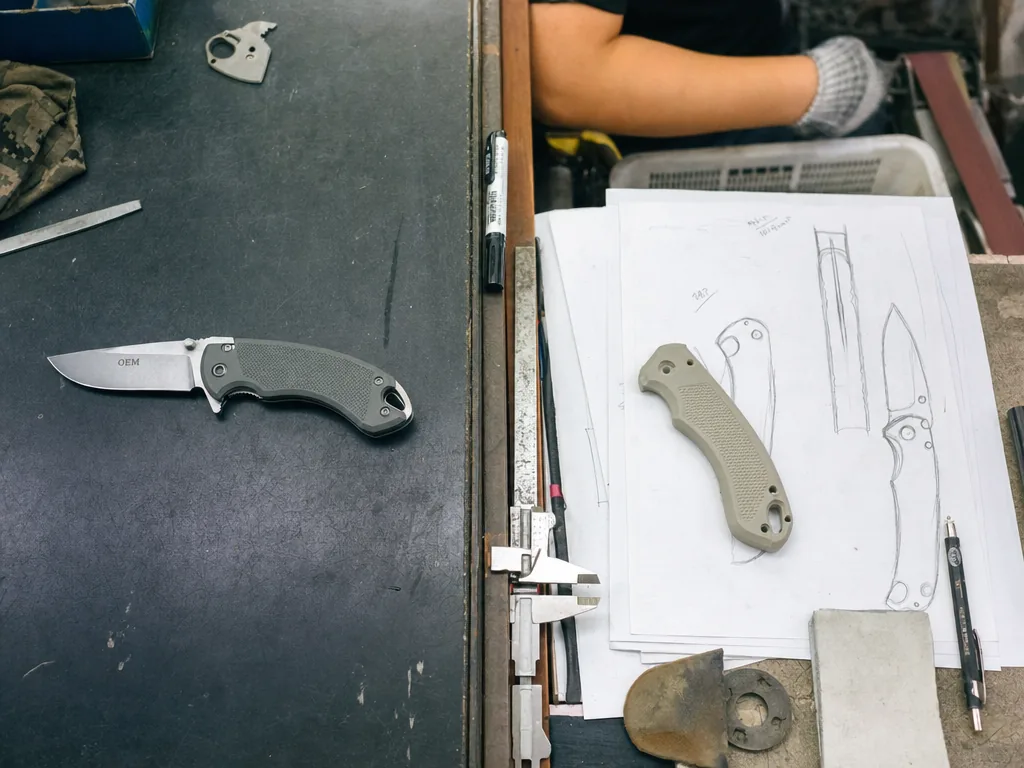
Sampling is the stage where estimated lead times become real. For knives based on open molds or existing dimensions, sample making usually takes 5-10 days. If the project requires a new handle mold, embossing die, or custom vacuum tray, tooling adds 7-20 days depending on complexity and supplier load. A simple steel stamp may be ready in 3-5 days; an injection mold insert may require 10-15 days plus trial adjustment.
Most factories break samples into two levels. The first is an appearance or engineering sample to confirm dimensions, logo size, finish, and assembly method. The second is a sealed pre-production sample, often called PPS, which becomes the reference standard for mass goods. Buyers using an OEM service should insist that the PPS records measurable criteria: blade length tolerance, total weight, edge angle, handle gap allowance, finish acceptance, and packaging count per carton.
Tooling fees vary widely. Basic logo dies may run USD 30-150. Packaging molds or tray tooling may be USD 100-500. New plastic handle molds can range from USD 1,500 to USD 8,000 depending on cavity count and complexity. These numbers do not always delay the project equally; packaging tooling can often run in parallel with blade sample approval.
The practical rule is this: do not count the knife production schedule from the day you send a logo. Count it from the day the factory receives final approved specifications and written sample confirmation.
Step-by-step custom knife production timeline on the factory floor
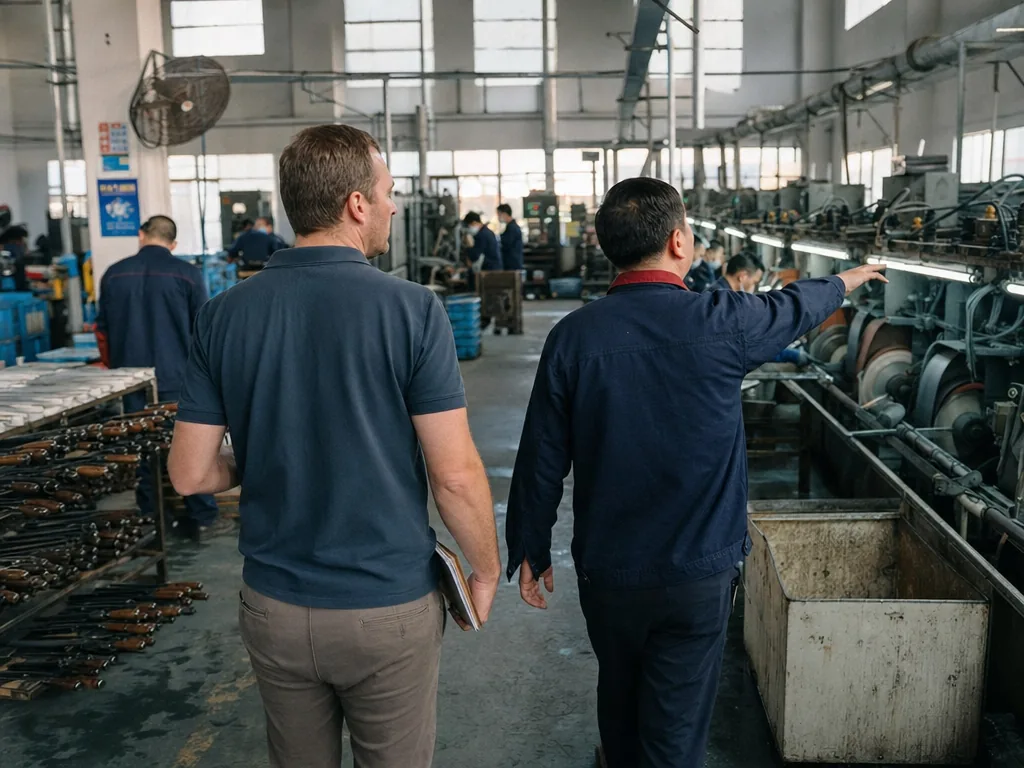
After PPS approval and deposit receipt, the production clock starts. A standard kitchen or utility knife order typically runs through material purchasing, blade forming, heat treatment, grinding, polishing, handle assembly, sharpening, marking, cleaning, packaging, and inspection. Buyers can review a supplier's manufacturing process to see where bottlenecks are likely to occur.
| Stage | Typical Duration | Main Variables |
|---|---|---|
| Raw material purchasing | 3-10 days | Steel grade availability, handle material, packaging suppliers |
| Blanking/stamping/CNC prep | 2-5 days | Knife geometry, batch size, die readiness |
| Heat treatment | 2-4 days | Steel type, target 54-58 HRC for common kitchen lines, rework rate |
| Grinding and beveling | 3-7 days | Finish level, edge angle, labor intensity |
| Polishing or stonewash/satin finish | 2-6 days | Cosmetic standard, scratch tolerance |
| Handle assembly | 2-5 days | Full tang vs molded handle, adhesive cure time |
| Logo, cleaning, sharpening | 1-3 days | Laser vs etch vs stamp, final edge standard |
| Packaging and carton pack-out | 2-5 days | Gift boxes, inserts, barcode labeling, carton drop requirements |
| Final inspection and rework buffer | 2-4 days | AQL level, defect rate, third-party inspection timing |
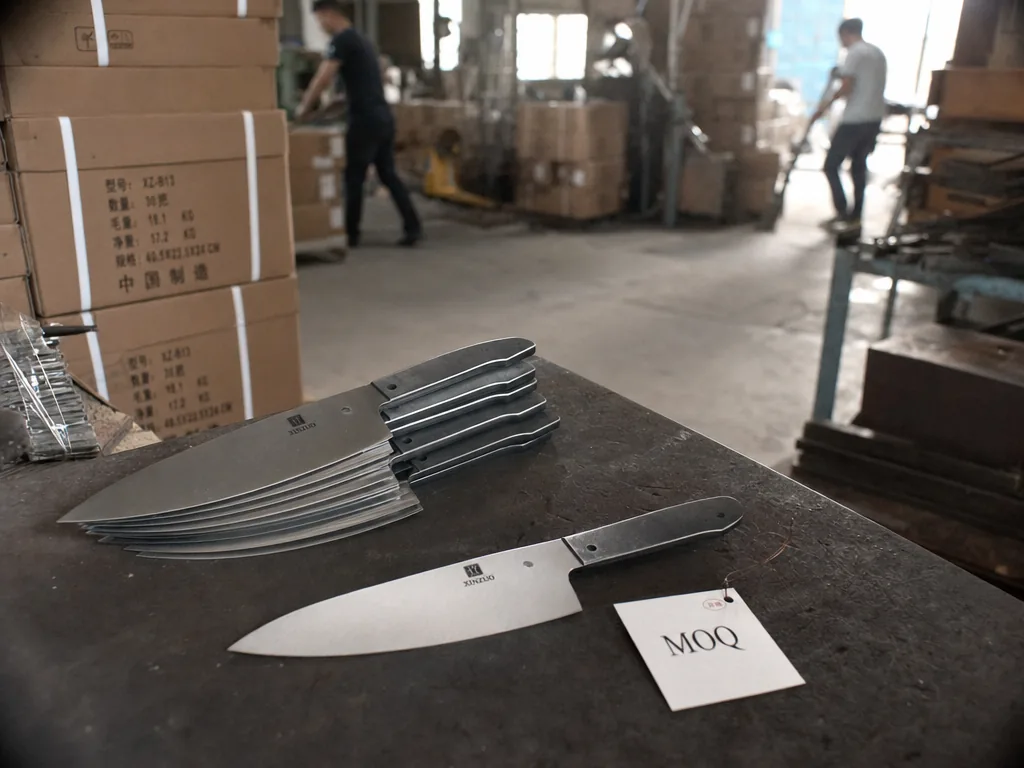
For an order of 3,000-5,000 pieces using common materials, this stage often totals 20-35 days. A 500-piece MOQ with mixed SKUs can take almost as long because line changeovers reduce efficiency. Conversely, a 10,000-piece single-SKU run may not scale linearly if polishing and sharpening become capacity constraints.
Knife manufacturing lead time by product type, MOQ, and finish
Not all knives move at the same speed. Product architecture changes labor content and quality risk. A stamped paring knife in 1.5-2.0 mm steel with PP handle can run much faster than a forged chef knife with pakkawood scales, mosaic pins, and premium gift packaging. Finish level matters as much as structure. Satin wash, mirror polish, black coating, or hammered texture each add different labor and inspection thresholds.
Below is a practical comparison for sourcing from China under normal factory loading conditions:
| Product type | Typical MOQ | Lead time after PPS | Notes |
|---|---|---|---|
| Stock model with custom logo | 300-500 pcs | 15-25 days | Fastest route; limited geometry changes |
| Stamped kitchen knife, custom color and box | 500-1,000 pcs | 25-35 days | Good balance of speed and brand customization |
| Forged kitchen knife, custom handle | 500-1,000 pcs | 30-45 days | More grinding and finishing time |
| Knife set with block or gift box | 300-1,000 sets | 35-50 days | Packaging and accessory sourcing extend schedule |
| Fully custom new model with tooling | 1,000-3,000 pcs | 45-90 days | Includes engineering, tooling trials, validation |
Seasonality also affects the knife manufacturing lead time. Before Canton Fair periods, Prime Day, and Q4 retail shipping deadlines, shared processes like polishing, assembly, and packaging usually tighten first. If your target ship date is fixed, book capacity 45-60 days earlier than you think you need, especially for mixed sets and gift-ready presentations.
Quality control checkpoints that stretch or protect the knife production schedule
Quality control does not only catch defects; it controls schedule risk. A disciplined factory inserts checks at incoming material, in-line processing, finished assembly, and packed goods. If the supplier waits until final inspection to measure hardness, edge symmetry, or handle gaps, rework can add 3-10 days. When checks are embedded earlier, the same issues are corrected in hours instead of days.
For knives, useful controls include steel certificate review, blade thickness verification, post-heat-treatment hardness testing, visual finish standards, balance and weight checks, logo legibility, corrosion spot checks, and carton count verification. Many importers still rely on final random inspection at AQL 2.5 for major defects and AQL 4.0 for minor defects. That is acceptable for many houseware programs, but products with stricter e-commerce review risk may benefit from tighter cosmetic criteria and 100 percent checks on logo orientation and barcode placement.
Factories operating under ISO 9001 systems generally document these points better, but buyers should still define defect standards in writing. Common knife defects include burrs after sharpening, uneven satin lines, off-center handles, glue overflow, coating pinholes, and carton labeling errors. A third-party final inspection usually needs 1-2 booking days plus the inspection day itself. If failures occur, expect 2-7 extra days for sorting and re-inspection.
The shortest schedules are usually not the cheapest quotes. They are the ones with fewer uncontrolled variables and a clear QC gate at every major process step.
Shipping, Incoterms, and the final week of the custom knife production timeline
Many buyers stop counting at production completion, but the last week often decides whether a launch lands on time. After final inspection pass, goods still need carton sealing, palletizing if required, export carton marking, booking confirmation, customs file preparation, and handoff to the forwarder. Under FOB China terms, factories typically need 2-5 days after inspection pass to prepare cargo for handover. Under DDP, supplier-managed logistics can save buyer coordination time but may reduce visibility if milestones are not documented.
Transit time should be segmented separately from production. As a working range, express air may take 5-10 days door to door, air freight 8-15 days, and ocean freight 25-40 days depending on route and customs congestion. For Amazon sellers, add prep and receiving variability at the destination. FBA check-in during peak periods can turn a 30-day production run into a 60-plus-day cash cycle.
- FOB: Better control over freight cost and routing if you already have a forwarder.
- EXW: Lowest apparent unit cost, but buyer manages pickup and export coordination.
- DDP: Easier landed-cost planning for smaller brands, but confirm customs liability and delay accountability.
A realistic launch plan should include a 10-15 percent time buffer on the full project, not just on manufacturing. If your knife OEM timeline is 35 production days and 30 ocean days, a 7-10 day contingency is not conservative; it is normal procurement practice.
How buyers shorten a custom knife production timeline without quality loss
Lead time compression works best when it removes waiting, not when it removes control. The biggest gains come from running parallel tasks. Packaging artwork can be finalized while samples are in transit. Carton spec approval can happen before the final blade polish standard is signed off. Third-party inspection can be pre-booked against the estimated completion date rather than arranged after notice.
Buyers can usually cut 5-12 days from the knife production schedule by doing the following:
- Approve one master specification sheet with version control instead of commenting through multiple spreadsheets and chat threads.
- Choose stocked steels and standard handle materials when launch timing matters more than novelty.
- Use existing blade geometry and customize branding, coating, color, and packaging first.
- Limit sample rounds to one engineering sample and one PPS unless a structural defect appears.
- Consolidate SKUs. Five color variants in one order often create more delay than a higher quantity of one color.
- Book shipping space before production ends during peak export windows.
For repeat orders, the benefit is even larger. Once tooling, work instructions, and approved quality limits are in place, replenishment orders may run in 15-30 days depending on material stock and line loading. Procurement teams should therefore separate first-order lead time from repeat-order lead time in any vendor scorecard. They are different operating conditions and should not be benchmarked as if they were the same.
Frequently asked questions
For a first order, expect 25-40 days after sample approval for a standard OEM knife using existing factory geometry. If the project includes new molds, custom trays, gift boxes, or multiple sample revisions, 45-90 days is more realistic. The biggest swing factors are tooling, packaging complexity, and how quickly the buyer approves PPS and artwork.
Sample lead time covers engineering review, prototype making, tooling trials if needed, and buyer approval. Mass production lead time starts only after PPS confirmation and deposit receipt. In practice, samples may take 5-20 days, while bulk production runs 20-45 days for common kitchen knife programs. Buyers should track these as separate schedule blocks.
Not always. A larger order can sometimes run more efficiently if it is a single SKU because setup losses are lower. A 5,000-piece order of one knife may ship faster than 1,000 mixed pieces across five variants. Lead time depends more on SKU complexity, finish level, and bottleneck capacity in polishing, assembly, and packaging than on unit quantity alone.
At minimum, buyers should require incoming material verification, post-heat-treatment hardness checks, dimensional review, visual finish checks, handle assembly control, sharpening consistency, and packaging verification. If these checks wait until final random inspection, any failure can trigger 2-7 days of rework. In-line control is the best protection for both quality and schedule.
A practical buffer is 10-15 percent on the total project timeline, including freight. For example, a 35-day production run plus 30-day ocean transit should carry at least 7-10 extra days. Peak season, custom packaging, and first-time SKUs may justify a larger buffer, especially when the delivery date is tied to retail launch windows or Amazon promotions.
Get your project quoted
From a single SKU to a full product line, we can quote, sample and ship from our Zhejiang facility. Talk to a specialist who's worked on hundreds of buyer briefs.
Request a Quote