OEM vs ODM knife manufacturing is not a branding nuance; it changes your cost structure, development timeline, intellectual property position, and launch risk. For knife importers, Amazon sellers, and established brands sourcing from China, the wrong model can add 30-90 days to development, force unnecessary tooling spend, or leave too little room for product differentiation.
At a practical level, OEM means the factory builds to your drawings, specifications, and brand requirements. ODM means the factory starts from an existing platform or in-house concept, then adapts it for your market. Both can produce compliant, high-quality knives, but they serve different business cases. This article breaks down where each model fits, how MOQs and unit economics usually differ, what quality controls matter at scale, and how procurement teams should compare offers before issuing a PO.
OEM vs ODM knife manufacturing: the operational difference
For procurement teams, the cleanest distinction is control over the product definition. In an OEM program, the brand supplies the technical package: blade length and thickness, steel grade, grind, heat-treatment target, handle material, logo method, packaging specification, and test criteria. The factory executes against that package through sampling, pilot run, and mass production. If you already have an industrial design, field feedback, or a SKU roadmap, an OEM service usually provides the best fit.
In an ODM program, the factory contributes the starting design. That could be a proven folding knife frame, a chef knife profile, or a handle architecture already engineered for production. The buyer then customizes selected elements such as colorway, blade finish, steel upgrade, logo placement, sheath, retail box, or accessory bundle. An ODM design service is typically faster because the supplier has already solved many engineering and manufacturing issues.
The distinction matters because it affects approvals, tooling, and revision cycles. OEM projects often need 2-4 rounds of prototype changes and 45-90 days before production release. ODM projects can move in 20-45 days when modifications are limited. The tradeoff is differentiation: OEM gives stronger exclusivity and feature control, while ODM lowers development risk by leveraging an existing production-ready platform.
- OEM: buyer-owned specification, higher development control, longer setup cycle.
- ODM: factory-originated platform, faster launch, lower upfront engineering burden.
- Shared reality: both models still require PP samples, approved golden samples, packaging sign-off, and shipment inspections.
When OEM knife factory programs make the most sense
An OEM knife factory program makes sense when the product itself is the brand asset. This is common for premium outdoor knives, kitchen knife sets with a defined ergonomic concept, or tactical lines where blade geometry and lock design drive the buyer decision. If your team needs specific steel such as 8Cr13MoV, 9Cr18MoV, 420J2, D2, or VG-10; targeted hardness windows like 56-58 HRC for 420J2 or 59-61 HRC for D2; and exact tolerances on blade thickness or handle fit-up, OEM gives the control needed to lock performance.
OEM is also better when you expect repeat orders above 3,000-5,000 units per SKU per year. The higher forecast helps absorb development expense such as molds, jigs, fixtures, test cutting, and custom packaging tooling. Depending on the knife category, upfront non-recurring engineering can range from USD 500 for simple artwork and packaging changes to USD 5,000 or more for new handle molds, custom hardware, or complex assembly fixtures.
Brand owners should still be realistic about complexity. A fully custom folding knife with unique handle scales, custom pivot hardware, laser logo, and molded gift box may require:
- Sample lead time: 15-30 days for first prototype
- Revision cycle: 7-15 days per round
- Mass production: 30-45 days after PP approval
- MOQ: often 500-1,200 units per model, depending on materials and packaging
If your team can define the product clearly and manage technical approvals, OEM builds stronger defensibility than a standard private label program.
Where ODM knife design delivers faster and lower-risk launches
ODM knife design is often the right commercial choice when speed, lower MOQ, and reduced development risk matter more than total product originality. Amazon sellers, regional distributors, and new knife brands frequently use ODM to validate demand before investing in custom tooling. The factory starts from a proven knife already engineered for manufacturability, then adjusts visible and marketable elements: logo, finish, scale material, packaging, color, or accessory configuration.
The biggest advantage is launch speed. If the blade shape, locking mechanism, and assembly method are already validated, a buyer can move from inquiry to approved sample in 10-20 days and into production in another 25-35 days. MOQ can also be lower, often 200-500 units for standard designs if the material stack remains unchanged. That can materially reduce cash exposure for first orders.
ODM also lowers technical failure risk. Factories already know the yield rate, heat-treatment behavior, and assembly sequence of an established model. That means fewer surprises around centering, lockup consistency, edge retention, or packaging fit. The compromise is weaker exclusivity. Even when cosmetic changes are significant, the underlying frame or silhouette may resemble products offered to other customers unless an exclusivity agreement is negotiated.
For many buyers, the practical path is phased: use ODM design service to test a category, collect sell-through data for 90-180 days, then migrate top sellers to OEM once the business case for deeper customization is proven.
OEM vs ODM knife manufacturing cost, MOQ, and lead-time comparison
Most sourcing decisions come down to three variables: capital at risk, launch speed, and margin potential. OEM usually has the higher setup cost but better long-term differentiation. ODM usually has the lower barrier to entry but tighter competitive spacing because other brands can access similar cores.
The table below reflects common ranges seen in China knife production for mid-volume export programs. Exact numbers vary by steel, complexity, packaging, and testing requirements.
| Factor | OEM Knife Program | ODM Knife Program |
|---|---|---|
| Product ownership | Buyer-defined spec and drawings | Factory-originated base design |
| Typical MOQ | 500-1,200 units/SKU | 200-500 units/SKU |
| Upfront development cost | USD 500-5,000+ | USD 0-1,500 |
| Sample lead time | 15-30 days | 10-20 days |
| Mass production lead time | 30-45 days | 25-35 days |
| Customization depth | High: geometry, materials, hardware, packaging | Medium: finish, logo, materials, packaging |
| Exclusivity potential | High, if documented | Medium to low unless contracted |
| Unit cost trend | Can improve at scale through design optimization | Competitive for small runs |
| Best fit | Established brands, differentiated SKUs | Fast launches, market testing, low-risk entry |
Buyers should compare quotations on a like-for-like basis: steel grade, HRC target, blade finish, handle resin or G10 grade, screw material, packaging board weight, inspection standard, and trade term such as FOB Shenzhen or DDP delivered. Without that normalization, apparent savings are often specification gaps.
Quality control in knife brand manufacturing under OEM and ODM
Whether the project is OEM or ODM, quality control should be documented at component, in-line, and pre-shipment stages. In knife brand manufacturing, the recurring failure points are usually not dramatic defects; they are consistency losses: uneven grind lines, off-center blades, scratch variation on stonewash surfaces, lock play, weak edge sharpness, glue overflow, and packaging damage under carton compression.
Buyers should require a control plan that covers measurable standards. Typical examples include blade hardness by steel type, salt-spray requirements for coated components, drop test standards for gift boxes, and edge sharpness acceptance based on test media agreed in advance. For final inspections, many importers use AQL 2.5 for major defects and AQL 4.0 for minor defects, with workmanship criteria attached to the approved golden sample.
Factories with ISO 9001 systems generally document process control more consistently, but the buyer still needs category-specific checkpoints. Recommended checkpoints include:
- Incoming material verification: steel certificate, handle material color match, packaging print confirmation
- In-process checks: grind symmetry, assembly torque, lock engagement, rivet or screw seating
- Functional checks: opening and closing action, centering, sheath retention, tip protection
- Final inspection: logo clarity, count accuracy, carton marks, barcode scan, moisture protection
If you are using an OEM service, add dimensional tolerance sheets to the PP approval. If you are buying ODM, insist that any material or finish upgrade be revalidated before mass production, because a steel change from 3Cr13 to D2 or a handle change from PP to G10 can alter yield and rework rates.
IP, exclusivity, and private label knife risk management
For many brand owners, the legal and commercial issue is less about OEM versus ODM in theory and more about what is actually protected in the contract. A private label knife launch can be commercially viable with either model, but only if artwork rights, tooling ownership, territorial exclusivity, and design-use restrictions are clearly defined. Verbal assurances are not enough.
In OEM, the buyer should state that custom drawings, logos, packaging files, and buyer-funded tooling are proprietary and cannot be used for third parties. In ODM, the same language may not apply to the base frame, because the factory originated it. Instead, exclusivity often attaches to a specific combination of materials, appearance, packaging system, or sales territory. Some suppliers will grant 6-12 months of exclusivity in a named market if annual volume targets are met.
Procurement teams should clarify these points before deposit payment:
- Who owns molds, fixtures, and CAD revisions funded by the buyer.
- Whether the factory may sell identical or substantially similar knives to other customers.
- What exclusivity applies by region, channel, or SKU configuration.
- Whether packaging artwork and UPC/EAN codes are isolated by account.
- What happens to leftover branded inventory after order completion.
For low-risk entry, some buyers start with a private label configuration on an ODM base, then move their best-selling SKU into a restricted OEM specification once reorder velocity justifies investment. That staged approach protects cash while tightening control over differentiation.
How to choose between OEM vs ODM knife manufacturing
The right model depends on your stage, forecast, and differentiation strategy. If your target is a fast launch with modest volume and limited engineering bandwidth, ODM is usually the more efficient route. If your target is a defendable product line with margin room and long-term brand equity, OEM is usually worth the extra setup time and cost.
A practical screening framework for buyers is:
- Choose OEM when: you need custom geometry, a unique handle architecture, a defined steel and HRC profile, or channel exclusivity; your annual forecast exceeds roughly 3,000 units per SKU; and your team can manage sample approvals.
- Choose ODM when: you need to launch in under 60 days, test a category with 200-500 units, or build an entry range without heavy tooling exposure.
- Use hybrid sourcing when: you want an existing chassis with custom blade steel, finish, packaging, and accessories, then a migration path into full OEM after validation.
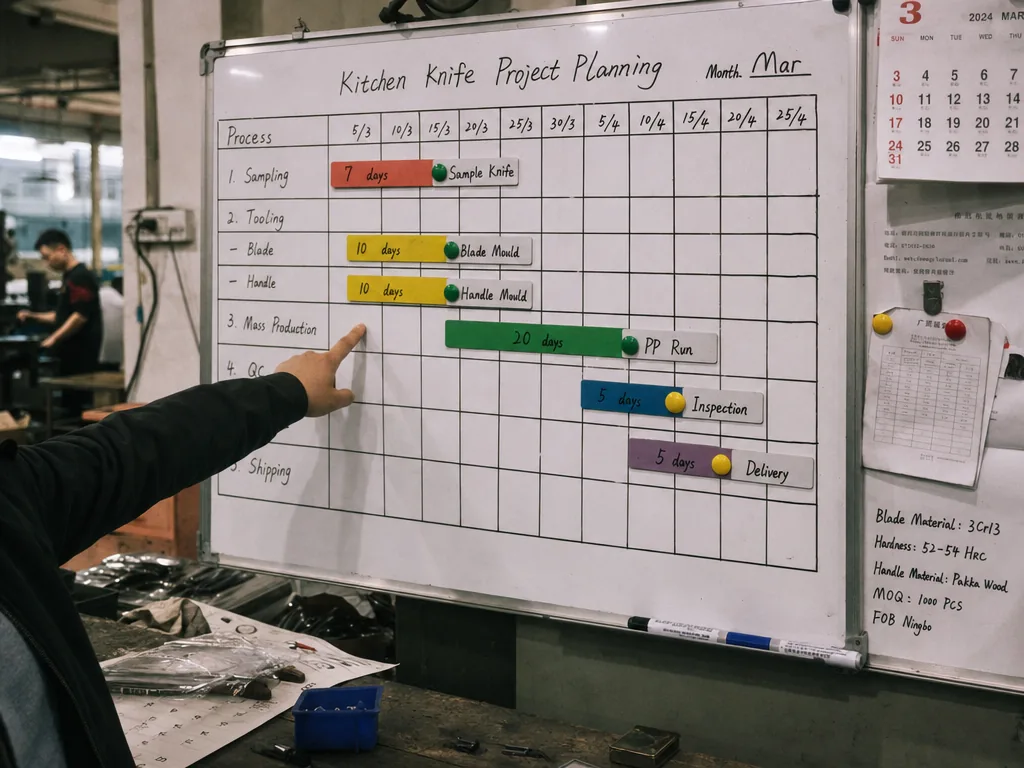
Before selecting a supplier, ask for three things: a specification sheet, a lead-time chart from sample to shipment, and a quotation broken down by unit price, packaging, tooling, and trade term. A capable factory should also explain how it handles PP sample approval, in-line QC, final AQL inspection, and shipping options such as FOB, CIF, or DDP.
For most importers, the choice is not ideological. It is a portfolio decision. Launch commodity-adjacent SKUs through ODM design service for speed, reserve OEM service for strategic hero products, and use private label only where standardization outweighs uniqueness.
Frequently asked questions
OEM means the buyer defines the knife specification and the factory manufactures to that requirement. ODM means the factory provides the base design and the buyer customizes selected elements. The operational difference is control: OEM offers more freedom on geometry, steel, and structure, while ODM offers faster launch and lower engineering burden.
Usually at the start, yes. ODM often has lower tooling cost, lower MOQ, and fewer prototype rounds, so first-order cash exposure is lower. Over time, OEM can become more cost-efficient if volume is high enough to justify optimized materials, packaging, and process design. The better question is total landed cost over the product lifecycle, not just first PO price.
For ODM-based programs, MOQ is commonly 200-500 units per SKU if the structure stays standard. For OEM, 500-1,200 units per SKU is more typical, especially if custom molds, hardware, or retail packaging are involved. Premium materials or mixed-color assortments can push MOQ higher because production planning and material utilization become more complex.
A realistic timeline is 15-30 days for first samples, plus 7-15 days for each revision round, followed by 30-45 days for mass production after PP approval. Ocean transit then depends on destination and trade term. Buyers trying to hit a seasonal window should work backward from the in-stock date and build buffer for sample corrections.
Yes, but only if the exclusivity is written into the supply agreement. A private label program can be exclusive by territory, channel, packaging configuration, or a specific material combination. Without that language, the supplier may be free to offer similar products to other customers. Exclusivity normally becomes easier to negotiate when annual volume commitments are credible.
Get your project quoted
From a single SKU to a full product line, we can quote, sample and ship from our Zhejiang facility. Talk to a specialist who's worked on hundreds of buyer briefs.
Request a Quote