Custom knife manufacturer China is a high-intent sourcing query because the decision is rarely about unit price alone. For importers, brand owners, and Amazon sellers, the real question is whether a supplier can repeatedly deliver the right steel, grind, finish, packaging, compliance, and shipment timing at commercial scale. A low quote that misses hardness, rust resistance, or packaging tolerances is expensive after freight, returns, and marketplace penalties are included.
This guide breaks supplier selection into eight practical checkpoints used in procurement: factory type, engineering capability, material control, process quality, inspection discipline, commercial terms, logistics readiness, and audit evidence. The goal is to help you compare an OEM knife factory China option on facts: HRC ranges, MOQ tiers, lead times in days, AQL plans, tooling amortization, and FOB versus DDP tradeoffs.
1) Confirm the custom knife manufacturer China business model fits your project
Start by identifying whether you are speaking to a true manufacturer, a trading company, or a hybrid. In knives, this distinction matters because development speed, tooling control, and corrective action usually sit with the factory, not the sales intermediary. A real producer should be able to explain its workshop flow in sequence: blanking or laser cutting, heat treat, grinding, surface finishing, handle assembly, sharpening, inspection, cleaning, packing, and carton control.
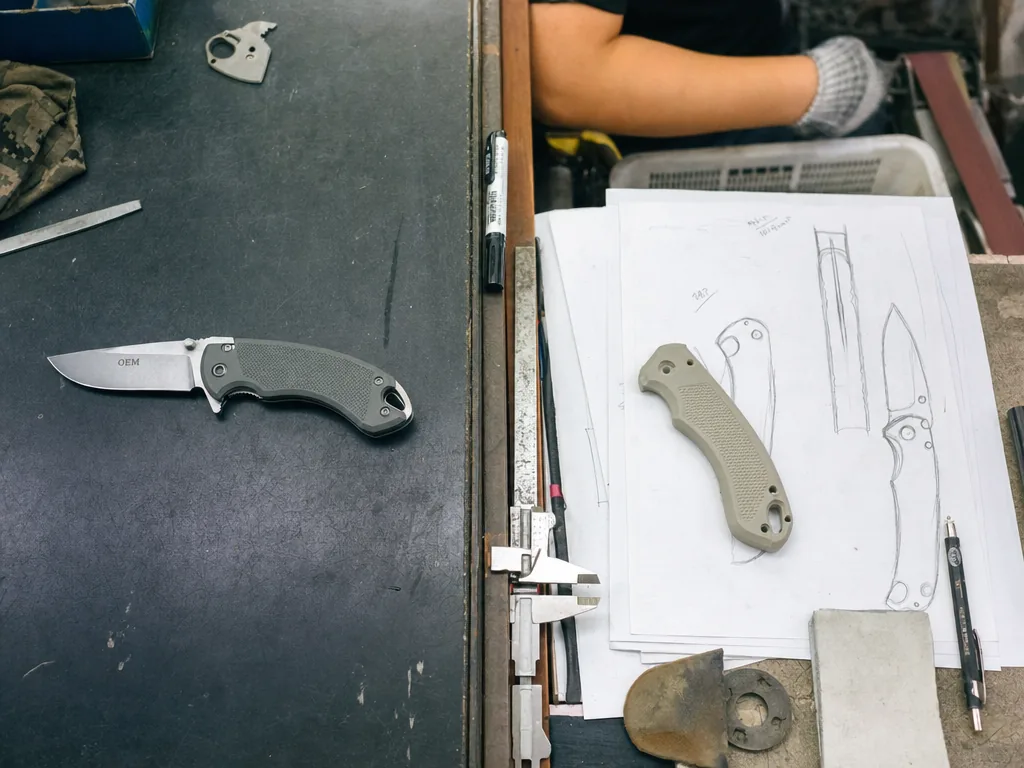
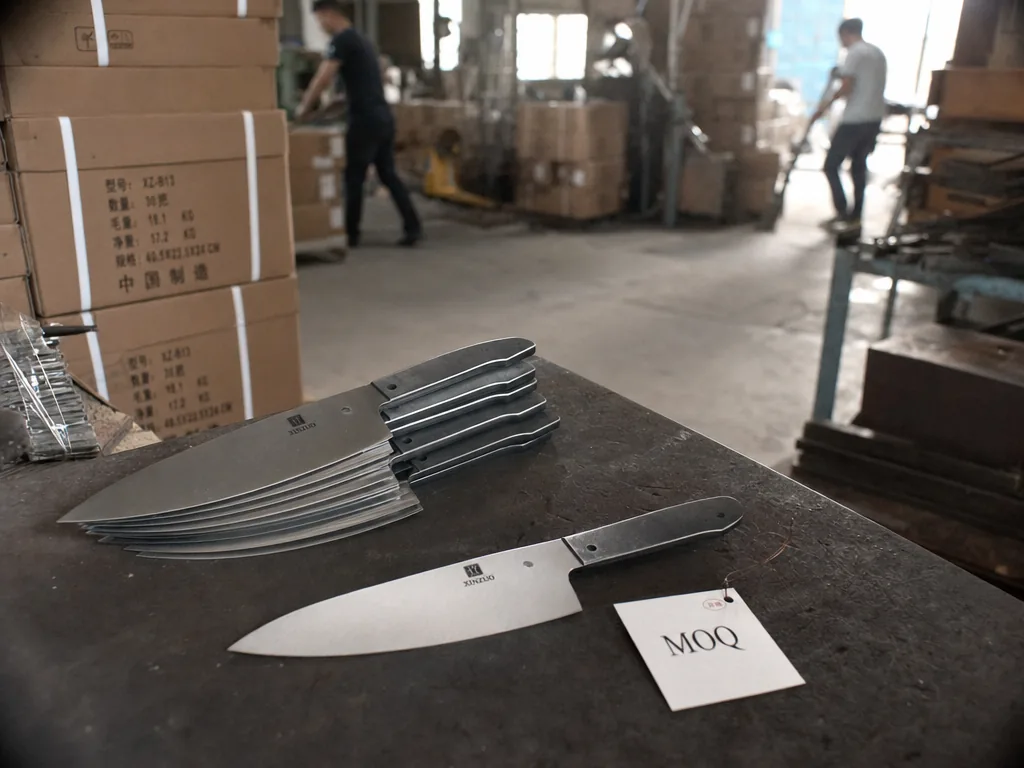
Ask for evidence beyond a catalog. Useful proof includes workshop photos by process, machine lists, monthly output by SKU family, and a documented factory tour. If they offer OEM knife manufacturing, they should also clarify what is done in-house versus outsourced, especially heat treatment, PVD/coating, injection molding, and packaging. Outsourcing is not automatically a problem, but unmanaged subcontracting increases variation and extends lead time.
- Good sign: supplier states in-house grinding, assembly, final inspection, and packing; subcontract heat treat to a named specialist with incoming hardness verification.
- Risk sign: supplier cannot specify who owns tooling, where blades are hardened, or how rework is tracked.
- Commercial impact: direct-factory projects often reduce communication loops by 2-4 days per revision cycle.
For small private-label runs under 2,000 units, a hybrid model can still work if project management is strong. For branded programs with repeat orders, factory transparency is usually the safer path.
2) Evaluate OEM knife factory China engineering and product development depth
Buyer problems often begin before production. If the supplier cannot convert your idea into an executable specification, quality drift is almost guaranteed. A capable OEM knife factory China partner should work from 2D drawings, 3D files, approved samples, or a detailed specification sheet covering blade length, stock thickness, steel grade, hardness target, handle material, finish, logo method, packaging dimensions, and drop-test requirements.
Ask how they manage design-for-manufacture. A practical engineering review should flag issues such as over-thin edge geometry for the chosen steel, poor fit-up between tang and scales, logo placement conflicts, and unrealistic cosmetic standards for stonewash or bead-blast finishes. For kitchen knives, common hardness windows are 54-56 HRC for tougher entry lines, 56-58 HRC for mainstream stainless programs, and 58-60 HRC for premium lines with tighter process control. Folding knives may use 57-59 HRC depending on steel and lock design.
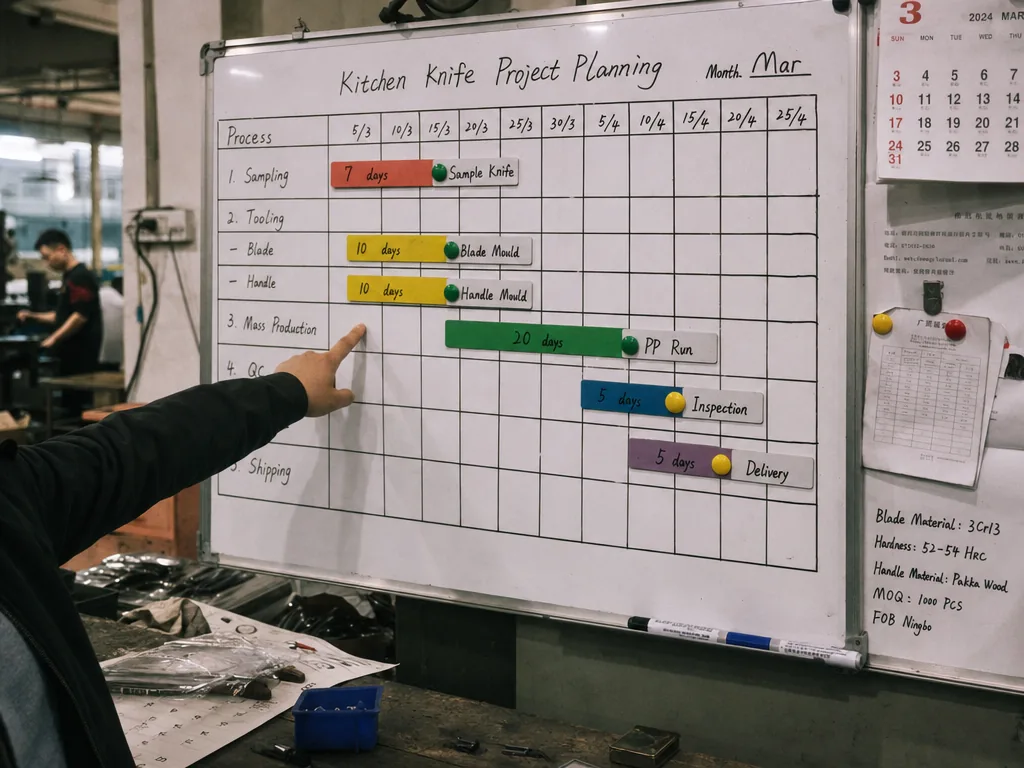
Prototype policy also matters. Typical development timing is 7-15 days for a simple logo sample, 15-30 days for a modified existing model, and 25-45 days where new molds, jigs, or handle tooling are required. Tooling can range from USD 150-500 for simple fixtures to USD 2,000-8,000 for complex molds. Ask who owns CAD files, who pays for tooling maintenance, and whether tooling cost is amortized over forecast volume. Strong engineering capability shortens mass-production debugging and lowers defect escape later.
3) Use knife supplier evaluation to verify material control and process capability
Material declarations should never be accepted at face value. In knife supplier evaluation, steel grade consistency and heat-treatment control are central because they drive edge retention, corrosion resistance, toughness, and warranty exposure. Request the supplier's incoming material process: mill certificate review, batch identification, storage segregation, and traceability from raw stock to finished lot. If they claim 3Cr13, 5Cr15MoV, 7Cr17MoV, 8Cr13MoV, 9Cr18MoV, D2, or 420J2, ask how they verify chemistry when needed and how mixed-stock risk is prevented.
Heat treatment deserves special scrutiny. The factory should specify target hardness by SKU and the tolerance window, for example 56-58 HRC with test points per batch. Ask how many blades are hardness-tested per lot, where on the blade they test, and what happens if a lot falls outside target. For coated blades, confirm whether hardness is tested before coating and whether coating adhesion is checked using a tape or abrasion method.
| Checkpoint | What to Ask | Typical Acceptable Range | Risk if Weak |
|---|---|---|---|
| Steel traceability | Can raw material batches link to finished lots? | Lot-level records retained 12-24 months | Mixed steel claims, recall difficulty |
| Hardness control | What HRC target and tolerance apply? | Usually ±1 to ±2 HRC | Soft edges or brittle failures |
| Thickness tolerance | How is blade stock verified? | Often ±0.05 to ±0.15 mm | Weight and balance drift |
| Finish consistency | How are scratches and color variation classified? | Golden sample plus defect standard | High cosmetic reject rate |
If a supplier cannot explain process capability in numbers, assume variation will show up at the customer end.
4) Run a Chinese knife factory audit focused on QC, AQL, and corrective action
A Chinese knife factory audit should go beyond social photos and a business license. The operational core is quality management: incoming inspection, in-process control, final inspection, defect classification, and corrective-action closure. ISO 9001 helps, but certification alone is not enough. Ask to see actual inspection forms, control plans, and examples of nonconformance reports. A credible factory should define critical, major, and minor defects and map them to an AQL sampling plan.
For most consumer knife shipments, buyers use AQL 2.5 for major defects and 4.0 for minor defects, with zero tolerance on critical safety defects. The supplier should be comfortable discussing the exact sample size by lot quantity and the acceptance/rejection thresholds. If they already operate formal AQL inspection procedures, ask where inspection occurs: pre-production, first article, inline, pre-shipment, or all four. Also ask whether carton drop tests, salt-spray checks, dishwasher disclaimers, and barcode scans are included where relevant.
- Audit item: calibration records for hardness testers, calipers, torque tools, and weighing scales.
- Audit item: rework area segregation to prevent mixed good/bad stock.
- Audit item: CAPA timing, such as 24-48 hours for containment and 5-10 working days for root-cause closure.
- Audit item: document control for approved samples and packaging masters.
If the factory cannot produce recent inspection reports with lot numbers and defect photos, it is difficult to trust verbal QC claims.
5) Compare knife manufacturer selection on MOQ, pricing logic, and total landed cost
Price comparisons fail when quotations are not normalized. In knife manufacturer selection, build a bid sheet that forces apples-to-apples review across blade steel, blade thickness, hardness, handle material, finish, logo application, packaging spec, and delivery term. A quote that looks 12 percent lower may simply exclude gift box assembly, spare screws, silica gel, barcode labeling, or export carton upgrades.
Typical MOQ tiers vary by project type. For stock models with logo customization, MOQ can start around 300-500 pcs per SKU. For modified handles, coatings, or custom packaging, 500-1,000 pcs is common. Fully custom programs with new molds often start around 1,000-3,000 pcs, depending on tooling intensity and component count. Lead times are often 7-15 days for samples and 30-55 days for bulk after sample approval and deposit, extending during peak seasons.
Costing should also distinguish EXW, FOB, CIF, and DDP. FOB may appear cheaper but shifts booking and destination costs to the buyer. DDP can simplify Amazon replenishment but often bundles less-visible charges and leaves less routing control. Ask for a cost breakdown covering unit price, tooling, sample fee, packaging, testing, inland trucking, export documents, and payment charges.
Commercial discipline matters as much as the number. Standard payment terms are often 30 percent deposit and 70 percent balance before shipment; larger repeat buyers may negotiate OA or reduced deposits. If a supplier underprices heavily on the first order, test whether they are buying the business or have actually engineered a sustainable cost structure.
6) Assess compliance, packaging, and shipment readiness before PO placement
Many delays happen after production is complete. The knives may be ready, but packaging, marks, documents, or destination requirements are not. A reliable supplier should ask early about market destination, labeling language, carton constraints, and retailer-specific rules. Amazon sellers should confirm FNSKU placement, suffocation warnings where needed, master carton dimensions, carton weight limits, and whether palletization or appointment booking support is required.
For branded importers, packaging controls should include approved artwork sign-off, color standard references, barcode verification, and transit testing where presentation boxes are part of the product value. If your product includes wood handles, ask whether fumigation or phytosanitary concerns apply to any packing materials used in export cartons or pallets. If batteries or magnets are included in accessories, shipping classification changes and documentation must be addressed before cargo handover.
Shipment readiness also means document readiness. At minimum, the factory should routinely issue commercial invoice, packing list, carton marks, and COO where requested. Better suppliers can coordinate test reports, inspection records, and destination-specific documentation through the same project owner. On lead time planning, leave margin for rework and booking volatility: production may take 35 days, but vessel space, truck booking, and customs cutoffs can add 5-12 more days before departure. Procurement teams that validate these details pre-PO avoid expensive storage and missed launch windows.
7) Score the custom knife manufacturer China shortlist with a weighted checklist
The most practical sourcing method is to score each supplier against the same weighted criteria. This reduces bias toward the lowest price or the most responsive salesperson. For a custom knife manufacturer China shortlist, use a scorecard where technical capability and quality systems outweigh unit cost on strategic programs. A sample weighting model is below.
| Criterion | Weight | What Good Looks Like |
|---|---|---|
| Engineering and sampling | 20% | Fast DFM feedback, clear drawings, sample revisions in 7-30 days |
| Material and heat-treat control | 20% | Lot traceability, target HRC defined, routine verification records |
| QC and audit performance | 20% | ISO 9001 discipline, AQL 2.5 familiarity, corrective actions documented |
| Commercial competitiveness | 15% | Transparent quote, sustainable pricing, workable MOQ and payment terms |
| Capacity and delivery reliability | 15% | Realistic lead times, peak-season planning, low schedule slippage |
| Communication and project ownership | 10% | Single accountable PM, 24-hour response, issue escalation path |
Run at least two rounds: an initial document review, then a sample-and-audit round. Eliminate any supplier that fails on safety, traceability, or document consistency, even if pricing is attractive. For most buyers, the best supplier is not the cheapest one. It is the factory that protects margin by preventing failures, shortening development cycles, and keeping reorder performance stable over 12-24 months.
Frequently asked questions
For existing models with logo customization, MOQ is often 300-500 pieces per SKU. Modified finishes, packaging, or handle materials typically move MOQ to 500-1,000 pieces. Fully custom knives with new tooling often start around 1,000-3,000 pieces. The exact threshold depends on tooling, component complexity, and whether packaging is bespoke.
A simple logo sample may take 7-15 days. A modified existing knife usually needs 15-30 days, while fully custom development with molds or fixtures can require 25-45 days. Bulk production commonly runs 30-55 days after sample approval and deposit. Add extra time for peak season, rework, and vessel booking.
Many importers use zero tolerance for critical safety defects, AQL 2.5 for major defects, and AQL 4.0 for minor defects. The supplier should understand sampling plans by lot size and have clear defect definitions for blade damage, loose handles, coating failure, rust spots, and packaging issues. Inline and pre-shipment checks are both recommended.
Ask for mill certificates, lot traceability records, and the supplier's incoming inspection method. Then verify the heat-treatment plan: target HRC, tolerance, test frequency, and where on the blade the test is taken. For higher-risk programs, use third-party lab checks on chemistry or hardness for pre-shipment confirmation, especially on first orders.
FOB gives the buyer more control over freight routing, destination charges, and forwarder selection. DDP can be useful for Amazon or smaller teams that want a simpler door-to-door model. The tradeoff is transparency: DDP often hides cost components and reduces buyer control. Compare both options on total landed cost and schedule reliability.
Get your project quoted
From a single SKU to a full product line, we can quote, sample and ship from our Zhejiang facility. Talk to a specialist who's worked on hundreds of buyer briefs.
Request a Quote