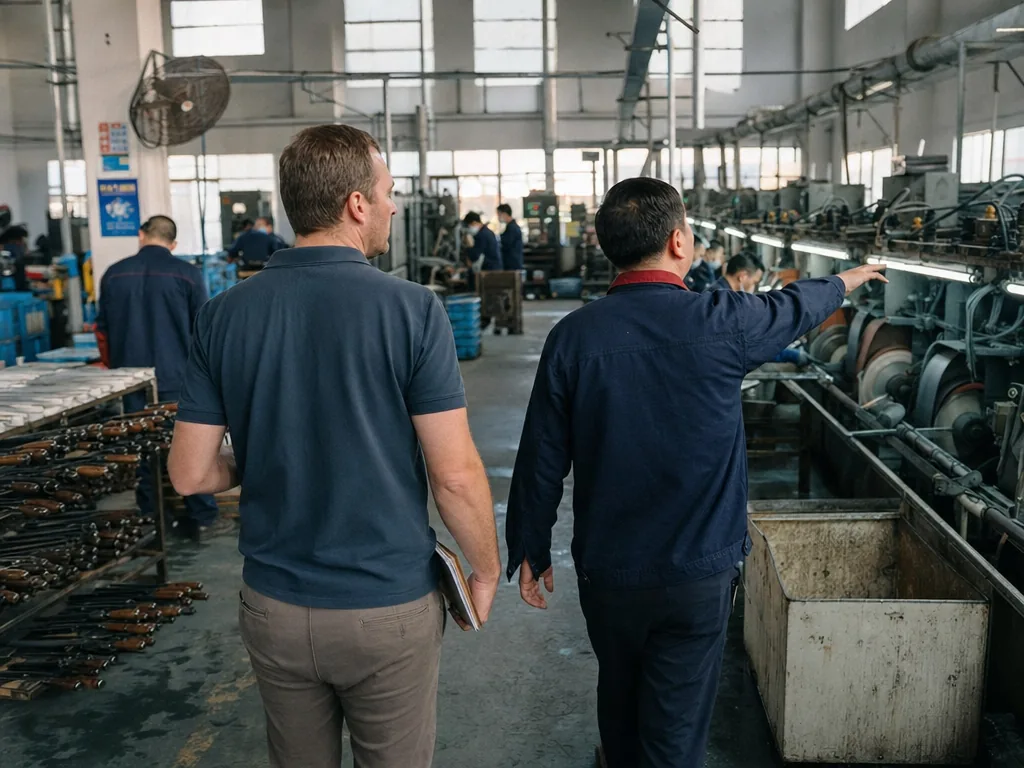
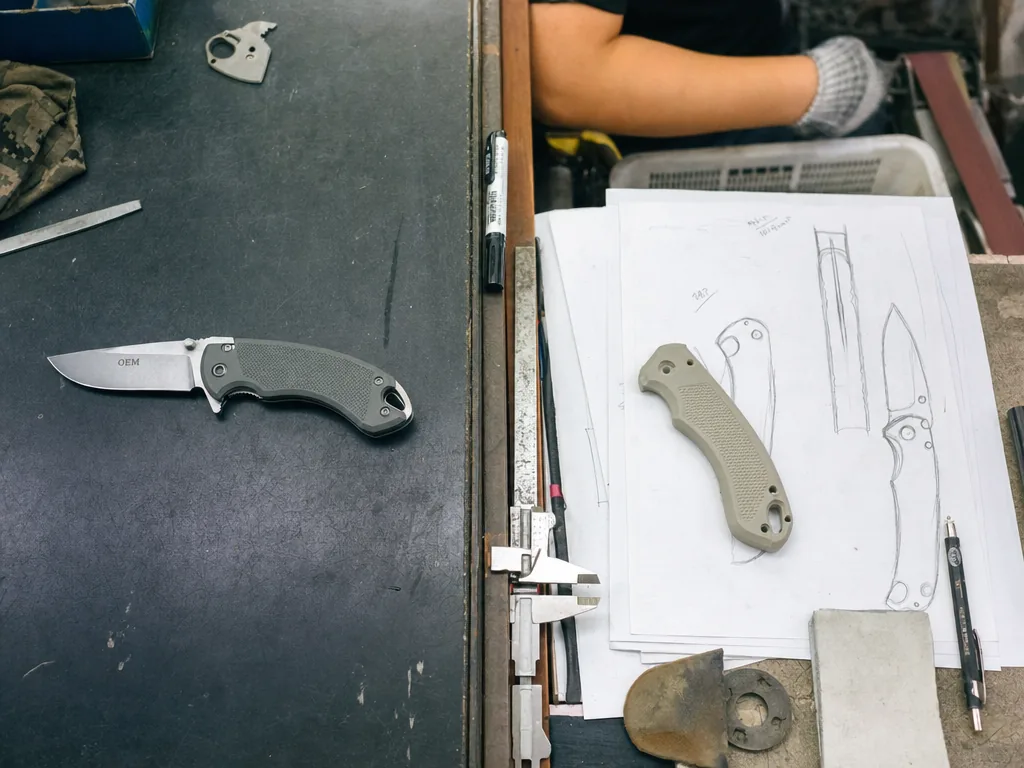
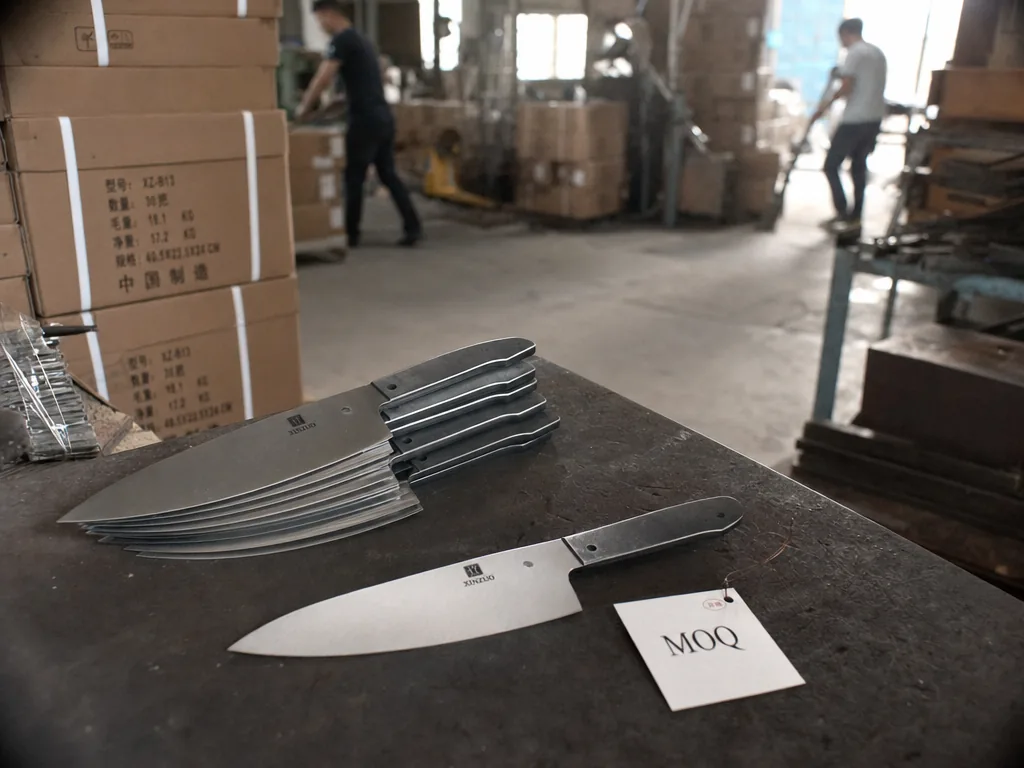
Best Japanese chef knife decisions look different for a procurement team than they do for a home cook. If you are sourcing for retail, Amazon, or private label, the relevant questions are not only edge retention and finish quality, but also MOQ, repeatability, QC escape rate, packaging cost, MAP pressure, and whether the specification can be controlled at factory level.
This guide compares Shun, Miyabi, Global, Mac, and Tojiro against custom Japanese-style OEM supply from China. The goal is practical: show where branded Japanese chef knife brands justify their premium, where they constrain margin, and when a custom program gives a better outcome. Benchmarks below use common buyer metrics including HRC range, FOB cost bands, 35-60 day production windows, AQL 2.5 inspections, and ISO 9001 process discipline.
How buyers should rank the best Japanese chef knife options
For consumers, the best japanese chef knife is often the one with the strongest story, the prettiest Damascus, or the sharpest factory edge out of the box. For a buyer, ranking needs a different framework. The right scorecard combines brand pull, gross margin, specification control, complaint risk, and replenishment speed. That is why a famous Japanese label may be commercially weaker than a custom OEM program, even when its retail perception is stronger.
A practical ranking model uses six weighted factors: steel and hardness consistency, geometry and grind repeatability, branding power, landed cost, MOQ flexibility, and supply chain responsiveness. In most mid-premium channels, a 210 mm gyuto selling at USD 89-149 retail must land with enough margin to absorb Amazon fees, returns, and promo spend. A branded import may arrive with excellent finish, but if distributor pricing leaves only 18-28% gross margin, the program is hard to scale.
Custom sourcing changes the equation because the buyer can specify blade thickness, 13-15 degree edge angle, handle material, logo process, and packaging. That is where a partner offering chef knife OEM programs becomes relevant. You are not only buying knives; you are buying control over cost structure, lead time, and defect prevention. The rankings below reflect that commercial reality rather than culinary nostalgia.
Best Japanese chef knife brands ranked by channel fit and margin
From a pure product reputation standpoint, Shun and Miyabi usually lead awareness in Western premium retail. Global stays strong in professional kitchens, Mac has a loyal performance-led following, and Tojiro remains the value benchmark. But for importers and private label sellers, the question is not simply which japanese chef knife brands are most admired. It is which can support profitable and defensible assortment building.
| Rank | Brand / Model Family | Typical Steel | HRC | Channel Strength | Buyer Constraint |
|---|---|---|---|---|---|
| 1 | Tojiro DP / similar | VG-10 clad | 60-61 | Value specialty retail, online | Limited differentiation, price competition |
| 2 | Mac Professional | Molybdenum / proprietary alloys | 58-60 | Chef-driven demand, low return risk | Moderate brand awareness outside pro segment |
| 3 | Global Classic | Cromova 18 | 56-58 | Distinctive design, strong recognition | Handle ergonomics divide buyers, less premium hardness |
| 4 | Miyabi lines | VG-10, SG2, FC61 | 60-63 | Premium department and gift retail | Higher acquisition cost, margin compression |
| 5 | Shun Classic / Premier | VG-MAX, VG-10 | 60-61 | Strong US awareness, giftable finish | MAP pressure, crowded reseller landscape |
| 6 | Custom OEM Japanese-style chef knives | 5Cr15MoV to 10Cr15CoMoV, VG-10, 9Cr18MoV | 56-62 | Private label, bundles, exclusive sets | Requires spec discipline and QC management |
That last entry ranks lower only if the buyer lacks sourcing discipline. With a capable factory and clear QA protocol, OEM often becomes the strongest business model. Using documented OEM manufacturing workflows, buyers can build a Japanese chefs knife line with exclusive geometry, packaging, and margin that a distributor-led import cannot match.
What Shun, Miyabi, Global, Mac, and Tojiro each do well
Shun wins on presentation and familiarity. Its layered finish, pakkawood handles, and broad US retail presence make it easy to merchandise. Typical hardness around 60-61 HRC supports a sharp out-of-box impression, but distributor economics can be tight for third-party sellers. Miyabi is usually the most refined in visual finishing, especially in SG2 or higher-end lines at 61-63 HRC, with cleaner polish and stronger premium positioning. The tradeoff is acquisition cost and tighter audience size.
Global is commercially distinctive because the all-stainless hollow handle remains recognizable at a distance. That matters in retail photography and storefront differentiation. However, the softer 56-58 HRC range limits the premium cutting narrative versus harder Japanese profiles. Mac is a quieter brand but arguably one of the safest operational choices: thin grinds, reliable performance, lower complaint rates, and less ornamental finish that can hide inconsistency.
Tojiro remains the benchmark for value. A VG-10 clad 210 mm gyuto often signals the best ratio of perceived quality to shelf price, which is why many importers use it as a competitive reference. If you need a quick steel benchmark, start with a blade steel comparison against VG-10, AUS-10, 9Cr18MoV, and 10Cr15CoMoV. For buyers entering the japanese damascus knife segment, Tojiro-level value is frequently the price ceiling consumers already understand.
Where custom OEM beats the best japanese chef knife labels
Custom OEM becomes commercially superior when the buyer needs exclusivity, controllable margin, and repeatable replenishment. A Japanese-style 210 mm chef knife built in China can be configured with 9Cr18MoV at 58-60 HRC for entry premium, 10Cr15CoMoV at 60-62 HRC for sharper performance positioning, or layered VG-10 for a premium story. FOB cost commonly ranges from USD 5.80-8.50 for simple satin models, USD 9.50-16.00 for hammered or layered finishes, and USD 18.00-32.00 for more developed japanese damascus knife executions with upgraded packaging.
MOQ flexibility is the larger advantage. Branded imports usually force the buyer into distributor cartons and fixed assortments. OEM factories can often start around 300-500 pieces per SKU, with 1,000+ pieces unlocking better handle materials, custom boxes, laser or etch logos, and accessory bundles. Lead time is typically 7-15 days for sampling, 35-50 days for repeat production, and 45-60 days when new molds or packaging structures are involved.
OEM also lets a brand match knife type to channel. A thinner 2.0-2.2 mm spine gyuto works for culinary enthusiasts; a sturdier 2.4-2.8 mm profile reduces tip breakage and return rates in mass online sales. Buyers exploring Damascus knives can develop differentiated face patterns without inheriting the resale restrictions and channel conflict of established labels.
Steel, hardness, and japanese chef knife types that matter in sourcing
Most buyers do not need the broadest possible catalog of japanese chef knife types. They need the three that sell: 210 mm gyuto, 180 mm santoku, and 150 mm petty. These cover the bulk of Western retail and Amazon demand. A gyuto usually carries the premium hero role, santoku drives higher unit volume in general home-use sets, and petty knives lift average order value when bundled. Deba, yanagiba, and kiritsuke are useful image builders but rarely the volume core outside niche culinary distribution.
Steel choice should match price architecture, not internet mythology. Entry-tier private label often works best in 5Cr15MoV or 7Cr17MoV at 55-57 HRC because it sharpens easily and controls cost. Mid-tier programs generally move to 9Cr18MoV or AUS-10 equivalents at 58-60 HRC. Premium Japanese-style lines often target 10Cr15CoMoV or VG-10 at 60-62 HRC. Above that, SG2 and powdered steels can impress, but they also raise grinding cost, scrap risk, and warranty sensitivity.
For procurement, the issue is repeatability. A knife specified at 61 HRC but produced with inconsistent heat treatment will generate more complaints than a stable 58.5 HRC program. Ask for hardness test records, edge retention benchmarks, and corrosion test notes. On the line, define acceptable variance for blade thickness, distal taper, and edge symmetry before PO release, not after the first failed inspection.
QC, compliance, and landed-cost controls for japanese chef knife sourcing
A credible sourcing decision depends less on brochure claims and more on process control. At minimum, buyers should require incoming material traceability, in-process hardness checks, and final inspection under AQL 2.5 with major and minor defect thresholds clearly stated. Common defects include over-grind at the heel, off-center tips, wavy bevels, gaps at bolster-to-handle junctions, unstable pakkawood color, and cosmetic rust from poor post-wash drying. None of these are rare. All of them are manageable when the factory uses standard work and closes feedback loops.
Ask whether the supplier operates under ISO 9001 or equivalent documented quality systems. That does not guarantee sharp knives, but it usually improves document control, corrective action handling, and lot traceability. Packaging also deserves procurement attention. A rigid gift box may add USD 1.20-2.80 per unit, while a basic color carton may stay under USD 0.45. If you sell on Amazon, the extra packaging cost may reduce damage claims enough to justify itself.
Landed cost needs to be modeled with Incoterms from the start. FOB is usually the cleanest basis for comparing factories; DDP can simplify small-market launches but may hide margin inside freight and duty assumptions. Before scaling, run a pilot order, inspect pre-shipment, and confirm whether the factory can hold repeat orders inside a 35-45 day window without quality drift. That is what separates a usable OEM source from a sample-only performer.
Which route is the best japanese chef knife strategy for your business
If your business model depends on immediate trust transfer, low content burden, and premium visual merchandising, branded Japanese imports still make sense. Shun and Miyabi help in department-store style channels where packaging, finish, and name recognition justify a higher ticket. Mac and Global suit more performance-led assortments. Tojiro is still the sharpest reference point for value-driven specialty retail.
But if you need a brand asset rather than a resale catalog, OEM is usually the better long-term strategy. It gives you control over the exact japanese chef knife geometry, handle shape, blade finish, hardness target, accessory bundle, and box design. More important, it gives you margin room. A knife landing at USD 11-15 with a clear premium spec and disciplined QC can sell at USD 69-119 with healthier contribution than a branded item bought through distribution.
The best japanese knife brand for a buyer is therefore not always a famous Japanese trademark. It is the supply model that fits your channel economics. Importers, brand managers, and Amazon sellers should compare not only reputation, but also MOQ, replacement rate, lead-time stability, and whether the factory can execute the same edge and finish on the fifth order that it did on the first.
Frequently asked questions
It depends on your channel. Branded imports work when you need instant recognition and can tolerate lower margin. Private label works better when you need exclusivity, better contribution per unit, and tighter control over steel, handle, finish, packaging, and replenishment. Most Amazon and direct-to-consumer sellers scale faster with OEM than with reseller inventory.
For most commercial programs, 58-60 HRC is the safest operating range because it balances sharpness, toughness, and lower complaint rates. Premium lines can push to 60-62 HRC in VG-10 or 10Cr15CoMoV for stronger edge retention. Going harder than that increases brittleness risk, sharpening sensitivity, and production scrap unless the factory has very stable heat treatment.
A realistic starting MOQ is 300-500 pieces per SKU for standard constructions. More custom packaging, special handles, or new molds usually move the efficient MOQ closer to 1,000 pieces. Sampling often takes 7-15 days. Production is commonly 35-50 days for repeat styles and 45-60 days for new-development programs with packaging approval.
Use a written checklist and inspect to AQL 2.5. Check hardness records, blade straightness, edge symmetry, polish consistency, handle gaps, logo placement, corrosion spots, and packaging drop resistance. For Amazon programs, also inspect carton labeling and barcode accuracy. A pre-shipment inspection is cheaper than absorbing returns caused by poor grind consistency or cosmetic defects.
Usually yes, if your market is gift-oriented or visually driven. Layered or etched Damascus can lift perceived value materially, often supporting a larger retail price increase than the added FOB cost. The key is to verify whether the pattern is genuine layered construction or decorative surface treatment, because that affects both product claims and long-term customer trust.
Get your project quoted
From a single SKU to a full product line, we can quote, sample and ship from our Zhejiang facility. Talk to a specialist who's worked on hundreds of buyer briefs.
Request a Quote