Damascus steel manufacturing matters because the visual pattern sells the knife, but the process behind that pattern determines edge retention, corrosion resistance, warranty rate, and landed cost. For importers and private label buyers, the relevant questions are practical: which steels are combined, whether the pattern is laminated or true pattern-welded, how the core is heat treated, and what level of process control the factory maintains.
This article explains how Damascus is made in production environments, including billet construction, forging or stock-removal routes, 67 layer Damascus structures, VG-10 Damascus cladding, hardness targets, tolerances, and inspection checkpoints. It also covers the commercial side: MOQ bands, lead times, AQL 2.5 inspection, and where visual appeal justifies extra unit cost. The objective is simple: help procurement teams specify Damascus knives that look right, cut consistently, and survive scale.
What Damascus steel manufacturing actually means in knife production
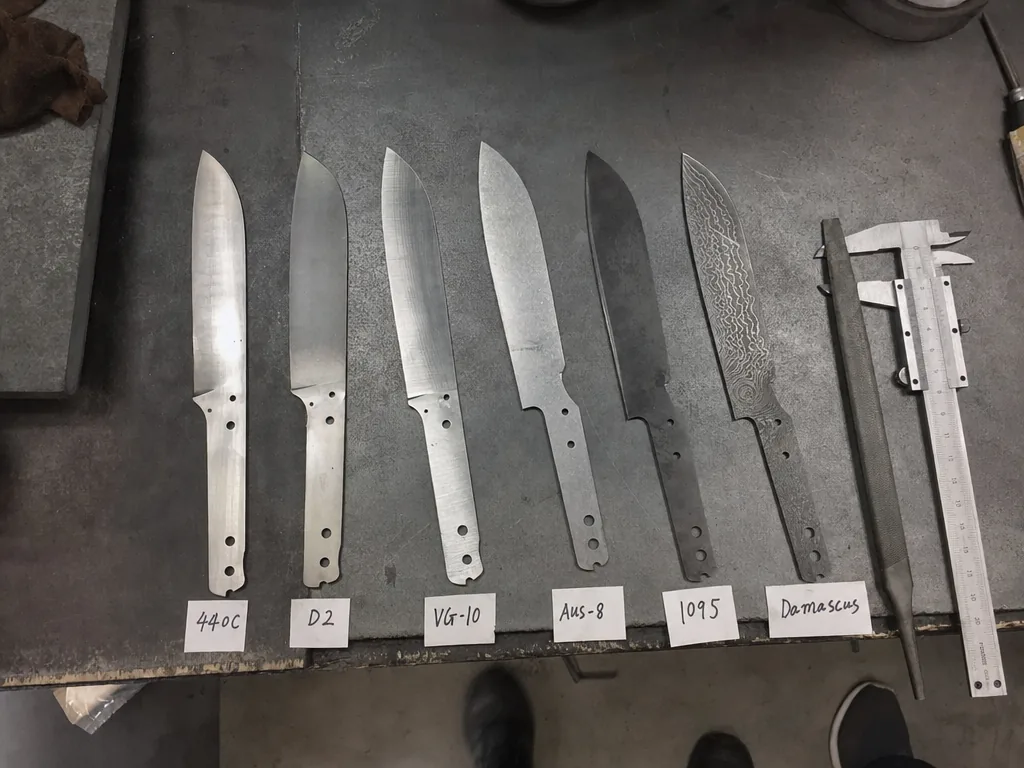
In modern knife sourcing, Damascus usually refers to pattern-welded laminated steel, not ancient crucible Damascus. The factory stacks two or more alloys with contrasting etch response, welds them into a billet under heat and pressure, then folds, twists, or restacks to create a visible pattern. For kitchen knives, the patterned outer layers are often paired with a monosteel core such as VG-10, AUS-10, 10Cr15CoMoV, or SG2/R2. That distinction matters: edge performance comes primarily from the core, while the side pattern drives aesthetics and perceived value.
There are two common commercial structures. First is san mai Damascus, where a hard center core is clad by patterned outer layers. Second is full pattern-welded construction, used more often in artisanal or premium outdoor knives. For mass retail and Amazon programs, san mai is more predictable on hardness, grind consistency, and corrosion performance.
Buyers should also separate true laminated material from cosmetic alternatives. Laser-etched patterns on plain steel are cheaper, but they do not carry the same premium or buyer trust. Reputable factories document the manufacturing process, identify the core alloy, state final hardness, and clarify whether the pattern is forged into the steel or applied later. If a supplier cannot define layer count, core material, and heat-treatment range, expect inconsistency in both performance and claims compliance.
How Damascus is made: billet stacking, welding, folding, and pattern control
When buyers ask how Damascus is made, the industrial answer starts with billet design. A typical billet uses alternating sheets 0.8-2.0 mm thick. Common combinations include 10Cr15CoMoV with a nickel-bearing contrast layer, or stainless pairs selected for corrosion resistance and etch differentiation. Layers are cleaned, stacked, tack welded, and heated to roughly 1050-1200°C depending on the alloy system. Under a power hammer, press, or rolling mill, the stack is consolidated into a solid billet.
Once welded, the billet is manipulated to create pattern. Ladder patterns use ground grooves and re-forging. Twist patterns use torsion before flattening. Raindrop effects are created by localized drilling or pressing before final forging. Each additional fold doubles layer count but also adds labor, scrap risk, and pattern compression. In production, many factories limit folding cycles because beyond a certain point the visual gain is modest while cost rises sharply.
Pattern control is not only artistic; it affects reject rate. Uneven welds, scale contamination, and overheating can create delamination or dead spots visible after etching. Professional suppliers use coupon cuts to inspect weld integrity before committing billet stock to blade blanks. Buyers evaluating Damascus knives should ask for cross-section photos, not just face shots, because a good face pattern can still hide poor side bonding near the spine or heel.
- Typical billet yield loss: 8-18% depending on pattern complexity
- Typical forged blank thickness before grinding: 2.5-4.5 mm
- Target decarburization control: minimal surface loss before final grinding
- Critical defect checkpoints: layer separation, voids, warpage, pattern inconsistency
67 layer Damascus and VG-10 Damascus: what buyers are really purchasing
67 layer Damascus is one of the most common retail specifications because it balances pattern visibility, cost, and manufacturability. In most cases, the count includes the core and both cladding sides. A typical structure might be 33 layers per side plus 1 core, yielding 67 total. More layers do not automatically mean better cutting performance. If the core steel and heat treatment are unchanged, moving from 33 to 67 or 110 layers mostly changes appearance and cost, not edge retention.
VG-10 Damascus usually means a VG-10 core laminated between patterned stainless cladding. VG-10 commonly targets 60-62 HRC in kitchen knives, with good stain resistance and acceptable toughness for thin geometries. For premium chef knives, a finished blade hardness of 60.5-61.5 HRC is a common commercial target, though actual acceptance bands should be stated clearly, for example 60-62 HRC with spot checks per lot.
| Specification | Common Structure | Typical HRC | Commercial Use | Cost Impact |
|---|---|---|---|---|
| 33 layer Damascus | 16+core+16 | Depends on core | Entry premium retail | Base |
| 67 layer Damascus | 33+core+33 | 60-62 HRC with VG-10 core | Mainstream premium kitchen knives | +8% to +18% |
| 110+ layer Damascus | Multiple folds/restacks | Depends on core | Gift/presentation lines | +15% to +35% |
| VG-10 Damascus san mai | VG-10 core with patterned cladding | 60-62 HRC | Private label chef knives | Common benchmark |
For sourcing, the decision should start with target retail price and review sensitivity. If the product will be sold on Amazon, visual pattern consistency often matters as much as nominal layer count because customer photos magnify defects. A useful cross-check is a documented steel comparison so the team understands what performance comes from the core versus the cladding.
Heat treatment in Damascus steel manufacturing drives actual performance
The best-looking billet still fails commercially if heat treatment is unstable. In most stainless Damascus kitchen knives, the core steel is the performance engine, so the thermal cycle must be designed around that core while protecting the cladding bond. For VG-10, factories commonly austenitize around 1000-1050°C, then quench and temper to reach 60-62 HRC. Cryogenic treatment may be added to reduce retained austenite and improve hardness consistency, particularly for premium batches.
Buyers should ask how hardness is verified. Good practice includes Rockwell C testing on every lot, with sample frequency defined in the control plan, plus micro-checks after process changes. A commercial tolerance of ±1 HRC is realistic. Claims tighter than that are possible, but only with strong furnace calibration and disciplined loading. ISO 9001 certification is useful, but on its own it does not prove metallurgical control; process records do.
Geometry and heat treatment must be considered together. A 210 mm gyuto at 2.2 mm spine thickness behind the handle and 0.15-0.25 mm behind the edge will feel very different at 59 HRC versus 61.5 HRC. Higher hardness improves edge retention but can increase microchipping if the grind is too aggressive or the end user cuts frozen food. For B2B programs, the right specification is the one that aligns metallurgy with the use case, not the highest number on the spec sheet.
- Kitchen knife core hardness target: 58-62 HRC depending on steel
- Flatness tolerance after heat treatment: often under 1.0 mm bow over blade length before final correction
- Common QC checks: hardness, warpage, belt burn, decarb, edge symmetry
Quality control checkpoints for Damascus pattern welding at scale
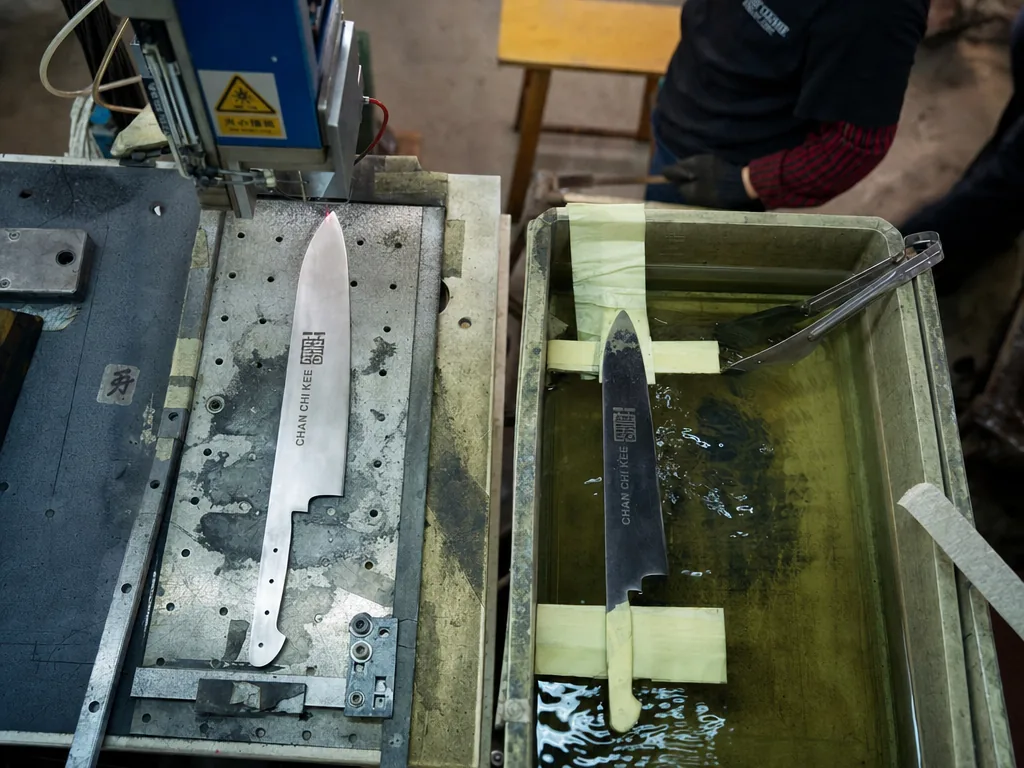
Damascus pattern welding is sensitive to contamination and operator variation, so quality control should start before forging and continue through final packing. Incoming material verification should confirm alloy grade, thickness, and surface cleanliness. During billet production, weld temperature, press sequence, and reduction ratio should be standardized. After forging, visual etch tests on sacrificial samples help reveal bond defects before the blades enter high-value grinding and handle assembly.
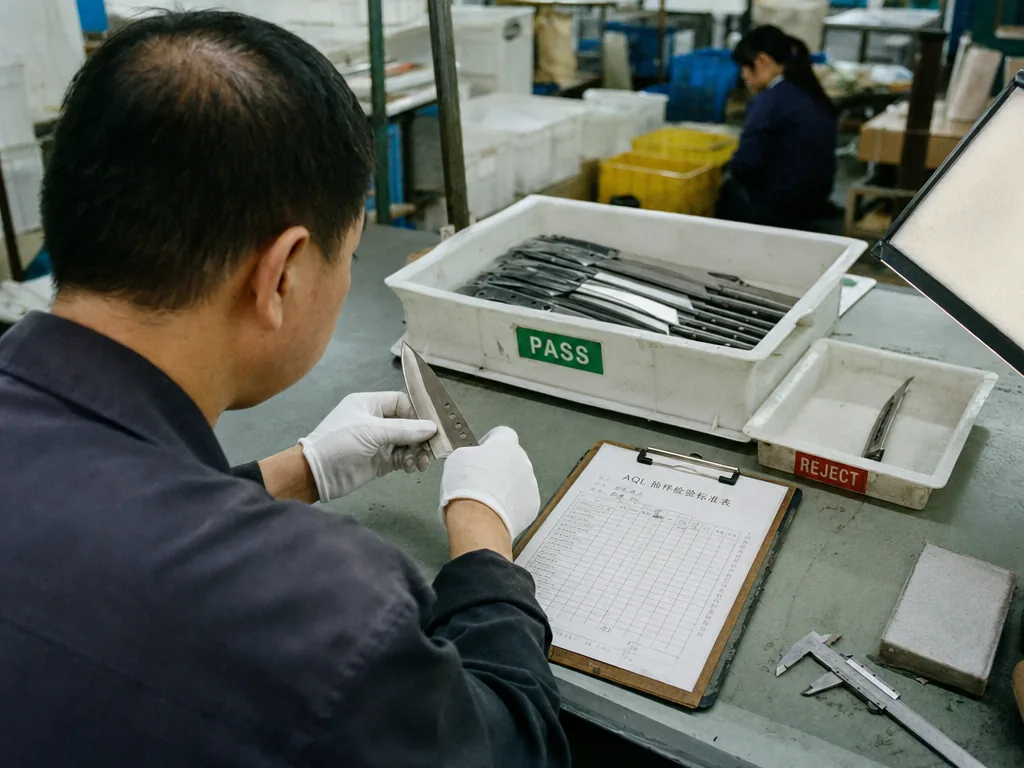
At blade level, inspection should cover pattern uniformity, grind symmetry, spine and choil finish, hardness, and straightness. For export orders, AQL 2.5 is a common final inspection level for major visual and functional defects, although some premium retailers use AQL 1.5 on appearance-critical SKUs. Typical defect definitions include open weld lines, over-etching, missing pattern near the heel, handle gaps above 0.20 mm, logo misalignment, and rust spots after salt exposure screening.
Packaging also matters because acidic residues from etching or polishing compounds can trigger surface staining if neutralization and drying are incomplete. A reliable factory uses rinse controls, anti-rust oil where appropriate, silica gel, and carton humidity management. For buyers building repeat programs, ask to see inspection SOPs and examples of non-conformance reports. A supplier that can explain root cause and corrective action is generally safer than one that only offers replacement promises after the fact.
- Typical pre-production sample lead time: 7-15 days
- Mass production lead time: 35-55 days after deposit and artwork approval
- Common MOQ: 300-500 pcs per model, lower for stock-based customization
- Final inspection basis: AQL 2.5 unless retailer standard specifies otherwise
Cost, MOQ, and lead-time implications of Damascus steel manufacturing
From a sourcing perspective, Damascus adds cost through material complexity, lower yield, slower grinding, and more stringent visual QC. For a 8-inch chef knife with VG-10 Damascus cladding, ex-works unit cost in China can vary widely, but a practical B2B planning range for decent quality is roughly USD 8-18 depending on handle material, packaging, polish level, and volume. Gift-box packaging, mosaic pins, hammered finishes, or premium pakkawood can push cost higher. Full custom forged patterns and low MOQs increase cost further because billet setup and sample waste are spread over fewer pieces.
MOQ depends on whether the factory starts from standard blade blanks or creates new tooling and packaging. Stock-based programs may start at 100-300 pcs per SKU. Fully custom private label projects often sit at 300-1000 pcs per model, with carton minimums and packaging MOQs separate from blade MOQs. For ocean freight, buyers usually work FOB terms, while small replenishment orders may be quoted DDP by air for convenience despite materially higher landed cost.
Lead time expands when the specification includes custom etch depth, exclusive patterns, or unusual handle constructions. Procurement teams should allocate time for sample revision because Damascus projects often require one extra loop to align pattern density, logo placement, and finish standards. If the program depends on Q4 retail, backward planning should include 10-15 days for pre-production samples, 40-50 days for bulk production, and freight plus customs buffer according to destination market.
When Damascus steel manufacturing is the right commercial choice
Damascus is commercially justified when visual differentiation supports a higher ASP or helps a private label product compete in crowded search results. On Amazon and DTC channels, patterned blades often improve click-through and giftability, but only when the finish is clean and the product page clearly explains the core steel and care instructions. In wholesale and specialty retail, Damascus can support premium positioning if the knife also delivers on fit, edge geometry, and packaging.
It is not always the best choice. If the target channel is value-driven foodservice, a monosteel blade in 5Cr15MoV, 7Cr17MoV, or X50CrMoV15 often produces better margin and fewer customer-service questions. If the retail story depends on top-end performance, powdered steels may outperform conventional VG-10 on edge retention, though they usually cost more and can be harder to sharpen. The correct approach is to define the product hierarchy first, then match steel and construction to that ladder.
For most importers, the safest Damascus program is a stainless san mai structure with a proven core steel, hardness around 60-62 HRC, and conservative geometry tuned for low warranty rates. Specify what can be measured: layer count method, core alloy, hardness band, flatness tolerance, finish standard, packaging test, and inspection AQL. Buyers who control those variables tend to get repeatable results instead of attractive samples followed by unstable bulk orders.
Frequently asked questions
Not automatically. In most commercial kitchen knives, cutting performance depends mainly on the core steel, hardness, and grind. Damascus cladding improves appearance and can add corrosion-resistant outer layers, but it does not guarantee better edge retention than a well-made monosteel blade. Compare the core alloy, HRC, and geometry before comparing the pattern.
Usually no. A higher layer count mainly changes visual density and can increase production cost. A 67 layer blade with stable heat treatment and good grinding will usually outperform a 110 layer blade with a poor core treatment or inconsistent geometry. Buyers should treat layer count as a design variable, not a stand-alone quality metric.
At minimum, specify core steel as VG-10, total layer count and counting method, target hardness such as 60-62 HRC, blade thickness and tolerance, finish standard, handle material, logo method, packaging, and inspection criteria. Also request confirmation that the pattern is true laminated Damascus rather than laser-etched decoration.
The main risks are weld delamination, visible dead spots after etching, uneven pattern density, warpage after heat treatment, over-grinding into cladding lines, and surface staining from poor post-etch cleaning. These defects are manageable, but only if the factory has billet inspection, hardness checks, neutralization controls, and a defined final QC standard.
For mainstream kitchen knives, Damascus versions often run about 20% to 60% higher than comparable monosteel products, depending on core steel, handle, finish, and packaging. The premium can be worthwhile in channels where the pattern improves conversion or supports a higher retail price, but it is less compelling in strictly price-driven segments.
Get your project quoted
From a single SKU to a full product line, we can quote, sample and ship from our Zhejiang facility. Talk to a specialist who's worked on hundreds of buyer briefs.
Request a Quote