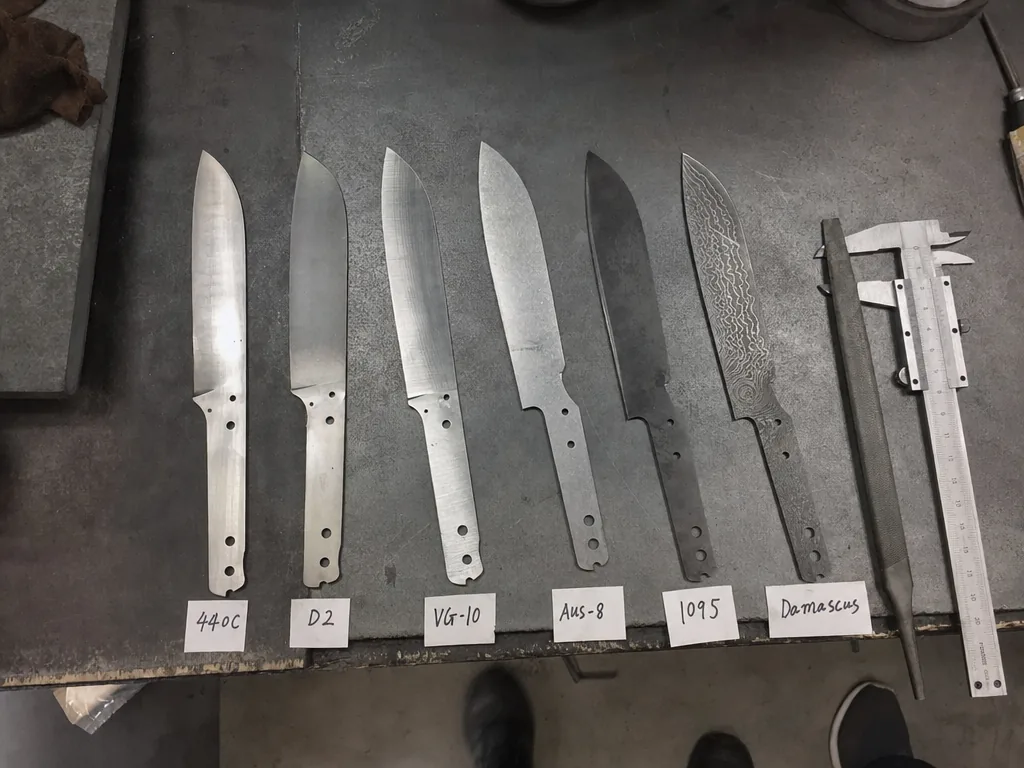
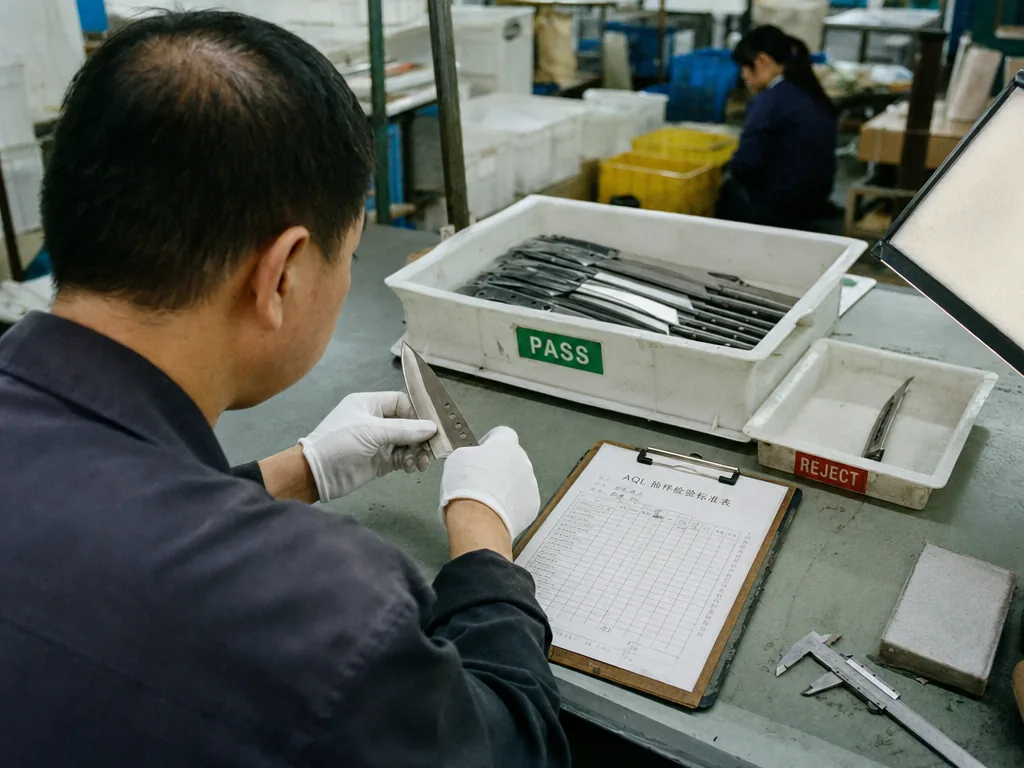
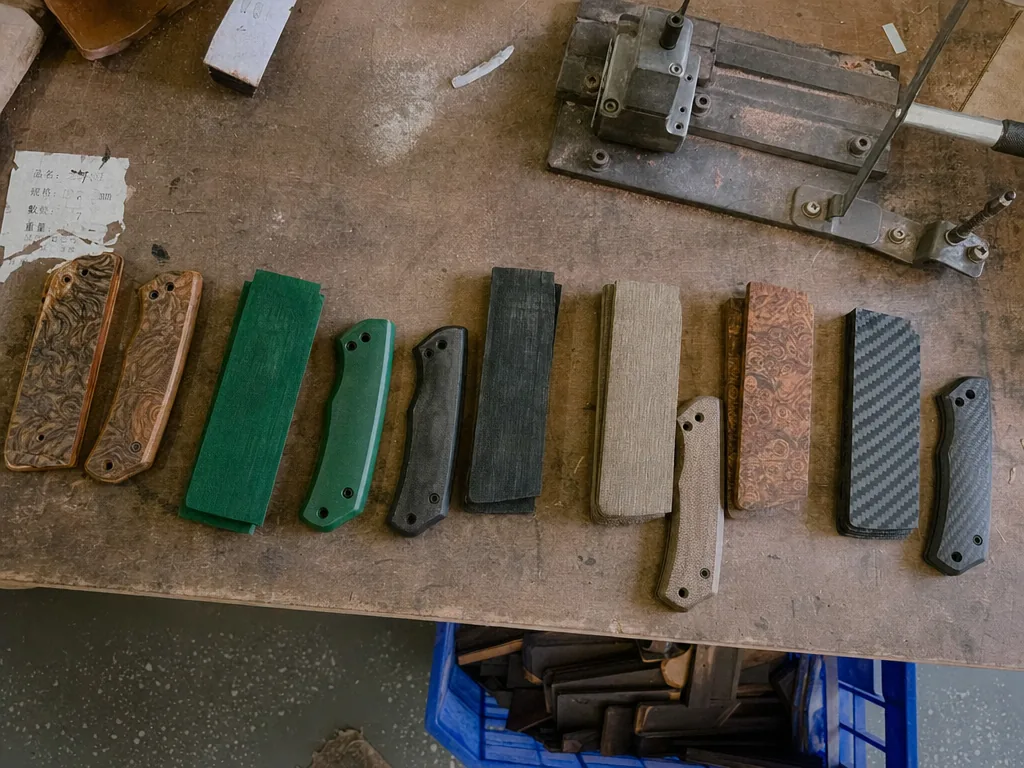
Knife logo engraving is not a cosmetic afterthought. For importers, brand managers, and Amazon sellers, the logo method affects unit cost, production speed, finish consistency, corrosion behavior, and even whether a model passes final inspection without rework. On knives sourced from China, the two most common permanent marking options are laser engraving and chemical etching, but they do not perform the same way on 3Cr13, 5Cr15MoV, 8Cr13MoV, D2, or coated stainless surfaces.
This article explains how each process works at factory level, where each method fits best, and what procurement teams should specify in RFQs and purchase orders. You will see typical depth ranges, lead-time impacts, MOQ implications, artwork constraints, and quality-control standards such as AQL 2.5 and ISO 9001 workflow. The goal is simple: help you select the right branding method for your blade steel, finish, channel, and margin target.
How knife logo engraving works on production blades
In factory terms, laser marking and chemical etching are different process families. A laser engraving knife program uses a focused beam, usually fiber laser for metal parts, to anneal, discolor, or ablate the surface. Depending on power, speed, and pulse settings, the mark may be shallow surface oxidation or a measurable cut, typically around 0.01-0.05 mm for standard logo work. Deep laser engraving beyond 0.08 mm is possible but slower and more expensive.
A chemical etching knife process uses a resist mask and an acid or electrolyte-based reaction to remove exposed metal. Typical logo depth is around 0.01-0.03 mm for decorative branding, with some factories pushing deeper at the cost of tighter process control and more cleanup. The result is usually softer-edged than laser, but very uniform across larger logo areas.
On folding knives, both methods are usually applied after grind and before final oiling or packaging. For fixed blades with stonewash or bead-blast finishes, sequencing matters: laser after finishing preserves contrast, while chemical etching may need masking strategy adjusted to avoid haloing. Buyers evaluating laser engraving service options should ask not only for artwork approval, but also for the exact process route by steel, finish, and logo position.
- Best laser use cases: small text, serial numbers, high SKU variation, low setup time.
- Best chemical etch use cases: broad filled logos, darker matte marks on certain steels, premium heritage styling.
- Critical variable: whether the logo sits on blade flat, ricasso, bolster, clip, or handle scale.
Knife logo engraving cost, MOQ, and lead-time impact
From a sourcing perspective, the practical question is not which method is more advanced, but which one delivers the required appearance at acceptable landed cost. Laser generally wins on setup speed. Once artwork is converted, the factory can switch logos quickly between SKUs, making it suitable for mixed orders, pilot runs, and Amazon private-label programs with 300-1,000 pcs per design. Chemical etching usually has more front-end prep because masks or stencils must be produced and validated.
At Chinese OEM factories, a common pattern is no major MOQ premium for laser once the knife itself meets the production MOQ, while chemical etching may carry a separate stencil or plate fee. For mass runs above 3,000 pcs, the per-unit gap often narrows. On budget knives under FOB USD 3-6, even a USD 0.05-0.12 branding difference matters. On higher-value D2 or G10 models at FOB USD 8-20, finish quality usually matters more than a few cents.
| Factor | Laser engraving | Chemical etching |
|---|---|---|
| Typical setup time | 0.5-1 day after artwork approval | 1-3 days including stencil prep |
| Per-unit cost impact | About USD 0.03-0.15 | About USD 0.05-0.20 |
| Ideal MOQ | 300+ pcs/SKU | 1,000+ pcs/SKU |
| Variable data | Excellent for serial numbers | Poor, higher changeover burden |
| Lead-time impact on bulk order | Usually 0-2 days | Usually 1-4 days |
| Artwork revision flexibility | High | Medium |
For buyers combining multiple SKUs such as branded pocket knives, laser usually reduces scheduling friction and lowers the risk of delayed consolidation before FOB shipment.
Laser engraving knife performance: precision, contrast, and durability
Laser is usually the best choice when your custom knife logo includes small text, fine lines, QR codes, date codes, or model identifiers. A modern fiber laser can hold very tight repeatability if the fixture is stable and the blade flatness is controlled. On satin stainless blades, logos as small as 0.8-1.2 mm text height are usually readable, while anything smaller becomes finish-dependent. If your brand requires exact line weight consistency across 5,000 pcs, insist on a first-article approval image and a logo position tolerance, for example ±0.5 mm from ricasso reference.
Durability depends on the laser mode. Surface annealing on stainless can create a dark mark with minimal depth, but abrasive cleaning or aggressive polishing can reduce visibility. Ablation marks remove material and are generally more permanent. On black-coated blades, laser can expose bright steel beneath the coating for high contrast, but the revealed metal may need corrosion testing if the product will face salt or humid environments.
There are also metallurgy issues. Steels hardened to about 56-59 HRC, common on 8Cr13MoV and 5Cr15MoV, laser mark consistently. D2 at around 58-60 HRC also marks well, though etched contrast can vary with surface prep. Titanium-coated or stonewashed surfaces can produce uneven visual density if fixturing or focus drift is poor. That is why competent suppliers tie logo marking into documented OEM manufacturing controls, not just standalone machine operation.
- Typical advantage: high precision and easy SKU changes.
- Main risk: inconsistent contrast across mixed finishes.
- QC check: 100 percent visual check for logo legibility on premium lines; AQL 2.5 on mass retail lines.
Chemical etching knife results: depth, finish compatibility, and brand look
Chemical etching remains relevant because it creates a different visual character. Where laser can look sharp and technical, etching often looks softer, deeper-toned, and more integrated into the steel. Many heritage-style hunting knives, commemorative runs, and premium fixed blades use etched logos because broad graphics and filled icons can look richer, especially on satin or mirror-polished flats.
For a chemical etching knife project, the biggest variables are surface preparation and resist quality. If the blade finish has residual oil, blast media contamination, or uneven polish direction, the etched result can show edge fuzz, variable depth, or a faint halo around the mask. Good factories standardize pre-cleaning, rinse stages, and neutralization to prevent staining. On stainless blades, etched logos are usually durable under ordinary use, but the exposed microtexture can hold moisture or residue more readily than a polished surface if post-treatment is poor.
Etching also has limitations. Fine text below roughly 1.0 mm height may lose crispness. Frequent logo changes are inefficient. Deep etching can be attractive, but if the blade stock is thin, such as 2.5-2.8 mm on economy folders, buyers should avoid excessive depth near stress-prone areas. For larger static programs with one stable logo and a premium visual target, etching can justify the extra setup. Ask suppliers for salt-spray or humidity exposure observations when the mark interrupts passivation on stainless steels.
- Typical advantage: premium matte look on broad logos.
- Main risk: more process sensitivity and slower revisions.
- QC check: edge cleanliness, depth uniformity, and post-etch stain inspection under 500-1000 lux light.
Choosing knife branding methods by steel, finish, and sales channel
Procurement teams should select knife branding methods by use case, not by habit. Start with the substrate. On 3Cr13 and 5Cr15MoV entry-level stainless, laser is usually the safest default because it is fast, repeatable, and cost-effective. On higher-appearance SKUs with polished flats, chemical etching can deliver a more upscale mark if the logo is simple and large enough. On black oxide, PVD, or painted surfaces, laser often creates the best contrast, but the buyer should evaluate whether exposing base metal creates a perceived premium look or a wear concern.
Then consider channel requirements. Amazon sellers usually benefit from laser because model iteration is frequent, order sizes start smaller, and packaging or listing changes may force quick artwork revisions. Traditional wholesale and outdoor brands placing 3,000-10,000 pcs per SKU may be better candidates for etching if they want a signature visual identity. Gift and commemorative projects often combine etched blade logos with laser serial numbering.
Finally, evaluate warranty and return risk. Consumer reviews often zoom in on crooked, faint, or cheap-looking logos. That means the branding method should match both product price and photo environment. A USD 14.99 online folding knife can tolerate a simple laser mark. A USD 49.99 branded fixed blade sold through specialty dealers may need etched presentation to support perceived value. Matching method to channel reduces claim rates and improves visual consistency across replenishment orders.
Knife logo engraving specifications buyers should put in the PO
Most logo disputes happen because the purchase order says “add logo” and nothing else. That is not enough. Buyers should define method, position, size, contrast expectation, acceptance criteria, and sample sign-off stage. For example: “Blade logo by fiber laser ablation, 12.0 mm wide, centered 8.0 mm from handle scale front edge, orientation parallel to blade spine, visual contrast medium-dark, no burn halo, no missing stroke.” That level of detail reduces factory interpretation error.
For chemical etching, specify whether depth is decorative or tactile, such as 0.01-0.02 mm max, and whether post-etch passivation or oiling is required. Include artwork format requirements, usually AI, EPS, or vector PDF, and set tolerance for placement. If your product is regulated or sold in the EU, ensure that origin marks, steel claims, and safety labeling are not confused with the brand logo. If multiple marks are required, define priority sequence to avoid crowding the blade flat.
Quality teams should also align logo checks with the inspection plan. Common practice is AQL 2.5 for major visual defects and AQL 4.0 for minor cosmetic variation, but premium programs may require tighter in-house sorting before third-party inspection. Ask whether samples are approved pre-production, in-line, and pre-shipment. If the order ships FOB Ningbo or Shanghai, late logo rework can easily add 3-7 days and create missed vessel risk. If shipped DDP by air for an urgent replenishment, the cost penalty is even greater.
- State exact branding method and logo file revision.
- Define location, size, orientation, and tolerance.
- Set appearance criteria with approved photos.
- Link logo approval to pre-production sample sign-off.
- Confirm inspection standard, usually AQL 2.5.
Supplier capability checks for knife logo engraving in China
Not every knife factory controls logo marking equally well. Some outsource laser to a nearby workshop; others run in-house machines but lack process discipline. For buyers sourcing from China, capability verification should go beyond asking for a machine photo. Request examples on the same steel and finish family as your product. A laser mark on satin 420J2 does not prove competence on stonewashed D2 or black-coated 8Cr13MoV.
Useful questions include: how many laser stations are in-house, what is the daily marking capacity, how logo files are revision-controlled, whether jigs are dedicated by SKU, and what the first-pass yield is on logo operations. For chemical etching, ask how masks are made, whether etch chemistry is logged, how neutralization is managed, and what stain-prevention controls exist. Factories operating under ISO 9001 discipline should be able to show work instructions, sample retention, and corrective-action records for visual defects.
A practical audit point is packaging flow. Logos should be checked before final assembly sealing and before VCI bagging or oiling. Otherwise, rework can contaminate handles or scratch blade finishes. Procurement teams should also ask if the supplier can combine methods, for example chemical etch on blade plus laser date code on inner liner, which is common for traceability. Strong suppliers treat branding as part of product engineering, not just decoration. That distinction matters when launch timelines are tight and returns are expensive.
Frequently asked questions
For most production knives, both are durable enough if executed correctly. Laser ablation is usually more resistant to polishing loss than a very shallow annealed laser mark. Chemical etching is permanent, but its microtexture can hold residue and may show more readily if post-treatment is weak. Durability should be tested on the actual steel and finish, not assumed from theory.
Usually, but not in every case. Laser has lower setup burden and cheaper logo changes, so it often wins on small and medium runs. On large stable programs with one logo and thousands of units, the unit-cost difference can narrow. Buyers should compare total cost including setup, sample revisions, lead-time risk, and rework probability.
As a practical guideline, text below about 1.0 mm height and very thin strokes can lose edge definition in chemical etching, especially on textured or stonewashed surfaces. Laser handles fine detail better. If your logo includes tiny registration marks, legal text, or serial elements, ask for a first-article sample at actual production size before confirming the process.
Yes. A common combination is chemical etching for the main blade logo and laser for date code, serial number, or inner-liner traceability. This hybrid approach works well for premium retail lines that need both a strong visual identity and batch control. It does add process steps, so confirm fixture control and inspection sequence in advance.
Include logo artwork in vector format, target method, mark size, exact position, contrast expectation, packaging stage for application, and acceptance criteria with photo references. Also ask for cost adder, setup fee, MOQ impact, and extra lead time. If third-party inspection applies, state the visual defect standard, such as AQL 2.5 for major defects.
Get your project quoted
From a single SKU to a full product line, we can quote, sample and ship from our Zhejiang facility. Talk to a specialist who's worked on hundreds of buyer briefs.
Request a Quote