Knife steel comparison is not a catalog exercise for procurement teams; it directly affects warranty rates, sharpening complaints, price positioning, and production stability. For importers and brand managers buying private-label knives from China, the right steel is usually the one that matches the product promise, target margin, and channel requirements rather than the highest advertised hardness.
This guide compares 440C, D2, VG-10 steel, and Damascus knife steel from a manufacturing and sourcing perspective. It focuses on practical variables: achievable hardness in mass production, corrosion behavior, edge retention, polishing difficulty, MOQ pressure, and lead times under OEM conditions. The goal is to help buyers choose a steel that survives quality control, meets listing claims, and lands within a realistic FOB cost band.
Knife steel comparison at a glance: performance, cost and production fit
For B2B buyers, steel selection should be screened against six factory variables: hardness window, corrosion resistance, grinding yield, cosmetic consistency, unit cost, and claim risk in marketplace channels. A steel that performs well in enthusiast reviews can still create procurement friction if the heat-treatment tolerance is narrow or if polishing rejects increase above AQL 2.5.
In mainstream OEM kitchen and outdoor knife programs, 440C remains a stable choice for corrosion resistance and moderate cost. D2 offers strong wear resistance and edge holding, but it is less forgiving in humid markets because it is semi-stainless rather than fully stainless. VG-10 steel occupies a premium stainless position with high hardness and a clean consumer story. Damascus knife steel adds visual value, but buyers must distinguish pattern-welded cladding from monosteel performance claims.
| Steel | Typical HRC | Corrosion resistance | Edge retention | Grinding difficulty | Indicative FOB blade cost impact | Best fit |
|---|---|---|---|---|---|---|
| 440C | 57-59 HRC | High | Medium | Low-Medium | Baseline | Mass-market kitchen, EDC, export humid markets |
| D2 | 59-61 HRC | Medium-Low | High | Medium-High | +10% to +18% | Outdoor, utility, value-performance lines |
| VG-10 | 60-61 HRC | High | High | Medium | +20% to +35% | Premium kitchen and gift channels |
| Damascus | Depends on core | Depends on core/cladding | Depends on core | High cosmetic control | +25% to +60% | Visual premium, gifting, high-AOV listings |
If you need a broader material map beyond these four families, review our full steel comparison to benchmark stainless, tool steel, and layered constructions across different knife categories.
440C vs D2 in a knife steel comparison for value-focused SKUs
The most common procurement debate in entry-to-midrange programs is 440C vs D2. Both steels can support attractive price points, but they solve different problems. 440C is a high-carbon stainless steel with around 16-18% chromium, making it easier to sell into coastal, tropical, and high-humidity markets. In production, it heat treats reliably to 57-59 HRC for kitchen knives and utility blades, with relatively predictable grinding and finishing behavior. That lowers scrap rates and simplifies satin or mirror polishing.
D2 usually contains about 11-12% chromium, which is not enough to behave like a fully stainless steel once carbides are considered. In use, it holds an edge longer than 440C because of its high wear resistance, often running 59-61 HRC in mass production. The tradeoff is visible staining, stricter oiling requirements, and a higher chance of customer complaints if end users expect stainless behavior.
- Choose 440C when your channel prioritizes low maintenance, dishwasher avoidance but general kitchen safety, and stable export quality.
- Choose D2 when your product page emphasizes edge retention, utility cutting, and enthusiast appeal over corrosion resistance.
- Watch QC points: D2 is more sensitive to decarb control, sharpening burr removal, and spotting during transit if packaging humidity is poorly managed.
From a sourcing standpoint, 440C often supports lower MOQs, such as 300-500 pcs per model, while D2 custom runs more commonly become cost-efficient around 500-1,000 pcs. Lead time for either steel is typically 30-45 days after sample approval, but D2 finishing can add 3-7 days if surface uniformity requirements are strict.
VG-10 steel in knife steel comparison: premium stainless without exotic risk
VG-10 steel is often the most practical premium option for kitchen-focused brands that want a stronger technical story than 440C without moving into unstable supply or excessive processing cost. Typical chemistry includes around 1.0% carbon, 15% chromium, with cobalt, molybdenum, and vanadium contributing to hardness and wear resistance. In OEM production, a realistic finished hardness target is 60-61 HRC. This delivers strong edge retention while keeping corrosion resistance high enough for broad retail acceptance.
For procurement teams, VG-10 has two key advantages. First, it is easy to position commercially: premium Japanese-style stainless, fine edge, good stain resistance. Second, it integrates well into layered blade constructions, such as 33-layer or 67-layer cladding, which gives premium visual appeal without the maintenance concerns associated with non-stainless decorative steels.
The main buying caution is authenticity and claim discipline. Marketplace listings often overstate layer counts or imply that all visible layers improve cutting performance. In reality, performance is mainly driven by core steel, heat treatment, edge geometry, and final sharpening angle. For kitchen programs, many buyers pair VG-10 with 15-18 degree per side sharpening, depending on blade thickness and use case.
VG-10 is especially suitable for branded chef knives where the target retail price can absorb a higher FOB cost. Relative to 440C, expect approximately +20% to +35% blade material and process cost, depending on cladding, finish, and handle configuration. MOQ is commonly 300-500 pcs for existing molds, or 800+ pcs if new tooling and gift packaging are involved.
Damascus knife steel comparison: visual premium versus technical reality
Damascus knife steel is the most misunderstood category in sourcing. In current mass production, Damascus generally refers to pattern-welded layered steel or a laminated blade with an etched surface pattern, not historical wootz steel. For buyers, this distinction matters because the visible pattern does not automatically mean better edge retention or toughness. The underlying core steel and heat treatment still define cutting performance.
There are three common OEM Damascus constructions. One is decorative laser-etched or printed patterning on monosteel, which is low cost but offers no metallurgical layer benefit. The second is stainless layered cladding over a VG-10 or 10Cr core, common in kitchen knives. The third is true forged pattern-welded Damascus, which is more labor intensive and less common in large-volume kitchen programs due to cost and consistency concerns.
Procurement risk with Damascus sits in cosmetics. Buyers should specify pattern visibility, acid-etch depth, contrast consistency, and allowed surface variation in the approved golden sample. Under AQL 2.5, cosmetic defect interpretation can vary sharply unless you define criteria for cloudy patterns, grind-over at spine transitions, and logo clarity after etching.
Damascus is usually strongest as a merchandising tool in gifting, premium kitchen, and Amazon hero listings where visual differentiation raises click-through and average order value. To review available constructions and design directions, see our range of Damascus knives. In FOB terms, Damascus-style blades often add 25% to 60% over plain 440C, depending on whether the pattern is decorative, clad, or forged.
Best knife steel by channel: kitchen retail, Amazon, gifting and outdoor
There is no single best knife steel across all channels. The right answer depends on how the knife is sold, how much education the buyer receives, and what failure mode creates the highest return rate. For Amazon private label, corrosion complaints and misleading claims are more damaging than modest differences in edge retention. For specialty retail, a stronger steel story can support margin if staff can explain maintenance and sharpening.
Kitchen retail programs generally perform best with 440C for value tiers and VG-10 for premium tiers. Both are stainless, easier to maintain, and less likely to trigger negative reviews from spot rust. D2 fits better in outdoor, workshop, and utility segments where users accept patina and prioritize wear resistance. Damascus works best when visual appeal is a clear purchase driver and the listing accurately states whether the performance comes from a VG-10 core or another steel.
- Amazon entry tier: 440C, 57-59 HRC, low complaint risk, broad market fit.
- Amazon premium kitchen: VG-10 core, 60-61 HRC, stronger conversion story.
- Outdoor and EDC: D2, 59-61 HRC, stronger edge retention narrative.
- Gift and visual merchandising: Damascus-clad VG-10 or similar layered stainless construction.
For private-label launches, align steel claims with actual use instructions. If a blade needs drying after use and oiling during storage, place that in packaging and listing content. This reduces misuse-driven returns and protects review scores.
Knife steel comparison in OEM sourcing: MOQ, lead time, QC and claims control
Steel choice changes more than performance; it affects production planning. In China OEM knife manufacturing, a standard development path includes sample confirmation in 7-15 days, pre-production sample in another 7-10 days, and mass production in 30-45 days for repeatable configurations. New molds, custom handles, or rigid gift boxes can add 10-20 days. VG-10 laminated and Damascus-style blades may need additional polishing, etching, and visual sorting time.
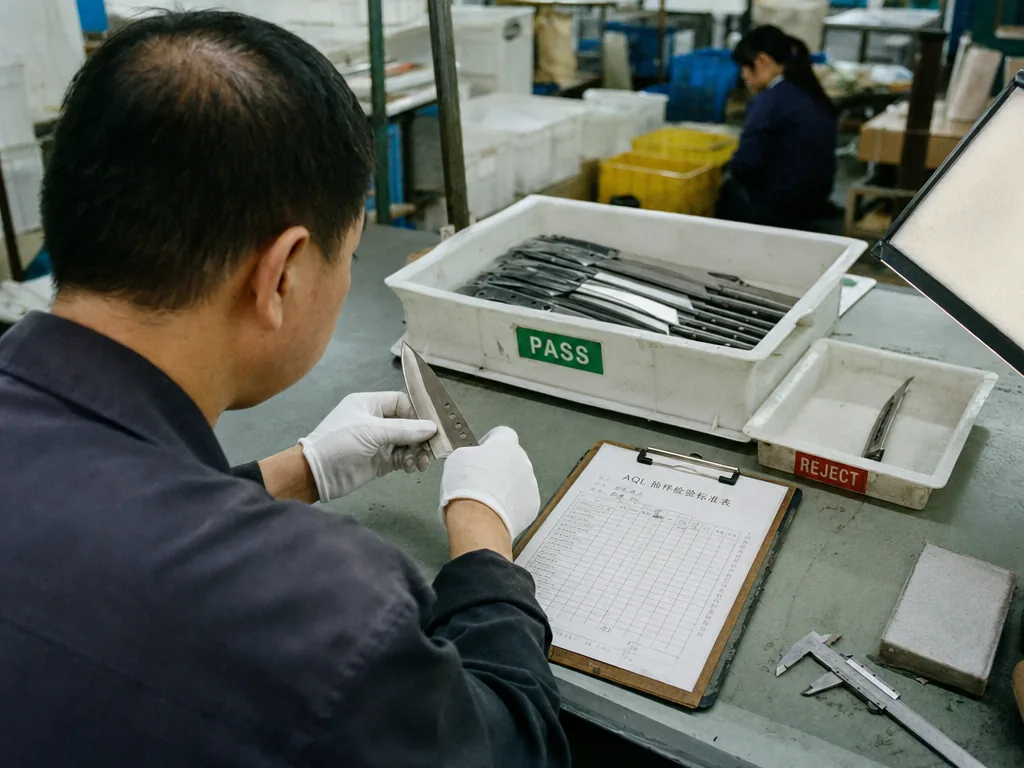
Buyers should ask suppliers for measurable controls rather than general quality promises. Minimum useful checkpoints include Rockwell hardness testing by batch, salt-spray or stain resistance expectations where relevant, bevel symmetry tolerance, and edge sharpness verification. For export, many procurement teams work to AQL 2.5 for major defects and 4.0 for minor cosmetic defects, but premium gift programs often tighten cosmetic standards further.
- Hardness spec: define target and tolerance, for example 60 ±1 HRC for VG-10.
- Finish spec: satin grit direction, mirror haze allowance, etch contrast for Damascus.
- Logo spec: laser depth and placement after final polish.
- Packing spec: VCI paper or rust-preventive sleeve for D2 where transit humidity is a concern.
- Trade term clarity: compare FOB, CIF, and DDP landed cost before approving steel upgrades.
ISO 9001 certification is useful, but it does not replace a product-specific inspection checklist. The practical goal is to prevent disputes about acceptable variation before the first carton leaves the factory.
How to choose after a knife steel comparison: a practical buyer framework
A workable decision framework starts with the sales claim, not the alloy. First define the product promise: low maintenance daily kitchen use, long-wear utility cutting, premium gift presentation, or enthusiast-grade chef performance. Then select the steel that supports that promise with the lowest execution risk at your target landed cost.
Use this sequence when approving a steel for a new SKU. Step one: set a target retail band and reverse-engineer allowable FOB cost. Step two: identify the likely complaint mode by channel, such as rust, chipping, dullness, or cosmetic inconsistency. Step three: match the steel and heat-treatment window to that risk profile. Step four: approve sample blades only after cut testing, stain exposure review, and packaging validation for transit.
In many cases, the best result is not a single “best knife steel” but a tiered lineup. A brand might use 440C for entry stainless utility products, VG-10 for premium kitchen, and Damascus-clad VG-10 for hero SKUs with higher visual appeal. D2 can remain a niche offer in outdoor or workshop collections where buyers understand maintenance. That tiered approach protects margin while keeping product claims accurate and easy for distributors to explain.
If a supplier pushes the hardest steel available without discussing corrosion, finish yield, or after-sales risk, treat that as a sourcing warning. In volume knife programs, balanced manufacturability usually beats headline hardness.
Frequently asked questions
For broad retail and Amazon kitchen SKUs, 440C usually creates the fewest problems. It offers high corrosion resistance, stable polishing results, and acceptable hardness around 57-59 HRC. That combination reduces rust complaints and lowers finishing rejects compared with D2 or more demanding layered constructions.
No, but it must be matched to the right channel and care instructions. D2 performs well for edge retention at roughly 59-61 HRC, yet it is not fully stainless. If your end market is humid or your customers expect low maintenance, you need stronger packaging control, explicit care guidance, and realistic listing claims.
Ask whether the blade is decorative etched monosteel, laminated cladding over a core steel, or true pattern-welded forged Damascus. Then request the exact core material, layer count, hardness target, and photos of approved cosmetic standards. Performance comes mainly from the core steel and heat treatment, not the surface pattern alone.
A practical OEM target is 60 ±1 HRC for most VG-10 kitchen blades. That range supports good edge retention while keeping brittleness and chipping risk manageable in mass production. Hardness claims above this should be reviewed carefully against blade geometry, final use, and the factory's actual heat-treatment consistency.
For many existing designs, MOQ starts around 300-500 pcs per model in 440C or VG-10-based configurations, while D2 and more cosmetic-heavy Damascus programs often become more efficient at 500-1,000 pcs. Typical lead time is 30-45 days after sample approval, with added days for new molds, gift boxes, or layered finishing.
Get your project quoted
From a single SKU to a full product line, we can quote, sample and ship from our Zhejiang facility. Talk to a specialist who's worked on hundreds of buyer briefs.
Request a Quote