Knife handle materials have a direct effect on landed cost, product positioning, failure rate, and user feedback. For importers and brand managers, the real question is not which material is "best" in the abstract, but which material fits the target price, cutting environment, compliance needs, and expected return rate. Pakkawood, G10, and micarta can all support successful knife programs, but they behave very differently in machining, finishing, water exposure, and long-term wear.
This comparison is written for sourcing teams evaluating OEM and private-label knives from China. You will see practical numbers: common thicknesses from 3-8 mm, hardness and density tendencies, tooling and finishing implications, MOQ impact, typical FOB cost deltas, and QC checkpoints aligned with ISO 9001 workflows and AQL 2.5 final inspection. The goal is to help you choose a handle material that matches your channel, whether you sell premium outdoor SKUs, value-led kitchen lines, or Amazon-first EDC products.
How knife handle materials affect cost, claims, and positioning
Handle material choice influences more than appearance. In production, it changes machining time, abrasive consumption, adhesive selection, polishing steps, reject rate, packaging protection, and even the complaint profile after sale. A G10 handle with CNC contouring and peel-ply texture may add 15-30 percent more machining time than a simple pakkawood slab, while a linen micarta handle often needs more hand-finishing to keep edge transitions consistent.
At the market level, each material signals a different value proposition. Pakkawood usually fits kitchen and gift-oriented products where color uniformity and a refined gloss matter. G10 is widely used for tactical, EDC, and outdoor models because it offers high dimensional stability, strong water resistance, and aggressive texturing options. A handle materials guide is useful at the shortlist stage, but procurement teams still need SKU-level tradeoffs around margin and defect risk.
- Pakkawood: wood-fiber composite, attractive grain, cost-efficient, best for controlled indoor use and polished aesthetics.
- G10: fiberglass-epoxy laminate, highly stable, moisture resistant, strong for thin scales, ideal for performance-first products.
- Micarta: fabric-resin laminate, warm hand feel, strong grip when finished correctly, premium heritage positioning.
For B2B buyers, the main decision filters are channel, target FOB, expected humidity exposure, grip requirement, and acceptable process variation. Those five factors usually resolve the debate faster than marketing language.
Pakkawood vs G10 in knife handle materials sourcing
In the pakkawood vs G10 decision, the practical difference is stability versus traditional appearance. Pakkawood is made by impregnating wood veneers or wood fiber with resin under heat and pressure. Density is typically around 1.0-1.3 g/cm3 depending on resin ratio and species blend. It machines cleanly, accepts rivets and mosaic pins well, and gives a premium wood look at moderate cost. However, although far more stable than natural wood, it can still show surface swelling, color shift, or finish wear faster than G10 in repeated wet-dry cycles.
G10 is a glass fiber laminate compressed with epoxy resin. It is dimensionally stable, non-porous in practical use, and highly resistant to kitchen moisture, blood, oils, and cleaning chemicals. Typical scale thicknesses are 3 mm for folding knives, 4-5 mm for compact fixed blades, and 6-8 mm for full-size outdoor knives. Because G10 is harder on tooling and generates hazardous dust during processing, factories must control extraction and PPE, and buyers should expect somewhat higher conversion cost.
| Factor | Pakkawood | G10 |
|---|---|---|
| Typical FOB material impact | Lower to mid | Mid to high |
| Moisture resistance | Good | Excellent |
| Visual consistency | Good, wood-grain variation remains | Excellent in solid colors/layers |
| Texture options | Mostly smooth or lightly contoured | Wide range: peel-ply, machined, blasted |
| Machining wear on tools | Moderate | High |
| Best fit | Kitchen, gift, classic folders | EDC, tactical, outdoor, wet-use knives |
For branded pocket knives, G10 usually supports stronger review language around grip and toughness. For entry to mid-tier chef knives, pakkawood often wins on visual warmth and cost discipline.
Knife micarta handle performance: grip, feel, and finishing realities
A knife micarta handle occupies a middle position between G10 and pakkawood. Micarta is a laminate made by saturating linen, canvas, paper, or similar fabric with resin, then compressing it under heat. The result is dense, durable, and less brittle in feel than many buyers expect. While exact density varies by fabric and resin content, practical handling characteristics matter more: micarta feels warmer and less synthetic than G10, and many end users prefer its tactile, broken-in character.
Grip performance depends heavily on finish. A polished micarta handle can become relatively slick when oily, while a bead-blasted or lightly machined finish tends to improve traction. Linen micarta often gives finer visual texture; canvas micarta usually delivers a more rugged, outdoor look. From a QC perspective, micarta can show more visible lot-to-lot color shift than black G10, especially in natural, green, brown, and layered shades. Buyers should therefore approve a retained color standard and define acceptable variation in the golden sample.
Micarta also requires disciplined finishing. Overheating during grinding can darken edges or create uneven resin smear. Undersanding leaves inconsistent texture around contours and lanyard holes. Well-run factories manage this with process sheets, grit-sequence controls, and in-process visual checkpoints. FOB cost commonly sits between pakkawood and premium-textured G10, though labor-heavy contouring can push micarta above standard G10 on some SKUs. For heritage outdoor brands, that premium can be justified by stronger perceived value and lower visual coldness than fiberglass composites.
Best knife handle material by product category and price band
There is no universal best knife handle material. The right choice depends on use case, target retail, and how the product is merchandised. In kitchen categories below roughly USD 20-35 retail, pakkawood often gives the most efficient balance of appearance and cost. It supports polished profiles, branded gift-box presentation, and broad consumer familiarity. In the USD 35-80 kitchen band, G10 becomes more attractive for water resistance and lower warranty risk, especially in commercial or semi-professional channels.
For folding knives and compact EDC products, G10 remains the default because a thin G10 knife scale retains strength, resists pocket moisture, and accepts CNC patterning well. Common thicknesses are 2.5-4 mm depending on liner construction. Micarta is frequently selected in higher-positioned EDC lines where tactile feel and visual aging are part of the brand story. Pakkawood appears less often in hard-use EDC due to lower impact confidence and lower perceived technicality.
- Value kitchen lines: pakkawood is usually the most competitive.
- Professional kitchen and wet environments: G10 reduces moisture-related complaints.
- Outdoor fixed blades: G10 for pure durability, micarta for premium tactile positioning.
- Amazon private label: G10 often produces clearer feature bullets and lower return risk than wood-based composites.
If the SKU must carry a premium story without moving to titanium or carbon fiber, micarta is often the commercial compromise that lifts perceived value while controlling material spend.
Manufacturing, QC, and compliance checkpoints for knife handle materials
From a factory viewpoint, these three knife handle materials create different process risks. Pakkawood can crack at pin holes if feed rate is too aggressive or if material dryness is inconsistent. G10 creates the highest tool wear and the most stringent dust-control requirement because fiberglass particles are abrasive and hazardous. Micarta is comparatively forgiving structurally, but its cosmetic consistency depends on careful grinding pressure, temperature control, and finish definition.
For OEM orders, buyers should request material specs covering thickness tolerance, color code, density range if available, resin system, and finish standard. Typical scale thickness tolerance after machining is within plus or minus 0.10-0.20 mm, depending on geometry. Flushness between tang and handle should normally be controlled within 0.10 mm on premium fixed blades. Adhesive bond checks, pin-set verification, and torque or pull checks for screwed scales should be recorded during pilot production.
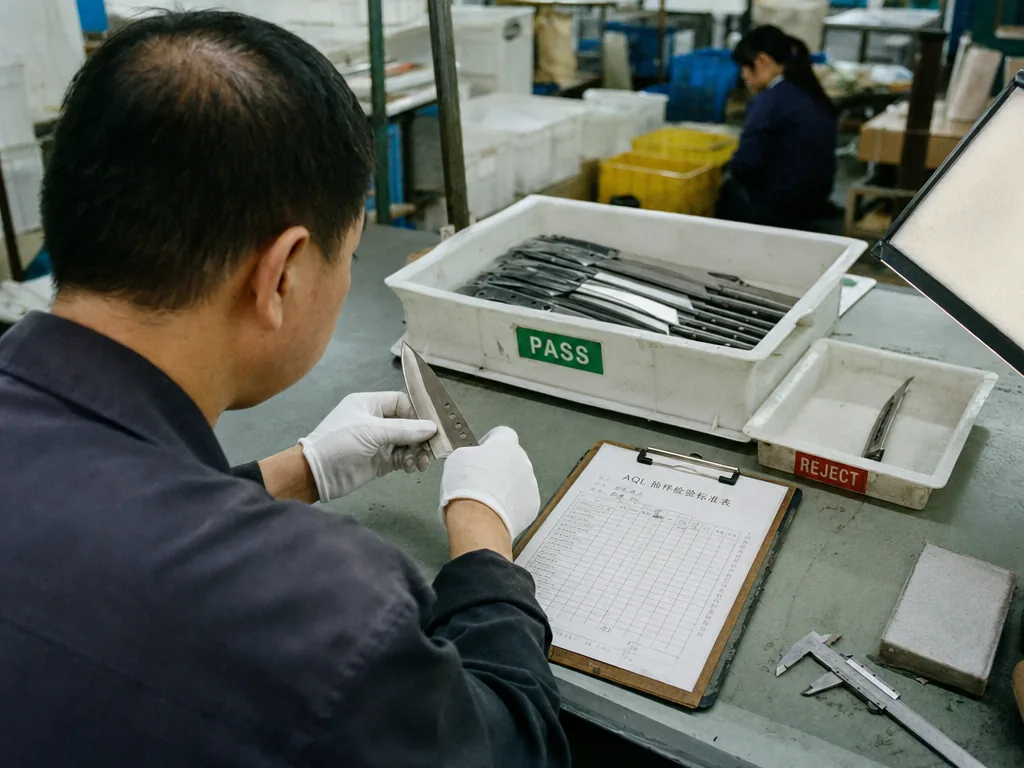
Final inspection should align to an agreed standard such as AQL 2.5 for major defects and AQL 4.0 for minor defects unless the program requires tighter control. Common defect definitions include color mismatch versus approved sample, visible glue line, chip-out at chamfers, uneven texture, over-buffing, and proud fasteners. Factories operating under ISO 9001 should have traceable incoming material records and CAPA workflows for repetitive handle issues. Buyers sourcing mixed catalogs should also compare the broader handle materials guide before freezing specs across multiple SKUs.
Lead times, MOQ, and FOB cost differences across knife handle materials
Commercially, material choice affects both lead time and MOQ flexibility. For standard black G10 and common pakkawood colors, Chinese OEM factories can often source material quickly from existing supplier channels. Micarta may require longer confirmation if the project uses a custom color, fabric weave, or layered structure. As a working benchmark, sample lead time for a revised handle specification is commonly 7-15 days after drawing approval, while bulk production runs 25-45 days depending on order size, blade finish, and packaging complexity.
MOQ also shifts with customization depth. Standard materials with existing stock may support 300-500 pieces per SKU in some factories, while custom-layered G10, dyed micarta, or exclusive pakkawood grain tones often push MOQ toward 800-1,200 pieces. FOB cost deltas vary by knife size, but for a mid-size full-tang kitchen or outdoor knife, moving from pakkawood to standard G10 can increase unit cost by roughly USD 0.50-1.50. Moving from standard G10 to labor-intensive contoured micarta may add another USD 0.30-1.20.
Incoterms matter as well. Under FOB, the buyer controls freight consolidation and can mix SKUs efficiently. Under DDP, packaging density and weight become more important; G10 and micarta are often slightly heavier than expected when scales are thick. Buyers planning broad assortments of chef knives and pocket knives should standardize screw sizes, thicknesses, and finish definitions where possible to reduce setup time and spare-parts complexity.
Selecting knife handle materials for Amazon and private-label programs
Amazon and marketplace channels compress the consequences of bad material decisions. Review language quickly exposes slippery finishes, swelling after dishwashing, uneven color, or edges that feel sharp at the handle contour. For that reason, many private-label sellers choose G10 even when pakkawood is slightly cheaper. The technical material story is easier to communicate, and the return risk from wet-use complaints is typically lower.
That said, pakkawood still performs well in kitchen sets and gift-oriented products when the product page clearly matches the use case. It should not be sold with maintenance language that implies dishwasher safety if the underlying assembly and finish are designed for hand wash only. Micarta can work strongly in premium outdoor or EDC listings, but imagery must show the finish and texture honestly because buyers often expect visible fabric character.
For launch-stage brands, the most reliable path is to decide early on three points: target retail, use environment, and claim hierarchy. If the feature bullets are “water resistance, grip, toughness,” choose G10. If they are “classic appearance, gift appeal, value,” choose pakkawood. If they are “premium feel, heritage, outdoor grip,” choose micarta. Then lock the handle spec in the BOM, define inspection criteria, and avoid mid-run substitutions. Material drift is one of the fastest ways to create listing inconsistency, negative reviews, and reorder friction.
Frequently asked questions
G10 usually gives the lowest warranty risk because it is highly stable in humidity, resists oils and cleaners, and tolerates thin-scale construction well. For programs selling into mixed climates or heavy-use channels, G10 reduces complaints tied to swelling, finish degradation, and grip performance. It is especially dependable for EDC, outdoor, and professional kitchen SKUs.
It can be, but only if the product is positioned correctly and the finish quality is controlled. Pakkawood performs well in many kitchen applications, especially value to mid-tier lines, yet repeated wet exposure and aggressive sanitation cycles favor G10. If the knives are intended for restaurant back-of-house use, G10 is usually the safer long-term specification.
Micarta can vary because fabric weave, resin saturation, grinding pressure, and finishing sequence all affect the final visible pattern and shade. Natural and colored micarta show this more than black variants. Buyers should approve a retained sample, define acceptable color range, and inspect edge finishing carefully to prevent cosmetic disputes during bulk shipments.
For many mid-size knives, moving from pakkawood to standard G10 increases FOB unit cost by about USD 0.50-1.50, depending on scale thickness, CNC patterning, and hardware. The gap can widen if the G10 uses layered colors or complex machining. However, lower return risk and stronger technical positioning often offset the higher initial cost.
Specify material type, color code, thickness tolerance, surface finish, edge radius, flushness with tang or liners, and defect definitions such as chips, glue lines, over-polish, and color mismatch. Also define inspection level, commonly AQL 2.5 for major defects, plus carton drop expectations, salt or humidity exposure if relevant, and whether substitutions are prohibited without written approval.
Get your project quoted
From a single SKU to a full product line, we can quote, sample and ship from our Zhejiang facility. Talk to a specialist who's worked on hundreds of buyer briefs.
Request a Quote