Folding knife lock mechanisms are not just a product feature; they determine unit cost, assembly complexity, user safety profile, and the defect modes your QC team will need to control. For importers, brand managers, and Amazon sellers, mechanism choice affects steel thickness, handle construction, spring tuning, finishing time, and even which markets a SKU can enter without compliance friction.
This article compares liner lock, frame lock, and slip joint structures from a manufacturing and procurement perspective. It also places them against other common folding knife lock types, including the axis lock knife category, so you can evaluate performance, MOQ impact, tolerance sensitivity, and post-sale risk before freezing drawings or approving a pre-production sample.
How folding knife lock mechanisms affect cost, safety, and returns
From a factory standpoint, the mechanism is the center of the folding system. It controls the number of components, machining paths, heat treatment windows, assembly time, and inspection criteria. A liner lock usually uses nested liners in stainless steel, commonly 1.2-1.5 mm thick, with a lock face engaging the tang at roughly 7-10 degrees. A frame lock eliminates one internal liner by turning the handle scale itself into the locking spring, typically in 3.0-4.0 mm stainless steel or titanium. A slip joint knife uses a backspring rather than a positive lock, which changes both user perception and legal positioning.
For procurement teams, these engineering differences translate into commercial variables. A basic 3.0 inch liner lock in 8Cr13MoV with G10 scales may be the lowest-cost route for branded pocket knives, while a titanium frame lock can add USD 4-12 per unit depending on material grade, CNC time, and finishing. Slip joints often reduce legal concerns in some EDC categories, but they demand consistent spring tension and walk-and-talk quality, which can increase tuning labor if the brand wants a premium feel.
The real sourcing question is not which mechanism is best in abstract terms. It is which mechanism fits the target retail band, return-risk profile, and market channel. A warehouse club SKU, an Amazon private label EDC knife, and a boutique dealer model can justify very different lock structures.
Liner lock vs frame lock: structure, strength, and production tradeoffs
The liner lock vs frame lock decision is usually a tradeoff between cost efficiency and perceived robustness. Both are leaf-spring locks that wedge a spring element behind the blade tang when opened. In a liner lock, the spring is cut from an internal liner. In a frame lock, the spring is cut from the handle frame itself. That sounds simple, but it changes stiffness, contact geometry, and finishing requirements.
Liner locks are more forgiving for mainstream production. Because the cosmetic scale sits over the liner, minor tool marks or spring relief variations are easier to hide. They also let the buyer specify lightweight FRN, G10, Micarta, aluminum, or wood handles while keeping the locking member in hardened stainless steel, commonly 420J2, 410, or 2Cr13. Typical hardness for lock liners is around HRC 45-52 after heat treatment, balancing spring resilience with wear resistance.
Frame locks generally provide stronger lock bar mass and stronger buyer perception in the USD 40-150 retail segment. However, they are less tolerant of cosmetic defects because the frame is visible. Titanium frame locks often need a hardened steel lockbar insert to reduce stick and tang wear. That adds parts count, fasteners, and machining steps. Factories offering OEM service often quote longer lead times for frame lock projects, especially when custom milling, stonewash blending, or anodized titanium finishes are involved.
| Factor | Liner Lock | Frame Lock | Slip Joint |
|---|---|---|---|
| Typical handle structure | Scale + internal liner | Locking frame/scale | Scales + backspring |
| Unit cost impact | Low to medium | Medium to high | Low to medium |
| Perceived strength | Good for EDC | High | No positive lock |
| Tolerance sensitivity | Moderate | High | High spring tuning |
| Common retail tier | Mass to mid-market | Mid to premium | Traditional, legal-sensitive |
| Main defect risk | Late/early lockup | Lock stick, overtravel | Weak or uneven walk-and-talk |
For large runs above 3,000 units, liner locks usually deliver the best cost-to-performance ratio. For premium launches where visual construction matters as much as function, frame lock is often worth the added complexity.
Slip joint knife design: compliance, spring tuning, and brand positioning
A slip joint knife does not positively lock the blade open. Instead, a backspring applies resistance through the open and closed positions, often with a half-stop. For many buyers, that is not a limitation but a market strategy. In regions or sales channels where non-locking designs face fewer restrictions or less consumer hesitation, slip joints can open distribution that a locking model cannot.
Manufacturing quality in slip joints is judged differently from locking folders. Buyers should evaluate spring flushness in open, half-stop, and closed positions; pull strength; centering; and the smoothness of the "walk and talk." Backsprings are commonly made from 420, 3Cr13, or 5Cr15 series stainless depending on target cost and corrosion expectations, with hardness often around HRC 46-52. If the spring is too soft, blade retention feels unsafe. Too hard, and spring cracking risk rises over repeated cycles.
Slip joints also reward careful blade tang design. Tang corners, kick height, and spring preload directly affect user feel and nail nick accessibility. For traditional patterns, the dimensional stack-up can be surprisingly sensitive: a 0.05-0.10 mm shift in tang geometry may change open spring flushness enough to trigger cosmetic rejects. This is where early ODM design input matters. A supplier that understands traditional mechanism tuning can reduce the number of pilot-round corrections before mass production.
Commercially, slip joints work well in heritage styling, gift channels, and lower-risk EDC assortments. They also fit brands that prioritize broad market acceptance over maximum lock strength.
Comparing folding knife lock types beyond the big three
Although liner lock, frame lock, and slip joint are the most common sourcing choices, buyers should understand where they sit among broader folding knife lock types. Lockback, button lock, crossbar systems, and compression-style locks all exist, but they are not interchangeable from a production-risk standpoint.
The axis lock knife category, more accurately called a crossbar lock in generic sourcing language, uses a spring-loaded bar moving transversely behind the tang. It offers ambidextrous operation and strong consumer appeal, but it also introduces more small parts: bar, omega springs or equivalent, liners, and precision cutouts. This raises assembly time and spring fatigue risk. It can be an excellent mechanism when the factory has stable process control, but for first-time private label buyers it usually presents more variables than a basic liner lock.
Lockbacks have strong retention and legal familiarity in many markets, but they require accurate rocker geometry and can be slower to assemble. Button locks demand careful plunge lock fitting and often stricter debris tolerance testing. Compression-style designs can be strong and user-friendly, but they may involve licensing or design-distinction concerns depending on the market and product architecture.
For most B2B programs, the practical ranking is straightforward. If the target is low defect rate and wide manufacturability, liner lock leads. If the target is premium perceived value, frame lock gains ground. If legal simplicity and classic styling matter, slip joint is often the right answer. More complex systems can sell well, but only when the brand can support higher validation and after-sales risk.
QC standards for folding knife lock mechanisms: tolerances, AQL, and test plans
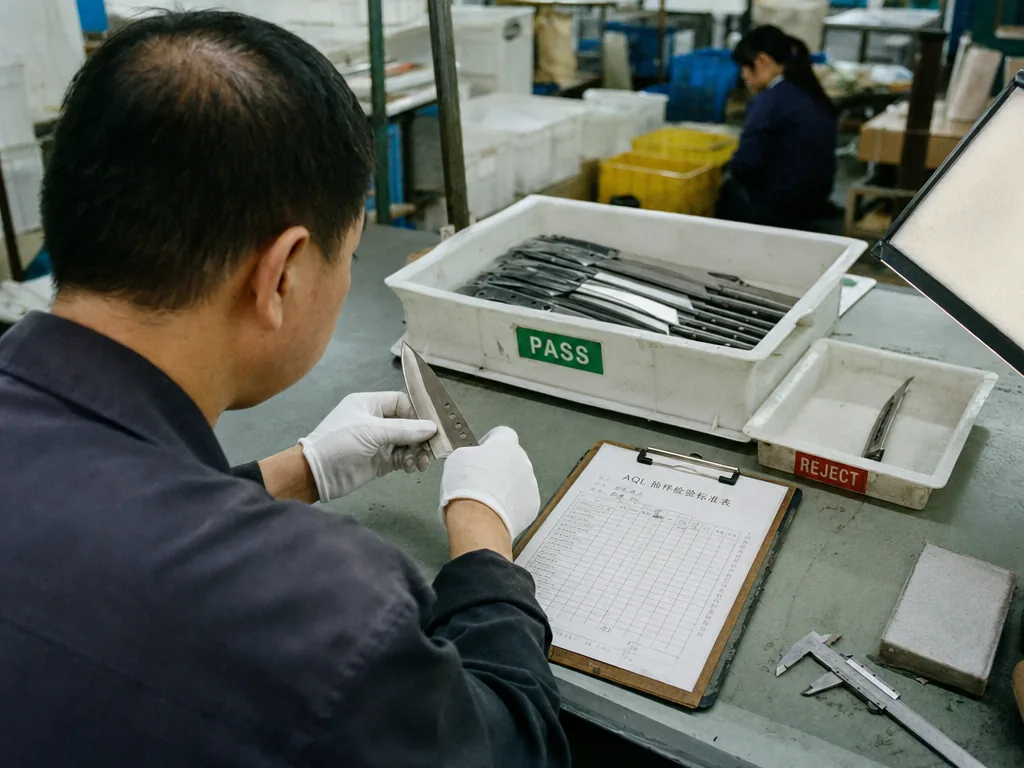
Mechanism QC should be written into the purchase specification, not left to visual approval. For locking folders, buyers typically need standards for lock engagement percentage, blade centering, opening torque, side-to-side play, vertical play, detent retention, and finish defects. On production runs, AQL 2.5 for major defects and AQL 4.0 for minor defects is common, but the lock itself should often be treated more strictly than cosmetics because failure creates safety and return exposure.
A useful incoming or pre-shipment protocol includes:
- 100 percent function test during assembly for open/close action
- Sample lockup measurement, often targeting 20-50 percent initial engagement on liner and frame locks
- Cycle testing of 500-2,000 openings on approval samples to observe wear path and lock migration
- Spine-whack or controlled shock testing only if defined carefully, because unmanaged force can damage even acceptable knives
- Salt spray or humidity checks for coated liners, springs, and hardware when corrosion resistance is a selling point
For slip joints, replace lockup criteria with spring force consistency, flush spring transitions, half-stop accuracy, and blade bias in the closed position. Brands should also define allowable blade rub, kick protection, and spring gap. Factories operating under ISO 9001 can document these controls more systematically, but the buyer still needs clear pass/fail thresholds.
Lead times are affected by validation depth. A standard OEM folding knife may sample in 15-25 days and mass produce in 35-55 days after deposit and sample approval. A new frame lock or crossbar design with multiple corrections can add 10-20 days.
Costing and MOQ implications by mechanism and material stack
Mechanism choice changes more than assembly. It changes material utilization, scrap risk, and how many process steps must be amortized across the order. As a rough FOB China guide for mid-volume production of 1,000-5,000 units, an entry liner lock in 3Cr13 or 8Cr13MoV with G10 or aluminum handle may land around USD 3.50-8.50 depending on blade finish, bearing system, and packaging. A frame lock in stainless steel may run USD 6.00-14.00, while titanium frame lock builds often start around USD 12.00 and can exceed USD 25.00 with premium steel, milled clips, lock inserts, and extensive CNC contouring.
Slip joints occupy a broader band. Simple stamped constructions can be inexpensive, but traditional multi-part slip joints with polished backsprings, bone-like covers, pinned construction, and matched finish can require substantial handwork. In those cases, unit cost may rival or exceed a basic liner lock despite the absence of a positive lock.
MOQ also shifts. Generic liner lock platforms can sometimes start at 300-500 units with logo customization. Fully custom mechanisms usually begin around 1,000 units per model, with handle color splits subject to component MOQ. Titanium frame locks and specialty spring systems may require higher minimums because setup cost and reject risk are higher. DDP pricing can simplify landed cost planning for Amazon sellers, while FOB gives importers more freight control. Neither term changes the fact that mechanism complexity is one of the fastest ways to move a project out of its target margin band.
How buyers should choose between liner lock, frame lock, and slip joint
The right choice starts with channel and claim set. If the product needs broad appeal, practical strength, and disciplined cost, choose liner lock first and optimize the rest of the build around blade steel, handle material, and finish. It is the most scalable mechanism for branded EDC folders and the easiest platform for iterative line extensions.
If the product is meant to signal durability and premium construction, frame lock has clear visual and structural advantages. It is especially effective when paired with titanium, stainless frames, stonewash finishes, and a stronger industrial design language. But buyers should budget for more engineering review and tighter assembly controls.
If legal simplicity, classic aesthetics, or gentler market positioning matter more than lock strength, a slip joint is often commercially smarter. It also reduces the chance that the product will be marketed with exaggerated hard-use claims that create return pressure later.
Before approving production, ask the supplier for three things: a mechanism-specific QC checklist, a tolerance drawing covering lock faces or spring geometry, and a pilot sample report showing centering, engagement, and cycle-test observations. This is the difference between selecting a mechanism and managing a category professionally. For TANGFORGE buyers, the best decision is rarely the most popular lock. It is the lock whose manufacturing realities align with your price target, market access, and acceptable defect rate.
Frequently asked questions
A basic liner lock is usually the safest starting point. It has fewer precision-fit variables than a frame lock or crossbar system, and the cosmetic scale can hide minor internal variation. If the factory already has a proven platform, defect rates and sampling cycles are generally easier to control at MOQs of 500-1,000 units.
Not automatically. A frame lock often feels stronger because the lock bar is thicker and more visible, but actual performance depends on tang geometry, lock face contact, material hardness, and assembly quality. A well-made liner lock can outperform a poorly tuned frame lock, especially if lock stick, overtravel, or poor engagement angles are present.
Choose a slip joint when channel access, legal simplicity, or traditional styling matter more than maximum lock strength. It is a practical option for gift, heritage, and lower-risk EDC categories. The buyer should still specify spring force, flushness, and half-stop requirements because slip joints can generate quality complaints if spring tuning is inconsistent.
At minimum, specify blade centering tolerance, lock engagement target, no vertical play, acceptable side play range, opening and closing feel, finish standards, and hardware fit. For pre-shipment inspection, many buyers use AQL 2.5 for major and 4.0 for minor defects, with 100 percent functional testing during assembly.
For a straightforward custom liner lock, expect about 15-25 days for samples and 35-55 days for mass production after approval. Frame locks, slip joints with premium tuning, or axis lock knife style projects often need extra validation and correction rounds, adding roughly 10-20 days depending on complexity and finish.
Get your project quoted
From a single SKU to a full product line, we can quote, sample and ship from our Zhejiang facility. Talk to a specialist who's worked on hundreds of buyer briefs.
Request a Quote