Full tang vs partial tang is one of the first structural decisions a buyer should lock before quoting, sampling, or packaging design. The tang determines how load moves from blade to handle, how the knife balances in hand, what handle materials are feasible, and where failures are most likely under abuse. For importers and private label brands, this is not a catalog detail. It affects steel yield, machining time, assembly method, carton weight, defect rate, and claim exposure.
For OEM and ODM knife sourcing, the right choice depends on use case rather than marketing language. A camp knife batoning wood, a 210 mm gyuto, and a budget utility knife should not be built to the same tang specification. This guide breaks down knife tang types, compares full tang knife construction with partial tang knife and hidden tang knife options, and translates those engineering differences into practical procurement criteria such as MOQ, AQL 2.5 inspection points, lead times, and price bands.
What full tang vs partial tang actually means in production
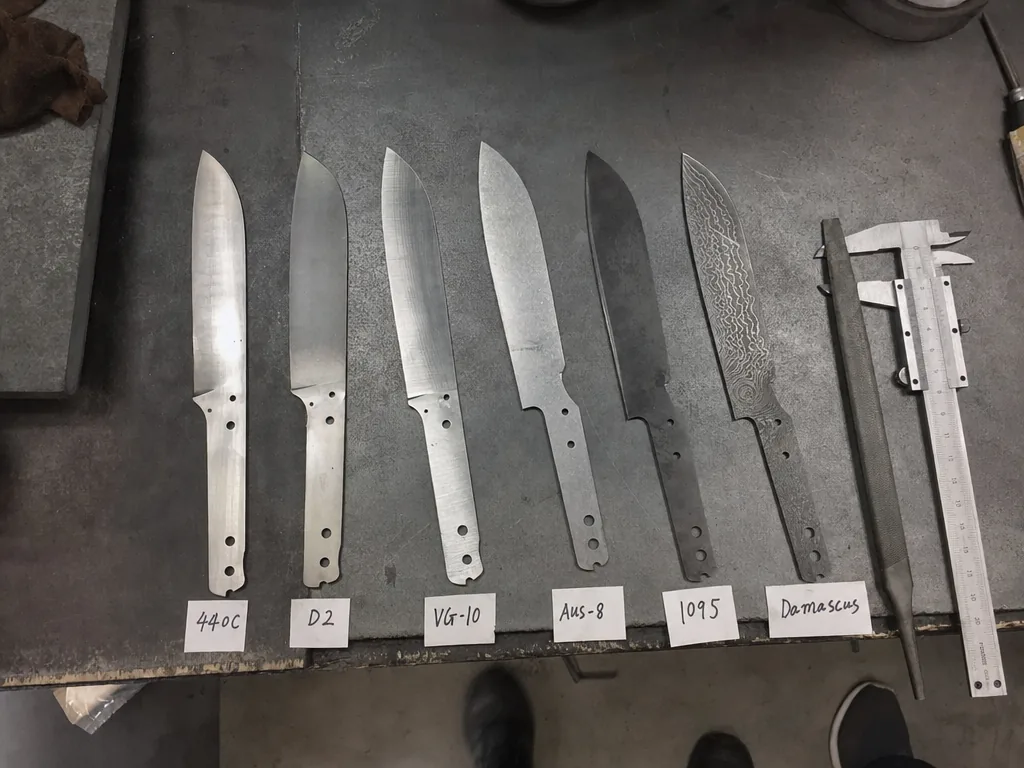
A tang is the portion of the blade steel that continues into the handle. In factory terms, the tang defines the structural interface between blade blank and handle assembly. A full tang knife construction usually means the tang runs the full length and nearly the full width of the handle. On most slab-handle knives, the steel is visible between two scales fixed by rivets, Corby bolts, tubular rivets, or screws.
A partial tang knife uses less steel inside the handle. The tang may be narrow, tapered, rat-tail, stick, or hidden. A hidden tang knife is a common subtype where the tang extends inside the handle core but is not visible from the handle sides. Hidden tang does not automatically mean weak. A properly forged or precision-ground hidden tang with correct shoulder geometry, fit, adhesive bonding, and mechanical locking can perform well in kitchen, carving, and light outdoor applications.
Buyers should separate structure from sales language. Some factories call any long tang “full tang,” even when width is reduced by 30-50 percent in the grip area. Others describe encapsulated molded handles as full tang because the steel runs full length but is not exposed. Your technical drawing should therefore specify:
- Overall tang length in mm
- Tang width at front, center, and butt
- Thickness before and after taper
- Visible or hidden tang construction
- Fastener type and quantity
- Adhesive type, cure standard, and pull-test requirement
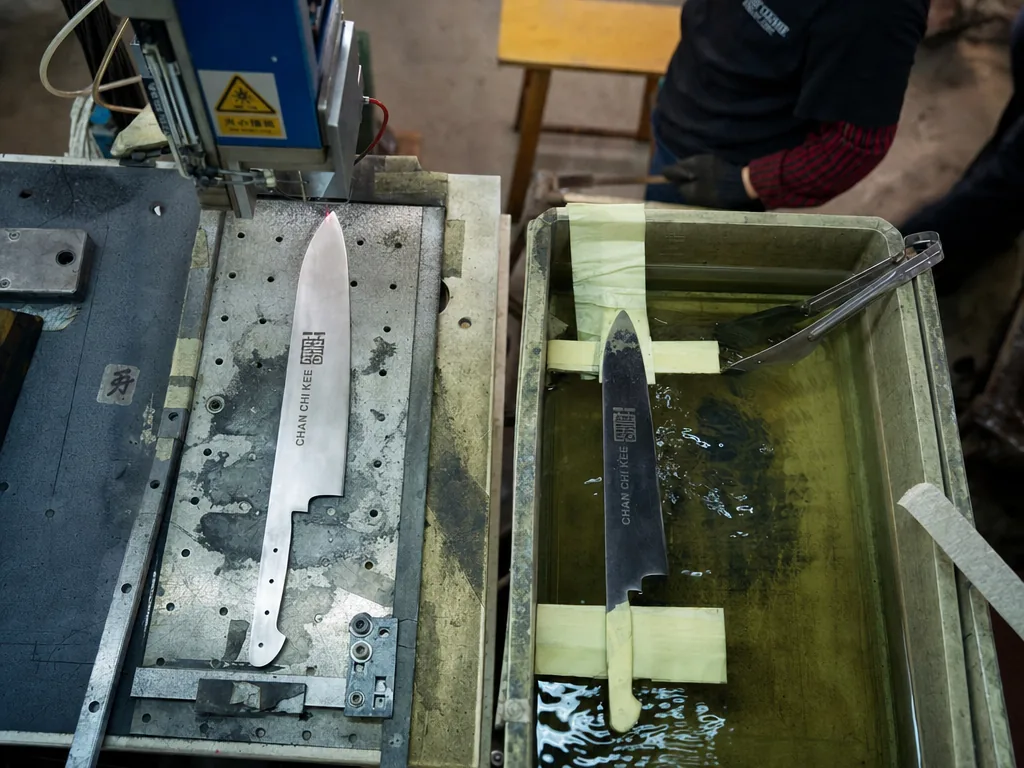
If you are reviewing a supplier’s manufacturing process, ask for blade blank drawings and cross-sections rather than relying on product copy alone.
Full tang knife construction: strength, balance, and failure modes
In field and survival categories, full tang knife construction remains the default because it distributes bending and impact loads across more steel mass. With a 4.0-5.0 mm blade stock in 3Cr13, 5Cr15MoV, 8Cr13MoV, D2, or 14C28N, a true full tang build usually tolerates prying, chopping, and batoning better than a narrow stick tang of the same hardness. Typical hardness ranges are 52-54 HRC for 3Cr13 outdoor utility, 55-57 HRC for 5Cr15MoV, 58-60 HRC for D2, and 58-60 HRC for 14C28N depending on heat treatment target.
Its main tradeoff is weight. A 240 mm overall outdoor knife with a 125 mm blade and 4.5 mm stock may gain 35-90 g compared with a reduced tang version. That can improve perceived solidity, but it may also shift balance rearward unless the blade profile or tang taper is adjusted. On kitchen knives, especially 200-240 mm chef patterns, excessive handle steel can make the knife feel handle-heavy and less agile during line work.
Failure modes on full tang knives are usually less dramatic but still real. Common issues include scale cracking from poor moisture conditioning, rivet looseness, exposed tang edges causing hot spots, and corrosion in the scale interface if passivation and sealing are weak. For outdoor knives, buyers should inspect tang symmetry, pin alignment, epoxy squeeze-out, and butt-end geometry. Request torsion and drop-test records where available, not just static photos.
Partial tang knife and hidden tang knife designs: where they make sense
A partial tang knife is often the correct commercial decision when product intent is slicing, carving, or controlled kitchen prep rather than impact. Hidden tang designs reduce steel consumption, simplify contouring, and allow cleaner premium handle forms in pakkawood, olive wood, G10 sleeves, stabilized wood, horn, or composite over a central core. This is one reason many Japanese-style kitchen knives, carving knives, and table knives use hidden tang knife construction.
There are strong and weak versions of partial tangs. A robust hidden tang on a 210 mm chef knife may be 10-14 mm wide near the shoulder, extend 70-90 percent of handle length, and be seated with high-strength epoxy plus a mechanical cap or compression fit. A low-cost rat-tail tang on a heavy chopper may narrow to 4-6 mm too early and become the failure point under lateral load.
The advantage for procurement is cost efficiency and design flexibility. Depending on blade size and steel, moving from full tang to hidden tang can reduce steel usage by 8-20 percent, shave some grinding time, and lower landed weight. On medium-volume OEM orders, that can change unit economics by roughly USD 0.30-1.50 per piece, more on larger fixed-blade formats.
For premium culinary programs, a hidden tang also supports wa-style or seamless western handles that would be awkward with exposed steel. Buyers sourcing chef knives should evaluate hidden tang not as a downgrade but as a fit-for-purpose construction, provided the tang length, shoulder radius, and bond integrity are engineered correctly.
Full tang vs partial tang by use case, cost, and specification risk
From a sourcing perspective, the right tang is the one aligned with actual abuse profile, price architecture, and return tolerance. Many returns happen because a product was overmarketed into a use case the structure was not built to survive. A USD 7-10 FOB hidden tang utility knife can be a strong value. It becomes a problem only when retail copy promises survival, prying, or hatchet-like use.
| Factor | Full tang | Partial/hidden tang |
|---|---|---|
| Typical use case | Outdoor, bushcraft, tactical, heavy utility | Kitchen, carving, light utility, premium handle aesthetics |
| Steel consumption | Higher | Lower |
| Weight | Higher by about 35-90 g on many fixed blades | Lower, often better for agile slicing |
| Balance bias | Can be handle-heavy unless tapered | Often more blade-forward or neutral |
| Assembly complexity | Scale fitting, drilling, riveting, contouring | Slotting, insert fit, adhesive bonding, end-cap control |
| High-abuse strength | Usually better | Highly variable by tang geometry |
| Aesthetic options | Exposed steel profile visible | Cleaner seamless handle options |
| Typical FOB impact | Higher by about USD 0.30-1.50+ | Lower at same blade size |
For Amazon private label and brand buyers, keep the claimed use case narrow. If the knife is intended for camp prep, skinning, and food work, a hidden or reduced tang may be acceptable. If packaging shows batoning, fire-making, or vehicle emergency use, full tang is the safer specification. The gap is not ideological. It is risk management tied to warranty reserve and review volatility.
QC checkpoints for full tang vs partial tang knife tang types
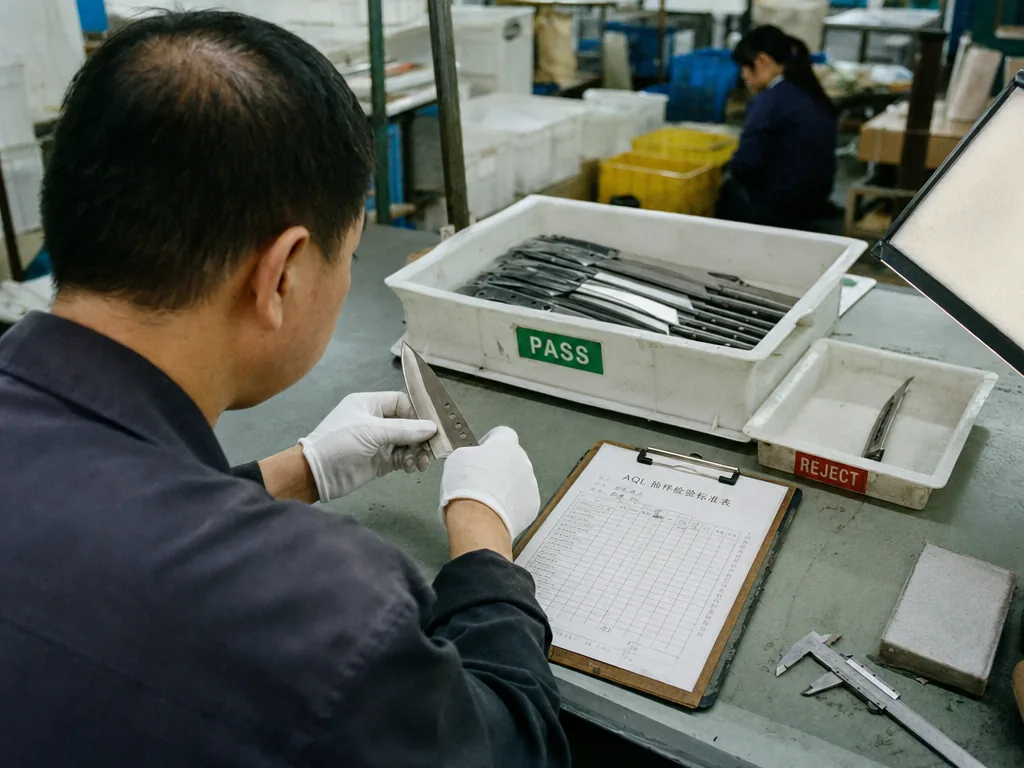
Inspection standards should reflect tang type because the defects differ. At final random inspection, many knife importers use AQL 2.5 for major defects and 4.0 for minor, though high-value programs may tighten further. The tang itself is not fully visible after assembly, so pre-assembly in-line control matters.
For full tang models, inspect blade blank profile against drawing tolerance, typically plus or minus 0.20-0.50 mm depending on process. Check handle scale flushness, pin compression, rivet cracks, epoxy voids, and symmetry from spine and butt views. Exposed tang edges should be chamfered consistently to avoid sharp contact points. Pull-off or shear checks on scale bonding are useful for new SKUs.
For partial and hidden tang knife types, the highest-risk points are shoulder fit, insertion depth, adhesive cure, and alignment. If the tang enters the handle off-center by even 1-2 mm, the knife can show a twisted visual line or uneven wall thickness. Ask suppliers to document:
- Minimum tang insertion depth in mm
- Epoxy brand/spec or equivalent performance standard
- Cure time and temperature
- Handle crack inspection after assembly and polishing
- Torque or bend test method for validation samples
On first orders, request destructive validation on retained samples. For example, test one unit per 500-1000 pieces from pilot production for handle separation, then compare failure behavior to your baseline sample. This is especially important when changing handle material, because wood moisture content above roughly 10-12 percent can alter bond reliability and crack rate during transit.
Lead times, MOQ, and pricing implications of full tang vs partial tang
Tang choice changes quoting more than many buyers expect. Full tang models often need larger blade blanks, more profiling, more handle finishing, and more handwork to flush scales to steel. Hidden tang models may save metal but require precise slotting or drilling in the handle block plus careful adhesive assembly. Which one is cheaper depends on knife size and handle style, but on mass-market fixed blades, full tang usually carries the higher FOB.
Typical OEM MOQs from Chinese manufacturers are around 300-500 pieces per SKU for existing constructions and 500-1000 pieces for fully custom new developments. Sample lead times are commonly 7-15 days for modified existing models and 15-30 days for custom tooling or new handle systems. Bulk lead times often run 25-45 days after sample approval and deposit, extending during peak season or if packaging and sheath suppliers are separate.
Indicative FOB ranges for mid-volume production can look like this:
- 3Cr13 or 5Cr15MoV fixed blade, basic molded or scale handle: USD 4.50-9.00
- D2 or 14C28N outdoor fixed blade with G10/micarta scales: USD 9.00-22.00
- 5Cr15MoV or 1.4116 kitchen knife with hidden tang pakkawood handle: USD 3.00-8.50
Shipping terms also matter. Under FOB, the weight difference between full and partial tang is modest per unit but material at carton level. Under DDP air replenishment, 40-80 g extra per piece can noticeably alter margin on lower-ticket SKUs. Procurement should therefore compare construction not just on factory quote, but on landed cost and defect cost.
How buyers should write tang specifications into RFQs
The cleanest way to avoid disputes is to convert “full tang vs partial tang” from a marketing phrase into a measurable specification. RFQs should include blade steel, hardness target, thickness, finish, handle material, and tang drawing references. If a tang type is critical to retail positioning, add a compliance clause stating that any reduction in tang width, length, or thickness requires written approval before production.
A practical RFQ checklist includes:
- Knife application and prohibited-use statement
- Tang type: full tang, reduced full-length tang, hidden tang, rat-tail tang
- Tang dimensions at key points in mm
- Handle fastening method: rivets, bolts, compression fit, adhesive, overmold
- Hardness range, for example 56-58 HRC for 5Cr15MoV kitchen or 58-60 HRC for D2 outdoor
- Surface finish and corrosion standard
- QC plan with AQL 2.5 and critical cosmetic/functional points
- Packaging drop requirements and salt-spray expectations where relevant
Also ask for cross-section photos during PP sample approval. This simple request prevents substitutions such as shorter hidden tangs or excessive grinding in the handle area. For private label programs, ensure product copy aligns with real construction. A hidden tang knife can be excellent, but if your listing invites impact use, the structure and warranty reserve need to support that claim.
Frequently asked questions
Usually under impact and lateral abuse, yes, but not in every application. A well-designed hidden tang with adequate width, length, shoulder radius, and strong bonding can outperform a poorly executed full tang. Buyers should compare actual tang dimensions, thickness transitions, and test data rather than relying on the term alone.
Kitchen knives prioritize balance, agility, and handle aesthetics more than chopping abuse. Hidden tang construction reduces handle weight, allows slimmer profiles, and supports wood or composite handle forms that are popular in culinary lines. For slicing and prep tasks, this is often the better functional and commercial choice.
Require blade and tang drawings, pre-assembly photos, and cross-section confirmation on PP samples. During production, verify insertion depth, assembly alignment, cure controls, and destructive test results on retained samples. At final inspection, focus on straightness, handle cracks, gaps, glue lines, and any movement under manual torque.
On many OEM fixed blades, full tang may add roughly USD 0.30-1.50 or more per piece depending on steel, size, and handle finishing. Larger knives and premium scale materials widen the gap. The true difference should be calculated on landed cost, including weight, packaging, and expected warranty exposure.
Define tang type with drawings and dimensions in mm, not just a name. Include width and thickness at key handle points, insertion depth for hidden tangs, fastening method, hardness target, and a no-substitution clause. Add approval requirements for any structural change and tie inspection to agreed AQL levels and sample baseline.
Get your project quoted
From a single SKU to a full product line, we can quote, sample and ship from our Zhejiang facility. Talk to a specialist who's worked on hundreds of buyer briefs.
Request a Quote