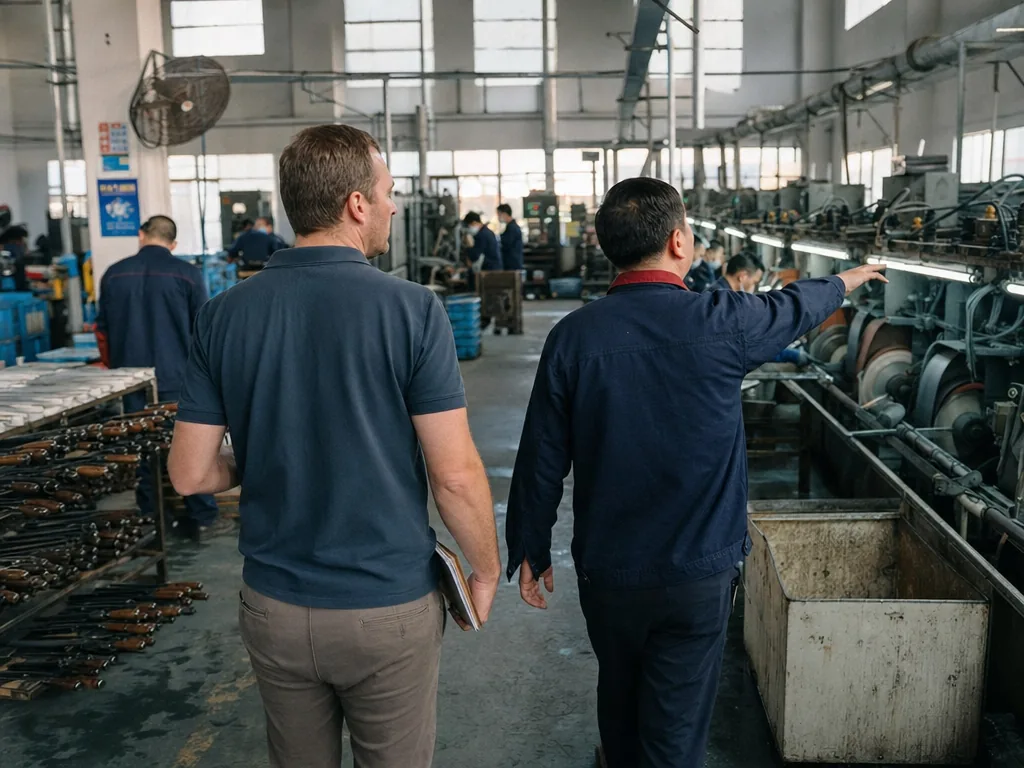
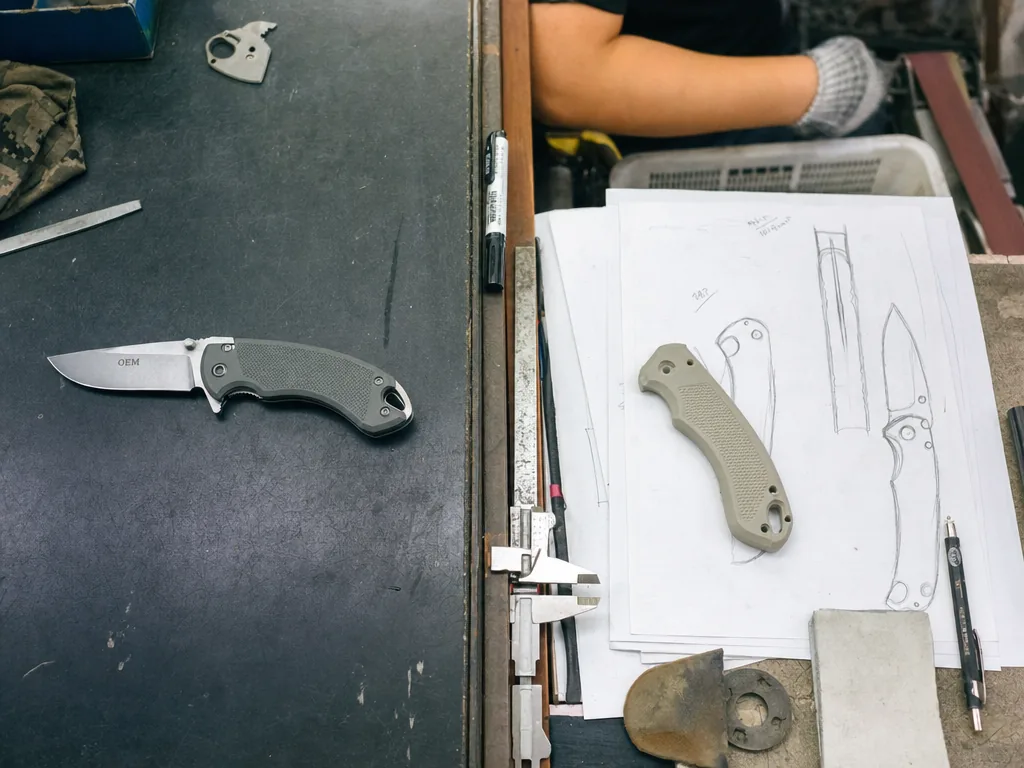
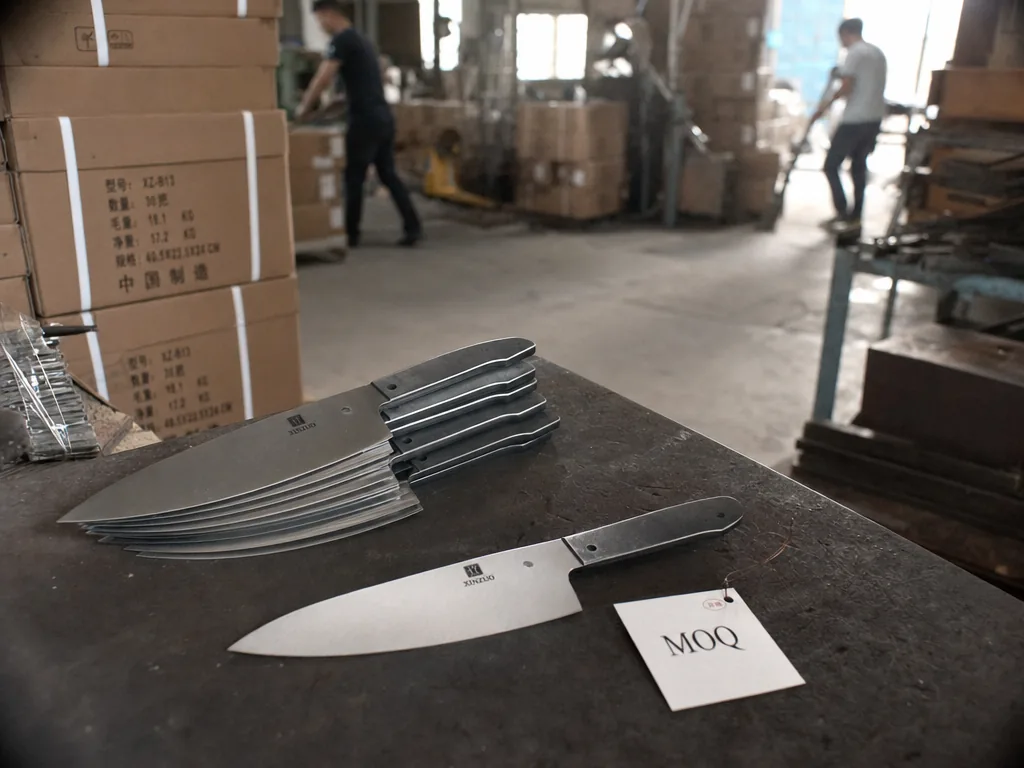
OEM knife manufacturing costs are often understated when buyers compare factories using only ex-works unit pricing. For custom pocket knives, kitchen knives, or fixed blades, the hidden spend usually sits in mold and fixture development, pre-production samples, logo application, packaging validation, testing, inspection, and shipping terms. A supplier that looks USD 0.40 cheaper per unit can become the higher-cost option once these line items are added back.
This guide is written for procurement teams, importers, and private-label sellers that already know the sourcing basics. It breaks down realistic cost ranges, where fees are negotiable, which items should be amortized across volume, and how to structure RFQs to reduce surprise charges. If you are budgeting a new knife program from China, this article will help you compare quotations on a like-for-like basis.
What OEM knife manufacturing costs actually include
Most knife quotations show only the visible components: blade steel, handle material, assembly, packaging, and FOB pricing. The full landed picture is broader. In custom knife programs, hidden costs appear because the supplier must convert a concept into stable mass production with repeatable quality at target hardness, finish, and fit tolerance. That work creates non-recurring engineering expense, trial loss, and compliance overhead.
At minimum, buyers should separate costs into four buckets:
- One-time development: CAD modification, prototype programming, jigs, fixtures, molds, logo dies, packaging dielines.
- Pre-production validation: sample rounds, courier fees, destructive testing, edge retention checks, salt spray where applicable, carton drop testing.
- Compliance and quality: material declarations, food-contact testing for kitchen knives, third-party inspection at AQL 2.5, and documentation review.
- Commercial terms: Incoterms, payment charges, destination duties, FBA prep, and rework reserves.
When a factory offers an OEM service, ask for a costed breakdown instead of a single all-in number. Serious suppliers can distinguish recurring unit cost from amortizable setup cost. This matters because the same program may be expensive at 500 units, acceptable at 2,000 units, and highly competitive above 5,000 units once tooling is spread over volume. Procurement teams should model at least three volume scenarios before approving a launch.
Knife tooling cost: where development fees accumulate
Knife tooling cost is the first area where buyers underestimate spend. Not every custom knife needs a hard mold, but almost every custom knife needs some form of production tooling. The exact cost depends on whether the product is a folding knife, fixed blade, or kitchen knife and how different it is from the supplier's existing platform.
Typical cost items include CNC fixtures for blade grinding, drilling jigs, spring-back compensation tools for liners, injection molds for plastic handles or sheaths, stamping dies, and laser or etching fixtures for logo placement. For G10 or micarta handle scales based on an existing shape, fixture updates may stay under USD 150-400. For a new FRN handle mold, costs can run USD 2,500-8,000 depending on cavity count and complexity. Sheath molds often add USD 800-3,000. If a folding knife uses a custom backspacer, clip, or lock geometry, expect more sampling iterations and fixture adjustments.
| Tooling item | Typical range (USD) | When it applies | Buyer note |
|---|---|---|---|
| Laser logo fixture / artwork setup | 30-120 | New logo or placement | Often negotiable at repeat order |
| Grinding / drilling fixture | 150-600 | New blade outline or hole pattern | Common for low-MOQ custom work |
| Stamping die | 800-3,500 | High-volume metal parts | Amortize over 5,000+ units |
| Plastic handle mold | 2,500-8,000 | FRN/PP/TPR handle programs | Clarify mold ownership in PO |
| Sheath mold | 800-3,000 | Injection sheath or accessory part | Can be separate from knife MOQ |
Always confirm who owns the tooling, where it is stored, whether maintenance is charged, and whether the supplier can use it for other customers. Those terms affect the real value of your upfront payment more than the tooling invoice itself.
Knife sample fee and trial-order economics before mass production
Knife sample fee is often treated as a small administrative charge, but it can represent real engineering time and scrap risk. For stock models with a logo change and retail box edit, sample costs may be only USD 50-150 plus courier. For a custom blade profile, custom colorway, and new packaging insert, pre-production samples can cost USD 150-500 each. Functional folding knives with tuned action, lock-up checks, and multiple finishing steps may exceed that range if the supplier must hand-build prototypes outside standard flow.
There are usually three sample stages:
- Visual mockup or digital proof: low cost, used to approve artwork and color placement.
- Hand-made or CNC prototype: confirms dimensions, ergonomics, and mechanism function.
- Pre-production sample: made using intended production process to validate manufacturability and packaging.
Freight is another hidden line. DHL or FedEx courier for knives can range from USD 35-90 for one parcel depending on destination and customs handling. If the project needs three rounds of samples, logistics alone can exceed the logo setup fee. Ask whether sample fees are refundable against a mass-production order. Many factories credit some or all sample charges back at MOQs of 1,000-3,000 units.
Buyers should also account for internal approval delay. Every extra sample round usually adds 5-10 days. For Amazon seasonal launches, that time can cost more than the sample fee itself. The right move is to lock the specification package early: blade steel, thickness in mm, target hardness such as 56-58 HRC or 58-60 HRC, finish, edge geometry, logo method, box dimensions, barcode placement, and carton count.
Knife certification cost and compliance by product category
Knife certification cost varies widely because knives are regulated less like electronics and more through material safety, labeling, and market-specific import rules. There is no universal single certificate for every knife. What matters is the destination market, product type, and contact surface. For kitchen knives, buyers may need LFGB or FDA-related food-contact testing for handle materials, coatings, inks, or packaging components. For folding knives sold in the EU, REACH declarations and packaging compliance are common. For outer cartons and transit packaging, buyers may request drop testing or packaging material declarations.
Typical third-party lab costs range from USD 150-400 for limited material screening up to USD 800-1,500 for broader test packages involving multiple materials or chemical scopes. If you change a handle polymer, coating, adhesive, or printed packaging ink, prior reports may no longer fully apply. That is why a very low quote can become expensive later when compliance is rebuilt from scratch.
Buyers should ask the factory for existing certifications and also distinguish between factory system certification and product testing. ISO 9001 supports process control, but it does not replace product-specific lab reports. AQL 2.5 pre-shipment inspection also does not replace compliance testing.
Useful checkpoints include:
- Factory quality system status, such as ISO 9001.
- Material traceability for steel grade and handle material.
- Food-contact reports for kitchen knife components where needed.
- Country-specific labeling and warning requirements.
- Packaging compliance for retailer or marketplace channels.
Good suppliers can reuse valid reports where the BOM remains unchanged, but procurement should assume new testing whenever materials, coatings, or prints change materially.
Knife OEM hidden fees in packaging, QA, and shipping terms
Knife OEM hidden fees commonly appear outside the factory gate. Packaging development can add USD 80-300 for dielines, prepress, color proofing, and carton optimization, even when the box itself is inexpensive. If your retail packaging requires foam inserts, molded trays, magnetic closures, or multilingual print runs under 3,000 units, the per-unit packaging cost can rise sharply because setup is spread over a small base.
Quality assurance is another area where buyers underbudget. Third-party pre-shipment inspection at AQL 2.5 often costs around USD 250-450 per man-day in China, sometimes more depending on city and report scope. If the product includes multiple SKUs, assortment packs, or Amazon-specific labeling, inspection time increases. Re-inspection after failed findings creates another fee plus schedule loss.
Commercial terms also distort comparisons. A supplier quoting FOB Ningbo is not directly comparable to one quoting EXW or DDP. Under EXW, local trucking, export customs, and port charges move to the buyer. Under DDP, the supplier may build duty, tax risk, and last-mile handling into the quote. For many knife programs, the difference between EXW and FOB can be USD 0.10-0.35 per unit depending on order size and carton density.
Other hidden charges include bank fees for TT or LC, palletization, FNSKU labeling, carton mark changes, split delivery, and storage if shipment is delayed by buyer-side approvals. If the project is cost-sensitive, use one commercial checklist for every quote and require each factory to fill the same template before comparison.
How to compare OEM knife manufacturing costs across suppliers
The most reliable way to compare OEM knife manufacturing costs is to force line-item visibility. Do not ask, "What is your best price?" Ask for a structured quotation with unit cost, non-recurring engineering, sample terms, packaging assumptions, QC assumptions, and Incoterms. This reduces the chance that one supplier buries setup cost in the unit price while another bills it separately.
A practical procurement template should request:
- MOQ by SKU and by colorway.
- Tooling list with refundable or non-refundable status.
- Sample fee by round and whether credited back.
- Lead time for prototype, pre-production, and mass production.
- Target hardness range, for example 54-56 HRC for budget kitchen knives or 58-60 HRC for many higher-end applications depending on steel.
- Inspection standard, such as AQL 2.5 major / 4.0 minor unless otherwise agreed.
- Packaging cost by unit and setup cost separately.
- FOB, EXW, and optional DDP pricing.
Lead times should also be benchmarked. For many programs, samples take 7-15 days for stock-based customization and 15-30 days for new designs. Mass production often runs 25-45 days after sample approval and deposit, though complex folding knives or molded handle programs can take longer. If a quotation is materially faster than the market without a clear reason, verify capacity and process realism.
Before committing, use the supplier's costing sheet to build a should-cost model. Then request a detailed quote with all assumptions frozen in writing. That simple discipline usually saves more money than aggressive price negotiation after tooling has already started.
Reducing OEM knife manufacturing costs without damaging quality
Cost reduction works best when applied to complexity, not to critical performance. Buyers should protect the items that affect safety, durability, and consistency: steel specification, heat treatment window, pivot or lock tolerance where applicable, handle fit, corrosion resistance, edge geometry, and final inspection. Savings usually come from standardization and volume planning.
Start by using an existing platform where possible. Adapting an existing blade thickness, screw size, clip form, or sheath architecture can eliminate custom fixtures and shorten sample time. Consolidate logos and packaging variants. Five colorways at 500 units each often cost more than one colorway at 2,500 units because setup loss, carton fragmentation, and inspection complexity increase. For private-label Amazon sellers, reducing SKU spread can improve both factory pricing and inbound freight efficiency.
Use tooling amortization intentionally. Instead of pushing to waive all development fees, negotiate a credit-back schedule tied to order volume, such as 30 percent credited at the first 2,000 units and the balance by 5,000 units. This protects the supplier's setup investment while keeping your long-run cost competitive.
Finally, qualify the supplier's process discipline. A factory with stable incoming material control, heat-treatment records, and final AQL execution may quote USD 0.20-0.60 higher per unit than a weaker shop, but the lower defect rate often wins financially after returns, rework, and account risk are considered. For retail and marketplace channels, hidden quality costs are usually more expensive than visible manufacturing costs.
Frequently asked questions
For simple logo and packaging customization, MOQ can start around 300-500 units. For new fixtures or mild geometry changes, 1,000-2,000 units is more realistic. If the program needs injection molds for handles or sheaths, buyers usually need 2,000-5,000 units or a multi-order forecast to amortize tooling without distorting unit cost.
Often yes, but only partially and only when defined in advance. Many suppliers credit sample fees against the first production PO once MOQ is met, typically at 1,000-3,000 units. Courier fees are less likely to be refunded. If the project uses extensive hand-built prototypes or repeated design changes, some sample charges remain non-refundable.
No. ISO 9001 indicates a factory quality management system, not product compliance. Third-party inspection at AQL 2.5 verifies lot quality before shipment, while lab testing checks materials or food-contact compliance. For kitchen knives, coatings, handle plastics, or printed packaging, product-specific reports may still be required by your market or retailer.
FOB is usually the cleanest comparison point because export-side charges are included and ocean freight remains visible to the buyer. EXW can look cheaper but shifts local transport and customs cost to you. DDP is useful for all-in budgeting, especially for Amazon sellers, but ask for the duty and freight assumptions behind the price.
Use existing factory platforms, standard hardware, and fewer color or packaging variants. Freeze the specification early, including steel, finish, hardness, logo process, and carton details. Negotiate tooling credit-back instead of demanding a waiver. Most importantly, do not cut final inspection or heat-treatment control, because defects cost more than the savings.
Get your project quoted
From a single SKU to a full product line, we can quote, sample and ship from our Zhejiang facility. Talk to a specialist who's worked on hundreds of buyer briefs.
Request a Quote