A honing rod is not a universal sharpener; it is an edge maintenance tool that works only when the knife geometry, steel hardness, and user instructions are aligned. For importers, brand managers, and Amazon private label teams, the question is not simply whether to bundle a rod. The question is which rod specification protects the product promise, reduces returns, and fits the landed cost target.
Kitchen knives leave the factory with a defined apex angle, burr removal standard, and cutting performance target. After use, the edge may roll, micro-chip, polish smooth, or become geometrically thick. Honing, ceramic abrasion, diamond abrasion, and full blade sharpening solve different failure modes. A sourcing brief should therefore specify the knife edge, the rod material, hardness relationship, packaging claim, instructions, inspection method, and whether aftermarket sharpening is part of the brand story.
What a Honing Rod Actually Does to a Knife Edge
A conventional steel honing rod realigns a slightly rolled edge. It does not remove enough metal to rebuild a dull apex. On a typical Western kitchen knife hardened to 54-58 HRC, a thin edge can bend microscopically during board contact, lateral scraping, or dishwasher abuse. A grooved or smooth steel rod applies localized pressure that pushes the deformed apex closer to center. The user feels improved bite, but the blade has not been resharpened in the manufacturing sense.
This distinction matters for product claims. If a boxed set says “keeps knives sharp,” buyers should know whether the included tool restores alignment or abrades steel. A steel rod paired with soft stainless kitchen knives is defensible. The same rod paired with 60-62 HRC Japanese-style knives can be ineffective or even damaging if the edge chips instead of rolls. For harder steels, a ceramic honing rod or fine diamond honing rod may be a better match because the tool abrades rather than only realigns.
Factory edge targets also influence rod performance. Common production specifications are 15-17 degrees per side for Japanese-style chef knives and 18-22 degrees per side for Western-style sets. If the consumer uses a rod at a much higher angle, the micro-bevel grows quickly and cutting performance falls. If the angle is too low, the rod misses the apex. Procurement teams should treat instructions, angle guides, and illustration accuracy as part of the specification, not as marketing afterthoughts.
Honing Rod vs Sharpening: Failure Modes and Decision Rules
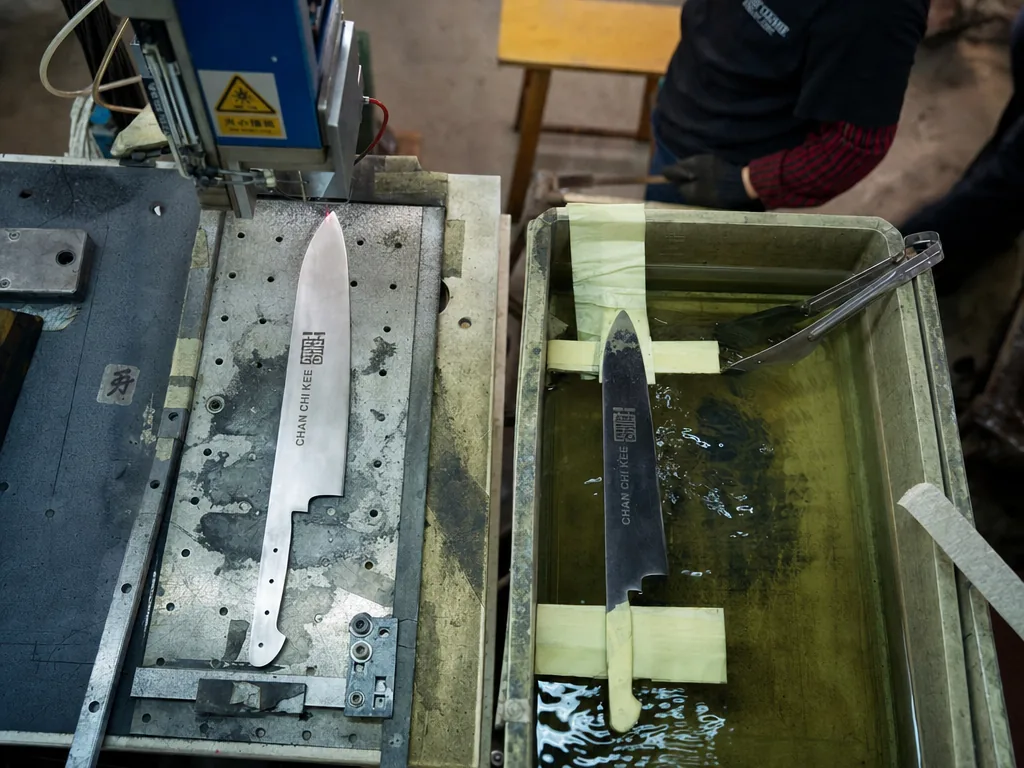
The practical difference in honing vs sharpening is metal removal. Honing handles edge deformation; sharpening creates a new apex by grinding both bevels until they meet cleanly. In a factory context, sharpening uses belts, wheels, stones, robotic fixtures, or manual finishing under controlled angle and pressure. The factory sharpening process should define belt grit sequence, coolant or heat control, deburring method, and final cutting test.
For buyers, the decision rule starts with the edge condition. If the knife still cuts paper in sections but feels inconsistent on tomato skin, a honing rod may restore continuity. If the knife slides on onion skin, shows reflected light along the apex, or has chips larger than 0.1-0.2 mm, it needs sharpening. If the blade is thick behind the edge after repeated consumer pull-through use, it needs thinning before normal sharpening can recover performance.
The following table summarizes typical sourcing implications. Values are practical ranges, not universal limits, because steel grade, heat treatment, and edge angle change the result.
| Condition | Best remedy | Tool or process | Buyer specification impact |
|---|---|---|---|
| Slight rolled apex on 54-58 HRC stainless | Realignment | Smooth or fine grooved steel honing rod | Bundle as maintenance accessory; include angle guidance |
| Polished edge with weak bite | Light abrasion | Ceramic honing rod, 1000-3000 grit equivalent | Position as fine maintenance tool for better bite |
| Minor flat spots or micro-chips below 0.2 mm | Abrasive correction | Fine diamond honing rod or stone | Warn against overuse; validate scratch pattern and coating life |
| Visible chips, thick edge, poor apex | Full sharpening | Factory belt, whetstone, or professional service | Do not claim rod can repair; define warranty and service language |
How to Specify a Steel, Ceramic Honing Rod, or Diamond Rod
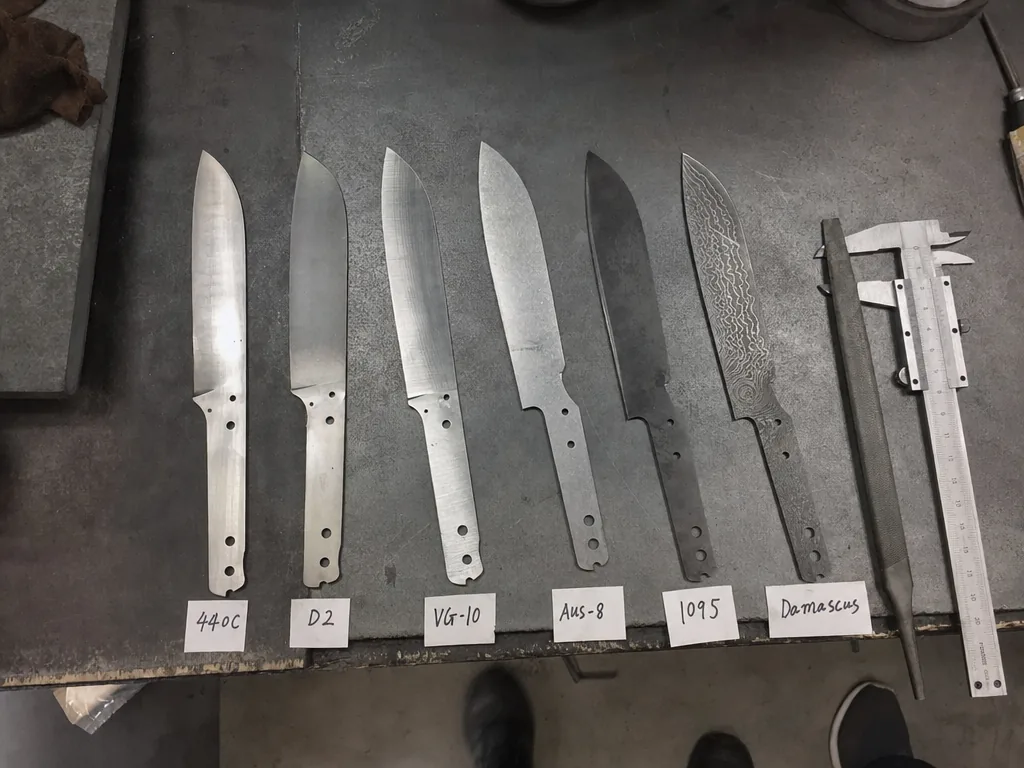
Rod material should be specified against knife steel hardness and brand positioning. A low-cost stamped knife set using 3Cr13, 420J2, or similar steel at 52-55 HRC can use a carbon steel or stainless steel rod with chrome plating. A mid-tier forged set using 5Cr15MoV, X50CrMoV15, or 1.4116 at 55-58 HRC should use a rod that is straight, corrosion-resistant, and hard enough to resist wear. Premium VG10, AUS-10, or powder steel knives at 60 HRC and above usually need ceramic or fine diamond, not a coarse grooved steel rod.
A ceramic honing rod is usually alumina-based and may be specified by diameter, length, grit feel, and straightness. Common diameters are 10-14 mm, with usable rod lengths of 200-300 mm. Fine ceramic rods often function around 1000-3000 grit equivalent, though suppliers may not use a standardized grit scale. Buyers should request cutting and scratch-pattern samples instead of relying only on grit labels.
A diamond honing rod uses abrasive particles bonded to a steel substrate. It removes steel quickly, which is useful for damaged edges but risky for daily maintenance claims. Coarse diamond can shorten knife life and create complaints if users see black swarf immediately. For retail kits, a fine diamond coating is usually safer. Specify coating uniformity, adhesion, salt spray requirements for exposed metal, handle pull strength, end-cap retention, and whether the rod is magnetic. MOQ often starts at 1000-3000 pieces for private label packaging, while custom handles, colors, or injected angle guides may require 3000-5000 pieces.
How to Use a Honing Rod: Instructions Buyers Should Require
Most consumer misuse comes from angle, force, and frequency. For B2B buyers, “how to use a honing rod” should be written as a controlled instruction set, translated clearly, and tested by non-expert users before mass production. The goal is to reduce returns caused by chipped edges, scratched blades, and unrealistic expectations. Instructions should state that honing is maintenance, not a repair for chips or fully dull knives.
A practical instruction standard is: hold the rod vertically on a stable board or use the classic freehand method only if confident; set the blade at the recommended angle; draw heel to tip with light pressure; alternate sides; use 4-8 passes per side; wipe the blade after use. For Western knives, 18-20 degrees per side is a common instruction. For thinner Japanese-style knives, 15 degrees per side may be appropriate, but only if the steel and edge are designed for it. Force should be described as light, roughly the pressure used to slice soft fruit, not chopping force.
Include warnings by rod type. A steel rod is for realignment on compatible knives. A ceramic rod is fragile and should not be dropped on tile. A diamond rod removes metal and should not be used daily on premium thin edges unless the brand intentionally sells it as an abrasive maintenance tool. If your SKU includes both a knife and rod, TANGFORGE can review angle claims and packaging instructions during sample development; for a program review, contact us with the target steel, HRC, blade geometry, and retail price band.
Factory Sharpening Specifications Before Any Honing Rod Bundle
A bundled honing rod cannot compensate for an inconsistent factory edge. Before adding an accessory, lock the knife edge specification. For many Western chef knives, a 18-20 degree per side V-edge with 55-58 HRC stainless provides durability for mass retail. For premium Japanese-style SKUs, 14-16 degrees per side with 60-62 HRC steel can improve cutting feel but raises chip risk and requires more precise consumer education. Serrated knives, bread knives, and some steak knives should not be marketed with standard rod maintenance unless the instruction clearly excludes them.
Buyers should ask suppliers to document edge angle tolerance, burr removal method, and final test. Practical factory controls may include belt grit progression such as 240/400/800 plus polishing, or stone finishing depending on the line. A cutting test can use copy paper, tomato skin, rope, or standardized media. The important point is repeatability. Heat buildup during belt sharpening should also be controlled because overheating the apex can reduce hardness locally even when the blade body passes HRC testing.
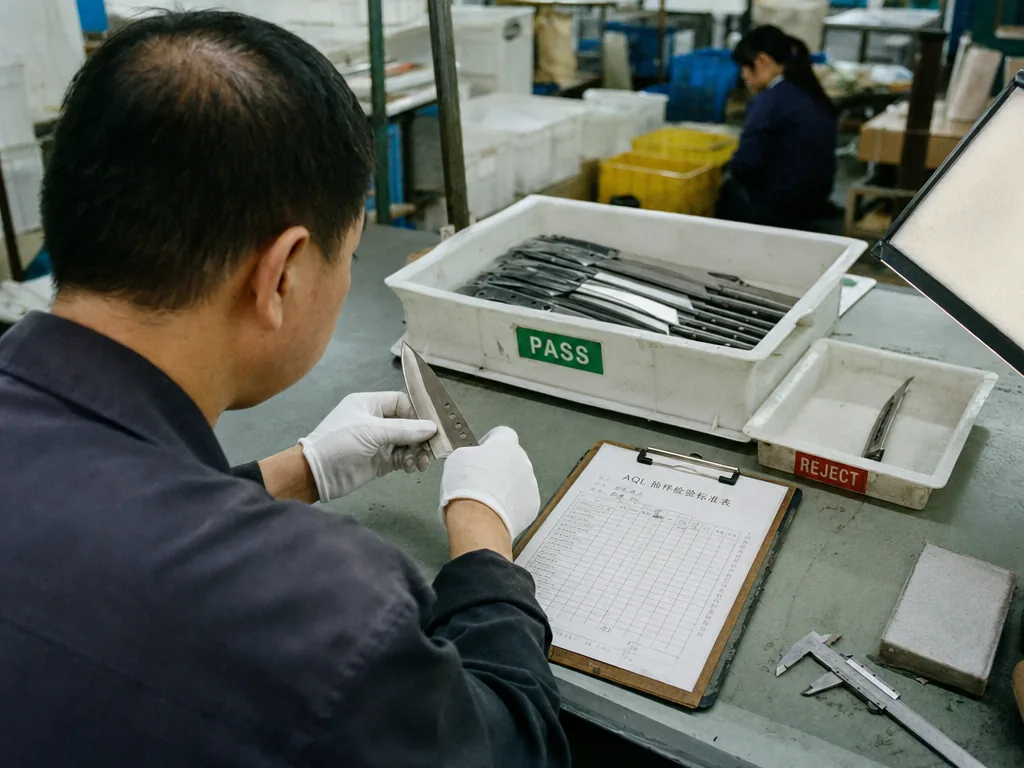
Quality agreements should include AQL inspection levels, commonly AQL 2.5 for major defects and AQL 4.0 for minor cosmetic defects, depending on buyer risk tolerance. Critical defects include loose handles, broken rod tips, severe edge chips, wrong angle, rust, and unsafe burrs. ISO 9001 certification does not guarantee sharpness, but it supports traceability, corrective action, and process discipline. Lead time for knife plus rod sets is commonly 45-60 days after sample approval and deposit; custom packaging, special coatings, or holiday capacity can push this to 70-90 days.
Cost, MOQ, Packaging, and Compliance for Honing Rod Kits
Cost structure depends on rod material, handle construction, packaging, and inspection requirements. A basic steel rod for an entry-level knife block set may add roughly USD 0.60-1.20 FOB, depending on length and handle. A ceramic honing rod generally adds USD 1.50-3.50 FOB, with higher breakage-control packaging costs. A diamond honing rod can range from USD 2.00-5.00 FOB or more, driven by abrasive quality, coating consistency, and handle design. These figures are indicative for sourcing comparison, not quotations.
Packaging should protect both edge and rod. Ceramic rods need molded pulp, EVA, or secure inserts because drop damage can create hidden cracks. Diamond rods should not rub directly against polished blades during transport. For Amazon FBA, buyers should check carton drop testing, barcode placement, suffocation warnings for polybags, and unit weight accuracy. For EU and North American markets, material safety claims, food-contact assumptions, and corrosion resistance should be reviewed carefully. If the rod handle uses wood, request moisture control and finish consistency; if it uses ABS, PP, or TPR, confirm odor and colorfastness.
Commercial terms also affect specification choices. FOB pricing is simpler for experienced importers managing freight and customs. DDP can help Amazon sellers forecast landed cost but requires clarity on duties, port congestion risk, and delivery appointment fees. MOQ tiers may be 1000 pieces for standard private label, 3000 pieces for custom color and packaging, and 5000 pieces or more for new handle tooling. A good RFQ should include target retail price, steel grade, HRC, rod type, packaging structure, test requirements, Incoterm, and expected reorder volume.
Frequently asked questions
No. A honing rod is useful when the knives are designed for edge realignment and the brand can explain correct use. For entry and mid-tier Western sets at 54-58 HRC, a steel rod is often practical. For hard, thin Japanese-style knives, a ceramic or fine diamond option may be better, or the brand may choose no rod and provide sharpening guidance instead.
Usually, yes for routine maintenance. A ceramic honing rod removes steel more slowly and can refresh bite without aggressive abrasion. A diamond honing rod cuts faster and can correct minor damage, but overuse may shorten edge life or change the bevel. For premium 60-62 HRC knives, specify fine ceramic unless the product positioning clearly requires abrasive correction.
The rod must be hard or abrasive enough to affect the edge. A grooved steel rod works best on softer stainless knives where the edge rolls. When the knife steel is around 60 HRC or higher, the edge is less likely to roll and more likely to chip or polish, so ceramic or diamond abrasion becomes more relevant than simple steel realignment.
Include blade hardness checks, edge angle verification, cutting performance tests, burr inspection, rod straightness, handle pull strength, corrosion checks, packaging drop protection, and barcode accuracy. Many buyers use AQL 2.5 for major defects and AQL 4.0 for minor cosmetic issues. Critical safety defects, such as loose handles or broken ceramic rod tips, should be treated separately.
For compatible Western knives, instructions can recommend light honing before or after several cooking sessions, not forceful daily grinding. A typical recommendation is 4-8 light passes per side at the correct angle. For diamond rods, frequency should be lower because the tool removes metal. Always state that chips, fully dull edges, or thick bevels require sharpening, not honing.
Get your project quoted
From a single SKU to a full product line, we can quote, sample and ship from our Zhejiang facility. Talk to a specialist who's worked on hundreds of buyer briefs.
Request a Quote