Knife heat treatment is the manufacturing stage that most directly controls hardness, toughness, edge stability, and field performance. For importers and private label buyers, the practical question is not whether a factory can quote 56 or 60 HRC, but whether it can repeatedly hit the specified range across lots, blade geometries, and steel grades without raising defect rates.
HRC matters because a knife that is too soft rolls and loses working sharpness quickly, while a knife that is too hard may chip, crack, or become difficult to grind consistently. In commercial sourcing, the right target is usually a hardness window, not a single number. This article explains how heat treatment works, what Rockwell hardness actually tells you, where common knife steels should land, how tempering changes outcomes, and what procurement teams should ask suppliers before approving mass production.
What knife heat treatment actually changes in a blade
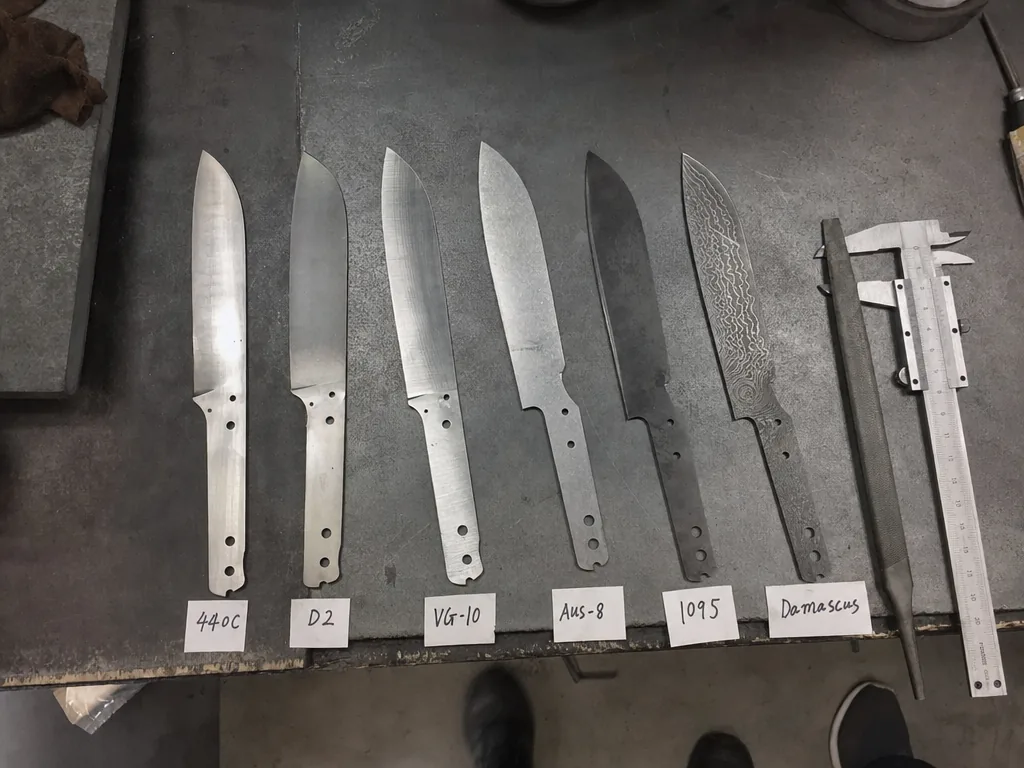
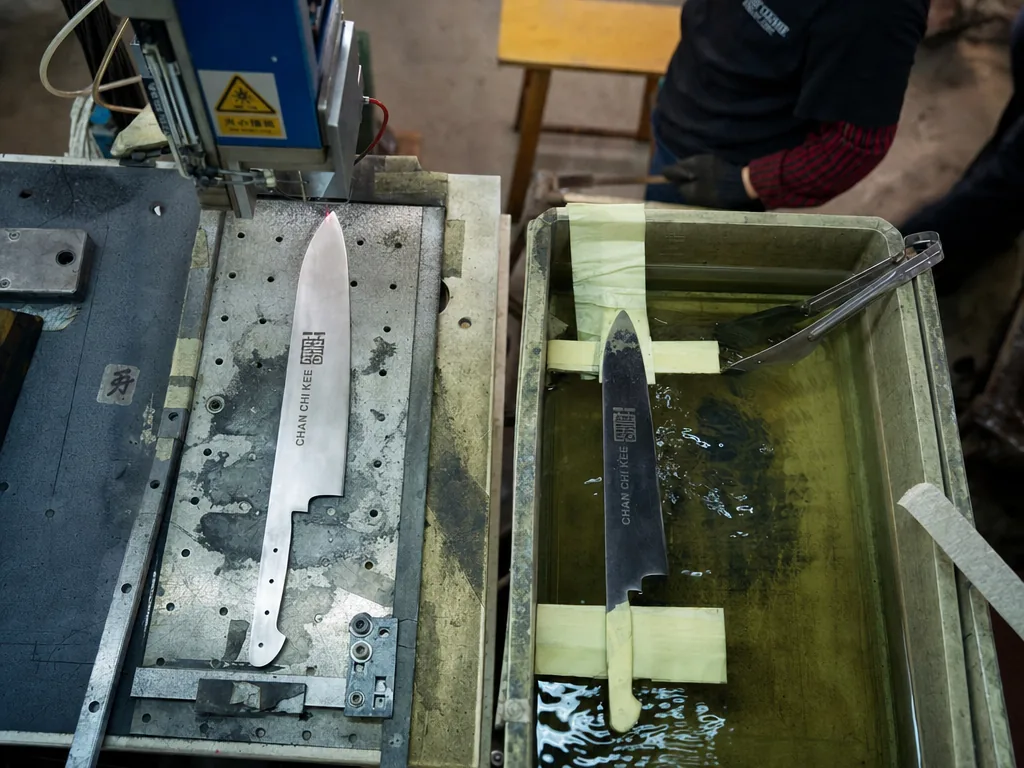
Heat treatment is a sequence, not a single furnace step. In knife production, it usually includes austenitizing, quenching, optional cryogenic treatment for some alloys, and one or more tempering cycles. The purpose is to convert the steel microstructure into a state that balances hardness with usable toughness. This balance is steel-dependent. A 3Cr13 blade at 54-56 HRC can be acceptable for low-cost utility use, while D2 may be specified around 58-60 HRC and 14C28N around 57-59 HRC for stronger edge retention with more corrosion resistance.
For buyers, the practical outputs are measurable. Hardness affects edge retention, apex stability, deformation resistance, and sharpenability. But it also interacts with blade thickness, grind angle, intended use, and finish. A 2.5 mm outdoor blade intended for chopping should not be treated the same way as a 1.8 mm slicer for light EDC use. Good suppliers define heat treatment as part of the full manufacturing process, not as an isolated promise on a quote sheet.
- Too low HRC: edge rolling, fast wear, weak tip stability, easier field sharpening.
- Too high HRC: brittle edge, micro-chipping, crack risk during grinding or use, more difficult finishing.
- Correct HRC window: balanced retention, lower returns, more predictable cutting feel.
Commercially, a realistic hardness tolerance for many production knives is often ±1 HRC, sometimes ±0.5 HRC on higher-control lines. If a supplier claims exact hardness without a range, procurement should ask how that is verified per lot and per blade location.
Knife HRC hardness and how Rockwell hardness knife tests are used
Knife HRC hardness refers to hardness measured on the Rockwell C scale. The test uses a diamond cone indenter under a defined major load and reports resistance to penetration as an HRC number. For knives, HRC is useful because it is fast, standardized, and directly comparable across lots when testing is done correctly. However, it is not a complete performance metric. Two blades at 58 HRC can behave differently if they use different steels, carbide volumes, grain structures, or tempering schedules.
On a production floor, Rockwell testing should be tied to a work instruction: test after final tempering, on a prepared flat area, with scale removed, and at a repeatable location such as the ricasso or tang where geometry allows accurate indentation. Thin blades can give false readings if unsupported. Some factories therefore test witness coupons heat-treated together with the blades, then verify random finished blades where feasible.
| Steel | Typical production HRC | Common use position | Main tradeoff |
|---|---|---|---|
| 3Cr13 | 52-56 HRC | Entry price private label | Lower edge retention, good cost control |
| 5Cr15MoV | 55-57 HRC | Mid-entry kitchen and utility | Easy sharpening, moderate wear resistance |
| 8Cr13MoV | 57-59 HRC | Value EDC and outdoor | Balanced cost vs retention |
| 14C28N | 57-59 HRC | Better stainless performance | Higher material cost, strong fine edge |
| D2 | 58-60 HRC | Wear-focused outdoor and work knives | Less stainless, chip risk if over-hardened |
| 440C | 57-59 HRC | Stainless premium mid-tier | Needs disciplined heat treatment for consistency |
When comparing options, use a structured steel comparison instead of focusing on hardness alone. HRC is best read as a control number linked to intended use, not a universal indicator of quality.
Target HRC ranges in knife heat treatment by use case
There is no best hardness for all knives. Buyers should define a target range based on use, steel family, and warranty exposure. For mass-market outdoor knives, many brands land between 56 and 59 HRC because this band gives acceptable retention without excessive brittleness in rough use. Kitchen knives may run slightly harder for slicing efficiency, while heavy-use survival designs often stay lower to protect against chipping and lateral stress.
Typical sourcing logic looks like this:
- Budget promotional knives: 52-55 HRC, usually 3Cr13 or similar, lowest cost and easiest polishing.
- Mainstream Amazon outdoor SKUs: 56-58 HRC, often 5Cr15MoV or 8Cr13MoV, balanced returns profile.
- Better stainless private label: 57-59 HRC, often 14C28N or 440C, stronger edge holding and higher product positioning.
- Wear-resistant tool-style knives: 58-60 HRC, often D2, stronger abrasive resistance but more caution needed on edge geometry.
Geometry changes the answer. A thick 4.0 mm camp knife with a 22 degree inclusive edge can tolerate different hardness than a thin 2.0 mm slicer ground to 16-18 degrees inclusive. This is why hardness should be approved with drawings, intended cutting media, and sample testing together. If your catalog includes outdoor knives, the right specification usually prioritizes toughness and edge stability over chasing the highest possible HRC number.
For RFQs, a useful line item is: steel grade, target HRC range, test location, sample size per lot, and acceptance rule. That turns hardness from a vague sales claim into a procurement control point.
Knife steel tempering and differential heat treatment tradeoffs
Knife steel tempering is the stage after quenching where hardness is reduced in a controlled way to improve toughness and relieve internal stress. A blade straight out of quench may test very hard, but it can also be unstable and brittle. Tempering tunes the final performance window. Depending on the alloy and target, factories may use double tempering to improve consistency. Tempering temperature and hold time matter. Small deviations can move final hardness by 1-2 HRC, enough to affect warranty performance.
Differential heat treatment creates different hardness zones in the same blade, usually with a harder edge and softer spine. This is more common in traditional carbon steel blades than in large-scale stainless OEM production, but the concept remains relevant. Differential treatment can improve toughness and create a visible transition line, yet it adds process complexity and can reduce lot-to-lot repeatability if not tightly controlled.
For most modern OEM stainless knives, full heat treatment to a controlled hardness window is the more scalable choice. Differential treatment may make sense when the brand story, design language, or use case supports it, but procurement should account for lower throughput and more variation in grinding and straightening.
- Specify target hardness as a range after tempering, not after quench.
- Ask whether the factory uses single or double tempering for the chosen steel.
- Confirm whether cryogenic treatment is standard, optional, or unnecessary for the alloy.
- Request evidence that hardness holds after finishing operations, not only before grinding.
A harder edge with poor tempering discipline is not a premium outcome. Stable tempering practice is what turns hardness into predictable product performance.
How to audit knife heat treatment quality in OEM sourcing
For procurement teams, the key issue is repeatability. A supplier may produce one attractive pre-production sample at 59 HRC, then ship mixed lots ranging from 56 to 60 HRC if fixtures, furnace loading, soak times, or temper cycles drift. This is why quality control around heat treatment should be audited like any other special process.
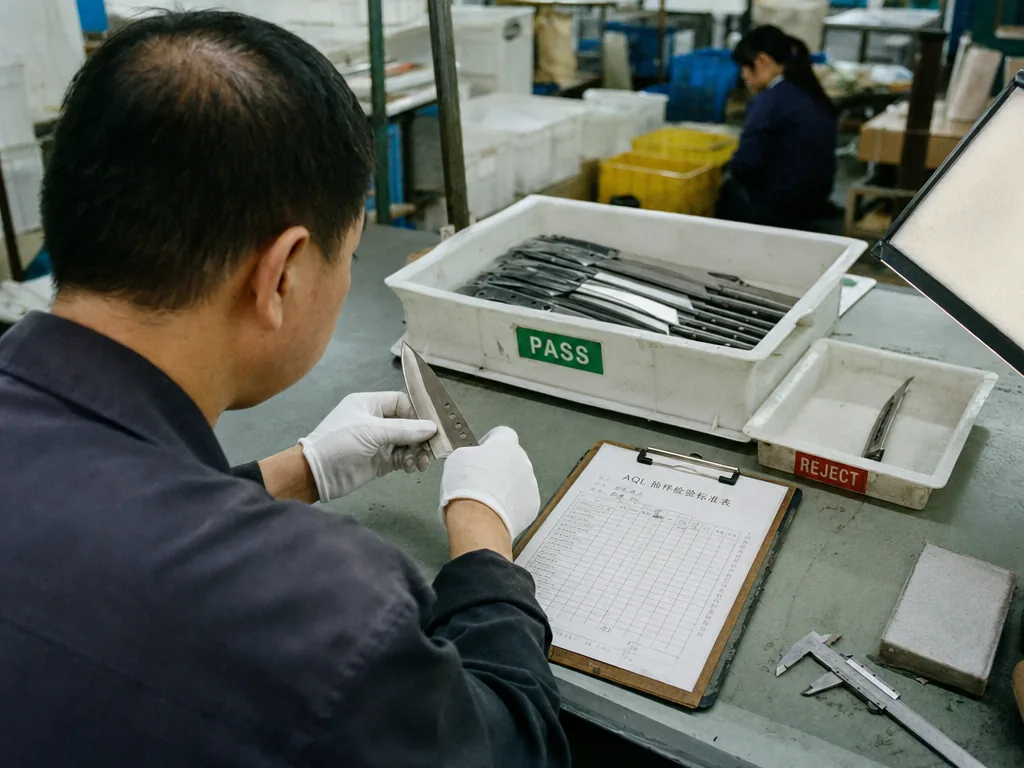
Start with documentation. Ask for furnace type, batch capacity, loading method, target austenitizing temperature by steel, quench medium, temper schedule, and hardness inspection records. A factory operating under ISO 9001 should be able to show controlled work instructions and traceability by lot. For incoming shipment inspection, many buyers use AQL 2.5 for major defects and AQL 4.0 for minor cosmetic issues, but hardness should usually be treated as a critical or major characteristic depending on end use.
- Pre-production: confirm target HRC on signed golden samples.
- In-process: verify hardness after tempering by lot or furnace batch.
- Final QC: spot-check finished blades at agreed sampling rates.
- Failure analysis: review chipped or rolled edges to determine whether geometry, steel, or heat treatment caused the issue.
Commercial terms matter too. If you buy FOB, require test records before shipment release. If you buy DDP and rely on Amazon replenishment cycles, lead time predictability may be just as important as absolute hardness. Typical knife programs in China may run 20-35 days for repeat orders and 35-50 days for new custom SKUs, depending on steel availability, logo method, sheath tooling, and heat treatment queue capacity.
A factory that openly discusses hardness variance, fixturing, and straightness loss after quench is usually more reliable than one that only repeats a headline HRC number.
Cost, lead time, and defect economics around Rockwell hardness knife specs
Tighter hardness specifications improve product control, but they are not free. More demanding steels, double tempering, cryogenic steps, additional hardness checks, and lower rework tolerance all add cost or extend lead time. For B2B buyers, the correct question is whether the incremental process cost reduces returns, review risk, and replacement expense enough to justify it.
On common OEM programs, moving from a basic stainless heat treatment to a more tightly controlled premium stainless program can add roughly USD 0.20-1.20 per knife depending on steel, size, and order volume. The effect is larger on smaller MOQs because setup and testing overhead are spread across fewer units. Example ranges seen in sourcing discussions:
| Program type | MOQ | Heat treatment control level | Typical impact |
|---|---|---|---|
| Entry utility knife | 1000 pcs | Basic batch control, broad range | Lowest unit cost, higher variance risk |
| Mainstream outdoor SKU | 500-1000 pcs | Lot records, ±1 HRC target | Balanced cost and consistency |
| Premium private label | 300-500 pcs | More testing, tighter process discipline | Higher cost, better claim support |
There is also a hidden cost in over-specification. If a product really needs 57-58 HRC, writing 59-60 HRC into the PO may raise scrap, increase grinding cracks, and reduce real-world toughness. The result can be worse customer outcomes despite a more impressive catalog line.
For Amazon sellers especially, hardness should be chosen to minimize negative reviews tied to edge damage after realistic use. A controlled 57-58 HRC with stable geometry often performs better commercially than an aggressive 60 HRC claim on a steel and grind combination not suited to it.
Specification checklist for knife heat treatment in purchase orders
The most effective buyers convert technical expectations into written controls. A purchase order that only says D2 steel or 58 HRC leaves too much room for interpretation. A better specification package links material, process, inspection, and commercial remedies.
Include the following in RFQs and POs:
- Steel grade and standard: for example 8Cr13MoV, 14C28N, D2, or 440C.
- Target hardness range: such as 57-59 HRC, not a single point unless technically justified.
- Test method: Rockwell C, test location, surface prep requirement, and whether witness coupons are acceptable.
- Heat treatment notes: full treatment or differential heat treatment, required temper cycles, any cryo requirement.
- Geometry references: blade thickness, edge angle, and intended use category.
- QC plan: sampling rate, AQL thresholds, lot traceability, and record retention period.
- Commercial remedy: rework, replacement, debit, or credit if hardness falls outside agreed range.
This level of detail reduces disputes and speeds approval because both factory and buyer know what will be checked. It also supports more accurate cost quotes. When a supplier can see the intended hardness window and QC expectation, it can choose the right furnace loading, fixturing, and finishing sequence from the start.
In practice, the best heat treatment specification is one that your supplier can hold consistently over repeat orders. Procurement value comes from stable outcomes lot after lot, not from the hardest number printed on packaging.
Frequently asked questions
For mainstream outdoor knives, 56-59 HRC is usually the workable range, depending on steel and edge geometry. 8Cr13MoV often performs well at 57-59 HRC, while 5Cr15MoV is commonly kept around 55-57 HRC. If the knife is thick and intended for prying or chopping, a slightly lower target can reduce chipping and warranty claims.
Not necessarily. Higher HRC can improve wear resistance, but it can also raise chipping risk and make poor sharpening feedback more visible in reviews. For Amazon channels, consistency usually matters more than chasing the hardest claim. A stable 57-58 HRC with sound geometry often performs better commercially than a nominal 60 HRC blade with brittle edges.
The standard approach is Rockwell C testing after final tempering, using a prepared flat area or a witness coupon heat-treated with the lot. Good practice includes documented batch records, defined test locations, and random verification on finished blades where geometry allows. Buyers should request lot traceability and keep hardness as a controlled characteristic in final QC.
It can be, but it is usually less scalable than uniform full heat treatment for stainless OEM knives. Differential treatment adds process complexity, can affect straightness and grinding consistency, and may widen variation across lots. It is best reserved for designs where the performance profile or brand story specifically benefits from a harder edge and softer spine.
For many commercial programs, ±1 HRC is realistic and practical. Tighter tolerance may be achievable on controlled lines, but only with more process discipline and cost. The acceptable range should reflect the steel, blade thickness, and intended use. What matters most is not the narrowest theoretical tolerance, but whether the supplier can hold it repeatedly over multiple batches.
Get your project quoted
From a single SKU to a full product line, we can quote, sample and ship from our Zhejiang facility. Talk to a specialist who's worked on hundreds of buyer briefs.
Request a Quote