Knife logo files factory preparation affects quoting speed, sampling accuracy, and whether your branding survives first-pass production without redraws. For custom knives, factories do not need a polished brand deck. They need artwork that can be scaled, converted to tooling paths, and applied consistently across steel, G10, wood, aluminum, packaging, and accessories.
Procurement teams and Amazon private label buyers usually lose time at the same point: the logo file arrives as a PNG, a flattened PDF, or an AI file with missing fonts and live effects. That forces the factory to trace the logo, simplify details, or ask for revisions before sampling. This article explains what a Chinese knife manufacturer typically needs, which formats are safest, what dimensions and line weights work for laser and etching, and how to reduce approval cycles from days to hours.
What the knife logo files factory actually needs
A factory-ready logo package is narrower than most brand teams expect. In most knife projects, the supplier needs a clean vector master, one approved placement drawing, and one written specification sheet. The preferred source files are AI or EPS saved with editable vector paths. PDF can work if it contains true vectors, but many exported PDFs are flattened. SVG is acceptable for some workflows, though many production teams still convert it to AI before nesting artwork for fixtures or marking programs.
For practical quoting and pre-production, provide the following:
- Primary vector file: AI or EPS, outlined fonts, no embedded raster effects.
- Reference image: PNG or JPG showing brand colors and intended appearance.
- Placement drawing: logo size in mm, location, orientation, and tolerance, such as 18.0 mm wide on blade face, centered 12.0 mm from plunge line, tolerance ±0.5 mm.
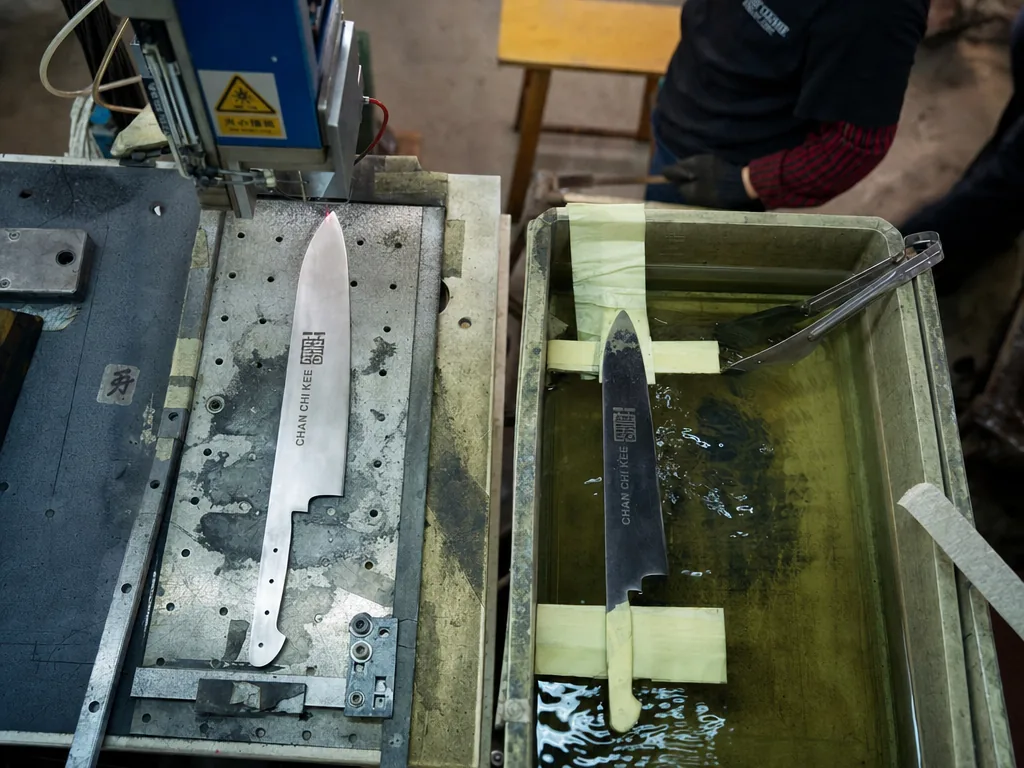
- Application method: laser, electro-etch, screen print, pad print, or emboss/deboss.
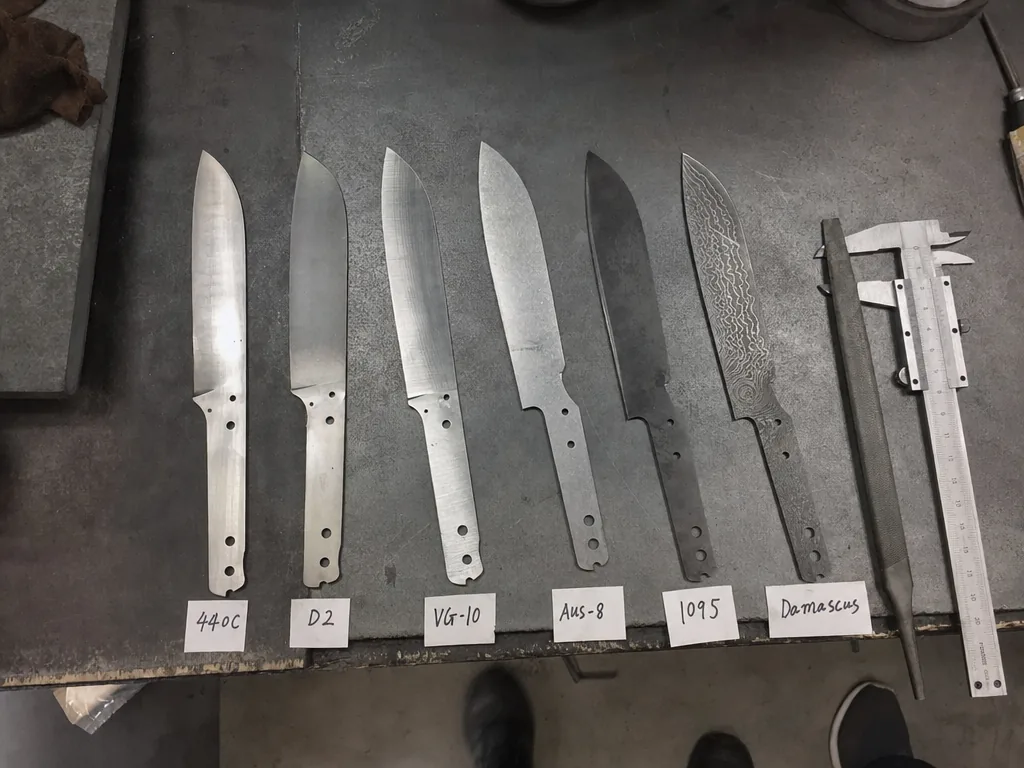
- Surface material: 420, 8Cr13MoV, D2, 14C28N, G10, micarta, pakkawood, aluminum, or carton.
Where branding is part of a larger custom program, include the logo package at RFQ stage, especially if you are using our OEM service. A supplier can often confirm feasibility within 24-48 hours if the vector paths are clean. If the logo has to be recreated, sampling usually slips by 1-3 working days before artwork approval even starts.
Knife logo AI EPS standards that avoid redraw fees
The safest route is to send both AI and EPS versions of the same approved logo. Many factories open AI natively, but EPS remains useful when software versions differ or when the file moves between design, CNC, and marking vendors. To make a knife logo AI EPS package production-safe, convert all text to outlines, expand strokes where appearance depends on stroke width, and remove clipping masks that hide unfinished artwork underneath.
Common file failures are simple but expensive in aggregate. Missing fonts can alter kerning. Live transparency can flatten unpredictably when imported into older software. Hairline strokes under 0.10 mm may disappear during laser marking or etching. Compound paths that are not merged can create filled islands or dropped counters in letters like A, R, or O.
Use this baseline checklist before sending:
- Artboard includes only approved logo versions.
- Color mode noted, even if final application is monochrome.
- Fonts converted to outlines.
- Strokes expanded if the stroke defines the final shape.
- No linked images required for the mark itself.
- No effects such as shadows, glows, mesh, or 3D bevels.
- Version label included, for example, Logo_Master_v3_2025-02-10.ai.
Factories rarely charge separately for artwork review, but redraw or vector cleanup can add USD 20-100 per file depending on complexity. More importantly, cleanup delays proofing. If your logo is intended for laser engraving, ask the supplier to confirm minimum reproducible line width on your target steel finish before the first sample is cut.
Vector logo for engraving: line width, fill, and minimum size
A vector logo for engraving must be designed around process limits, not screen appearance. On knife blades, logos often land in a narrow zone between the spine, bevel, and pivot area. Usable branding width can be only 12-30 mm on a folding knife and 20-45 mm on a fixed blade. At that scale, fine detail is the first thing to fail.
For laser marking on satin or stonewashed steel, a conservative production rule is to keep positive lines at or above 0.15-0.20 mm and negative gaps at or above 0.20-0.25 mm. On dark coated blades, reverse marks may need larger gaps to stay legible after handling tests. Deep etch logos can hold more contrast but also need stronger bridges in enclosed areas to avoid visual filling. If the logo includes a tagline, expect to remove it unless the mark width exceeds roughly 25-30 mm.
| Application | Recommended Min Line | Recommended Min Gap | Typical Logo Width | Comments |
|---|---|---|---|---|
| Laser on satin blade | 0.15-0.20 mm | 0.20-0.25 mm | 14-24 mm | Best for simple monochrome marks |
| Laser on black coating | 0.20-0.25 mm | 0.25-0.30 mm | 14-22 mm | Contrast depends on coating response |
| Electro-etch | 0.18-0.25 mm | 0.20-0.30 mm | 16-28 mm | Good for steel flats, less ideal for micro detail |
| Pad print on handle | 0.20-0.30 mm | 0.25-0.35 mm | 12-20 mm | Depends on substrate texture and ink adhesion |
Ask the factory to proof your smallest intended application, not just the hero version. A logo that looks sharp at 35 mm on a carton may fail at 16 mm on a blade ricasso. If needed, approve two production versions: a full brand mark and a simplified micro-mark.
How to prepare logo for laser on blades and handles
When buyers ask how to prepare logo for laser, the main issue is not file format. It is interaction between the logo geometry and the substrate finish. Laser settings that work on 3Cr13 bead-blast steel may not produce the same edge definition on 7Cr17, D2, or 14C28N with stonewash, black oxide, titanium coating, or DLC-like finishes. Handle materials also vary: G10 and micarta can haze, wood can char, and anodized aluminum can shift tone based on dwell time.
To reduce trial cycles, specify four variables in writing: material grade, surface finish, target mark color, and acceptable mark depth. For example: 8Cr13MoV, fine satin, dark gray cosmetic mark, no tactile depth. That gives the laser operator a usable target instead of a vague request for a black logo.
Production-oriented preparation should include:
- One-color vector artwork only. Gradients do not translate to standard laser workflows.
- Defined clear space around the logo, usually at least 1.0-1.5 mm from bevel breaks, jimping, screws, and chamfers.
- A note on orientation relative to blade opening direction and show side.
- A sample hierarchy: blade logo first, handle logo second, packaging logo third.
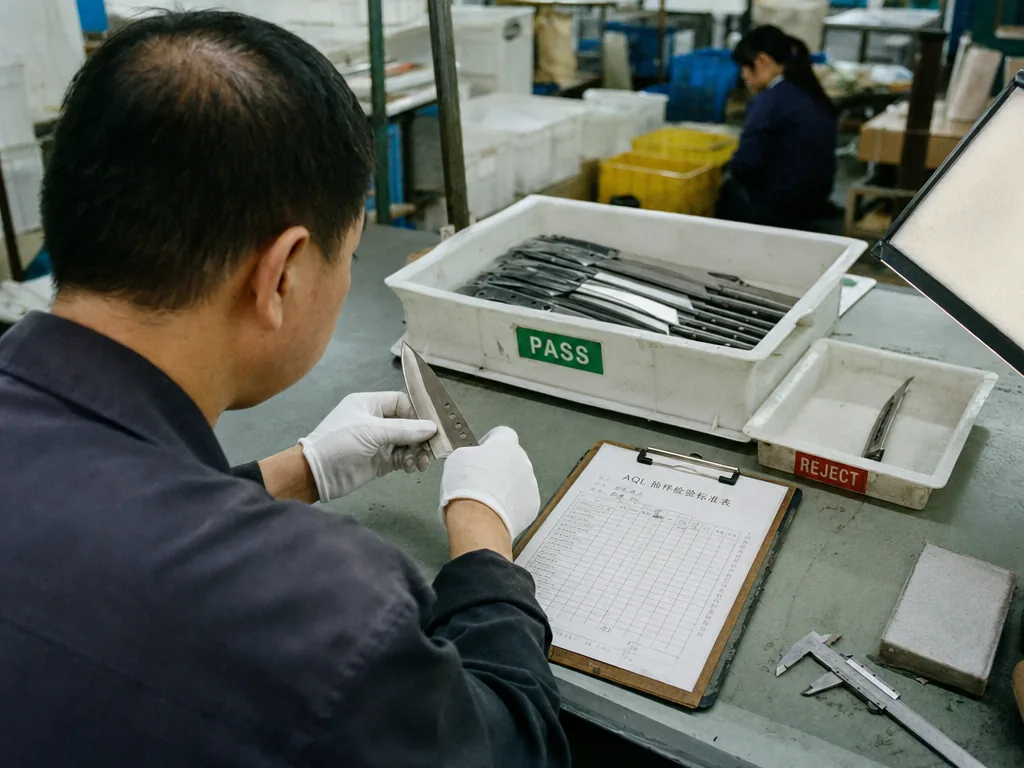
If your branding program spans several SKUs, ask for one laser test panel with 3-5 scaled logo sizes on the real material. This is faster and cheaper than running repeated knife samples. Most suppliers can prepare such a panel within 2-4 days before full sample assembly. For production launch, pair artwork approval with first article inspection and cosmetic criteria under AQL 2.5 for major defects if logo legibility is contract-critical.
Knife logo specifications buyers should put on the PO
Artwork approval alone is not enough. The purchase order or specification sheet should translate the approved logo into measurable production language. This is where many disputes start: the buyer approved a proof, but the factory interpreted size, location, or contrast differently across batches. Clear knife logo specifications reduce that risk.
A robust specification block includes logo revision code, process, placement, dimensions, and acceptance standard. Use millimeters, not visual descriptions like small or centered. If your order uses multiple factories for knives and packaging, identify which file version controls each application.
- Logo file: BrandMark_Blade_v2.ai and .eps
- Process: fiber laser cosmetic marking
- Location: show side blade flat, 10.0 mm from handle scale front edge, parallel to spine
- Size: 17.5 mm width x proportional height
- Tolerance: position ±0.5 mm, width ±0.2 mm
- Appearance: dark gray, uniform fill, no visible burn halo beyond 0.1 mm
- Inspection: 100 percent visual check during first production day, then in-line spot checks per AQL 2.5
It is also good practice to define commercial terms around logo tooling and samples. Typical custom knife programs may run MOQ 300-500 pcs per SKU for simpler OEM models, with sample lead times around 7-15 days after artwork confirmation and mass production around 25-45 days depending on steel, finish, and packaging. If you need mixed delivery terms, state whether pricing is FOB, EXW, or DDP and whether logo approval is a ship-hold checkpoint. When in doubt, send your files before issuing the PO so engineering can review feasibility.
Approval workflow for knife logo files factory sampling
The fastest approval workflow is sequential and documented. Brand teams often send a logo, then discuss placement in email, then revise after seeing the sample. That creates conflicting approvals and version drift. A better workflow is file review, digital placement proof, material test, sample approval, then mass production release. Each stage should have one owner on the buyer side and one on the supplier side.
A practical timeline for standard projects looks like this:
- Day 0-1: buyer sends AI/EPS, placement notes, and target SKU list.
- Day 1-2: factory checks vector integrity and confirms process limits.
- Day 2-3: digital proof issued with dimensions in mm.
- Day 3-6: laser or etch test on actual material.
- Day 7-15: pre-production sample built.
- Day 25-45: mass production after approval and deposit, depending on order size and materials.
For large orders, require sample sign-off against a controlled document set: logo file version, proof image, and signed specification sheet. If packaging and knife body are produced separately, lock both to the same revision date. Factories operating under ISO 9001 usually have document control procedures, but buyers still need to supply unambiguous source files and naming conventions.
Finally, decide early whether the supplier may simplify the logo for small-format applications. A pre-approved micro version avoids repeated back-and-forth when a 0.12 mm serif disappears on a 15 mm blade mark. This is especially useful for importers managing multiple Amazon SKUs with similar branding but different knife geometries.
Frequently asked questions
You can send it as a reference, but not as the production master. Most factories will need to trace it into vector paths before sampling. That adds risk because tiny spacing, corners, and letter shapes may change. For branded knife programs, ask your designer for AI or EPS first, or approve a traced vector before any sample is made.
AI and EPS are usually the safest because they are standard in production artwork workflows and easier for engineering teams to edit. PDF works only if it contains true vectors and no flattening issues. SVG can be acceptable, but many factories still convert it before use. Sending both AI and EPS reduces compatibility delays.
For many folding knives, practical logo width is around 14-24 mm, depending on blade geometry and finish. Below that, taglines and fine serifs usually fail first. Keep positive lines around 0.15-0.20 mm minimum and negative gaps around 0.20-0.25 mm minimum as a conservative starting point, then verify with a real-material test.
In many cases, yes. The same master logo may need a simplified micro version for the blade, a standard version for the handle, and a full version for packaging. Different processes have different line and gap limits. Approving separate application files prevents the factory from making ad hoc simplifications during production.
Include file revision, process type, exact location, width in mm, orientation, tolerance, material and finish, target appearance, and inspection standard. If logo quality is commercially important, note whether first article approval is required before mass production. This turns artwork into a measurable manufacturing requirement rather than a subjective expectation.
Get your project quoted
From a single SKU to a full product line, we can quote, sample and ship from our Zhejiang facility. Talk to a specialist who's worked on hundreds of buyer briefs.
Request a Quote