Forging a knife is often treated as a quality signal, but for procurement teams it is mainly a manufacturing decision with measurable consequences: tooling spend, grind allowance, hardness consistency, scrap rate, and lead time. A forged chef knife, a forged hunting knife, and a forged utility blade can all look premium, yet some programs would perform better and cost less with a stock-removal blade route.
For importers, brand managers, and Amazon private label sellers, the right choice depends less on workshop folklore and more on order volume, steel grade, target geometry, and tolerance stack-up after heat treatment. A factory with ISO 9001 controls can produce strong blades through either route if the process window is defined correctly. The buyer's job is to specify the method that fits the commercial brief: hardness target, bevel type, finish, MOQ, AQL 2.5 inspection standard, and shipping terms such as FOB or DDP.
What Forging a Knife Actually Changes in Production
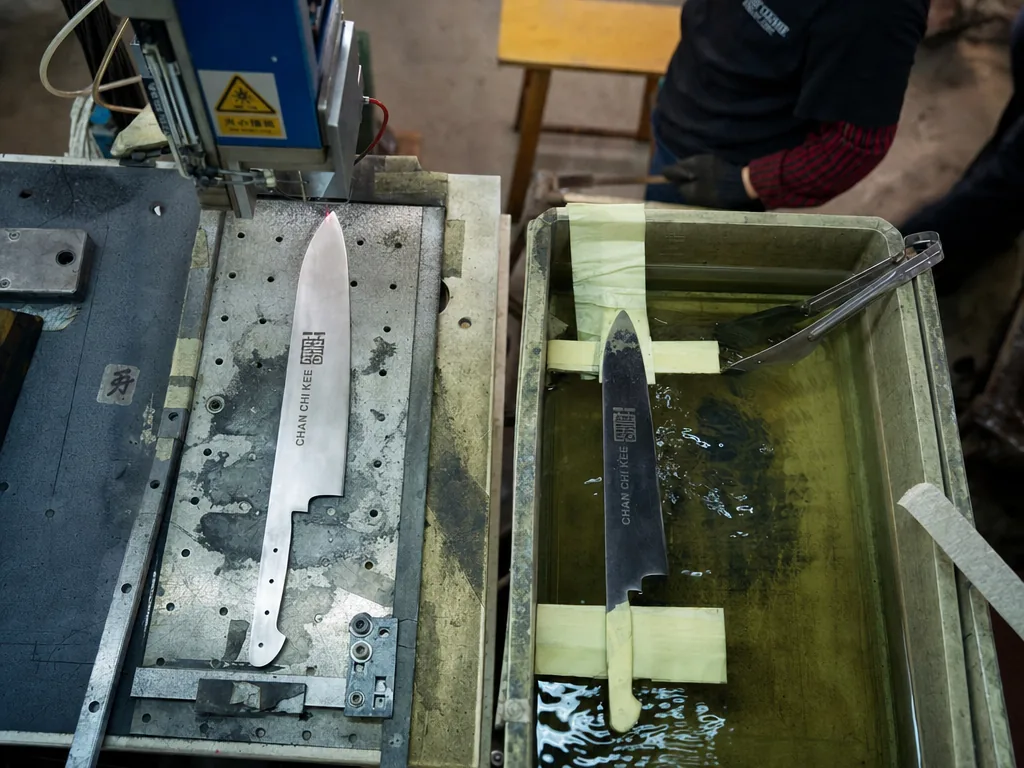
In industrial terms, forging a knife means shaping heated steel under repeated hammering or closed-die pressure before final grinding and heat treatment. The manufacturing process typically includes billet cutting, heating to roughly 900-1100 C depending on alloy, upsetting or drawing, trimming, normalizing, rough grinding, quenching, tempering, straightening, finish grinding, polishing, and handle assembly.
The main production effect is not magic grain alignment by default; it is pre-forming. A forged blank places mass where the design needs it, especially around bolsters, distal taper, or thick spines. That can reduce material waste on heavy profiles, but it also introduces forging dies, operator dependency, and more process variation before grinding. For most OEM knife programs, die cost runs about USD 800-3,500 per model, with higher figures for multi-cavity or complex bolster shapes.
Forging is commercially useful when the design benefits from integrated mass and when annual volume can amortize tooling. Common MOQ expectations are 1,000-3,000 pieces per SKU for a dedicated forged setup, although some Chinese factories will open at 500 pieces with a higher unit cost. Lead time is usually 45-65 days after sample approval because die preparation, process tuning, and straightening add time. Buyers should ask for post-forging thickness tolerance, decarb control, and straightness criteria in mm per 300 mm, not just a generic claim of hand-forged quality.
Stock Removal Blade Making: Faster Setup, Tighter Repeatability
A stock removal blade starts with flat bar or sheet stock that is laser cut, blanked, or waterjet cut, then profiled, ground, heat treated, and finished. For many branded knife programs, this route delivers the cleanest balance of repeatability, lower startup cost, and faster commercialization. It removes the forging die from the equation and relies on controlled grinding to create final geometry.
From a sourcing perspective, stock removal is usually easier to quote and easier to audit. If the incoming steel is certified and thickness is controlled, the factory can hold profile dimensions and grind symmetry more consistently across medium-volume runs. Setup cost is often limited to cutting fixtures and grinding jigs, commonly USD 100-600 instead of four-figure die tooling. MOQ can start around 300-500 pieces per SKU for simpler kitchen or outdoor blades.
Lead times are commonly 30-45 days for repeat orders, sometimes 25-35 days when materials are in stock and the finish is straightforward. Scrap rate can also be more predictable because the process skips forging cracks, scale loss, and preform distortion. The tradeoff is material utilization on thick sections: if a design needs a full bolster or a large forged-style heel, stock removal wastes more steel and more grinding time. Buyers comparing designs should review blade thickness, spine taper, and bevel depth before assuming stock removal is automatically the lower-cost option.
Forging a Knife vs Stock Removal on Cost, MOQ, and Lead Time
For procurement teams, the decision usually comes down to economics first and brand positioning second. Forged construction may support a premium narrative, but the numbers only work when the design and volume justify the route. A buyer should compare total landed cost, not just ex-works blade cost: tooling, scrap allowance, inspection burden, packaging, and shipping terms all matter.
| Factor | Forged blade | Stock-removal blade |
|---|---|---|
| Typical startup tooling | USD 800-3,500 per model | USD 100-600 for jigs/fixtures |
| Common MOQ | 1,000-3,000 pcs | 300-1,000 pcs |
| First-order lead time | 45-65 days | 30-45 days |
| Best fit | Bolsters, thick spines, premium mass | Precise profiles, fast iteration, lean launches |
| Variation risk | Preform distortion, decarb, straightening | Grinding consistency, heat-treat warp |
| Material yield | Better on heavy sections | Better on thin, simple profiles |
For Amazon-focused launches, stock removal often wins because it lowers capital exposure and shortens the time from sample sign-off to FBA receipt under FOB or DDP planning. For heritage-style kitchen knives or outdoor products where bolster feel and weight distribution matter, forging may justify its overhead. In either case, write the quote package around incoterms, target defect rate, and AQL 2.5 sampling so the factory prices the same quality expectation you intend to inspect.
Knife Forging Process and Heat Treatment: Where Blade Performance Is Won
Whether the blank is forged or cut from stock, end performance depends more on heat treatment than on origin story. The critical controls are austenitizing temperature, soak time, quench medium, cryogenic treatment when applicable, and temper cycles. Buyers should request the factory's hardness window by steel grade and blade type, then confirm it with batch testing. A useful reference is this guide to heat treatment and HRC.
For common stainless kitchen steels such as 3Cr13, 5Cr15MoV, and 7Cr17MoV, practical production targets are often 54-58 HRC depending on corrosion priority and edge stability. For mid-range outdoor steels such as 8Cr13MoV or 9Cr18MoV, 57-60 HRC is common. D2 may run 59-61 HRC in many OEM programs. Harder is not automatically better if the section is thin and the edge angle is aggressive.
This is also where buyers need to separate tempering vs annealing. Annealing softens steel for machining or stress relief before final hardening; tempering follows quenching to reduce brittleness while keeping useful hardness. Confusing the two in a specification sheet is a real sourcing error. If a supplier claims forged superiority but cannot provide quench records, temper cycle standards, or hardness inspection frequency, the process claim has limited value. Ask for at least 3-5 hardness checks per batch and clear rework criteria for warped blades.
When Forging a Knife Helps Geometry, and When Grinding Matters More
Forging can be valuable when the design needs a thick heel, integrated bolster, or pronounced distal taper before finish grinding. It allows the factory to move steel into shape instead of removing large volumes later. That is why forged chef knives often feel denser near the handle and can carry a visually strong spine line. But geometry at the edge is still created by grinding, not by the forging alone.
For cutting performance, the buyer should pay close attention to primary grind type, edge angle, and thickness behind the edge. A blade with clean hollow grinding or a controlled flat grind can outcut a heavier forged blade if the grind is thinner and more consistent. The correct route depends on intended use. Kitchen knives generally benefit from thinner cross-sections and consistent taper; survival or camp knives may prefer more meat behind the edge.
Some programs also consider differential heat treatment, usually to keep the spine tougher while the edge runs harder. In volume OEM work this is feasible but not always efficient, because it adds process complexity and can increase cosmetic variation. It makes more sense on specialist outdoor knives than mainstream private label kitchen lines. Before approving it, review expected hardness gradient, visible temper line requirements, and reject thresholds. A simpler full-hardening program with tighter grind control is often the more bankable commercial decision.
How to Specify Steel and QC for Either Knife Making Route
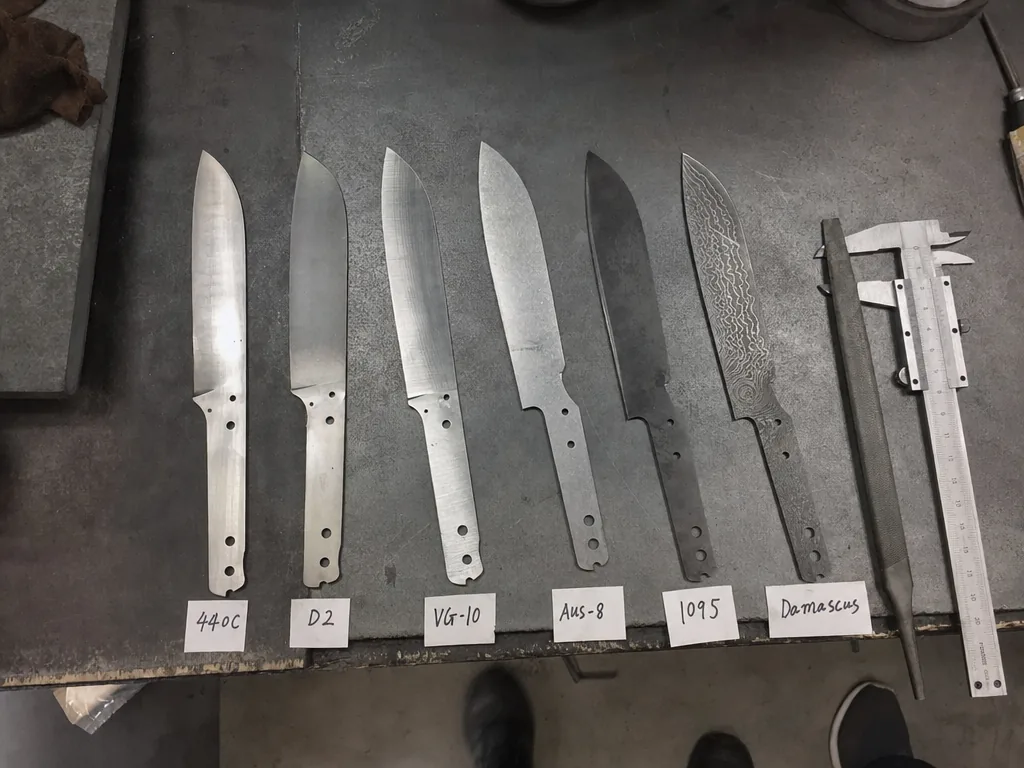
The most expensive sourcing mistakes happen when buyers specify a production method without locking the steel, heat treatment, and inspection criteria around it. Start with steel selection. A premium forged profile made from basic 3Cr13 will not compensate for weak edge retention, while a well-ground stock-removal blade in 9Cr18MoV or D2 can perform strongly if heat treated correctly. Use a practical steel comparison when aligning target price against corrosion resistance, polishability, and hardness range.
Your technical sheet should define at minimum:
- Steel grade and source standard, such as 5Cr15MoV, 7Cr17MoV, 8Cr13MoV, 9Cr18MoV, or D2
- Target hardness and tolerance, for example 56 plus or minus 1 HRC
- Blade thickness tolerance in mm before and after grinding
- Straightness limit, for example less than 1.0 mm deviation over 300 mm
- Grind type, bevel angle, and finish requirement such as satin 400 grit or stonewash
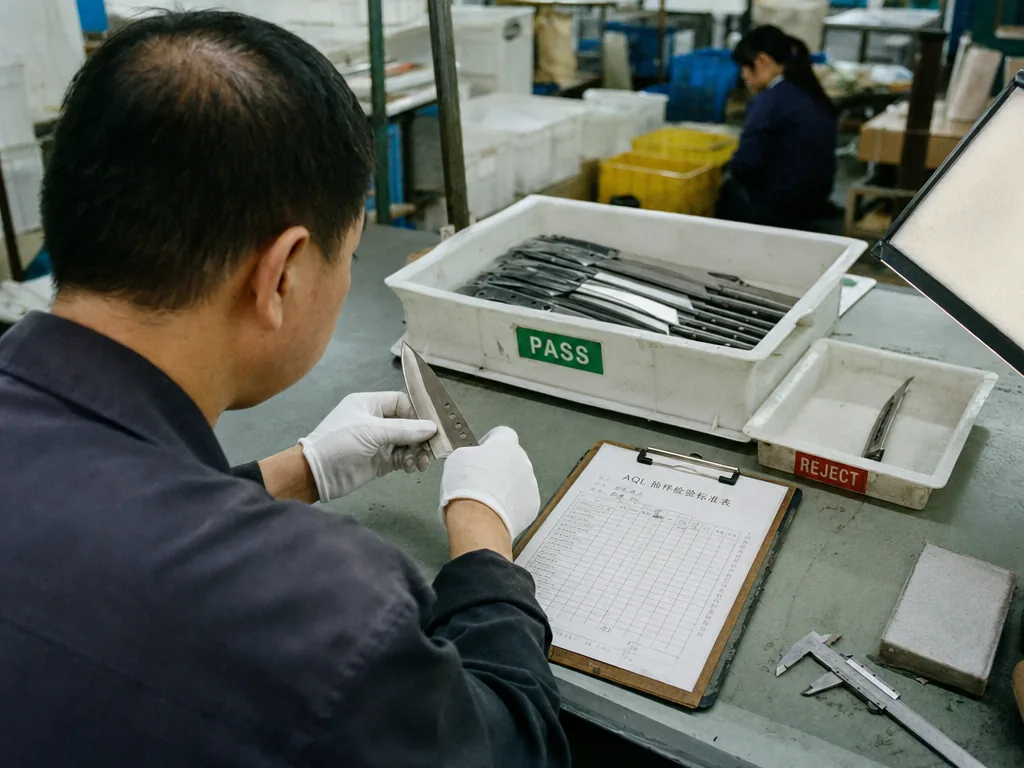
- AQL 2.5 final inspection with defined critical, major, and minor defects
Also specify packaging drop expectations, barcode placement, and corrosion-prevention method for sea freight. For stainless kitchen lines shipped FOB, a VCI bag plus desiccant may be enough. For carbon or semi-stainless outdoor knives moving DDP through a longer transit chain, oiling, rust-inhibitor paper, and sealed cartons reduce claim risk. Knife making is not one decision; it is a stack of tolerances that either holds together or fails at arrival inspection.
Which Method Buyers Should Specify for Different Commercial Programs
If the goal is rapid product launch, lower MOQ, and faster revision cycles, specify stock removal first unless the design truly depends on forged mass. This is usually the better route for Amazon private label assortments, test-market SKUs, and brands building 3-10 item catalogs where cash conversion speed matters. It simplifies quoting, shortens sample loops, and reduces the chance that expensive die work gets trapped in a slow seller.
If the brief is a premium kitchen line with visible bolster architecture, stronger in-hand weight, and annual demand above roughly 5,000 pieces per model, forging becomes more defensible. The die cost can be amortized, and the product story may support a higher retail band. Even then, buyers should treat forging as one part of the specification rather than the quality guarantee. Without controlled quenching and tempering, grind symmetry checks, and clear final inspection gates, a forged knife can still underperform.
The practical rule is simple. Specify the blade method that best fits the geometry, expected reorder cadence, and margin structure. Ask suppliers to quote both routes when possible, using the same steel, hardness target, finish, packaging, and incoterm. That side-by-side view usually reveals the real answer faster than marketing language. In B2B sourcing, the best production method is the one that hits performance requirements with stable yield, acceptable lead time, and predictable claims exposure.
Frequently asked questions
No. A forged knife may offer better mass distribution or bolster integration, but a stock-removal blade can match or exceed it on cutting consistency, startup cost, and lead time. For OEM programs, the better choice depends on geometry, annual volume, steel grade, and how tightly the factory controls quenching, tempering, and final grinding.
As a working range, stock-removal programs often start around 300-500 pieces per SKU, while forged programs usually become commercially cleaner at 1,000-3,000 pieces because die cost has to be amortized. Some factories will accept lower MOQs on forged blades, but unit cost and lead time usually increase.
Specify hardness by steel and use tolerance bands, such as 56 plus or minus 1 HRC for 5Cr15MoV kitchen knives or 59-61 HRC for D2 outdoor blades. Do not ask for maximum HRC without context. Include test frequency, sample position, and rework rules so the factory cannot hide unstable heat treatment behind one acceptable reading.
Differential heat treatment is worth considering for specialist outdoor knives where buyers want a harder edge and a tougher spine. It is less attractive for mainstream kitchen programs because it complicates processing and can increase visual variation and yield loss. Most commercial lines get better value from uniform hardening plus tight grind and edge-angle control.
The highest-value checks are HRC verification, straightness, grind symmetry, edge apex continuity, handle fit, finish consistency, and corrosion spotting after packing. Use AQL 2.5 with defined critical defects, and add dimensional checks in mm for blade thickness and overall length. For forged programs, include extra review of warpage, scale cleanup, and bolster geometry.
Get your project quoted
From a single SKU to a full product line, we can quote, sample and ship from our Zhejiang facility. Talk to a specialist who's worked on hundreds of buyer briefs.
Request a Quote